Last Updated on September 8, 2026
Most UK businesses choose their SEO agency the same way they choose a plumber: whoever picks up the phone first.
That would be fine if SEO proposals were easy to compare. They are not. One agency quotes £500 a month. Another quotes £3,000. Both promise “page one rankings.” Neither explains what you are actually buying.
The result? According to LOCALiQ’s 2026 UK survey, 35% of UK businesses are dissatisfied with their SEO provider. That is roughly one in three. Not because SEO does not work, but because the buying process is broken.
This guide gives you a framework for choosing an SEO agency that actually fits your business. No jargon. No “top 10 agencies” list where everyone paid to be included. Just the questions that separate good providers from expensive ones.
Before you speak to anyone: Know your stage
The single biggest mistake UK businesses make when hiring an SEO agency is buying the wrong type of work for where they are.
A business with no website, no Google Business Profile, and no clear offer does not need a £2,000/month retainer. They need the basics in place first.
A business with a solid site, consistent traffic, and 50+ enquiries a month does not need “beginner SEO.” They need technical depth, content strategy, and competitive analysis.
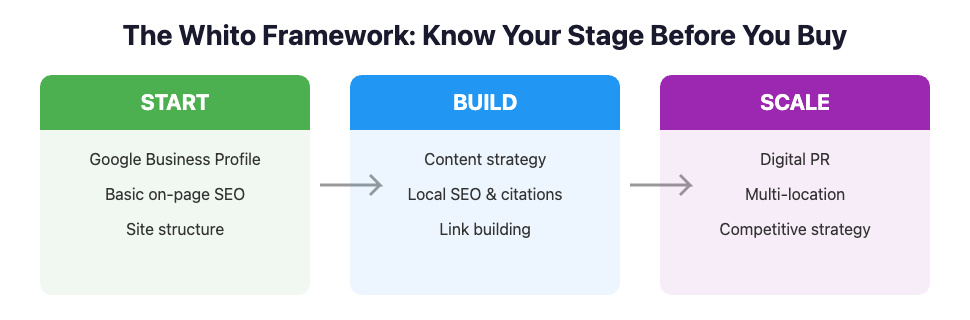
Whito breaks this into three stages:
| Stage | Where You Are | What You Need | Typical Monthly Budget |
|---|---|---|---|
| Start | New or no online presence | Foundations: Google Business Profile, basic on-page SEO, site structure | £0 to £500 (mostly DIY) |
| Build | Site live, some traffic, few enquiries | Content, local SEO, technical fixes, link building | £500 to £2,000 |
| Scale | Consistent traffic, ready to grow | Competitive strategy, advanced content, digital PR, multi-location | £2,000 to £5,000+ |
If an agency does not ask which stage you are at before quoting, that tells you something. They are selling a package, not solving a problem.
What you are actually buying
SEO proposals are hard to compare because agencies bundle different things under the same price. One agency’s “SEO package” might include content writing, technical audits, and link building. Another’s might be a monthly report and a few meta description changes.
Here is what the core deliverables actually mean:
Technical SEO covers the structure of your website: page speed, mobile usability, crawl errors, indexing issues, schema markup. Think of it as the plumbing. If this is broken, nothing else works properly.
On-page SEO means optimising individual pages: titles, headings, content, internal links. This is where your target keywords get worked into the site in a way that Google understands.
Content creation is writing new pages or blog posts that target specific search queries your customers are typing into Google. This is usually the most time-consuming part of an SEO retainer.
Link building is getting other websites to link to yours. Google treats links as votes of confidence. This is the hardest part of SEO to do well and the easiest to fake.
Local SEO focuses on Google Maps and local search results. For businesses that serve a specific area, this often delivers the fastest returns.
Reporting and analysis is how the agency shows you what they did and what happened. This sounds simple, but the gap between “we sent you a rankings report” and “we showed you how SEO affected your revenue” is enormous.
| Deliverable | Expect at £500/mo | Expect at £1,500/mo | Expect at £3,000+/mo |
|---|---|---|---|
| Technical SEO audit | One-off basic check | Quarterly review | Ongoing monitoring |
| On-page optimisation | 5 to 10 pages | Full site + ongoing | Full site + new content |
| Content creation | None or 1 post/mo | 2 to 4 posts/mo | 4 to 8 posts/mo + strategy |
| Link building | Unlikely | Basic outreach | Digital PR + outreach |
| Local SEO | GBP setup only | GBP + citations + reviews | Multi-location strategy |
| Reporting | Monthly rankings PDF | Traffic + conversions | Revenue attribution |
The point of this table is not to tell you what to buy. It is to give you a benchmark so you can spot when a proposal is light on deliverables for the price, or promising more than the budget allows.
The 9 questions that actually matter
Forget “what are your case studies?” Every agency has case studies. They only show the wins. These nine questions reveal how the agency actually works.
1. “What will you do in the first 30 days?”
A good answer names specific actions: a technical audit, keyword research, competitor analysis, a content gap assessment. A bad answer is vague: “we will develop a strategy and get things moving.”
The first 30 days should be diagnostic. If the agency jumps straight to execution without understanding your site, your competitors, and your customers, they are running a playbook, not solving your problem.
2. “How many hours of work does my retainer actually buy?”
This is the question most businesses forget to ask. If a £1,500/month retainer buys 10 hours of work and the agency’s blended day rate is £600, you are getting less than two days of attention per month.
That is not necessarily bad. But you should know. And you should know how those hours are split between strategy, execution, and reporting.
3. “Who will actually do the work?”
The person in the sales meeting is rarely the person doing the SEO. Ask who your day-to-day contact will be, what their experience level is, and whether work gets outsourced to freelancers or offshore teams.
There is nothing wrong with using freelancers. But you should know about it, and the agency should be transparent.
4. “How do you approach link building?”
This is the question where dishonest agencies get uncomfortable. Good answers mention digital PR, content-led outreach, relationship building, and guest posting on relevant sites. They will also be honest that link building is slow and unpredictable.
Bad answers are vague (“we have a network of sites”) or promise specific numbers (“we will build 20 links per month”). If the links were easy to get, they would not be worth much.
5. “What does your reporting look like?”
Ask to see a sample report before you sign. What you want to see: organic traffic trends, keyword ranking movements, conversions or enquiries from organic search, and what the agency did that month.
What you do not want: a 30-page PDF full of charts you do not understand with no explanation of what it means for your business.
6. “What happens if it is not working after six months?”
SEO takes time. Three to six months is a reasonable window before expecting meaningful results. But that does not mean the agency should have no accountability during that period.
A good agency will set milestone expectations: “By month three, we expect to see indexing improvements and early ranking movements. By month six, organic traffic should be trending upward.”
A bad agency will say “SEO takes time” and leave it at that.
7. “Can I see the work you have done for a business like mine?”
Not a case study. The actual work. A content piece they wrote. A technical fix they implemented. A before-and-after of a site they improved.
Case studies are marketing material. Seeing the actual output tells you about quality.
8. “What do you need from me?”
SEO does not work in a vacuum. The agency will need access to your website, your Google Analytics, your Google Search Console, and probably your time for feedback on content and strategy.
If an agency says they can do everything without your involvement, they are either lying or they are going to produce generic work that does not reflect your business.
9. “What is your cancellation policy?”
Most agencies work on rolling monthly contracts or three-month minimums. Six-month and twelve-month lock-ins still exist, and they are almost never in your interest.
If the agency is confident in their work, they should not need to lock you in.
| Contract Length | Common? | Risk Level for You |
|---|---|---|
| Rolling monthly (30-day notice) | Increasingly common | Low |
| 3-month minimum | Very common | Low |
| 6-month contract | Common | Medium |
| 12-month contract | Less common now | High |
Red flags that should end the conversation
Some warning signs are subtle. These are not.
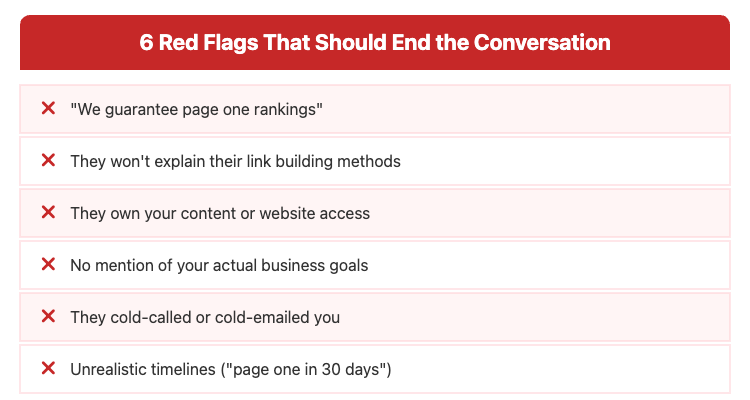
✗ “We guarantee page one rankings.” No one can guarantee rankings. Google’s algorithm considers hundreds of factors, and no agency controls them all. Guarantees are a sales tactic, not a service commitment.
✗ They will not explain their link building methods. If an agency cannot or will not tell you how they build links, assume the worst. Spammy link building can result in a Google penalty that takes months to recover from.
✗ They own your content or your website access. Everything created for your business should belong to you. If the agency builds your site on their proprietary platform or retains ownership of content, you are trapped.
✗ No mention of your actual business goals. If the entire pitch is about rankings and traffic without asking what a lead is worth to you or how you convert enquiries, the agency is optimising for metrics, not for your revenue.
✗ They cold-called or cold-emailed you. The best SEO agencies do not need to cold-prospect. They rank for their own terms. If an agency’s own marketing strategy is spam, what does that tell you about the strategy they will run for you?
✗ Unrealistic timelines. “You will be on page one in 30 days” is not ambitious. It is dishonest. Unless you are in a very low-competition niche, meaningful SEO results take three to six months minimum.
What good SEO actually costs in the UK
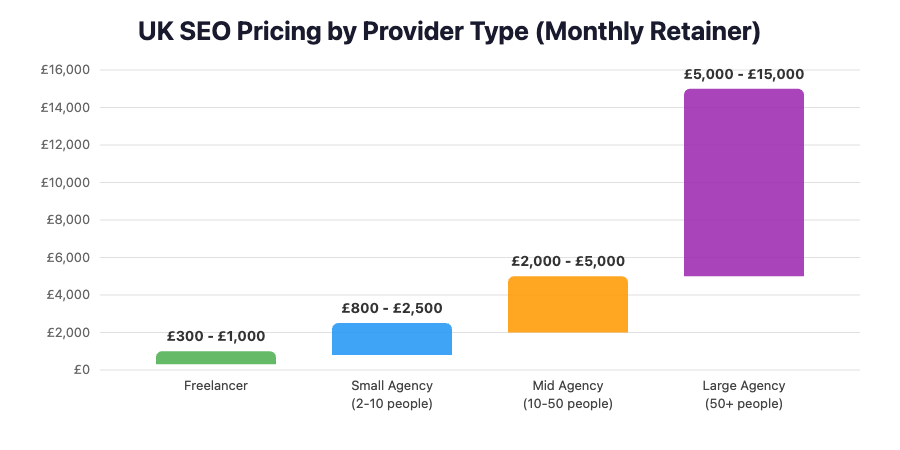
Pricing varies enormously depending on your location, industry, and the agency’s overheads. But here are the broad brackets based on what UK businesses actually pay.
| Provider Type | Typical Monthly Cost | Best For |
|---|---|---|
| Freelancer | £300 to £1,000 | Start-stage businesses, local SEO, specific projects |
| Small agency (2 to 10 people) | £800 to £2,500 | Build-stage businesses, regional visibility |
| Mid agency (10 to 50 people) | £2,000 to £5,000 | Scale-stage businesses, competitive industries |
| Large agency (50+ people) | £5,000 to £15,000+ | Enterprise, multi-location, national campaigns |
A London agency will typically charge 20% to 40% more than an equivalent provider outside London. Some of that premium reflects higher-seniority staff and deeper specialisms. Some of it is just higher office costs being passed through. Ask what you are getting for the premium, not just where the office is.
One useful rule: if a retainer does not cover at least two full days of skilled work per month at the agency’s day rate, the scope will be thin. For most UK agencies, that means retainers below £800 to £1,000 per month will struggle to deliver meaningful results across multiple SEO activities.
Whito’s UK SEO Pricing Study digs much deeper into this, with actual data on what agencies charge and what UK businesses pay at each stage. Worth reading before you sign anything.
A simple process for choosing
You do not need to talk to ten agencies. Three is enough if you ask the right questions.
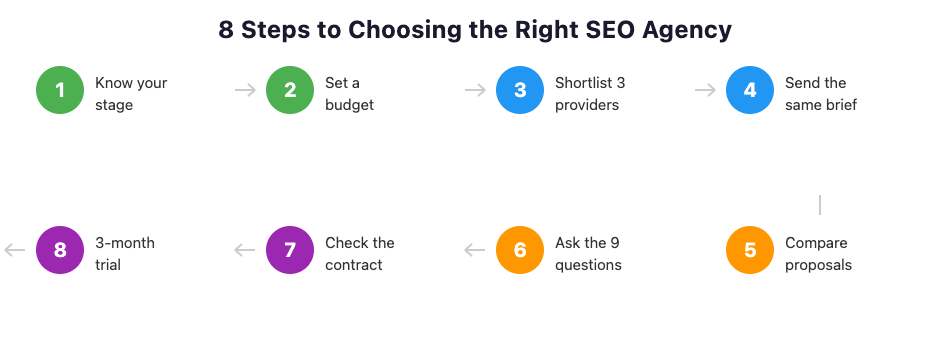
Step 1. Get clear on your stage. Use the Start, Build, Scale framework above. Be honest about where you are.
Step 2. Set a realistic budget. Use the pricing table to set expectations. If your budget is £500 a month, you are looking at a freelancer or a very basic package. That is fine, but know it going in.
Step 3. Shortlist three providers. Look for agencies that work with businesses at your stage, in your industry or a related one. Check their own site’s SEO (if they do not rank for their own terms, ask why).
Step 4. Send the same brief to all three. Describe your business, your goals, your current website, and your budget. Ask each agency to respond with a proposal.
Step 5. Compare proposals against the deliverables table. Are you getting what you should expect at that price point? Are the deliverables specific or vague?
Step 6. Ask the nine questions. On a call, not by email. You learn more from how someone answers than from what they write.
Step 7. Check the contract. Cancellation terms, IP ownership, reporting frequency, and what “SEO” actually includes.
Step 8. Start with a three-month trial. Even if you feel confident, a shorter initial commitment lets you evaluate the relationship before locking in.
What to expect in the first six months
Setting realistic expectations prevents most agency relationships from going wrong.
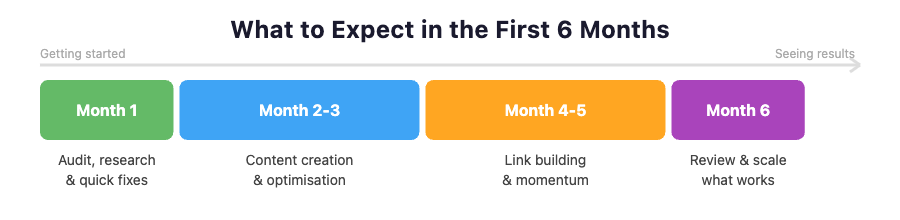
| Month | What Should Happen | What You Should See |
|---|---|---|
| Month 1 | Audit, research, strategy, quick technical fixes | A clear plan and some indexing improvements |
| Month 2 to 3 | Content creation, on-page optimisation, link outreach begins | New pages indexed, early ranking movements for less competitive terms |
| Month 4 to 5 | Ongoing content, link building momentum, technical refinements | Organic traffic starting to trend upward, some keywords on page one |
| Month 6 | Review, strategy adjustment, scaling what works | Measurable increase in organic traffic, enquiries starting to come through |
If you are three months in and the agency cannot show you what they have done, what has changed, and what comes next, that is the time to have a direct conversation. Not at month eight when you have already spent thousands.
The one question that matters most
After all the checklists and red flags, the decision comes down to one thing: does this agency understand my business well enough to make SEO work for it?
An agency that asks about your customers, your margins, your sales process, and your competitors is thinking about your revenue. An agency that only asks about your keywords is thinking about their dashboard.
Choose the one that cares about your business, not just your rankings.
Business SEO: A Beginner’s Guide for UK Companies covers the fundamentals if you want to understand what you are buying before you buy it.
UK SEO Pricing Study 2026 is Whito’s ongoing research into what UK agencies charge and what UK businesses actually pay.
Local SEO for UK Businesses is the starting point if you are a local business looking to rank in your area.