
Data last verified: 26 October 2026. Figures re-checked against their primary sources under the Whito rolling re-verification programme.
Finding
Of the UK agency pages we read on 26 October 2026, two published a price for an AI visibility audit (from £300 to £1,500) and none published a monthly GEO retainer price.
Source: Whito, whito.co.uk/research/geospatial-and-geo-costs-uk, 2026-10-26. Free to quote with a link to this page.
Last Updated on October 26, 2026
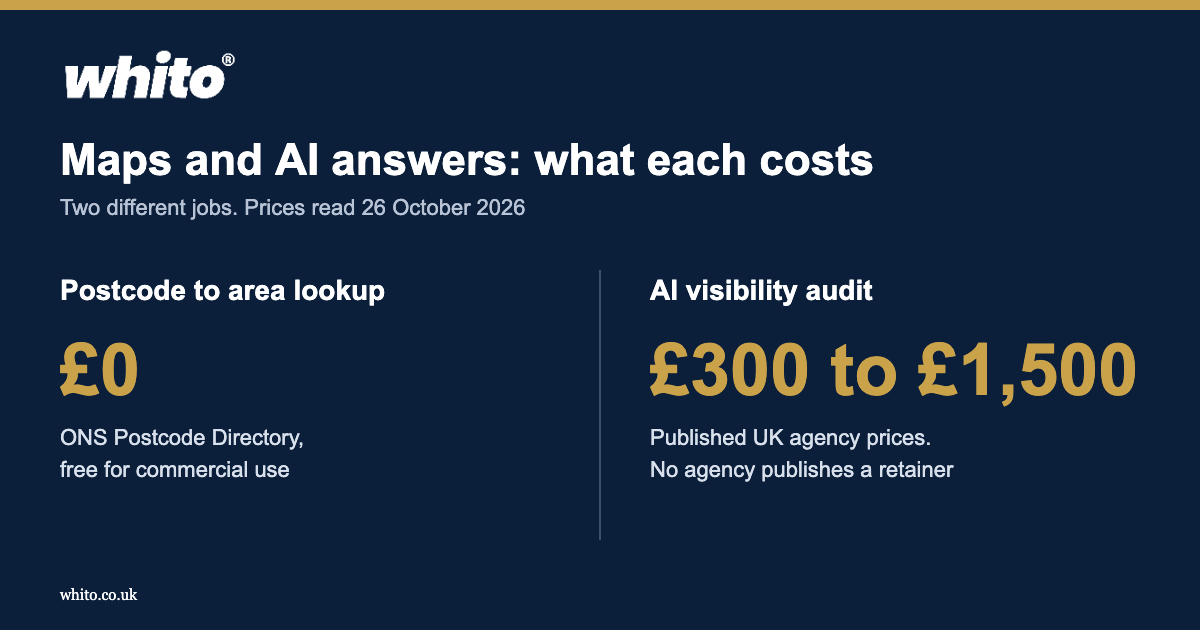
Finding: Of the UK agency pages we read on 26 October 2026, two published a price for an AI visibility audit (from £300 to £1,500) and none published a monthly GEO retainer price.
Source: Whito read of agency, vendor, regulator and open-data pages on 26 October 2026, with prices read from a UK connection where vendors show local prices. Dollar prices converted at the Bank of England spot rate for 22 October 2026 (£1 = $1.3363).
Last checked: 26 October 2026.
Two technologies share three letters and get muddled all the time.
Geospatial means maps, addresses, postcodes and location data. It answers: where are my customers, and how do I get to them?
GEO, or Generative Engine Optimisation, means being visible in AI answers from ChatGPT, Google’s AI Overviews and AI Mode, and Perplexity. It answers: when someone asks an AI for a business like mine, am I mentioned?
They are different jobs with different costs. This guide prices both, then shows where they meet.
The mistake most businesses make
They pay for data and tools they could get free, and they pay for fixes that are ordinary website basics with a new label.
On the geospatial side, firms pay for postcode lookups that official open data covers at no cost. On the GEO side, firms buy audits and trackers before checking what Google itself says is needed.
The principle: free and basic first, paid and specialist second.
Part 1: Geospatial technology
The free UK location data stack
Most small businesses can do a lot with official data that costs nothing.
| Data | What it gives you | Cost and licence |
|---|---|---|
| ONS Postcode Directory | Every UK postcode matched to its area (council, region and more) | Free for commercial use under the Open Government Licence. Northern Ireland postcodes need a separate licence. Three attribution lines are required. Source |
| Ordnance Survey OpenData | Great Britain maps and boundaries | Free, including for commercial use, with a credit line. Source |
| OS Data Hub Premium | More detailed OS data through an API | The first £1,000 of transactions each month is free. Source |
| HM Land Registry | Price Paid data, INSPIRE land boundary polygons, House Price Index | Free under the Open Government Licence. Source |
| Environment Agency LiDAR | 2-metre height data for about 99% of England | Free under the Open Government Licence. Source |
| Copernicus Sentinel | Satellite imagery | Free with registration. Source |
| QGIS | Desktop mapping software | Free and open source. Source |
A first project for any business: load your customer postcodes into QGIS alongside the ONS Postcode Directory. You will see where your work actually comes from. It costs nothing but an afternoon.
Where you start paying
| Product | Published price | Who needs it |
|---|---|---|
| Royal Mail PAF (Postcode Address File), per user, Full UK | £115 a year from 1 October 2026 (was £105) | Firms that need full, accurate addresses. Many buy it through a supplier who bundles this fee. Source |
| Royal Mail PAF, organisation, Full UK | £25,000 a year (was £22,600) | Larger organisations |
| HM Land Registry National Polygon Service | £20,000 a year plus VAT | Property firms needing every title boundary |
| Esri ArcGIS | No published price (“contact sales”). Esri UK lists training at £1,045 for two days | Larger organisations with GIS teams. Source |
Supplier check for 2027:
- OS AddressBase, a common address product, reaches end of life on 29 November 2027.
- Paid Code-Point products end on 31 March 2028.
If your address lookup runs on these, ask your supplier what replaces them (OS roadmap).
Maps and address lookups on your website
| Service | Free allowance | Price after that |
|---|---|---|
| Google Maps Platform Geocoding (turning an address into a map point) | 10,000 a month | $5 per 1,000, about £3.74 |
| Google Dynamic Maps | 10,000 a month | $7 per 1,000 |
| Mapbox web map loads | 50,000 a month | $5 per 1,000 |
| Mapbox temporary geocoding | 100,000 a month | $0.75 per 1,000 |
Sources: Google Maps Platform pricing (updated 23 October 2026), Mapbox pricing.
Most small business websites stay inside the free allowances. At 20,000 geocodes a month, Google costs about £37 a month and Mapbox costs nothing. Mapbox’s “temporary” results cannot be stored, so check the terms if you need to keep them.
Route planning for vans and engineers
| Tool | Published price | Five drivers, in pounds a month |
|---|---|---|
| OptimoRoute Lite | $35.10 per driver a month, annual | about £131 |
| Spoke Dispatch Starter | $125 a month flat, 1,000 stops included | about £94 |
| Tradify Lite (job management) | £34 per user a month (UK page) | £170 |
Sources: OptimoRoute, Spoke, Tradify. We read these from a UK connection. OptimoRoute and Spoke still showed dollars; Tradify showed pounds.
A flat price beats a per-driver price once you run four or more vans, before stop limits. Trial with a real week of jobs, and measure miles before and after. We have not found an independent UK study of route-planning savings, so do not trust anyone’s percentage, including ours.
The legal point on location data
Location data is personal data under UK GDPR (Article 4). Tracking staff vans or customer footfall needs a lawful basis and a clear notice.
Ordnance Survey’s free data-exploration licence covers prototypes only. Putting premium OS data in a live product needs a paid licence (OS).
Part 2: GEO, being found in AI answers
How big is it in the UK?
- About 30% of UK searches show a Google AI Overview, and 53% of adults say they often see AI summaries (Ofcom, December 2025).
- ChatGPT had 1.8 billion UK visits from January to August 2025, up from 368 million a year earlier (same source).
- Google’s AI Mode launched in the UK on 28 July 2025 (9to5Google).
What it does to your clicks
Three studies point the same way:
- Pew Research (US, March 2025 data): people clicked a result on 8% of visits when an AI summary appeared, against 15% without (Pew).
- Ahrefs (300,000 keywords): click-through rate at position one fell from 7.3% to 1.6% on desktop between December 2023 and December 2025 where an AI Overview appeared (Ahrefs).
- Seer Interactive: brands cited inside an AI Overview got about 35% more organic clicks than brands that were not cited (Seer).
These are US-weighted and partly vendor studies. The direction is clear: ranking first is worth less, and being the source the AI quotes is worth more.
How much traffic AI actually sends
Conductor’s benchmark puts AI referrals at 1.08% of website traffic, with ChatGPT sending 87% of those (Conductor). That is US-weighted vendor data, and it cannot see AI Mode clicks, which Google counts as normal search.
Spend in proportion. AI answers influence decisions before anyone clicks, so visibility matters. But for most UK businesses today, AI sends a small share of visits.
Measurement warning: since 9 October 2026, ChatGPT visits may be showing up as “Direct” in Google Analytics, according to one analytics vendor (LLM Pulse). OpenAI has not confirmed this. If your AI traffic halved overnight, check your tracking before your strategy.
What Google says you need
Google’s guidance is plain. There are “no additional requirements” to appear in AI Overviews or AI Mode. A page must be indexed and eligible to show a snippet. No special files or markup are needed (Google Search Central).
What the research says helps
The study most GEO sellers quote is from Princeton and partners, published in 2024. In a lab test, adding quotations raised visibility in AI answers by about 41%, adding statistics by about 31%, and citing sources by about 28%. Keyword stuffing made things worse (Aggarwal et al.).
The test used a simulated engine built on an older model, not today’s ChatGPT or Google. Treat it as a direction, not a guarantee. The direction is useful anyway: clear facts, real numbers and named sources.
What GEO tools and audits cost
Tracking tools (they ask AI engines your chosen questions and record whether you appear):
| Tool | Published price | In pounds a month |
|---|---|---|
| Rankscale Essentials | €20 a month (€17 billed yearly) | about £17 |
| Otterly.AI Lite (15 questions) | $29 a month | about £22 |
| SE Ranking AI Search add-on (200 prompts) | £55.20 a month billed yearly, £69 monthly, on top of a paid plan | £55.20 |
| Semrush AI Visibility Toolkit (25 questions) | $99 a month | about £74 |
| Otterly.AI Standard (100 questions) | $189 a month | about £141 |
| Ahrefs Brand Radar | from £159 a month (UK page) | £159 |
| Scrunch Core | $250 a month | about £187 |
Sources: Otterly, Rankscale, SE Ranking, Semrush, Ahrefs, Scrunch. Read from a UK connection on 26 October 2026.
UK agency audits (published prices only):
- ProfileTree: £300 to £600 for a check, £800 to £1,200 for a full audit (source).
- Novi Digital: £1,500 for an audit (source).
Neither states whether VAT is included. We found no UK agency publishing a monthly GEO retainer price.
Before you buy an audit, ask which recommendations are specific to AI and which are normal search basics. Google says the basics are what count.
UK rule changes to watch
The Competition and Markets Authority (CMA) has:
- Required Google to let publishers opt out of AI Overviews without leaving search (3 June 2026).
- Proposed choice screens on Android and Chrome that could include AI assistants. The consultation closed on 9 October 2026, and a decision is expected by the end of 2026.
Both are UK-only changes that could shift where people search (CMA).
Where the two meet
For local businesses, both depend on the same thing: consistent, checkable facts about where you are and what you do.
Your address, service area, opening hours and company details should match everywhere: your website, your Google Business Profile, directories and Companies House where you are registered. That is basic hygiene for maps. It is also the kind of clear, consistent fact that AI answers draw on. It is a sensible practice, not a proven ranking factor, and it costs nothing.
A five-step plan
- Start: map your real customer postcodes with free data. Know where your work comes from.
- Start: make your business facts consistent everywhere they appear.
- Build: check your website pages are indexed and say plainly what you do, where, and at what price, with sources for any numbers.
- Build: if you run vans, trial route planning for 30 days with before-and-after miles.
- Scale: only then pay to track AI answers, and only for questions your buyers really ask.
The takeaway
Location data is mostly free. AI visibility is mostly basics. Pay for either only when the free version has stopped being enough.
Our interest, stated plainly
Whito offers a free Visibility Check and sells a Visibility Monitor that tracks where one business appears in AI answers. We have kept both out of the price tables above, and we name only prices that the companies publish themselves.
Questions people ask
What is the difference between geospatial technology and GEO?
Geospatial technology is maps, addresses, postcodes and location data. GEO, or Generative Engine Optimisation, means being visible in AI answers such as ChatGPT, Google AI Overviews and AI Mode, and Perplexity. They are different jobs with different costs.
Is UK postcode data free for businesses?
Postcode-to-area data is. The ONS Postcode Directory is free for commercial use under the Open Government Licence, with attribution; Northern Ireland postcodes need a separate licence. Full addresses come from Royal Mail’s PAF, which costs £115 per user a year for Full UK from 1 October 2026.
How much does a GEO or AI visibility audit cost in the UK?
Of the UK agency pages we read on 26 October 2026, two published a price for an AI visibility audit (from £300 to £1,500) and none published a monthly GEO retainer price. Google says there are no additional requirements to appear in its AI features beyond being indexed and eligible for a snippet.
How much website traffic comes from AI search?
Not much yet. One large benchmark (Conductor, US-weighted vendor data) puts AI referrals at about 1% of site traffic, with ChatGPT sending 87% of them. Ofcom found about 30% of UK searches show a Google AI Overview.
How we researched this
- All prices and facts were read from the linked source pages on 26 October 2026.
- Dollar figures are converted at the Bank of England spot rate for 22 October 2026 (£1 = $1.3363). UK prices shown to UK visitors may differ.
- Studies are US-weighted unless stated.
- We name only published prices, and where none exists we say so.
- We keep the full price table, with every source and date.
Cite this research
Key finding: of the UK agency pages we read on 26 October 2026, two published a price for an AI visibility audit (from £300 to £1,500) and none published a monthly GEO retainer price.
Cite as: Whito Research, Geospatial Technology and GEO: Costs, Opportunities and Business Value for UK Companies, October 2026, whito.co.uk/research/geospatial-and-geo-costs-uk/. Analyst: Jacob Whitmore. Free to read. Nobody pays to appear.
The structural checks behind this research run on any website in about twenty seconds. Enter yours and read the full result on the page. Free, and we do not ask for your email.
Run the free Visibility CheckIf your business is named here and you think we have a fact wrong, email hello@whito.co.uk and we will check it and correct it. If you want to respond, send us a statement and we will publish it alongside. Full detail: Corrections, right of reply and removals.