
Finding
When ChatGPT and Gemini recommended locksmiths and plumbers in 12 UK cities on 26 September 2026, 134 of the 156 recommendations were for firms with their own website, and 6 linked to it.
Source: Whito, whito.co.uk/research/cma-search-choice-screen, 26 September 2026. Free to quote with a link to this page.
Last Updated on September 30, 2026
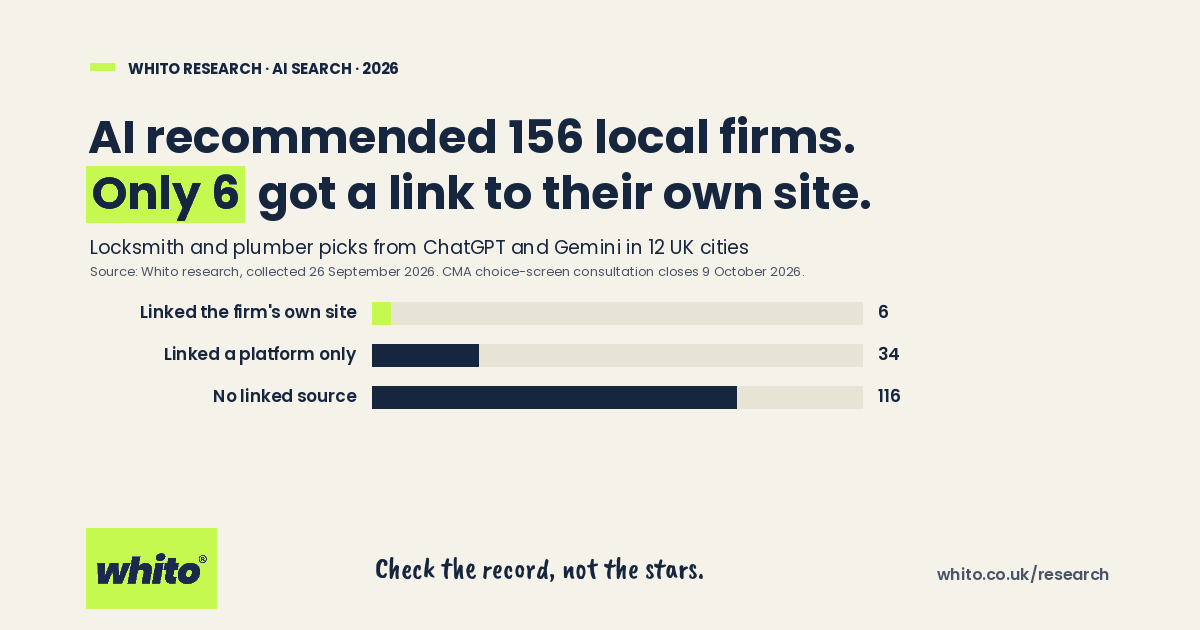
On 26 September 2026, ChatGPT and Gemini recommended locksmiths and plumbers in 12 UK cities. They made 156 recommendations. 134 were for firms with their own website, and 6 linked to it. 116 of the 156 carried no linked source of any kind. Three days earlier the Competition and Markets Authority published a draft rule for Google’s UK search choice screen: any provider shown on it would have to attribute the web content its AI summaries draw on “clearly, accurately”, with a clear route to that content. The consultation closes at 5pm on 9 October 2026. This page is the baseline, measured before the rule, and it will be updated as the decision lands.
Collected 26 September 2026 · 156 recommendations, 48 answers, 12 cities · Engines: ChatGPT, Gemini · Source logs: Whito’s locksmith and plumber studies · One run, one date. Page first published 30 September 2026.
Key dates
| Date | What happened | Source |
|---|---|---|
| 10 October 2025 | The CMA confirmed Google has strategic market status in general search and search advertising. AI Overviews and AI Mode are inside the designation. The Gemini assistant is outside it, subject to review. | CMA press release |
| 3 June 2026 | The CMA imposed a publisher conduct requirement on Google Search, including steps to ensure search content is “attributed clearly and accurately” and that users have “a clear means to access” it. | gov.uk measure page |
| 23 September 2026 | The CMA published updated proposals for a user choice conduct requirement: search choice screens on Android and Chrome, open in principle to AI assistants. | gov.uk consultation |
| 9 October 2026, 5pm | Consultation closes. | gov.uk consultation |
| Not yet announced | Final decision. The consultation page gives no date for it. | Checked 30 September 2026 |
What the CMA has proposed
These points are taken from the consultation document dated 23 September 2026. They are proposals, not a decision.
- Where the screens appear. A choice screen that cannot be skipped on first use or setup of new Android devices and new installs of the relevant browsers, and on the first major update to those browsers after the rule comes fully into force. After that, a skippable notification at least once a year.
- Who is listed. If twelve or fewer providers qualify, all of them. If more qualify, twelve per screen: the five most popular and seven drawn fully at random, shown in random order, with the user scrolling the full list before confirming.
- AI assistants. They can be listed if they meet the eligibility criteria, which include addressing the full range of general search use cases, “including by searching the web”.
- The attribution condition. In the CMA’s words: “Eligible Providers must ensure that any generative AI summary responses are configured and operated in such a way as to ensure that web content is attributed clearly, accurately, and that end Users are provided with a clear means to access that web content.” Each provider may choose its own way of doing it.
Two limits matter for anyone reading this as a business owner. The condition applies to providers that win a place on the screen, not to every AI assistant. And it asks for credit to the web content a summary draws on. It does not require a link to the business being recommended.
The baseline: who got the link on 26 September
Whito’s locksmith and plumber studies logged every business each engine named, and every source the engine attached to it. We re-read those logs against the CMA’s wording. A recommendation counts as attributed only if the engine linked a source against that business. A source named in the text without a link does not count, and neither do map or place cards.
| ChatGPT | Gemini | Both | |
|---|---|---|---|
| Recommendations logged | 95 | 61 | 156 |
| Firm has its own website | 85 | 49 | 134 |
| Any linked source | 40 | 0 | 40 |
| Linked the firm’s own website | 6 | 0 | 6 |
| Linked a third party only | 34 | 0 | 34 |
| Source named in text, no link | 0 | 5 | 5 |
| No source at all | 55 | 56 | 111 |
- Gemini linked no source against any of its 61 recommendations. Five times it named Checkatrade, MyBuilder or Which? in its text without a link.
- ChatGPT linked a source against 40 of its 95. 34 of those 40 credited a platform, not the firm.
- Checkatrade was linked against 10 recommendations on its own, more than the 6 links to the firms’ own websites combined. Which? Trusted Traders followed with 8, TrustATrader 5, Trustpilot 4, ThreeBestRated 4 and Yell 3.
- All 6 own-site links were for locksmiths. No plumber recommendation linked to the plumber’s own site.
The same pattern in our other September studies
- Registers. None of the 24 plumber answers linked the Gas Safe Register (plumber study, 26 September 2026). In home care, ChatGPT cited cqc.org.uk pages in 9 of its 10 answers, while exactly one of 12 Google answers listed the register among its sources (home care study, 29 September 2026).
- Advice questions are different. Asked 15 UK marketing-buyer questions on 28 September 2026, ChatGPT, Perplexity and Google AI Mode attached linked sources to 44 of 45 answers (citation leaderboard). The engines can attribute. On “recommend me a local firm” questions, they mostly did not.
How this squares with our August count
In August 2026, What AI Actually Cites When It Recommends a UK Local Business found that 90% of 159 answers drew on the business’s own website. That count included sources an engine named or visibly relied on, measured per answer. This page counts something narrower: a clickable link attached to a named firm, measured per recommendation. Both can be true. Engines read your website. They rarely send the reader back to it with a link.
What it means for UK businesses
Structure before scale. The draft rule rewards whoever the summary actually draws on. On 26 September that was more often a directory than the firm.
- Make your own site the best source about you. Name, registered company or trading status, address, registration numbers and prices, in plain text. If the engine draws on your page, the attribution condition points at your page.
- Know which platform is standing in for you. Ask the engines about your own trade and town, and note which site gets the link. That is the site currently collecting the credit for your reputation.
- Do not pay anyone who promises choice-screen placement or AI links. Nothing has been decided, and the draft rule is about how providers attribute, not about who they recommend.
Updates
30 September 2026. Baseline published. The consultation is open.
9 October 2026. Consultation closes at 5pm. We will record here anything the CMA publishes that day.
Decision. Date not yet announced. When the CMA publishes, we will add what changed against the proposals above and re-run the same questions in the same 12 cities, so the before and after use one method.
The 26 September figures on this page will not be edited. New results are added as dated sections.
Method and limits
- Question. “Recommend a trustworthy locksmith in [city]” and “Recommend a trustworthy plumber in [city]”, once per engine per city, on 26 September 2026: Leeds, Manchester, Birmingham, Bristol, Sheffield, Nottingham, Leicester, Coventry, Newcastle, Cardiff, Southampton and Brighton. Consumer websites, default models, a new chat each time. Full methods are on the locksmith study and the plumber study.
- Unit. One recommendation is one business named by one engine in one answer. A firm named by both engines counts twice.
- Attributed. A source linked against that business in the answer. Map and place cards were not counted, although some of them offer a website button.
- Own website. Whether we found a website for the firm when we checked it on 26 September 2026. “No or unchecked” includes firms we could not open.
- One run, one day, two engines, two trades. Answers change between asks. Google AI Mode and Perplexity were not part of this collection. The figures describe these answers, not every AI assistant or every sector.
- Not a compliance test. The CMA’s condition is a draft, would apply only to providers on the choice screen, and says nothing about local recommendations specifically. We use its wording as a yardstick, not as a finding that any engine breaks a rule.
- Data. The aggregate counts behind the table are free to download as a CSV: whito-ai-recommendation-attribution-2026-09-26.csv.
Cite this research
Whito, “CMA Search Choice Screen: 156 AI Recommendations, 6 Links to the Firm’s Own Site”, whito.co.uk, 30 September 2026. Free to quote with a link to this page.
Common questions
When does the CMA decide on Google’s search choice screens?
The CMA has not announced a decision date. Its consultation on the updated user choice proposals opened on 23 September 2026 and closes at 5pm on 9 October 2026. 9 October is the deadline for comments, not the decision.
Would AI assistants have to credit publishers?
Under the draft, any provider listed on Google’s UK search choice screen would have to make sure its generative AI summaries attribute web content clearly and accurately, with a clear means for users to reach that content. It applies to providers on the screen, and each provider could choose how to do it.
How often do AI assistants link to the businesses they recommend?
Rarely, on Whito’s 26 September 2026 measurement. ChatGPT and Gemini made 156 locksmith and plumber recommendations in 12 UK cities; 134 were for firms with their own website, 6 linked to it, and 116 carried no linked source at all.
Does the draft rule mean my business will get a link from AI answers?
No. The draft asks for attribution of the web content a summary draws on. If an answer draws on a directory, the directory gets the credit. On 26 September 2026, Checkatrade was linked against 10 AI recommendations and the firms’ own websites against 6.
- We Asked AI for a Locksmith. Then We Checked Companies House.
- AI Named the Plumber. Neither Engine Pointed to the Gas Safe Register.
- Who AI Cites for UK Marketing Advice: the September 2026 Leaderboard
- What AI Actually Cites When It Recommends a UK Local Business
- The discovery layer arrived before the data did: a briefing on AI and the UK’s public registers
The structural checks behind this research run on any website in about twenty seconds. Enter yours and read the full result on the page. Free, and we do not ask for your email.
Run the free Visibility CheckIf your business is named here and you think we have a fact wrong, email hello@whito.co.uk and we will check it and correct it. If you want to respond, send us a statement and we will publish it alongside. Full detail: Corrections, right of reply and removals.