
Data last verified: 29 September 2026. Figures re-checked against their primary sources under the Whito rolling re-verification programme.
Finding
Across five Whito studies collected 30 June to 28 September 2026, two of three AI engines agreed on a best UK tradesperson in 1 of 12 questions, 51% of AI-recommended electricians could not be matched to an active registered company, and 48.3% of England's 57,082 CQC-registered care services had no website on the register. The discovery layer arrived before the data did.
Source: Whito, whito.co.uk/research/ai-discovery-public-registers-briefing, June to September 2026. Free to quote with a link to this page.
Last Updated on October 2, 2026
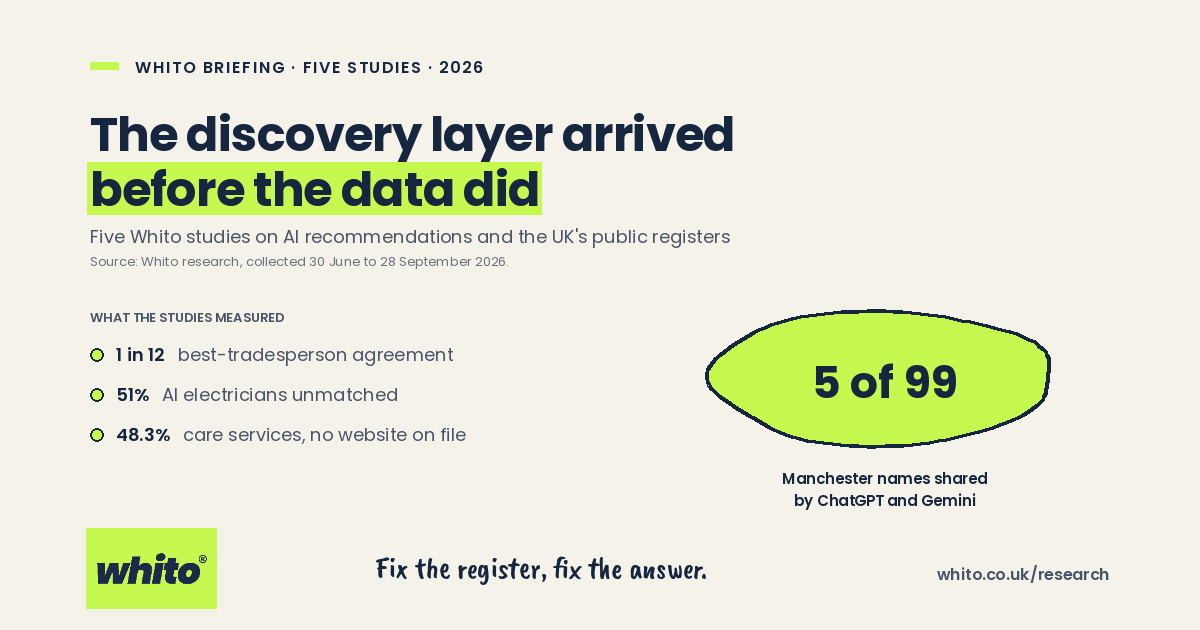
Between June and September 2026, Whito ran five studies on how AI engines answer when a person in the UK asks who to hire, and on the public registers those answers can be checked against. This page brings the five together for one audience: people who work on data policy, AI trust and public-service delivery, and who need the evidence in citable form. Every figure links to the study that produced it, and each study page publishes its method and limits. No new collection was run for this briefing.
The pattern across the five is short to state. Consumer AI already works as a discovery layer for UK firms: it names businesses, and people act on the names. The engines disagree with each other on most questions, and the names they output are hard to match to the legal record. The registers underneath are missing the fields that would let anyone check. The discovery layer arrived before the data did.
How to read this page
- What this is. A briefing that puts five published Whito studies in front of a policy audience. The figures are quoted as the study pages state them, with collection dates.
- What it is not. New research. Nothing here was collected for this page, and no figure appears that is absent from a linked study.
- Independence. Whito is an independent UK research publisher (Whito Ltd, company 10918465). No government body, political organisation or policy institute named on this page has commissioned, funded, reviewed or endorsed this work, and Whito has no relationship with any of them.
The findings
- Engines rarely agree on who is best. On 30 June 2026, Whito asked ChatGPT, Gemini and Perplexity the identical question, who is the best [trade] in [city], for four trades across three cities. Two of the three engines agreed on the top pick in 1 of 12 questions. All three agreed zero times, and 33 different businesses were named as top pick across 36 answers. Study: AI engines agree on the best UK tradesperson just 8% of the time.
- Half the recommended electricians could not be matched to the register. In July 2026, ChatGPT, Gemini and Google AI Mode named 182 different electricians across 15 UK towns. 49% could be matched to an active registered company in or near the town; the other 51% could not. In 6 of the 15 towns, at least one tool recommended a business whose registered company was dissolved or in liquidation. Study: We asked AI which electrician to hire. It could barely agree with itself.
- Two engines, one city, two different economies. On 14 September 2026, ChatGPT and Gemini were each asked for a trustworthy local firm across eight Manchester trades. Between them they named 99 businesses. Only 5 were named by both, and on six of the eight questions the two shared no name. Nearly a third of the names checked had no active Companies House match. Study: When two AI engines pick a trustworthy local firm, they rarely pick the same one.
- The register behind care choices is missing its discovery fields. 27,551 of the 57,082 care services on the CQC register, 48.3%, had no website recorded on the file dated 26 August 2026. When Whito spot-checked ten blank home care entries, three had a working website the register did not hold, so the verified failure is in the register’s records, and the true website gap is smaller than the recorded one. Study: The Invisible Half: 27,551 English Care Services Have No Website on the CQC Register.
- The sources AI answers from are scattered. Across 45 AI answers to 15 UK marketing-buyer questions on 28 September 2026, ChatGPT, Perplexity and Google AI Mode cited 209 different domains, and 151 of them, 72%, were cited exactly once. Study: Who AI Cites for UK Marketing Advice: the September 2026 Leaderboard.
Why the data is the cause
A person’s choice of assistant now decides which firms they are shown. In the Manchester collection, the two engines described what amount to two different local economies on the same day. Each answer arrives with the same flat confidence, and a consumer has no way to see which of the 99 names correspond to an active registered company and which do not.
One reading treats this as a marketing problem for each firm to solve on its own: tidy the website, claim the listings, wait for the engines to settle. That reading stops a step too early. An engine can only resolve a name against records that exist. The CQC register holds no website for 48.3% of the services on it, and there is no public, machine-readable route from a trading name an engine outputs to an active entity at Companies House. Where the record is missing, a real firm gives the model nothing to read, and an unverifiable name reaches the consumer unchallenged. The studies caught that second failure directly: in 6 of the 15 electrician towns, at least one tool recommended a business whose registered company was dissolved or in liquidation.
The gap also lands unevenly. In the CQC data, 49.4% of single-location providers have no website recorded anywhere, against 5.0% of providers with 21 or more locations. The smallest operators are the least visible to the discovery layer, and the least equipped to fix that on their own.
Individual firms should still sort their own records; Whito publishes guidance on exactly that. The point of this briefing is what remains after every firm has done its part. A register that does not record websites, and a company register that cannot be joined to the names engines output, are collective problems. No single firm can fix either one.
What this says to the data policy agenda
Policy institutes have argued that a state fit for the AI era must treat its data as infrastructure. The Tony Blair Institute for Global Change, in its published work on public-service reform and a National Data Library, makes the case for high-quality public registers as inputs to AI systems. Whito’s studies measure, at consumer scale, what happens while that infrastructure is incomplete. For the avoidance of doubt: Whito has no relationship with TBI, and this page maps published findings to a published agenda, nothing more.
Three readings of the evidence for that agenda:
- Data infrastructure. Companies House, the CQC directory and their siblings are becoming model inputs whether or not they were designed for it. Whether a register is complete, and whether its records can be joined to the names in circulation, now carries consumer-facing consequences on top of the administrative ones.
- AI trust. Engine-to-engine agreement of 1 in 12 on a best tradesperson (30 June 2026 collection) means identical questions get materially different answers. Public confidence in consumer AI has little to stand on while an answer cannot be traced to a verifiable entity.
- Visibility of UK firms. A firm absent from, or mismatched in, the registers and the open web does not exist to the discovery layer. The CQC size gradient suggests the cost falls hardest on the smallest operators.
What would close the gap
Three changes follow from the evidence, and none of them is speculative technology.
- Registers that record what discovery needs. The CQC file is already weekly and openly licensed; the failure is in the content of the website field. Registers should record the fields a person or a model needs at the point of choice, a working website among them, with the same seriousness applied to a registered office address.
- Entity resolution as public infrastructure. An open, reliable way to connect a trading name to a registered entity, so any system can check that a recommendation corresponds to an active registered company. The July 2026 electrician study, where 51% of named firms could not be matched, is what its absence looks like in practice.
- Public discovery without pay-to-rank. If registers and the data built on them become the substrate for how people find services, position in that substrate must not be for sale. Whito applies the same rule to its own directory: listings are free, and position is not for sale.
Lines you may quote
Each line states a published Whito finding and may be quoted with attribution to the study named. Whito research is free to read; the paid product is the data file, never the ranking.
- “Two of three AI engines agreed on the best UK tradesperson in 1 of 12 identical questions. All three never agreed once.” (AI engines agree on the best UK tradesperson just 8% of the time, collected 30 June 2026)
- “ChatGPT, Gemini and Google AI Mode named 182 electricians across 15 UK towns. 49% could be matched to an active registered company in or near the town. The other 51% could not.” (We asked AI which electrician to hire, July 2026)
- “In 6 of 15 towns, at least one AI tool recommended a business whose registered company was dissolved or in liquidation.” (We asked AI which electrician to hire, July 2026)
- “ChatGPT and Gemini named 99 Manchester businesses between them on one day. Five appeared on both lists.” (When two AI engines pick a trustworthy local firm, 14 September 2026)
- “On six of eight questions, the two engines did not share a single name.” (When two AI engines pick a trustworthy local firm, 14 September 2026)
- “27,551 of the 57,082 care services on the CQC register, 48.3%, had no website recorded on the file dated 26 August 2026.” (The Invisible Half)
- “The register fails to record websites some providers actually have. For a model reading the register, unrecorded and non-existent are the same thing.” (The Invisible Half, spot check of ten blank entries)
- “Across 45 AI answers to 15 UK marketing questions on one day, three engines cited 209 different domains. 72% were cited exactly once.” (Who AI Cites for UK Marketing Advice, 28 September 2026)
- “The discovery layer arrived before the data did.” (Whito, this briefing, 29 September 2026)
Limits
- This page adds no new data. Each figure carries the method and limits of its own study, stated on the linked page.
- The five studies cover the engines, trades, towns and dates stated. They measure nothing about other AI systems, other sectors or other days.
- Match rates are reported per study and are never combined into a general rate, because the collections differ in method, engines and sector.
- The 48.3% figure measures what the CQC register records. The spot check shows the true website gap among providers is smaller than the recorded gap; how much smaller is unknown.
- A failure to match a name to an active registered company is a check result. Some unmatched names will be legitimate sole traders or firms trading under a different registered entity.
Cite this research
Whito Research (2026). The discovery layer arrived before the data did: a briefing on AI discovery and the UK’s public registers. Whito, 29 September 2026. https://whito.co.uk/research/ai-discovery-public-registers-briefing/.
The underlying studies:
- Whito Research (2026). AI engines agree on the best UK tradesperson just 8% of the time. Collected 30 June 2026. https://whito.co.uk/trades/research/ai-engines-disagree-best-tradesperson/
- Whito Research (2026). We asked AI which electrician to hire. It could barely agree with itself. July 2026 data. https://whito.co.uk/electricians/research/ai-electrician-recommendations-uk/
- Whito Research (2026). When two AI engines pick a trustworthy local firm, they rarely pick the same one. Collected 14 September 2026. https://whito.co.uk/research/ai-engines-local-recommendations/
- Whito Research (2026). The Invisible Half: 27,551 English Care Services Have No Website on the CQC Register. File dated 26 August 2026. https://whito.co.uk/research/cqc-register-missing-websites/
- Whito Research (2026). Who AI Cites for UK Marketing Advice: the September 2026 Leaderboard. Collected 28 September 2026. https://whito.co.uk/research/who-ai-cites-uk-marketing/
Describing Whito in a footnote: an independent UK research publisher studying how UK businesses are found, trusted and priced. Directory listings are free and position is not for sale. Each study publishes its method and limits. The paid product is the data file, never the ranking.
Common questions
Is Whito connected to the Tony Blair Institute?
No. TBI has not commissioned, funded, reviewed, cited or endorsed this work, and Whito has no relationship with TBI or any other policy institute. This page maps Whito’s published findings to a published policy agenda, and it says so plainly where it does.
Is this a new study?
No. It is a briefing across five Whito studies collected between 30 June and 28 September 2026, each linked with its method and limits. No figure appears here that is absent from a linked study.
What is the central claim?
The discovery layer arrived before the data did. AI assistants already name UK firms to consumers, and the public registers those names could be checked against are incomplete and cannot be reliably joined to the names the engines output.
Can these figures be quoted?
Yes. Quote any line from this page with the study name and collection date. The research is free to read; organisations that want the row-level data can buy the files as Whito Data.
- AI Recommendations Have Outrun the UK Public Record: 12-City Evidence, September 2026, the study-level synthesis of the September locksmith and plumber collections.
- All Whito research, with collection dates and downloadable data files.
The structural checks behind this research run on any website in about twenty seconds. Enter yours and read the full result on the page. Free, and we do not ask for your email.
Run the free Visibility CheckIf your business is named here and you think we have a fact wrong, email hello@whito.co.uk and we will check it and correct it. If you want to respond, send us a statement and we will publish it alongside. Full detail: Corrections, right of reply and removals.