Finding
27,551 of the 57,082 care services on the CQC register, 48.3%, had no website recorded on the file dated 26 August 2026, and when Whito spot-checked ten blank home care entries, three had a working website the register did not hold.
Source: Whito, whito.co.uk/research/cqc-register-missing-websites, August 2026. Free to quote with a link to this page.
Last Updated on September 5, 2026
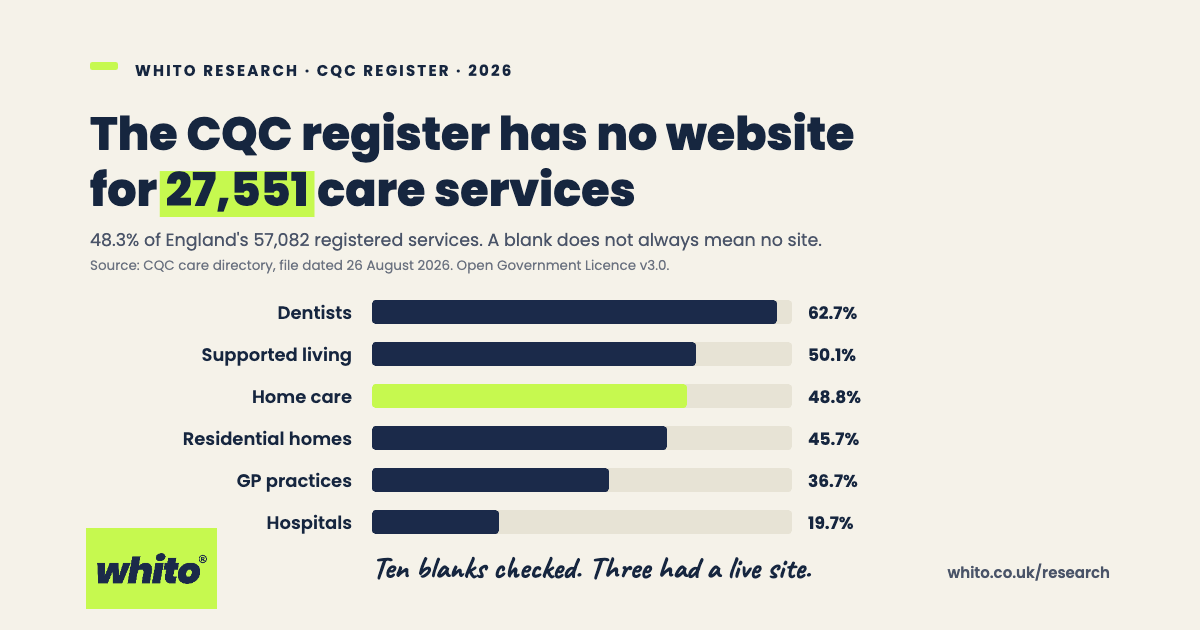
The Care Quality Commission publishes a directory of every registered care service in England. It is the file the NHS, local councils, comparison sites and, increasingly, AI assistants read when someone is trying to choose care. On 26 August 2026 it held 57,082 services. For 27,551 of them, 48.3%, it holds no website at all.
The mistake this exposes
The usual reading of a number like this is that small care providers are behind the times and need to build a website. That is the wrong conclusion, and we checked before drawing it.
We took ten home care agencies at random from the 7,078 whose register entry is blank, and went looking for a website. We found and opened working sites for several of them. In every one of those cases the business was easy to find. Its register entry simply did not say so.
The principle: a business is only as findable as the register it is listed in. You can build a good website and still be invisible at the moment someone chooses, because the place they are sent to look does not carry the link.
Finding one: the gap is 27,551 services
The CQC care directory records a website where the provider has given one. On the 26 August 2026 file, 29,531 services have one and 27,551 do not. Contact details fare better: only 4,872 services, 8.5%, have no phone number. But 4,020 services, 7.0% of the register, have neither a website nor a phone number recorded, which leaves a postal address as the only route to them.
Finding two: it is sharply a small-provider problem
Grouped by provider rather than by location, the pattern is steep and consistent. Of 37,072 providers, 17,302 have no website recorded against any of their locations.
| Provider size | Providers | No website anywhere | % | |
|---|---|---|---|---|
| One location | 32,023 | 15,815 | 49.4% | |
| 2 to 5 locations | 4,179 | 1,401 | 33.5% | |
| 6 to 20 locations | 709 | 78 | 11.0% | |
| 21 or more locations | 161 | 8 | 5.0% |
A provider with one location is ten times more likely to be missing from the register than a provider with twenty-one or more. The largest groups are almost always recorded. The single-site agency, which is most of the sector, usually is not.
Finding three: dentists are the worst affected
A service can hold more than one service type, so these categories overlap and do not sum to the total.
| Service type | Services | No website | % | |
|---|---|---|---|---|
| Dentist | 12,282 | 7,698 | 62.7% | |
| Supported living | 5,014 | 2,511 | 50.1% | |
| Homecare agencies | 14,509 | 7,078 | 48.8% | |
| Supported housing | 746 | 362 | 48.5% | |
| Mobile doctors | 385 | 178 | 46.2% | |
| Residential homes | 10,426 | 4,762 | 45.7% | |
| Nursing homes | 4,492 | 2,015 | 44.9% | |
| Diagnosis/screening | 1,190 | 506 | 42.5% | |
| Community services, healthcare | 972 | 409 | 42.1% | |
| Ambulances | 400 | 168 | 42.0% | |
| Clinic | 865 | 363 | 42.0% | |
| Doctors and GP practices | 18,580 | 6,827 | 36.7% | |
| Urgent care centres | 322 | 116 | 36.0% | |
| Community services, mental health | 319 | 106 | 33.2% | |
| Long-term conditions | 307 | 92 | 30.0% | |
| Rehabilitation | 809 | 199 | 24.6% | |
| Hospital | 782 | 154 | 19.7% | |
| Hospitals, mental health | 697 | 129 | 18.5% |
Nearly two thirds of dental services have no website on the register. Home care, the category people most often search for under time pressure, sits at 48.8%. Hospitals, which have communications teams, sit at 19.7%.
Finding four: a blank does not mean there is no website
We drew ten home care agencies at random from the 7,078 with a blank website field, searched for each, and opened what we found. The result:
- Three confirmed. We opened a working site and matched the business by name and by area or postcode: Almond Tree Care Ltd in Norfolk, Easton Care Ltd in County Durham, and Care4Less Limited in Birmingham, whose website gives the same B16 8SP postcode as the register.
- Two probable. A working site with the right name offering the right regulated services, but the page we opened did not state the location, so we are not counting them as confirmed. One of the two belongs to one of the largest home care groups in England.
- One rejected. A site trading under the same name existed, but it listed no branch anywhere near the register address, so we could not treat it as the same business.
- One unreadable. The site returned a 403 error and we could not open it, so it does not count.
- Three not found. We could find no website. That is not proof there is not one.
So at least three, and realistically five, of ten blank entries belong to a provider with a working website. That is a recording failure rather than an absence of websites.
Why this looks different from “78% of UK businesses have a website”
Whito has previously published that 78% of UK businesses say they have a website. That figure comes from a survey of small business owners on a commercial online panel. It measures what businesses report about themselves.
This study measures something else: what a regulator’s public register holds at the point where a member of the public is choosing. Both can be true at once, and the gap between them is the point. The two numbers are not in conflict, they are two different questions, and only one of them describes what a customer can actually see.
Why a missing field matters more than it used to
This register is not read only by people. It is bulk-published under an open licence, which means it is ingested by comparison sites, council directories, the NHS service finder and the systems behind AI assistants. When a field is empty in the source, it is empty everywhere downstream.
Whito’s own measurements sit alongside this. Our audit of what AI assistants cite when recommending UK local businesses found they lean heavily on a small set of source types, and our check of 100 UK trade directory listings against Companies House found 29 pointed at businesses that were dissolved, in liquidation, facing strike off, or had never existed on the register. So register quality ends up shaping whatever a machine later says about you, which makes it rather more than an administrative chore.
By region
| Region | Services | No website | % | |
|---|---|---|---|---|
| Yorkshire and Humberside | 5,067 | 2,665 | 52.6% | |
| North West | 7,259 | 3,721 | 51.3% | |
| London | 9,459 | 4,825 | 51.0% | |
| North East | 2,289 | 1,167 | 51.0% | |
| West Midlands | 6,061 | 3,040 | 50.2% | |
| East of England | 6,321 | 3,025 | 47.9% | |
| East Midlands | 4,901 | 2,297 | 46.9% | |
| South East | 10,011 | 4,353 | 43.5% | |
| South West | 5,703 | 2,452 | 43.0% |
The spread runs from 43.0% in the South West to 52.6% in Yorkshire and Humberside. Every region is above 40%.
Local authorities, highest and lowest
Across the 90 local authorities with at least 250 registered services:
| Highest share with no website | % | Lowest share with no website | % |
|---|---|---|---|
| Greenwich | 60.4% | Camden | 37.4% |
| Redbridge | 60.2% | Oxfordshire | 38.1% |
| East Riding of Yorkshire | 59.3% | Bristol, City of | 38.7% |
| Wakefield | 58.1% | Wiltshire | 39.1% |
| Southend-on-Sea | 57.7% | Somerset | 40.1% |
| Enfield | 57.2% | Lincolnshire | 40.1% |
The sharp takeaway
If you run a care service, the useful question is whether the register has your website, not whether you have one. That is a five minute administrative job with the CQC, and it does more for how findable you are than most of what gets sold as marketing. The exact route, checked against the CQC’s own guidance, is here.
And if you are building anything that reads public registers, treat a blank field as missing data, not as a fact about the business. We nearly published this study with the opposite headline.
Method
Source. The CQC care directory CSV, the file dated 26 August 2026, downloaded from the Care Quality Commission’s “Using CQC data” page. The CQC updates it about once a week and publishes it under the Open Government Licence. The CQC’s own description states the file “does include links to websites, which can be used to find email addresses where providers have chosen to publish them”.
What was counted. Every row in the file, 57,082 active registered locations. A location counts as having no website when the website column is empty. Percentages by service type use each location’s listed service types, and a location can hold several, so those rows overlap and do not sum to the total. Provider-level figures group locations by CQC provider ID, and a provider counts as having no website only when every one of its locations is blank.
The spot check. Ten home care agencies drawn at random, with a fixed seed, from the 7,078 homecare-agency locations with a blank website field. Each was searched for by name and area, and every candidate site was opened and read before being counted. Sites we could not open, or could not match to the business, were not counted as matches.
Collected and checked. 30 August 2026. Analysis by Whito. The raw file is public and the counts above can be reproduced from it directly.
What this study does not claim
- It does not claim that 48.3% of care services have no website. It claims the register does not hold one for them, and our spot check found that is often not the same thing.
- It does not measure website quality, speed, accessibility or whether a site is current.
- It does not cover Wales, Scotland or Northern Ireland. The CQC regulates England only.
- It does not establish why fields are blank. A provider may never have supplied one, may have supplied one that has since been removed, or may have a site the CQC does not hold.
- “No website found” in the spot check is not proof that none exists. Three of the ten fall in that group.
- It does not grade or rank any named provider. Providers are named only as worked examples of a register gap, and naming is not a criticism of them.
Common questions
How many care services in England have no website on the CQC register?
On the CQC care directory file dated 26 August 2026, 27,551 of 57,082 registered services had no website recorded, which is 48.3%. That is a count of the register, not a survey of the businesses.
Does a blank website field mean the provider has no website?
No. We drew ten home care agencies at random from the blanks and looked for each. We confirmed working websites for three by opening the site and matching name and area or postcode, and found two more that were probable matches. Only three of the ten had no website we could find at all.
Which type of care service is worst affected?
Dental services, at 62.7% with no website recorded, followed by supported living at 50.1% and home care agencies at 48.8%. Hospitals are the best recorded at 19.7%.
Is this a small business problem?
Sharply so. 49.4% of single-location providers have no website recorded against any location, against 5.0% of providers with 21 or more locations.
How does a care provider fix a blank entry?
By giving the website to the CQC so it appears on the provider’s register record. It is an administrative change rather than a marketing project, and it propagates to the many services that read the register.
Can I reuse these figures?
Yes, with a link to this page. The underlying file is public and published under the Open Government Licence, so anyone can reproduce the counts.
Download the data
Every count on this page, plus the ones that did not fit. The file has the national figure, all 18 service types, all nine regions, all 151 local authorities with 50 or more registered services (the page shows only the highest and lowest six), the four provider size bands and the contactability counts. 194 rows.
Download the counts as a CSV (8 KB)
Free to reuse with a link to this page. The counts are derived from the CQC care directory file dated 26 August 2026, which is itself published under the Open Government Licence v3.0, so anyone can reproduce them from source.
The structural checks behind this research run on any website in about twenty seconds. Enter yours and read the full result on the page. Free, and we do not ask for your email.
Run the free Visibility CheckIf your business is named here and you think we have a fact wrong, email hello@whito.co.uk and we will check it and correct it. If you want to respond, send us a statement and we will publish it alongside. Full detail: Corrections, right of reply and removals.