Data last verified: 29 October 2026. Figures re-checked against their primary sources under the Whito rolling re-verification programme.
Finding
On 12 October 2026, 17 of 120 English care homes for older people that list a website on the CQC register published a weekly fee for that home on their own site; 14 of the 120 register web addresses did not work.
Source: Whito, whito.co.uk/care-homes/research/care-home-fees-published, 2026-10-12. Free to quote with a link to this page.
Last Updated on October 29, 2026
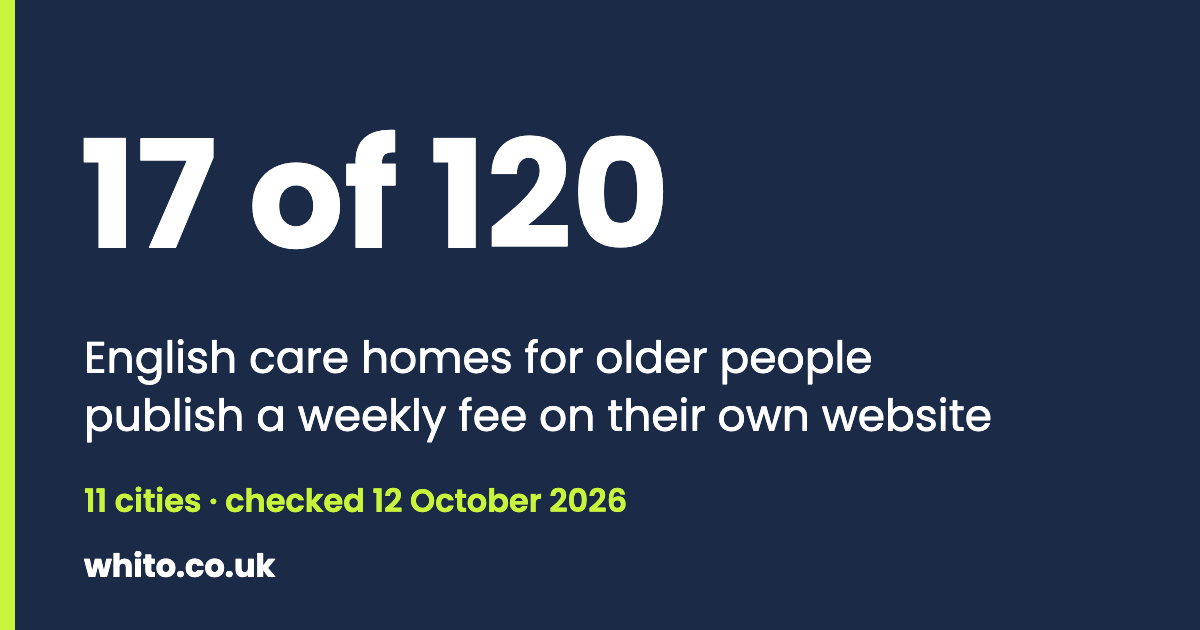
Checked: 12 October 2026. 120 English care homes for older people, drawn at random from the CQC register across 11 cities. Every fee taken from the home’s own website on that day, nothing from directories.
Re-checked 29 October 2026. We re-read all 17 published fees, and every one was unchanged. We tried the 14 register web addresses that did not work again: 10 still fail, 1 now loads but shows no fee, and 3 refused our checking tools, so we could not tell either way. We also re-opened 40 homes, picked at random from those that had published nothing. None had added a fee.
Choosing a care home is one of the biggest purchases a family ever makes. At the median published fee we found, a year in a care home costs about £71,500. So we checked something simple: can you find out what a home charges before you pick up the phone?
Mostly, no. On 12 October 2026, 17 of 120 English care homes for older people that list a website on the CQC register published a weekly fee for that home on their own site. A further 14 of the 120 register web addresses did not work at all.
What the regulator expects
The Competition and Markets Authority’s consumer law advice for care homes (revised December 2021) says homes are more likely to comply with the law if their website gives “an accurate and up-to-date indication of the total weekly fee rates charged to self-funding residents”, for each type of care they offer. It says this key information should be prominent, and its footnote puts it “no more than one click away from the main home page”.
That gives a test any family can run in under a minute. We call it the one-click fee test: from the care home’s own page, can you reach a weekly fee for that home in one click or less?
What we found
| Result for the 120 homes | Homes |
|---|---|
| Weekly fee for this home published on its own site | 17 |
| Only a group-wide “from” price, not specific to the home | 2 |
| A figure with no label or unit | 1 |
| Says contact us, ask the manager, or fees vary | 18 |
| Says nothing about what the home charges | 66 |
| Web address on the CQC register did not work | 14 |
| Could not be checked | 2 |
| Total | 120 |
Of the 104 homes with a working website we could check, 17 passed the one-click fee test. All 17 showed the fee on the home’s own page or in a document linked from it. None hid it deeper than one click. So the homes that publish do it properly. Most simply do not publish.
City by city
| City (council area) | Homes checked | Working website | Weekly fee published |
|---|---|---|---|
| Birmingham | 10 | 9 | 0 |
| Brighton and Hove | 11 | 10 | 2 |
| Bristol | 9 | 7 | 2 |
| Coventry | 15 | 12 | 2 |
| Leeds | 10 | 9 | 3 |
| Leicester | 13 | 9 | 0 |
| Manchester | 12 | 12 | 3 |
| Newcastle upon Tyne | 9 | 9 | 2 |
| Nottingham | 10 | 10 | 0 |
| Sheffield | 11 | 9 | 2 |
| Southampton | 10 | 8 | 1 |
| All 11 cities | 120 | 104 | 17 |
Samples per city are small, so read the city rows as a snapshot, not a ranking. In Birmingham, Leicester and Nottingham, none of the working sites we checked published a fee.
What the published fees show
Where a home did publish, the lowest weekly fee it showed ran from £1,112 to £2,150. The median was £1,375 a week across the 17 homes. Most are “from” prices for a standard residential room. Nursing and dementia care cost more, and the homes that priced them showed it: one Brighton home listed residential care from £2,150, dementia care from £2,330 and nursing care from £2,580 a week.
Two of the 17 print the figure without the word “week” beside it. We counted them because the page presents it as the home’s fee for self-funders.
Bigger operators publish, smaller ones mostly do not
We counted how many care homes each home’s provider runs, using the same CQC file. Among working sites run by providers registered for 10 or more care homes, 12 of 39 published a weekly fee. Among smaller providers, 5 of 65 did. In this sample, the homes that published were mostly run by large operators, and smaller homes mostly asked families to call.
One in nine register web addresses did not work
The website a family finds on a home’s CQC profile is supposed to be a route to the home. For 14 of 120 homes it was not. Ten addresses failed to load in a normal browser. Two now carry gambling content with nothing to do with care. One points to a different company with a similar name. One is a Google Business Profile web address, a type of site Google switched off in 2024. We have written before about care services with no website on the register at all. This is the other side of it: a website on the register that leads nowhere.
If you are choosing a home
- Run the one-click fee test on every home on your shortlist. A home that passes has told you its starting point before you call.
- If a home does not publish, ask for the weekly fee in writing, for the type of care you need, and what it does not include.
- Ask how and when fees are reviewed, and how much notice you get of a rise.
- Check the home’s CQC profile yourself. If the website listed there does not work, use the home’s name to find its real site, and tell CQC.
If you run a care home
Publishing a weekly “from” fee for each type of care, labelled for self-funders, puts you in the 17 of 104. It is one afternoon’s work and it answers the first question every family asks. Then check the website on your CQC profile actually loads your site. If it does not, the fix is an email to update your CQC profile. Our free Visibility Check shows what else a family, or an AI assistant, can and cannot find on your site. For what to put on a fees page, see our guide care home fees: what to publish.
What this does not prove
- A published fee is a starting point, not a quote. The final weekly fee depends on room, care needs and assessment.
- The CMA advice is guidance on consumer law, not a new rule. A home that does not publish is not proven to be breaking the law, and we do not say any home is.
- We sampled homes that list a website on the CQC register. Homes with no website on the register were outside this sample.
- “Older people” means homes registered for caring for adults over 65. Of the 165 homes first drawn, 45 are not registered for adults over 65. Many take council referrals only. They are reported separately in the data file.
- Small samples per city. The national figure is the reliable one.
- Pages change. Every result carries its check date, 12 October 2026.
How we did it
We took the CQC care directory file dated 26 August 2026 (Open Government Licence) and kept residential and nursing homes that list a website. In each of 11 English council areas we drew 15 homes at random, using a fixed seed so the draw can be repeated. 120 of the 165 are registered for adults over 65, and those 120 are the headline sample. On 12 October 2026 we opened each home’s website, looked for a weekly fee on the home’s page, its fees, funding and FAQ pages, and any fee document linked from them. Every site was then re-opened in a normal browser, and every published fee was re-read live before this page was written. Where a page had changed, the live page won. Directories and comparison sites were ignored. Nothing is ranked and no home is named as best or worst. If you think a result is wrong, use corrections.
The data behind this page
The home-level file behind this page lists all 165 homes drawn: CQC location ID, provider, the website on the register, what we found, the fee and its exact wording where published, the page it came from and the check date. It is available as Whito Data. Nobody can pay to be added to a study, removed from one or moved within one. How Whito makes money.
Cite this research
Whito Research (2026). Care home fees: of 120 English care homes for older people checked on 12 October 2026, 17 published a weekly fee for that home on their own website. https://whito.co.uk/care-homes/research/care-home-fees-published/
Contains CQC data, Open Government Licence v3.0. These figures are free to quote with a link to this page.
- How old are CQC ratings?
- Care services with no website on the CQC register
- Emergency plumber call-out prices
Questions
Do care homes have to publish their fees?
The CMA’s consumer law advice says homes are more likely to comply if their website gives an up-to-date indication of weekly fees for self-funders, no more than one click from the home page. On 12 October 2026, 17 of 120 English care homes for older people that we checked did. Source: Whito, home websites read 12 October 2026.
How much does a care home cost a week?
Among the 17 English care homes in our sample that published a fee, the lowest weekly fee shown ran from £1,112 to £2,150, with a median of £1,375. Nursing and dementia care cost more. Source: Whito, home websites read 12 October 2026.
What is the one-click fee test?
From a care home’s own web page, can you reach a weekly fee for that home in one click or less? It follows the CMA’s advice on where key fee information should sit. 17 of 104 working care home sites we checked passed. Source: Whito, 12 October 2026.
If your business is named here and you think we have a fact wrong, email hello@whito.co.uk and we will check it and correct it. If you want to respond, send us a statement and we will publish it alongside. Full detail: Corrections, right of reply and removals.