
Data last verified: 24 October 2026. Figures re-checked against their primary sources under the Whito rolling re-verification programme.
Finding
Across the latest statutory payment reports of 47 of the UK's 50 biggest construction firms, the median firm takes 30 days to pay an invoice and passes 62% of the retention its clients hold from it down onto its own supply chain.
Source: Whito, whito.co.uk/research/uk-contractor-payment-league, 2026-10-24. Free to quote with a link to this page.
Last Updated on October 25, 2026
Read: 24 October 2026. The latest statutory payment practices reports of the UK’s 50 biggest construction firms by turnover, covering £15.7bn of payments to suppliers. Every figure on this page is the firm’s own report on a government register, and every firm name links to that report. Being named is not a comment on any business: these are public statutory filings, and the page reports what each firm says about itself. If your firm is in this table and a figure has changed or looks wrong, tell us. We check it against your published report and correct the page, free of charge.
Every large UK company must publish, twice a year, how quickly it pays its suppliers. Since this year, firms with construction contracts must also publish what they hold back in retentions: the part of a subcontractor’s money kept until long after the work is done. We read the latest report for each of the top 50 and, for the first time anywhere that we can find, their new retention disclosures, firm by firm.
The median firm takes 30 days to pay an invoice, pays 15% of payments outside its own agreed terms, and passes 62% of the retention money its clients hold from it down onto its own supply chain. That 62% median retention pass-down rate is the number nobody has had before. And three firms report holding back more from their suppliers than their clients hold back from them.
The one-minute brief
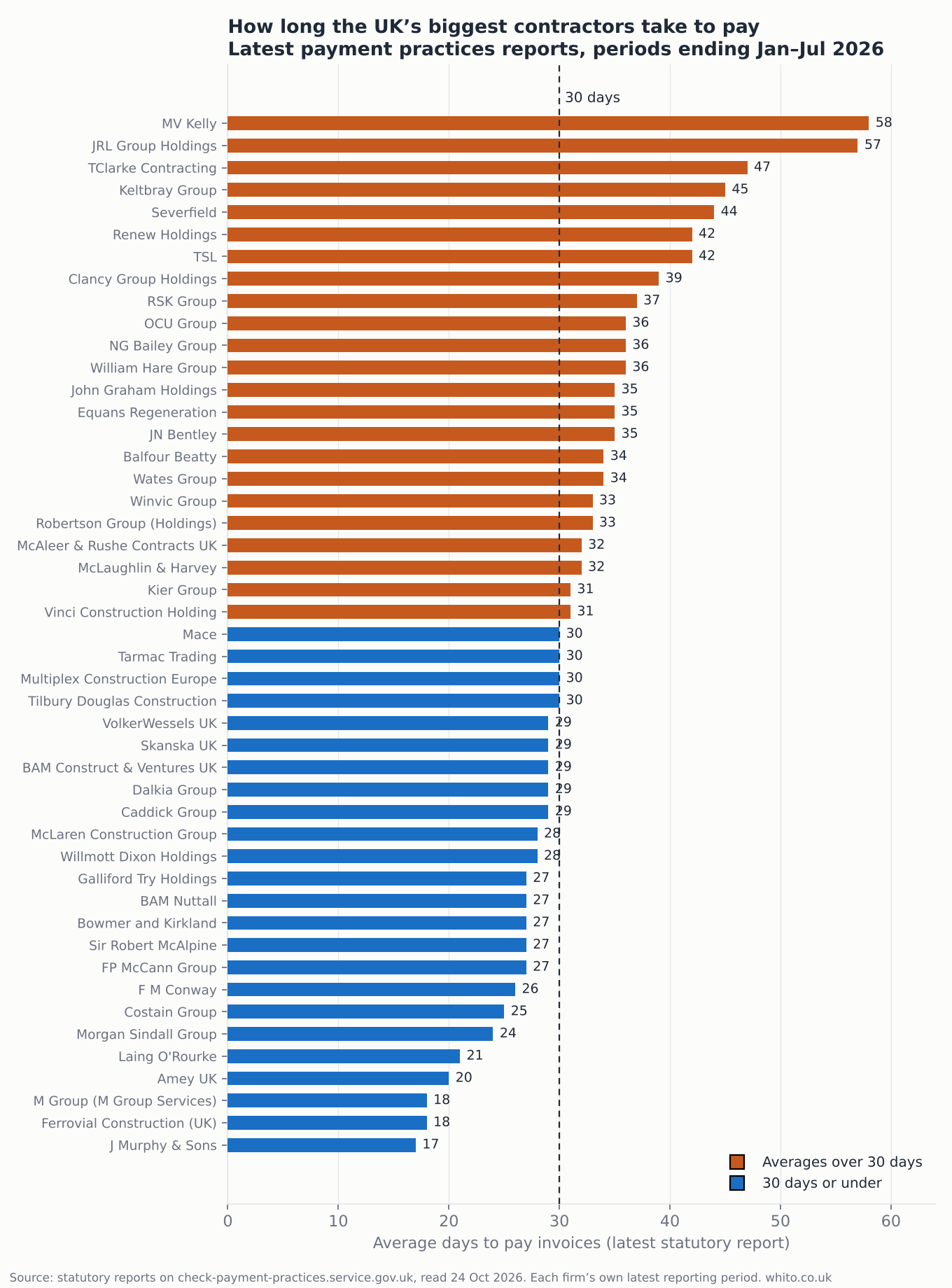
- 47 of the 50 biggest contractors have a report covering a 2026 period. The median takes 30 days to pay an invoice; 23 of 47 take longer; the slowest averages 58 days.
- Not one pays 95% of invoices within 30 days, the Fair Payment Code’s Gold standard. The best manages 86%; the median is 60%.
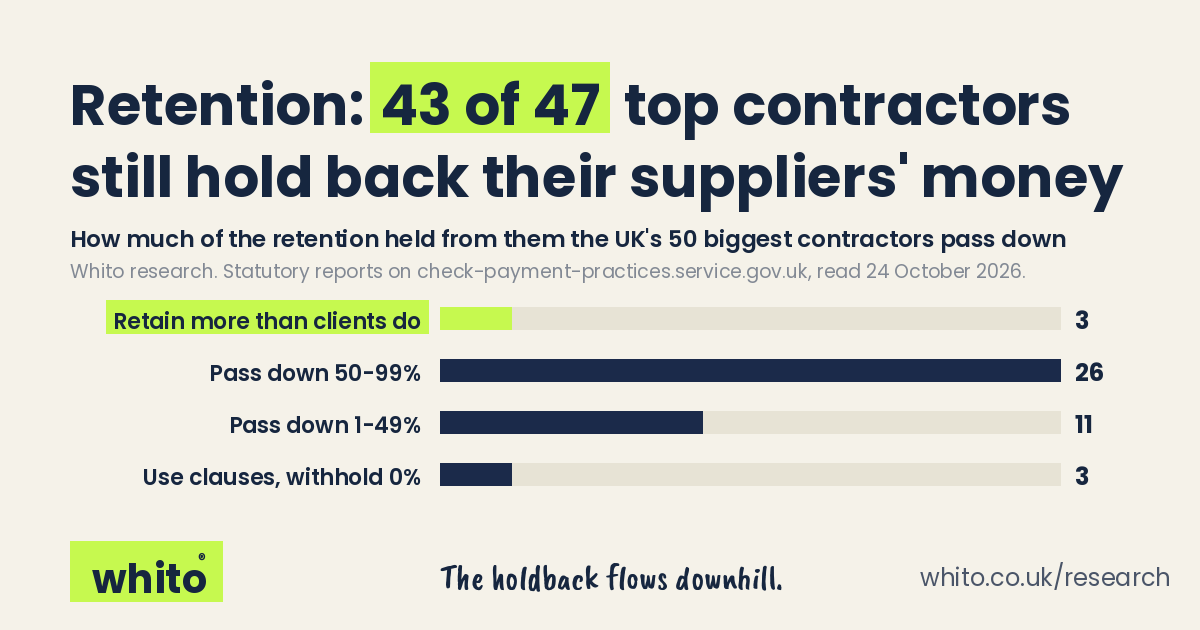
- 43 of 47 use retention clauses with suppliers. The median firm withholds retention worth 2% of its construction payments.
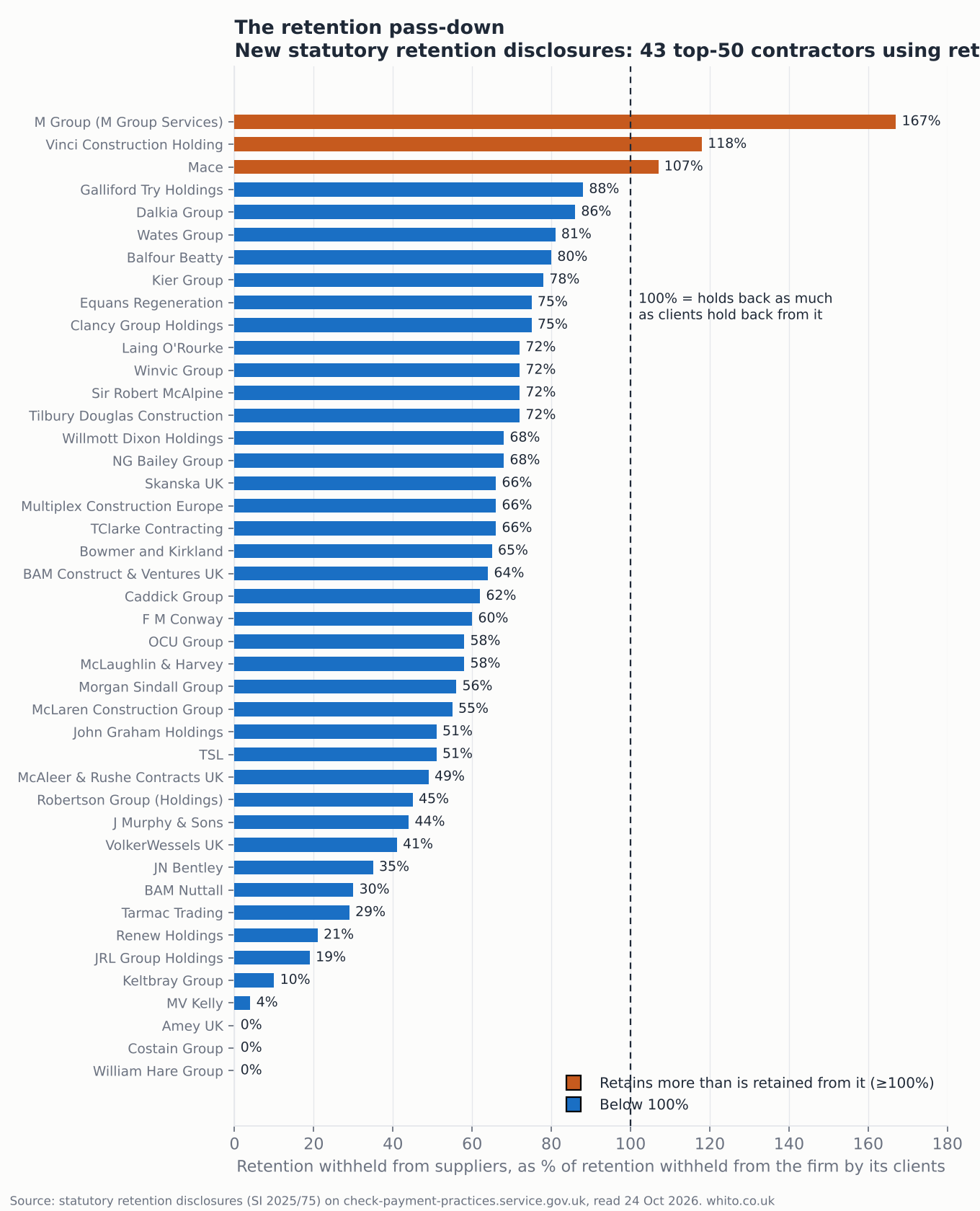
- On their own reported figures, three firms hold back more from their supply chain than their clients hold back from them: M Group’s water business (167%), Vinci Construction UK (118%) and Mace (107%).
- The fastest payers average 17 to 21 days: J Murphy & Sons, Ferrovial Construction UK, M Group’s water business, Amey and Laing O’Rourke.
Method: frame is The Construction Index Top 100 (2026), ranks 1 to 50; each group resolved to its principal reporting entity on the government’s payment practices register, read 24 October 2026. Free to quote with a link. The working data behind our studies is sold as files →
What we did
The frame is The Construction Index Top 100 Construction Companies 2026, ranks 1 to 50, a published ranking by latest turnover. Large groups file payment reports per legal entity, so we resolved each group to its principal reporting entity: the entity whose latest report covers the largest total payment value, checking up to three candidates per group. The chosen entity, its company number and the alternates considered are all recorded in the data file.
For each entity we read its latest report and the one before it on check-payment-practices.service.gov.uk, the government service where the reports are published under the Reporting on Payment Practices and Performance Regulations 2017. Every figure was transcribed from the report page on 24 October 2026. Nothing is estimated. Four of the headline reports were independently re-read in a second pass and matched exactly, and an independent audit recomputed every statistic on this page from the data file before publication.
Reports are self-declarations. Publishing a false or misleading report is a criminal offence, which is the only external control: read every number on this page as what the firm says about itself.
The league: how long each firm takes to pay
Average days to pay, share of invoices paid within 30 days, and share of payments made outside the firm’s own agreed terms. Each firm links to the statutory report the figures come from. Reporting periods are the firm’s own latest half-year, so they differ; each row states its period.
| Firm (links to its report) | Period | Avg days to pay | Invoices paid within 30 days | Paid outside agreed terms |
|---|---|---|---|---|
| MV Kelly | Dec 2025–May 2026 | 58 | 8% | 4% |
| JRL Group (Midgard) | Nov 2025–Apr 2026 | 57 | 28% | 30% |
| TClarke | Oct 2025–Mar 2026 | 47 | 62% | 14% |
| Keltbray (Built Environment) | Nov 2025–Apr 2026 | 45 | 26% | 34% |
| Severfield (C&I) | Oct 2025–Mar 2026 | 44 | 29% | 51% |
| Renew (AmcoGiffen) | Oct 2025–Mar 2026 | 42 | 37% | 16% |
| TSL | Jan 2026–Jun 2026 | 42 | 41% | 17% |
| Clancy (Docwra) | Oct 2025–Mar 2026 | 39 | 34% | 9% |
| RSK Group | Oct 2025–Mar 2026 | 37 | 59% | 22% |
| OCU Group | Nov 2025–Apr 2026 | 36 | 54% | 22% |
| NG Bailey | Feb 2026–Aug 2026 | 36 | 37% | 2% |
| William Hare | Jan 2026–Jun 2026 | 36 | 55% | 5% |
| GRAHAM | Oct 2025–Mar 2026 | 35 | 40% | 4% |
| Equans Regeneration | Jan 2026–Jun 2026 | 35 | 44% | 27% |
| JN Bentley | Jan 2026–Jun 2026 | 35 | 39% | 7% |
| Balfour Beatty | Jan 2026–Jun 2026 | 34 | 72% | 10% |
| Wates Group | Jan 2026–Jun 2026 | 34 | 64% | 11% |
| Winvic Group | Feb 2026–Jul 2026 | 33 | 51% | 8% |
| Robertson (Central Scotland) | Jan 2026–Jun 2026 | 33 | 51% | 16% |
| McAleer & Rushe | Jan 2026–Jun 2026 | 32 | 50% | 4% |
| McLaughlin & Harvey | Jan 2026–Jun 2026 | 32 | 51% | 15% |
| Kier Group | Jan 2026–Jun 2026 | 31 | 45% | 16% |
| Vinci Construction UK | Jan 2026–Jun 2026 | 31 | 63% | 55% |
| Mace | Jan 2026–Jun 2026 | 30 | 71% | 25% |
| Tarmac Trading | Jan 2026–Jun 2026 | 30 | 63% | 17% |
| Multiplex | Jan 2026–Jun 2026 | 30 | 72% | 21% |
| Tilbury Douglas | Jan 2026–Jun 2026 | 30 | 74% | 8% |
| VolkerWessels UK | Jan 2026–Jun 2026 | 29 | 70% | 16% |
| Skanska UK | Jan 2026–Jun 2026 | 29 | 69% | 8% |
| BAM Construct & Ventures | Jan 2026–Jun 2026 | 29 | 79% | 17% |
| Dalkia Group | Jan 2026–Jun 2026 | 29 | 63% | 17% |
| Caddick Group | Sep 2025–Feb 2026 | 29 | 17% | 0% |
| McLaren Construction | Aug 2025–Jan 2026 | 28 | 56% | 21% |
| Willmott Dixon | Jan 2026–Jun 2026 | 28 | 60% | 8% |
| Galliford Try | Jan 2026–Jun 2026 | 27 | 60% | 8% |
| BAM Nuttall | Jan 2026–Jun 2026 | 27 | 75% | 18% |
| Bowmer & Kirkland | Sep 2025–Feb 2026 | 27 | 80% | 15% |
| Sir Robert McAlpine | Nov 2025–Apr 2026 | 27 | 73% | 5% |
| FP McCann | Jan 2026–Jun 2026 | 27 | 58% | 2% |
| FM Conway | Jan 2026–Jun 2026 | 26 | 74% | 10% |
| Costain Group | Jan 2026–Jun 2026 | 25 | 78% | 18% |
| Morgan Sindall (C&I) | Jan 2026–Jun 2026 | 24 | 73% | 3% |
| Laing O’Rourke | Oct 2025–Mar 2026 | 21 | 69% | 22% |
| Amey UK | Jan 2026–Jun 2026 | 20 | 72% | 17% |
| M Group (Water) | Oct 2025–Mar 2026 | 18 | 86% | 5% |
| Ferrovial Construction UK | Jan 2026–Jun 2026 | 18 | 80% | 15% |
| J Murphy & Sons | Jan 2026–Jun 2026 | 17 | 85% | 4% |
Three of the top 50 groups are not in the table, because we could not find a report covering a 2026 period under the UK companies we searched for each group. Groups often report through several companies, and a company below the size thresholds does not have to report at all, so this says nothing about whether any firm has met its obligations.
Who pays best
The top of the league deserves as much attention as the bottom. J Murphy & Sons reports a 17-day average with 85% of invoices paid within 30 days. M Group’s water business pays 86% of invoices within 30 days, the highest share in the table, at an 18-day average. Ferrovial Construction UK averages 18 days and Bowmer & Kirkland pays 80% of invoices within 30 days.
On paying within agreed terms, Caddick Construction reports 0% outside terms, NG Bailey and FP McCann 2%, and Morgan Sindall’s construction and infrastructure business 3%. Three firms do both: Morgan Sindall (24 days, 3%), M Group’s water business (18 days, 5%) and J Murphy & Sons (17 days, 4%).
Slow is not the same as late
The regulations measure two different things: how fast a firm pays, and whether it pays within whatever terms it agreed. They diverge, and the divergence matters when you price a job. M.V. Kelly pays slowest in the table, a 58-day average with 8% of invoices paid within 30 days, yet reports only 4% of payments outside agreed terms, because its agreed terms allow up to 90 days. Vinci Construction UK pays a 31-day average but reports 55% of payments outside terms.
That is why the two figures need reading together. Among the 35 firms that answer the longest-standard-term question, the median longest term is 60 days, and six firms report maximum contractual periods of 90 days or more, the longest 120. The Commercial Payments Bill, now before Parliament, proposes a 60-day maximum payment period for private-sector payers, which would bite directly on those six. The number to negotiate is the agreed period, not the promise of punctuality.
The retention pass-down: numbers nobody had before
Since the 2025 amendment regulations, firms must disclose their retentions for financial years beginning on or after 1 April 2025. All 47 current reports carry the section. 43 of 47 report using retention clauses with suppliers; only four say they do not.
Two new statistics appear in each report. The first is retention as a share of construction payments: the median is 2%, the range 0 to 8%. The second we call the retention pass-down rate: retention withheld from suppliers as a percentage of retention withheld from the firm by its clients. The median firm passes down 62%. Ten of 43 pass down 75% or more. Three exceed 100%: on their own disclosures, they hold back more from their suppliers than their clients hold back from them.
| Firm (links to its report) | Retention withheld, as % of retention withheld by its clients | Retention as % of construction payments |
|---|---|---|
| M Group (Water) | 167% | 2% |
| Vinci Construction UK | 118% | 1% |
| Mace | 107% | 2% |
| Keltbray (Built Environment) | 10% | 2% |
| MV Kelly | 4% | 0% |
| Amey UK | 0% | 0% |
| Costain Group | 0% | 2% |
| William Hare | 0% | 0% |
A pass-down rate above 100% has innocent readings. A firm doing work where clients retain little, such as utilities frameworks or housebuilding, can show a high ratio while still retaining normally from subcontractors. M Group’s water business, the highest at 167%, works mainly for water utilities. At the other end, Amey’s reporting entity, Costain and William Hare report 0%, and Keltbray’s built-environment business 10%. A low figure means the firm holds back less from its suppliers than its own clients hold back from it.
Parliament is considering a phased ban on retention clauses in the Commercial Payments Bill. If it passes, this page is the baseline the ban will be measured against.
Payment codes and the numbers
21 of 47 firms cite a payment code in their report. Their median late share, 16%, is no better than the 14.5% of firms citing none. Three firms’ 2026 reports still cite the Prompt Payment Code, which the Fair Payment Code replaced in December 2024. And measured against the Fair Payment Code’s Gold criterion, at least 95% of invoices paid within 30 days, none of the 47 qualifies on its reported figures. A code is a commitment and the report shows the result, so it is worth reading both.
When the reports appear
Reports are due within 30 days of the end of each period. Most of the 47 appeared on the service within that window. The date the service shows is the date a report was published there, which is not always the date a firm prepared or submitted it, and some firms were changing their reporting cycle. Each report’s period and publication date are in the data file for anyone who wants to look.
What to do with this if you work for the majors
Before you price a job for a big contractor, spend thirty seconds on the register. The report tells you the average wait, the late share, the agreed terms and now the retention. Price the retention in: at the median, 2% of contract value will be held back. And read a firm’s reported numbers alongside any payment code it has signed. For what late payment costs UK businesses overall, see our UK late payment statistics; for what the Budget could change, the Autumn Budget 2026 hub; for what a trade job needs to earn to cover its marketing, the break-even price of a trade lead.
Limits
- Every figure is self-reported. False reporting is an offence, but no independent audit of these numbers exists.
- Groups report per legal entity. We took each group’s principal reporting entity by payment value and recorded the alternates; a different entity choice changes some firms’ numbers materially, and the data file shows both where it does.
- Reporting periods differ by firm, ending between January and July 2026. No comparison on this page assumes aligned periods.
- “Paid outside agreed terms” is relative to each firm’s own terms, which is why the average-days column sits beside it.
- Medians are unweighted: one firm, one vote. The £15.7bn is stated for scale, not used for weighting.
- Several firms’ published late-payment values in pounds are internally inconsistent, and two firms attribute 100% of late payments to disputes in consecutive reports. We used the percentage fields and flagged the anomalies in the data file.
- This is the top 50 by turnover, not UK construction at large. Firms below the reporting thresholds are invisible to this instrument.
- Figures are as each firm published them on the date we read them, 24 October 2026. A firm can publish a later report or a revised one; if yours has, tell us and we will update the page.
Common questions
How long do big UK construction firms take to pay invoices?
On their latest statutory payment practices reports, read 24 October 2026, the median of the UK’s 50 biggest contractors takes 30 days to pay an invoice. 23 of the 47 with current reports average longer than 30 days, the slowest 58 days and the fastest 17.
What is a retention in construction?
A retention is part of each payment, commonly a few percent, held back from a contractor or subcontractor until after the work is finished, often until the end of the defects period. Since 2025 regulations, large firms must disclose their retention practices in their payment practices reports. 43 of the 47 top contractors with current reports use retention clauses with their suppliers.
What is the retention pass-down rate?
The retention pass-down rate is retention withheld from suppliers as a percentage of retention withheld from the firm by its own clients, a statistic firms must now publish. Across the 43 top-50 contractors using retention clauses, the median is 62%. Three firms exceed 100%, meaning they hold back more from their supply chain than their clients hold back from them.
How do I check a contractor’s payment record?
Search the company on check-payment-practices.service.gov.uk, the free government register. Its latest report shows the average days to pay, the share of invoices paid within 30, 60 and more days, the share paid outside agreed terms, its standard payment terms, and its retention disclosures.
For the firms in this table
Corrections are always free. Separately, we build peer benchmarks to order: your firm’s figures against the top-50 median and the firms nearest you, how they have moved across your last four reports, and how your terms and retention sit against the Commercial Payments Bill as introduced. £1,280 per firm, bought outright, scope agreed in writing first. No VAT is added.
Buying a benchmark does not change anything on this page. Nobody pays to appear, or to be left out. Ask for your benchmark →
Download the data
All 50 rows, with each group’s reporting entity, company number, reporting period, every transcribed figure, the trend fields from the previous report, and a link to every statutory report: whito-contractor-payments-top50-2026-10-24-v2.csv. Free to reuse with a link to this page. If you spot an error, tell us through our corrections page.
Cite this research
Whito Research (2026). How Construction’s Biggest Firms Pay: The Top 50 Payment and Retention League. Whito. https://whito.co.uk/research/uk-contractor-payment-league/
Key finding: Across the latest statutory payment reports of 47 of the UK’s 50 biggest construction firms, read 24 October 2026, the median firm takes 30 days to pay an invoice, pays 15% of payments outside its agreed terms, and passes 62% of the retention its clients hold from it down onto its own supply chain.
The structural checks behind this research run on any website in about twenty seconds. Enter yours and read the full result on the page. Free, and we do not ask for your email.
Run the free Visibility CheckIf your business is named here and you think we have a fact wrong, email hello@whito.co.uk and we will check it and correct it. If you want to respond, send us a statement and we will publish it alongside. Full detail: Corrections, right of reply and removals.