
Finding
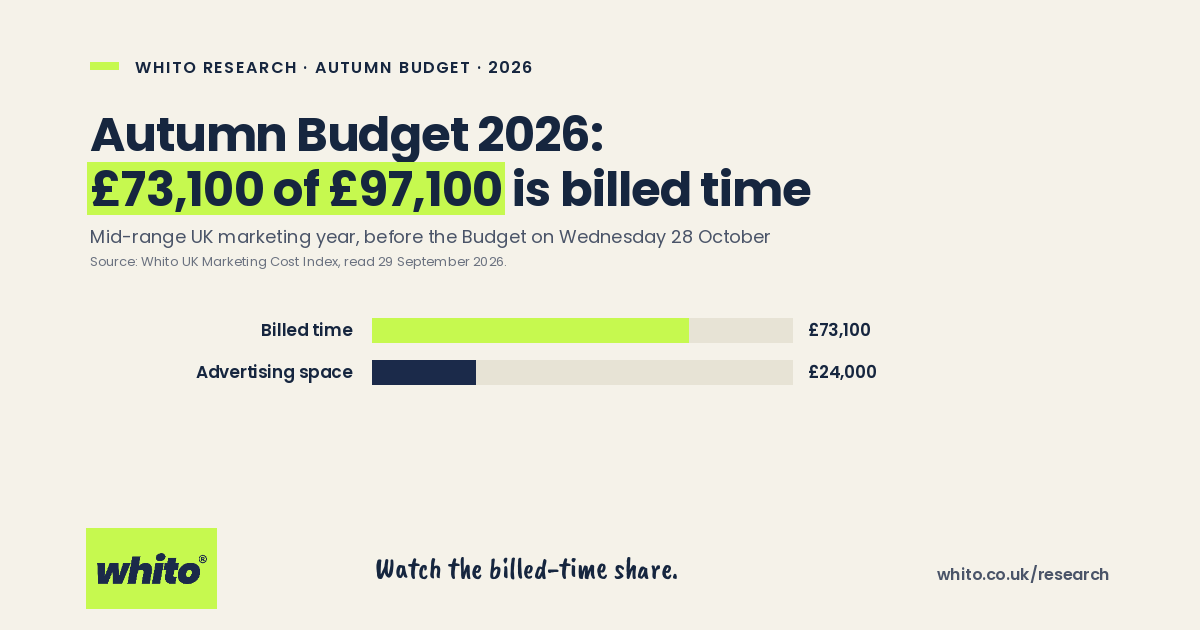
At the mid range of Whito's published UK marketing budget table, £73,100 of a £97,100 year pays for work billed as people's time. The Autumn Budget on 28 October 2026 can reprice that time. This page holds the published baselines and updates within an hour of the Chancellor sitting down.
Source: Whito, whito.co.uk/research/autumn-budget-2026. Free to quote with a link to this page.
Last Updated on September 29, 2026
The Autumn Budget lands on Wednesday 28 October 2026. It will be John Healey’s first as Chancellor, and within an hour of him sitting down this page will say, in pounds, what the announcements do to the cost of running a UK business. Until then it holds the baselines: the current rates and thresholds any change will be measured against.
Most Budget reaction is written before the speech and could be attached to any Budget since 2010. This page does something narrower and more useful: it names the eleven lines in a business’s bill the Chancellor can actually move, states where each one stands today with a source read on 29 September 2026, and reprices them on the day if they change. Where a line touches marketing, Whito’s own published price benchmarks put the change in pounds.
Key takeaways
- At the mid range of Whito’s published UK marketing budget table, £73,100 of a £97,100 year pays for work billed as people’s time, and £24,000 buys advertising space.
- Four Budget lines can reach a marketing invoice: employer National Insurance, VAT, the Digital Services Tax, and the wage floor.
- Employer National Insurance stands at 15% above £96 a week for 2026-27. It is the single biggest lever on the price of billed time.
- This page updates within an hour of the Chancellor sitting down on 28 October 2026. Each update will be dated and set against the bands below.
- Seven more lines cover the rest of the bill: corporation tax, dividend tax, business rates, the Employment Allowance, fuel duty, the investment allowances, and Making Tax Digital’s timetable.
The billed-time share is the part of a marketing budget that ends up as somebody’s working hours: retainers, day rates, project fees and in-house pay. It matters on Budget day because employment taxes reprice hours, and hours are most of what UK businesses buy when they buy marketing.
The table below restates the annual budget table from the UK Marketing Cost Index, read on 29 September 2026, with one added column: what the money actually buys.
| Budget line | Mid-range year | What the money buys |
|---|---|---|
| SEO | £18,000 | Billed time |
| PPC management fees | £12,000 | Billed time |
| PPC ad spend | £24,000 | Advertising space |
| Social media management | £9,600 | Billed time |
| Website (build plus year one) | £5,500 | Billed time, some hosting |
| Email marketing | £6,000 | Billed time, some software |
| Content and copywriting | £12,000 | Billed time |
| Branding | £5,000 | Billed time |
| Video | £5,000 | Billed time |
The mid-range column adds up to £97,100 a year. £24,000 of it buys advertising space. The other £73,100 pays for work billed as people’s time, which puts the billed-time share at just over 75p in every pound. The website and email lines include some hosting and software inside their totals; the bulk of both is still billed time. That is the limit on the figure, and it is a small one.
This is why a Budget that never says the word “marketing” can still reprice it. Anything that changes what an hour of UK labour costs to sell changes what marketing costs to buy.
The four lines to watch on 28 October
1. Employer National Insurance
For 2026-27, employers pay 15% National Insurance on earnings above £96 a week, about £5,000 a year per employee (GOV.UK rates, read 29 September 2026). On a marketing executive’s £30,000 average salary, from Whito’s UK marketing salaries research, that is about £3,750 a year before the Budget says a word. On a marketing manager at £44,500 it is about £5,930.
Agencies and freelancers carry the same cost inside their rates. The Cost Index puts a UK copywriter’s day rate at £350 to £500, and a mid-tier social media retainer at £600 to £1,200 a month. If the employer rate or the threshold moves on 28 October, those are the bands that absorb it, usually at the next renewal.
2. VAT
The registration threshold stands at £90,000 of taxable turnover (GOV.UK, read 29 September 2026). Marketing services carry VAT at 20% once the supplier is registered, which produces the quiet price gap between freelancers under the threshold and agencies above it. On a £1,500 a month retainer, VAT is £300 a month, reclaimable if the buyer is VAT-registered and a straight cost if it is not.
A threshold change moves suppliers across that line. The Cost Index band it shows up in first: a freelancer blog post runs £75 to £400, an agency post £200 to £800.
3. The Digital Services Tax
Since 1 November 2020 Google has added a 2% “UK DST Fee” to invoices for ads served in the UK, passing the Digital Services Tax to advertisers (Google’s surcharge page, read 29 September 2026). On the Cost Index mid-range ad spend of £24,000 a year, that fee is £480. If the Budget changes the DST, expect the platforms to change the fee, and the ad spend line to move with it.
4. The wage floor
The National Living Wage rose to £12.71 an hour in April 2026 for workers 21 and over (GOV.UK, read 29 September 2026). Full time at 37.5 hours that is about £24,800 a year, which now sits £5,200 under the average marketing executive salary of £30,000. Each rise in the floor narrows that gap and pushes junior marketing pay, and the junior day rates built on it, upward. The next rate is normally announced at the Budget.
The rest of the bill: seven more lines
Marketing is one column of a business’s costs. These are the other lines the same speech can move, each with its baseline as it stands today.
5. Corporation tax
Companies pay 19% on profits up to £50,000 and 25% above £250,000, with marginal relief between the two (GOV.UK, read 29 September 2026). Both thresholds shrink where a company has associated companies, which catches owners running more than one. A change here arrives with a start date, usually the next April, so the day-of update will state the new figure and when it bites.
6. Dividend tax
For 2026-27, dividends above the £500 allowance are taxed at 10.75% at the basic rate, 35.75% at the higher rate and 39.35% at the additional rate (GOV.UK, read 29 September 2026). For an owner-managed company, this line and corporation tax together decide what a pound of profit is worth taking home, so a small movement in either shows up in director pay decisions before anything else.
7. Business rates
England moved to five multipliers on 1 April 2026: 38.2p in the pound for small retail, hospitality and leisure properties, 43.2p for other small properties, 43p and 48p at standard size, and 50.8p for properties with a rateable value of £500,000 or more (Cambridge City Council’s published 2026-27 multipliers, read 29 September 2026). Next year’s multipliers are set at the Budget, so the announcement to listen for is the uprating decision and anything touching the retail, hospitality and leisure rates. These figures are England only; Scotland, Wales and Northern Ireland set their own.
8. The Employment Allowance
Eligible employers can take up to £10,500 a year off their employer National Insurance bill (GOV.UK, read 29 September 2026). It is the counterweight to line 1: the same Budget can raise the National Insurance rate and raise this allowance, and a small employer feels the net of the two, not the headline.
9. Fuel duty
Fuel duty stands at 52.95p a litre on petrol and diesel (GOV.UK, read 29 September 2026). Whether it rises is decided at the Budget, and for any business running vans it is a cost that repeats on every job, which is why a few pence a litre moves more money over a year than most headline measures.
10. Full expensing and the Annual Investment Allowance
Companies can deduct the full cost of qualifying plant and machinery in the year they buy it under full expensing, and the Annual Investment Allowance covers up to £1 million of qualifying spend a year (GOV.UK, read 29 September 2026). Budgets change what counts as qualifying more often than they change the headline, so the day-of update will read the published documents, where the qualifying rules live, and report what changed.
11. Making Tax Digital for Income Tax
The rollout is already scheduled: sole traders and landlords with qualifying income over £50,000 came in from 6 April 2026, the £30,000 band follows from April 2027 and the £20,000 band from April 2028 (GOV.UK, read 29 September 2026). It is a filing change with a software cost attached, on a timetable that has slipped several times before, so the update will say whether the dates held.
What this page will publish on the day
Within an hour of the Chancellor sitting down on 28 October, a dated section will appear above this one covering each of the eleven lines: moved or unchanged, the new figure beside the baseline it replaces, and when it takes effect. If the marketing lines move, it will include a repriced version of the £97,100 mid-range year in pounds. If a headline measure touches none of the eleven, one sentence will say so.
What this page will do before the speech: nothing. It carries no predictions about rates, thresholds or reliefs, because a prediction would be somebody’s opinion and the point of holding a price dataset is that opinion is unnecessary. The baselines above were collected and published before the speech, which is what makes the day-of comparison worth reading.
Method and limits
Price bands are from the Whito UK Marketing Cost Index and Whito’s UK marketing salaries research, both read on 29 September 2026; the Cost Index states its own collection method and sample on its page. Tax rates and thresholds are from the linked GOV.UK pages and Google’s published surcharge notice, each read on 29 September 2026; the 2026-27 business rates multipliers are as published by Cambridge City Council, since the multipliers are set nationally for England. The Budget date and the Chancellor’s first-Budget status are as reported by Professional Pensions, read 29 September 2026. The billed-time share is calculated from the Cost Index mid-range column only; a business at the low or high end of the bands will have a different split. Nothing here is tax advice. For what a specific plan should cost, use the UK Marketing Cost Calculator.
Common questions
When is the Autumn Budget 2026?
Wednesday 28 October 2026. It is John Healey’s first Budget as Chancellor. This page updates the same afternoon.
What is the billed-time share?
The part of a marketing budget that pays for people’s working hours: retainers, day rates, project fees and in-house pay. At the mid range of Whito’s published budget table it is £73,100 of a £97,100 year, just over 75p in the pound.
Can the Budget really change what marketing costs?
Through four lines: employer National Insurance, VAT, the Digital Services Tax and the wage floor. Each reaches invoices with a delay, usually at contract renewal, which is why this page prices the mechanism before the speech and measures the movement after it.
Which lines matter most for a small limited company?
Employer National Insurance and the Employment Allowance set what staff cost, and corporation tax and dividend tax together set what a pound of profit is worth taking home. Those four decide most of the difference an owner-managed company feels the morning after a Budget.
The structural checks behind this research run on any website in about twenty seconds. Enter yours and read the full result on the page. Free, and we do not ask for your email.
Run the free Visibility CheckIf your business is named here and you think we have a fact wrong, email hello@whito.co.uk and we will check it and correct it. If you want to respond, send us a statement and we will publish it alongside. Full detail: Corrections, right of reply and removals.