
Finding
Only five of the 59 dental practices named by ChatGPT, Gemini and Google AI Mode across six UK cities were recommended by all three engines in Whito's August 2026 test, and 66% were named by one engine only. The median quoted review count was 368.
Source: Whito, whito.co.uk/dentists/research/ai-dentist-recommendations, August 2026. Free to quote with a link to this page.
Last Updated on October 12, 2026
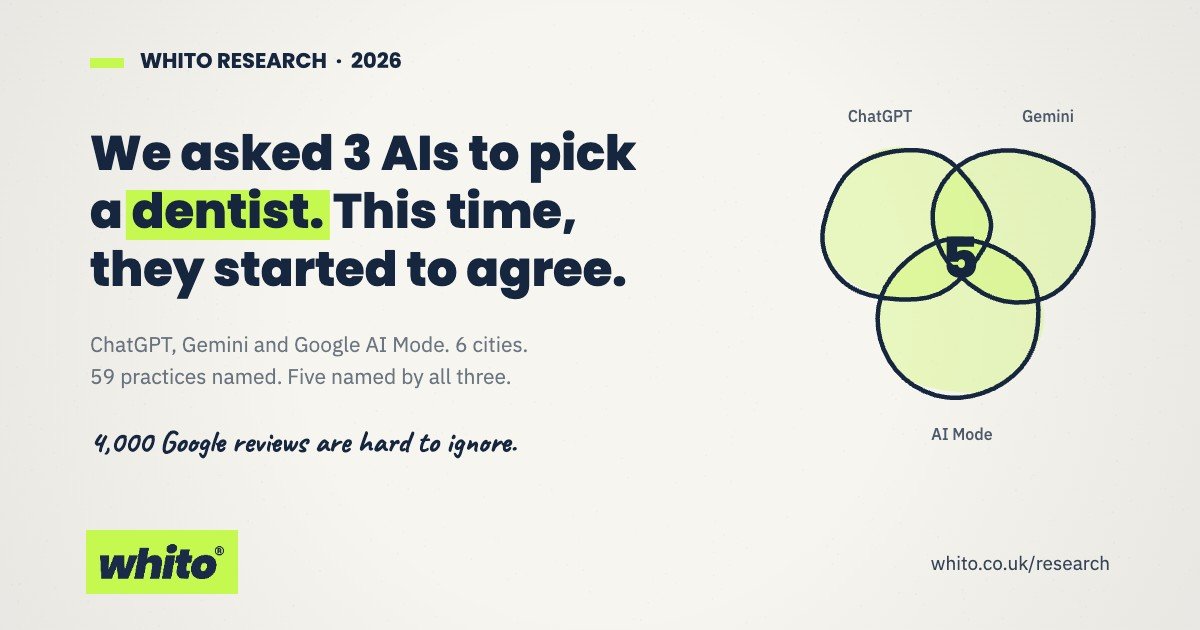
We asked ChatGPT, Google Gemini and Google AI Mode to name the best private dentist in six UK cities, and kept the screenshots. This is the third profession in our series, and the first where the engines are starting to agree. The reason is not a directory. It is review volume.
This week we ran the same experiment twice: ask three AI engines to recommend an accountant, then a solicitor, in six UK cities. Accountants got almost no consensus (1 firm in 109). Solicitors got five times more (3 in 61), because the engines all read the same legal directories.
Today, the third profession: private dentists. Same six cities, same day, same three engines. And the agreement rate nearly doubled again.
What we did
One fixed question, worded the way a patient would ask it: “Who is the best private dentist in [city]?”
We asked it in Manchester, London, Birmingham, Leeds, Bristol and Glasgow, across three engines, all on 14 August 2026 from a UK browser: ChatGPT (free tier, with web search), Google Gemini (free app), and Google AI Mode (Google’s AI search). We recorded every practice named, matched the overlaps with set logic, and screenshotted what each engine actually showed.
The headline numbers
- The engines named 59 different dental practices across 84 recommendation slots.
- 66% of practices were named by only one engine. For solicitors it was 74%; for accountants, 85%.
- Five practices achieved full three-engine consensus: Harley Street Dental Studio in London, Clarendon Dental Spa and The Dental Architect in Leeds, The Bristol Dental Practice in Bristol, and The Berkeley Clinic in Glasgow. That is 8.5% of practices, against 4.9% for solicitors and 0.9% for accountants.
- In two cities, two engines named the same explicit first choice: Smile Stylist Dental Clinics in Manchester and The Bristol Dental Practice in Bristol, both by ChatGPT and Google AI Mode.
- One curiosity: Gemini answered our Manchester question without naming a single practice. It gave generic advice on how to choose a dentist, then warned us not to confuse Manchester with Manchester, Connecticut.
| City | Unique practices named | Named by 2+ engines | Named by all 3 |
|---|---|---|---|
| London | 13 | 4 | 1 (Harley Street Dental Studio) |
| Birmingham | 10 | 3 | 0 |
| Bristol | 10 | 4 | 1 (The Bristol Dental Practice) |
| Glasgow | 10 | 3 | 1 (The Berkeley Clinic) |
| Manchester | 8 | 2 | 0 |
| Leeds | 8 | 4 | 2 (Clarendon Dental Spa, The Dental Architect) |
| Total | 59 | 20 | 5 |
What the engines actually show
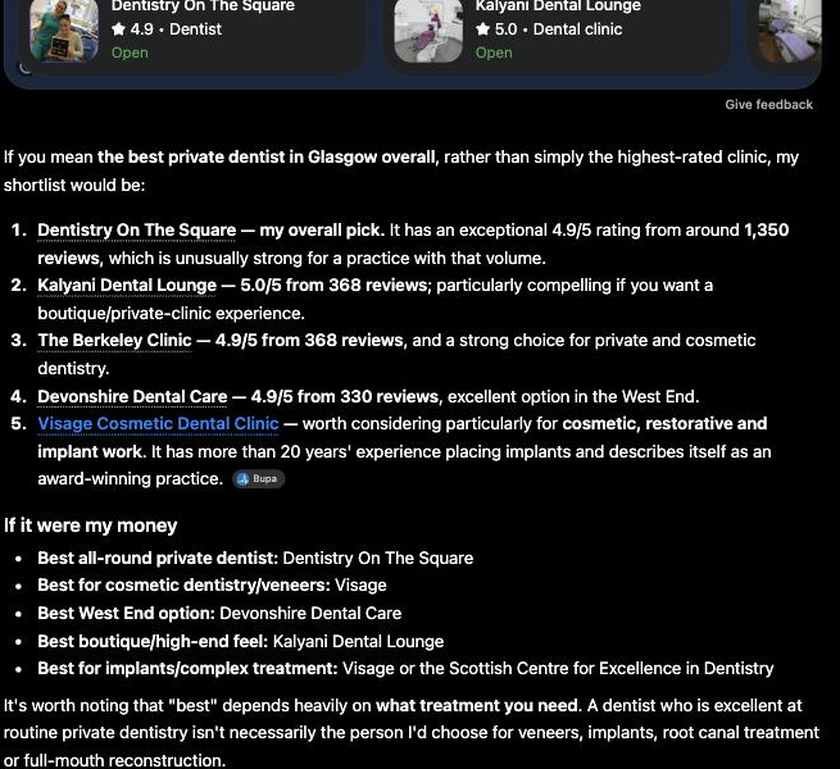
ChatGPT answers like a comparison site. It opens with business cards showing star ratings, writes a ranked shortlist with review counts for every entry, then adds a section it titles “If it were my money” with a best-for breakdown. This is not a search result. It is a buying guide.
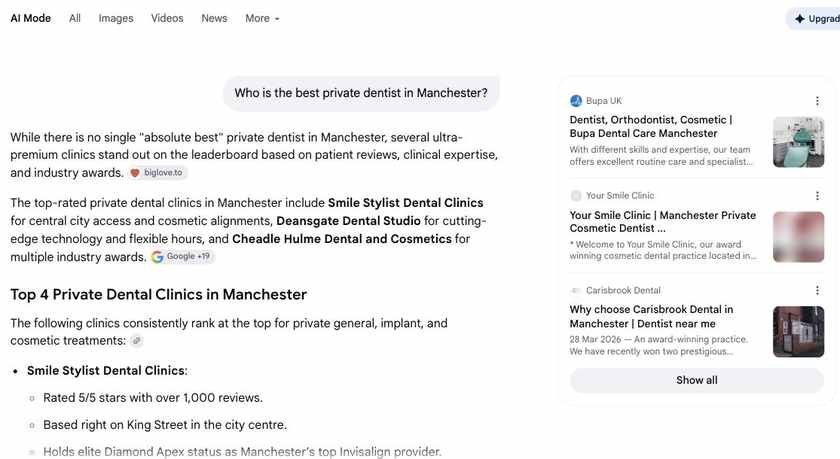
Google AI Mode went furthest of all. In Manchester it described the city’s clinics as a “leaderboard” and ranked them by reviews, awards and clinical claims, with source citations down the side.
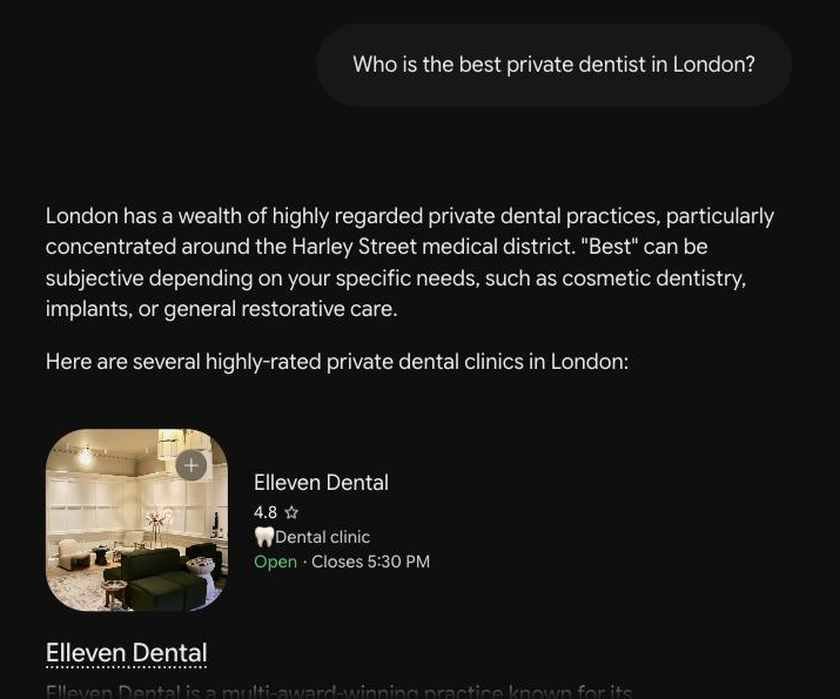
Gemini embeds live business cards, with photos, ratings and opening hours, directly in the answer, then writes a profile under each one. Its London answer led with a card for Elleven Dental, described as “frequently recognised at industry ceremonies like The Private Dentistry Awards”.
Why dentists get the most consensus yet
This is our reading of the data, not something any engine documents.
Solicitors converged because of directories: Chambers and the Legal 500 gave every engine the same list to copy. Dentistry has no Chambers. What it has instead is enormous public review volume, and an unusually busy awards circuit, and both are visible to every engine.
Look at what the five consensus practices have in common. Clarendon Dental Spa was quoted at around 4,000 reviews, and both ChatGPT and AI Mode independently repeated its “Practice of the Year 2026 Yorkshire” award. Harley Street Dental Studio was quoted at 4.7 from 767 reviews by two engines, word for word the same numbers. The Dental Architect’s founder was cited as a “UK Dentist of the Year”. The Bristol Dental Practice and The Berkeley Clinic both carry four-figure or near-four-figure review counts.
The review counts quoted across this study tell the story on their own. Where engines quoted review data (54 recommendations), the median quoted count was 368 reviews, with several practices over 4,000. For solicitors the median was 113. For accountants, 37.
The rule from the accountants and solicitors studies still holds, but dentistry adds a second clause: where no directory exists, engines will build their own authority layer out of whatever public data is biggest, and in dentistry that is Google reviews and awards. A practice with 4,000 reviews is hard for three different engines to miss.
The awards circuit is quietly becoming AI infrastructure
Award names came up constantly: the Private Dentistry Awards in three different answers across three different engines, “UK Dentist of the Year” twice, “Practice of the Year”, British Academy of Cosmetic Dentistry accreditation, Doctify review scores, Bupa accreditations. Engines treat these as evidence, and repeat them as reasons.
Dental awards were once marketing wallpaper, a logo for the waiting room wall. On this evidence they now function like a directory entry does for solicitors: a machine-readable authority signal that engines quote back to patients by name.
We also saw ChatGPT’s ad slot working the same sector: during this study its free tier showed labelled adverts for a dental studio’s brace treatments and for a dental marketing agency beneath our answers. The answer page around AI recommendations is becoming commercial real estate, on both the organic and paid layers.
What a dental practice should do with this
Three things, in order of leverage.
Treat review volume as your directory entry. In this study, no signal predicted being recommended like a large, high-scoring Google review profile. The median quoted count was 368. If your practice is at 60 reviews, that gap is your AI visibility problem, and closing it costs nothing but a consistent ask.
Enter the awards you can credibly win. Engines quoted award wins as reasons in city after city. A regional “Practice of the Year” is no longer just a plaque; it is a line the machines repeat.
Keep your public listing complete. Gemini embedded live business cards, photos, hours and ratings straight into its answers. An out-of-date listing, wrong hours or no interior photos now shows up inside the AI answer itself.
The sharp takeaway
Across three professions, one pattern: AI engines agree exactly as much as the public data lets them. Accountants have thin data, so recommendations are a lottery. Solicitors have directories, so they get half a league table. Dentists have thousands of reviews and a heavy awards circuit, so they get the most consensus we have measured yet.
Whatever your industry, the engines will rank you with whatever public evidence exists. The only question is whether you are building any.
Would AI recommend your business?
The free Whito Visibility Check checks the surfaces AI engines actually read, and tells you the one thing to fix first. It takes about two minutes.
Method, limitations and what this study does not say
Method. One question, asked verbatim in each engine: “Who is the best private dentist in [city]?” Six cities: Manchester, London, Birmingham, Leeds, Bristol, Glasgow. Three engines, queried 14 August 2026 from a UK browser: ChatGPT (free tier, logged in, default model with web search), Google Gemini (free app, default model), Google AI Mode. Every practice named as a recommendation was recorded and matched by name within each city; agreement statistics were computed with deterministic set logic. Gemini’s Manchester answer named no practices and contributes zero recommendations. Source citation chips (as opposed to recommended practices) were excluded. Screenshots are unedited apart from cropping.
On named practices. Practices are named only as having been recommended by an AI engine, a positive or neutral fact about visibility. We make no claims about the quality of any practice’s dentistry. Ratings, review counts, awards and accreditations are as quoted by the engines at query time; we have not audited them.
Snapshot, not league table. AI answers vary by day, account, session and location. A different day would produce different lists. The comparison with our accountants and solicitors studies is directional: the day, cities and question structure were the same, but the professions’ question wording naturally differs, and the accountants study used Perplexity rather than Google AI Mode as its third engine.
This article is general information based on a snapshot study, not advice for any specific business, and not a recommendation of any dental practice. Whito has no commercial relationship with any practice named. Nothing here is health advice; choose a dentist on clinical grounds, not AI visibility.
Common questions
Do AI engines recommend the same dentists?
More than any profession we have tested so far, but still mostly no. In our August 2026 test, 66% of the 59 practices recommended were named by only one of three engines. Five practices were named by all three, the highest consensus rate in our series.
How does ChatGPT choose which dentist to recommend?
Largely from Google review data and awards. In our test it justified nearly every shortlist entry with a star rating and review count, and cited award wins such as the Private Dentistry Awards as supporting evidence.
Why do dentists get more consistent AI recommendations than accountants or solicitors?
Our reading: dental practices carry unusually large public review counts, with a median of 368 among quoted recommendations and several over 4,000, plus a dense awards circuit. All three engines read the same review data, so they converge on the same names.
Do dental awards help with AI visibility?
On this evidence, yes. Engines quoted the Private Dentistry Awards, “UK Dentist of the Year” and regional practice-of-the-year titles as stated reasons for recommendations, and both engines that named Clarendon Dental Spa in Leeds repeated the same award independently.
How many Google reviews does a dental practice need to be recommended by AI?
There is no fixed threshold, but in our study the median quoted review count was 368 at ratings of 4.7 or higher, and the practices with full three-engine consensus mostly held four-figure counts. Volume plus score is the pattern.
- Which solicitors does AI recommend? The directory effect, with screenshots
- Which accountants does AI recommend? One firm in 109 got consensus
- AI engines can’t agree on the best tradesperson either
The paid data underneath this study
This study stays free, with no gate and no email wall, and it always will. Whito Data is the deeper version of the same work: the method run at scale, repeated every quarter, with every business named and checked against the public register. It is priced for software vendors, lead platforms, franchisors, trade bodies and investors, not for the businesses we write about.
If your business is named here and you think we have a fact wrong, email hello@whito.co.uk and we will check it and correct it. If you want to respond, send us a statement and we will publish it alongside. Full detail: Corrections, right of reply and removals.