Last Updated on November 20, 2026
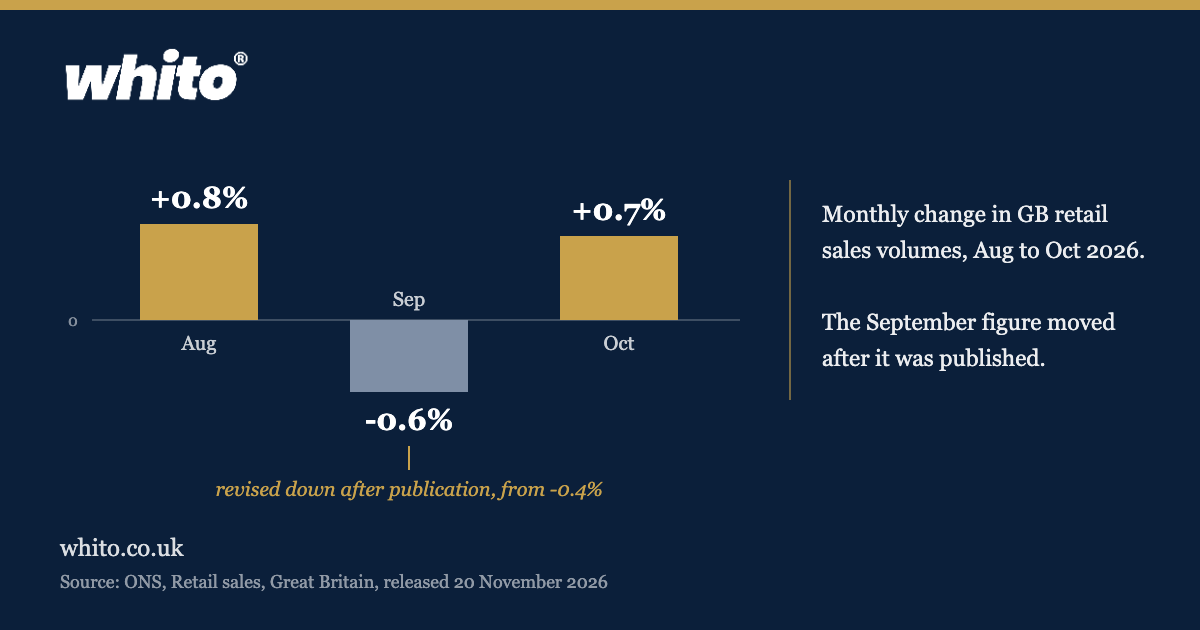
The Office for National Statistics published October’s retail figures this morning. Retail sales volumes rose 0.7% on the month. If you sell to the public, you will see that number repeated all day as proof that spending is coming back in time for Black Friday.
Read the detail and it is a different story. A good part of October’s rise came from people buying tinned goods and long-life milk because the government told them to.
What the figures actually say
ONS reports volumes up 0.7% in October 2026, after a fall of 0.6% in September. That September figure was revised down from the 0.4% fall first published. August was revised the other way, from a 0.7% rise to 0.8%. Across the three months to October, volumes rose 0.4% against the three months to July, and 1.7% against the same three months a year earlier.
Then comes the reason. Food store volumes rose because supermarkets reported an October uplift on emergency items such as UHT milk and tinned goods, following the launch of the government’s Be Ready campaign on 22 October 2026. Other non-food stores were helped by art galleries recovering from a quiet September, and by sports equipment, games and toy stores. Clothing rose, which retailers put down to people buying more per visit, new launches, and better stock after September shortages. Online clothing sellers said the more autumnal October weather supported sales. Automotive fuel volumes fell back to August levels as prices rose for a third month running.
So the month was carried by a stockpiling campaign, a weather correction, and a rebound in a few named categories. That is not the same as households deciding they feel better off.
The mistake most businesses make with this number
Owners treat the national retail index as a demand signal for their own business. It is not one. It is an average across every retailer in Great Britain, weighted by turnover, and in any single month it can be shifted by one unusual event in one category.
| What the headline says | What sat behind it |
|---|---|
| Sales volumes rose 0.7% in October | After a 0.6% fall in September, itself revised down from the 0.4% fall first reported |
| Food stores led the rise | Supermarkets reported an uplift on UHT milk and tinned goods after the Be Ready campaign launched on 22 October |
| Non-food stores up 1.1% on the month | Helped by art galleries recovering from a quiet September, plus sports equipment, games and toys |
| Clothing sales rose | Retailers cited more per visit, new launches and restocking after September shortages |
| Volumes up 2.3% on last October | Fuel volumes fell back to August levels as prices rose for a third consecutive month |
If you sell garden furniture, nothing in October’s rise tells you anything about your December. If you run a convenience shop, it tells you quite a lot, and it tells you the uplift was probably temporary, because a cupboard full of tins gets bought once. Which category you sit in matters more than the national direction, and the long view on that sits in our study of which high street shops and services have grown or shrunk since 2010.
The number that does matter
Online spending values rose 9.7% against October 2025. Total volumes rose 2.3%. Yet the share of all retail sales made online moved only from 29.1% in September to 29.2% in October.
Both of those are true at once because the money going through online channels is growing faster than online’s slice of the market. The practical read for a small business: online is not quietly swallowing the high street this quarter, but the spend per online customer is climbing. Being findable online earns its place because of basket size, not because the street is emptying.
Read the response rate before you quote the figure
ONS states the October survey response rate was 57.5% by returned forms, 1.8 percentage points below the average of the past 12 months, while those returns covered 93.8% of turnover in the sample, 5.8 points above average. In plain terms, fewer firms replied but the large ones did. The national headline holds up. Any read-across to one small category is thin.
That is the habit worth building whenever a figure lands. Find what it compares and who it counted, which is the same discipline behind the official numbers on UK business we keep updated. The September revision from a 0.4% fall to a 0.6% fall in a single month is the reminder: these figures move after publication.
What to do this week
A twenty minute check, before Black Friday pricing is locked:
- Pull your own October against your own September, in units sold, not revenue. Revenue hides a price rise.
- Split your October uplift, if you had one, into lines that get repurchased and lines that do not.
- Check your own fuel and delivery costs for the same three months. Rising input costs quietly eat a volume gain.
- Set December stock and discount depth from your own last four weeks, not from a national index.
The takeaway
A national average is a weather report, not a forecast for your street. October’s rise was real, and mostly explained by one government campaign and one change in the weather. Your December margin will be decided by your own costs and your own repeat customers, and on the cost side it is worth being clear on what actually moved for business costs in the Budget. Price your Black Friday against your own four weeks of sales. Leave the index to the economists.