Last Updated on August 25, 2026
This morning the Prime Minister confirmed it. The government plans to ban under-16s from social media, with rules they want passed before Christmas. The likes of TikTok, Instagram, YouTube, Facebook, Snapchat and X would be off limits to anyone under 16. Messaging apps like WhatsApp are not included.
Cue a lot of noise. Most of it is about parenting and politics. Very little of it is about what this means if you run a business that markets on these platforms. That is the part worth thinking about calmly.
What was actually announced
The government wants to restrict social media access for under-16s and is asking Ofcom to set out how platforms prove someone is over 16. Self-declared birthdays are out. The direction of travel is proper age checks, things like facial age estimation, digital ID or photo matching.
Nothing is law yet. The aim is to pass regulation before Christmas, which points to the rules landing around spring 2027. So this is a heads-up, not a fire alarm.
The mistake most owners will make
Two reactions are coming, and both are wrong.
The first is panic. Owners who assume their whole audience is about to vanish. For most UK businesses it will not. Unless you sell to teenagers, your buyers are adults, and adults keep their accounts.
The second is to shrug and ignore it. That is the bigger risk. Because the real lesson here is not about teenagers at all. It is about how much of your business sits on land you do not own.
Why this matters even if you do not sell to teenagers
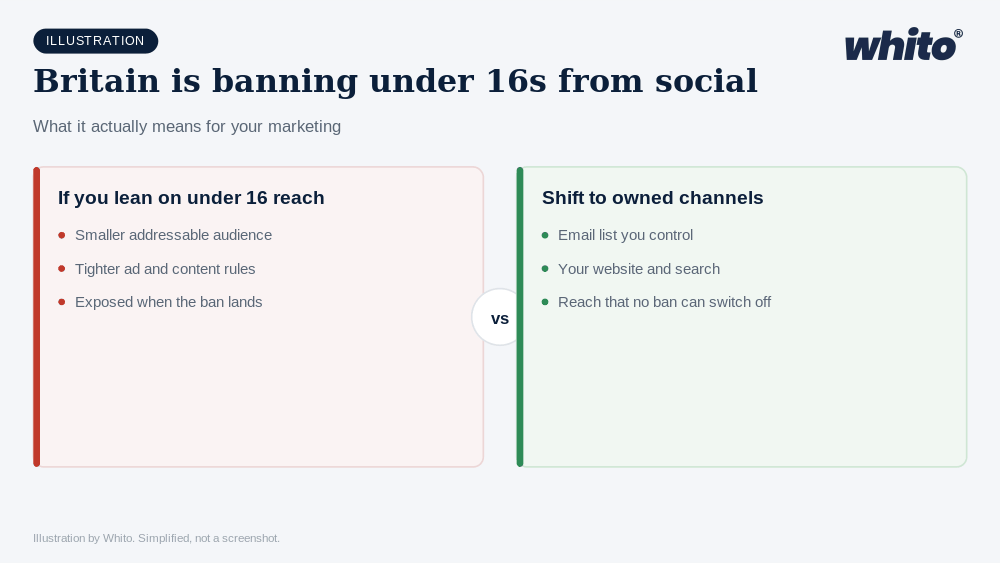
A ban this size changes the platforms themselves. Smaller audiences, tighter rules, age checks at sign-up, and more compliance cost for the networks. When platforms change, reach changes, ad prices move, and the algorithm you depend on shifts under your feet. You will not get a warning email when it does.
This is the quiet danger of building a business entirely on social. You are renting attention from a landlord who can change the rules overnight. A government can too, as today shows.
| Channel | Who controls it | What a ban or rule change does to it |
|---|---|---|
| Social media following | The platform | Reach and rules can change without notice |
| Paid social ads | The platform | Smaller audience can push costs up |
| Your email list | You | Unaffected. You still reach every subscriber |
| Your website | You | Unaffected. Your shop window stays open |
What to do about it
You do not need to quit social. It still works, and for many businesses it will keep working. The point is balance. Treat social as a way to reach people, not the only place you keep them.
Three practical moves, in order.
Start by owning a channel you control. Build an email list and point your social traffic towards it. If a platform changes overnight, your list does not. If you have been meaning to sort this out, our guide to the best email marketing platforms for UK businesses is the place to begin.
Then make your website do real work. Not a brochure that sits there, but a site that captures enquiries and sales on your terms. If yours is tired, see our pick of the best website builders for UK businesses.
Finally, watch where attention is moving. Search is changing at the same time, and the businesses that pay attention to both shifts will be the ones still standing. We covered the search side in what the new AI search data means for UK businesses.
The takeaway
The under-16 ban is not the end of social media marketing. It is a reminder that social was always rented. Spend the next few months turning rented reach into owned audience. Then whatever the platforms do next, your business keeps its own front door.