
Last Updated on October 15, 2026
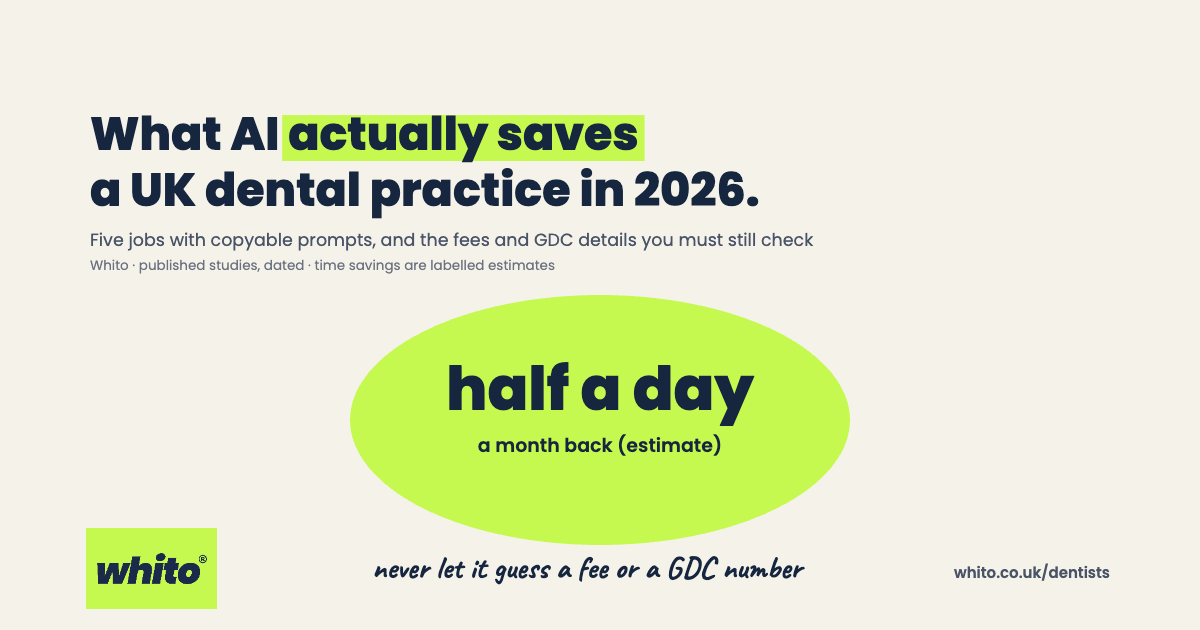
The short answer: AI takes a dental practice’s patient-facing writing from hours to minutes: treatment pages, fee explanations, review replies, recall and reminder messages. We estimate half a day a month back for the practice manager or principal who currently writes these, with the hours moving from writing to checking. The caveat: AI invents facts confidently, so your fees, your clinicians’ GDC numbers, your CQC details and every clinical claim get checked by a human, every time, and review replies never confirm who is or is not a patient.
Sources: every figure below comes from a published Whito study, with its date beside it. Time savings are Whito estimates, labelled as such. Last checked 15 October 2026.
What the measured numbers say
The engines already recommend dentists, and they do not check the register. ChatGPT, Gemini and Google AI Mode named 67 dental practices across six UK cities from one identical prompt on 27 September 2026. One answer in 18 pointed at the GDC register; the rest recommended on star ratings and review counts. Only 26 of the 67 practices could be traced from the name given to an active Companies House registration (AI dentist recommendations vs the GDC register). Asked the same question a month earlier, the engines named 59 practices and 66% appeared in one engine’s answers only: the recommendations are unstable, which means they are winnable.
On fees, dentistry publishes more than the trades but still leaves a gap: 83 of 120 practice websites read in October 2026 publish a private check-up fee, from £33 to £102 (UK Dentist Statistics). A practice with a clear, dated fee page is both easier to choose and easier for an engine to cite; across Whito’s citation study, 98% of AI answers rested on the business’s own website, its Google presence, or both.
For scale on costs: the published median for a small business website build is £520 one-off (Whito dataset, June 2026). Most of what this guide covers needs no new spend at all.
Five jobs to hand to AI this week
Each job has a prompt to copy, what to check before it goes live, and an estimated time saving. The estimates are ours, from drafting these tasks with AI; they are not a timed study.
1. Treatment pages in plain English
One page per treatment: examinations, hygiene, fillings, crowns, implants, whitening. Prompt: “Write a 300-word web page for a UK dental practice about [treatment]. Plain British English, short sentences, no hype and no clinical outcome promises. Explain what happens at the appointment and how long it takes, and leave clearly marked gaps for our own fee and our clinicians’ names. Do not invent fees, qualifications, GDC numbers or clinical claims.” Verify: a clinician reads it for accuracy, the fee is your current one, and nothing promises an outcome. Estimated saving: an hour per page.
2. The fee page
Prompt: “Turn this fee list into a clear patient-facing fee page: [your fees]. Group by category, state what each fee includes, add a line that fees were last reviewed on [date]. Do not add, round or estimate any figure.” Verify: every figure against your practice management system, NHS bands stated only if you hold an NHS contract, and the review date is real. Estimated saving: two hours, and 83 of 120 practices already publish a check-up fee, so silence now reads as evasion.
3. Review replies that respect confidentiality
Prompt: “Draft a reply to this Google review of a dental practice: [paste review]. Do not confirm or deny that the reviewer is a patient, include no clinical details, thank them, address the general point, and invite them to contact the practice directly. Three sentences maximum.” Verify: no acknowledgement of patient status, no treatment details, no admissions. This rule is absolute: confidentiality applies even when the reviewer has shared details themselves. Estimated saving: 10 minutes per reply.
4. FAQs and the schema behind them
Prompt: “Write six FAQs for a dental practice website covering registration, fees, emergencies, nervous patients, payment plans and parking, using these facts: [your facts]. Then output valid FAQPage JSON-LD for the same questions. Do not invent any detail I have not given you.” Verify: validator-check the JSON-LD, read every answer against your real policies, and list clinicians with their GDC numbers exactly as the register shows them. Estimated saving: two hours the first time.
5. Recall and reminder messages
Prompt: “Write five short message templates for a dental practice: appointment confirmation, 48-hour reminder, recall due, missed appointment follow-up, treatment plan follow-up. Under 50 words each, warm and plain, with [bracketed] gaps for name, date and time. No clinical details in any message.” Verify: no clinical information in any template, and gaps rather than example names or dates. Estimated saving: an hour once, then minutes weekly.
| Task | Without AI (typical) | With AI (draft plus your checks) |
|---|---|---|
| Treatment page | 1 to 2 hours, or not done | 10 to 15 minutes |
| Fee page | 2 to 3 hours, often outdated | 30 minutes |
| Review reply | 10 to 15 minutes, often skipped | 2 to 5 minutes |
| FAQ page with schema | 2 to 3 hours, usually never | 30 minutes |
| Message templates (set of five) | An hour, usually never | 10 minutes |
Times are Whito estimates, not a timed study.
What AI must never invent
Fees. Every figure a patient sees comes from your own fee list, dated. AI engines ran a median 14% above measured prices in Whito’s October 2026 accuracy check.
GDC numbers and titles. Each clinician listed exactly as the GDC register shows them. In Whito’s study, 17 of 18 AI answers never mentioned the register, so your site is where a patient actually verifies.
CQC and company details. Your CQC registration (in England) and your Companies House details, exact. Only 26 of 67 AI-recommended practices could be traced to an active registration from the name given.
Clinical claims. No outcome promises, no “painless”, no “permanent”, no invented statistics. A clinician signs off every treatment page.
Free fixes first
The same structural logic as Whito’s free Visibility Check:
1. Clinicians listed with GDC numbers matching the register.
2. Company number and registered name visible and matching Companies House; CQC registration stated.
3. A published, dated fee page. 83 of 120 practices publish a check-up fee; join them with a fuller list.
4. Structured data: Dentist or LocalBusiness schema with real name, address and contact, plus FAQPage.
5. Google Business Profile complete and current, with reviews replied to within confidentiality rules.
All five are free. Run the Visibility Check after, and keep the result as your dated baseline.
Next steps: Start, Build, Scale
Start: the free-fix list, then the five AI jobs above. £0 spent.
Build: a proper site if yours cannot carry a fee page and treatment pages (published median build £520, June 2026; see the dental practice website guide), then paid channels only once fees and pages are in place.
Scale: multi-site practices repeat the treatment-page and fee-page jobs per location, keep GDC and CQC details current on a schedule, and re-run the Visibility Check quarterly.
One limitation, stated plainly: the time savings here are Whito estimates from doing these tasks with AI, not measurements of working practices. The study figures around them are measured and dated.
Questions practices ask
Will AI engines recommend my practice?
They already recommend someone: 67 practices across six cities in one Whito test, unstably (66% of names appeared in one engine only a month earlier). The answers rest on your website and Google presence, so those are where the work goes.
Should we publish our private fees?
83 of 120 practices already publish a private check-up fee, £33 to £102 (October 2026). A dated fee page is easier for patients to trust and for engines to cite than silence.
Can AI reply to patient reviews?
It can draft replies, within one absolute rule: never confirm or deny that anyone is a patient and never include clinical details, even details the reviewer shared. A human checks every reply before it posts.
Figures on this page: Whito published studies, dated beside each figure. Estimates are labelled as estimates. Free to read. Nobody pays to appear.