Last Updated on September 17, 2026

You could be the best electrician in Birmingham and still not show up when someone searches “electrician near me.” That is not a skills problem. It is a visibility problem.
Local SEO is how Google decides which businesses to show when someone searches for a service in their area. It is a set of signals that tell Google you exist. No paid ads involved. No agency required, where you work, and whether people trust you.
For tradespeople, local SEO is the difference between getting calls from Google and getting nothing. Most of your competitors are not doing it. The ones who are getting steady work from Google have usually figured out a few of these things, whether they know the terminology or not.
What local SEO actually is
Local SEO is everything that helps your business appear in location-based searches. When someone types “roofer in Leeds” or “emergency plumber near me,” Google uses a combination of signals to decide which businesses to show.
Those signals fall into three areas: your Google Business Profile, your presence across the web (citations), and your website.
If you have already set up your Google Business Profile properly, you have handled the biggest piece. This post covers the other two.
The local map pack: what it is and why it matters
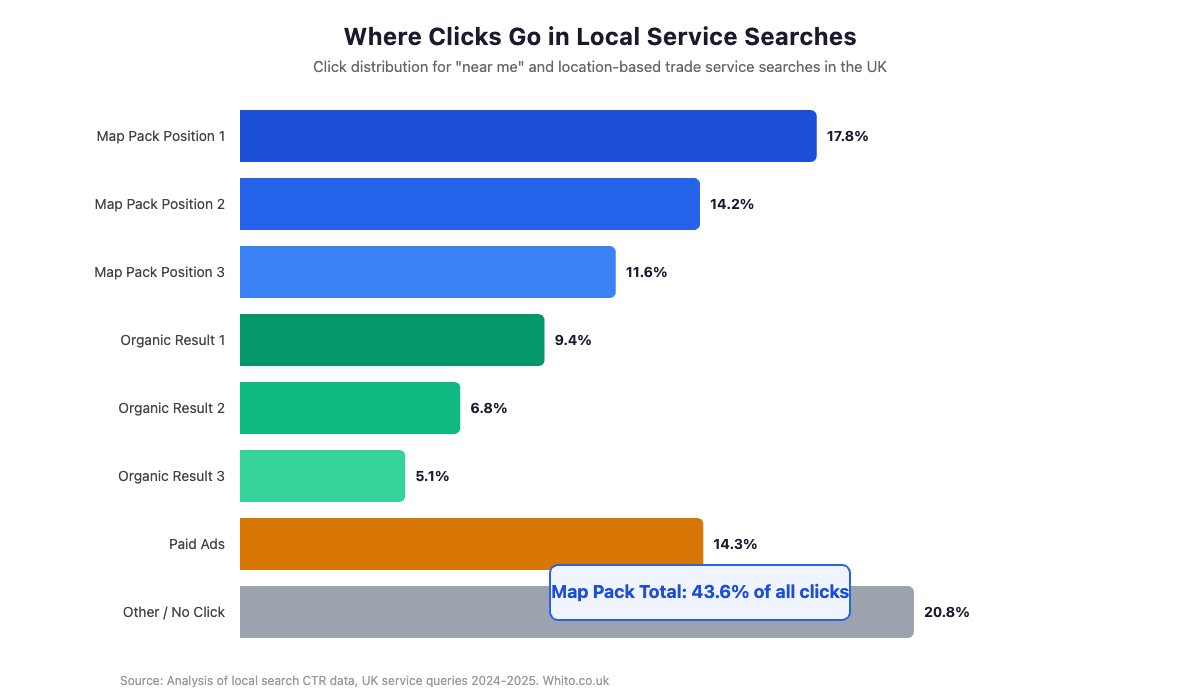
When someone searches for a local service, Google typically shows a map with three business listings above the normal search results. This is the local map pack, and it gets roughly 44% of all clicks for local searches.
Below the map pack are the organic results, regular website listings. These get clicks too, but significantly fewer for “near me” type searches.
For tradespeople, the map pack is where the work comes from. If you are not in those three spots for your key services and areas, you are invisible to most potential customers.
Citations: the UK directories that actually matter
A citation is any online mention of your business name, address, and phone number. Google uses these to verify that your business is real and to confirm your location.
Not all directories are equal. For UK trades businesses, these are the ones worth being listed on:
Tier 1 (do these first): Google Business Profile, Yell.com, Thomson Local, Bing Places, Apple Maps.
Tier 2 (trades-specific): Checkatrade, MyBuilder, Rated People, Bark, TrustATrader.
Tier 3 (general but helpful): FreeIndex, Cylex, Scoot, 192.com Business, TouchLocal.
You do not need to be on 50 directories. You need to be on the right 10-15 with consistent information. Being on fewer directories with accurate details beats being on dozens with mismatched information.
NAP consistency: the boring thing that breaks everything
NAP stands for Name, Address, Phone number. It needs to be identical everywhere your business appears online. Not similar. Identical.
“J Smith Plumbing” on Google, “John Smith Plumbing” on Yell, and “J. Smith Plumbing Services” on Checkatrade looks like three different businesses to Google. It dilutes your authority instead of building it.
Pick one version of your business name, one address format, and one phone number. Use exactly that everywhere. If you have moved or changed numbers, update every directory. This is tedious but it matters more than most things people spend money on.
Common mistakes: using a mobile number on some listings and a landline on others. Using “St” on one listing and “Street” on another. Having an old address on directories you forgot about.
Do an audit. Search your business name. Check every listing matches. Fix the ones that do not.
Your website: what Google needs to see
For local SEO, your website does not need to be fancy. It needs to be clear about three things: what you do, where you do it, and how to contact you.
Service pages. Have a separate page for each main service you offer. “Boiler installation” and “emergency plumbing” should be different pages, not a single “services” page that lists everything. Each page should mention the service and the areas you cover.
Location signals. Mention the towns and areas you serve naturally throughout your site. Your homepage, your about page, your service pages. Not stuffed in unnaturally, just present where it makes sense. “We provide electrical services across West Yorkshire, including Leeds, Bradford, Wakefield, and Huddersfield.”
Contact information. Your NAP should be on every page, ideally in the footer. Make your phone number clickable on mobile. Include a contact form. Make it obvious how to reach you.
Schema markup. This is code that tells Google exactly what type of business you are, where you are located, and what services you offer. It sounds technical but most WordPress SEO plugins (like AIOSEO or Rank Math) let you set this up without touching code. It is worth 15 minutes of setup.
Reviews and their SEO impact
Reviews are not just social proof. They are a direct ranking factor for local SEO. Businesses with more reviews, higher ratings, and recent review activity rank higher in the map pack.
Google has confirmed this. The quantity, velocity (how often you get new ones), and diversity of your reviews all influence your local ranking.
If you are not actively collecting reviews, read the guide on getting more Google reviews. It covers the system that makes review collection automatic rather than something you remember to do occasionally.
What to do about competitors who rank above you
If a competitor consistently ranks above you in the map pack, they are probably doing one or more of these things better:
They have more reviews. They have been listed longer. Their website mentions local areas more consistently. Their citations are cleaner. Their GBP profile is more complete.
None of these are things you cannot fix. They just take consistency over time. Local SEO is not a one-off project. It is a set of habits that compound month after month.
The bottom line
Local SEO for tradespeople comes down to three things: a complete Google Business Profile, consistent citations on the right directories, and a website that clearly states what you do and where.
None of this requires an agency. None of it requires a monthly retainer. It requires an afternoon of setup and then 30 minutes a week of maintenance.
Every month you are not doing it, the competitors who are doing it are pulling further ahead. The gap gets harder to close the longer you leave it.
Whether you are a plumber, electrician, builder, or roofer, this is the system that gets you found when people search for what you do, where you do it.
New to SEO entirely? Start with the beginner’s guide to business SEO for the full picture.