
Last Updated on September 28, 2026
The Whito stage check
Most UK small businesses add live chat and watch it waste staff time instead of making money
Here is the pitch every live chat company makes: customers who use chat spend 60% more per transaction, they are 2.8 times more likely to convert, and 41% of UK consumers now prefer chat over phone or email. Those numbers are real. They are also dangerously misleading.
Because here is what those statistics leave out. A live chat widget sitting unanswered on your website does not increase conversions. It decreases them. A chat window that pops up while someone is reading your pricing page and then shows “average response time: 4 hours” actively damages trust. A support team fielding chat messages alongside emails and phone calls does not get more productive. They get stretched thinner.
The businesses seeing those 20% conversion increases and 60% higher order values are not just “using live chat.” They have configured it as a sales tool, staffed it properly, and integrated it with their existing systems. Everyone else has a chat widget collecting dust in the bottom-right corner of their screen.
This guide compares every major live chat platform available to UK businesses in 2026, with real pricing in pounds, honest assessments of what each tool actually does well, and specific recommendations based on your business type, team size, and budget. No affiliate rankings. No “best overall” awards that happen to coincide with the highest commission.
The real numbers: What live chat actually does to revenue
Before choosing a platform, you need to understand what live chat can realistically deliver for your business, and where the marketing hype diverges from reality.
| Statistic | What It Actually Means |
|---|---|
| Live chat increases conversion rates by an average of 20% | Only when chat is actively managed with sub-30-second response times |
| Chat users are 2.8x more likely to convert | Self-selection bias: customers already closer to buying are more likely to initiate chat |
| Ecommerce brands see chat boosting conversions up to 70% | Best-case scenario for well-staffed ecommerce operations, not typical for service businesses |
| Customers who chat spend 60% more per order | Chat allows upselling and cross-selling in real time, but only if your team is trained to do it |
| Live chat earns 88% customer satisfaction rating | Highest of any digital support channel, but only when response times are fast |
| 48% increase in revenue per chat hour | Applies when chat is used as a sales channel, not just support |
| Consumers expect responses in under 30 seconds | Miss this window and satisfaction drops sharply. Slow chat is worse than no chat. |
| AI chatbots can handle up to 90% of routine queries | For FAQ-type questions. Complex issues still need humans. |
The critical takeaway: live chat works when it is fast, proactive, and treated as a sales channel. It fails when it is slow, reactive, and treated as another support burden for an already stretched team.
For a UK service business generating 500 website visits per month with a 3% conversion rate (15 customers), adding well-managed live chat could realistically push that to 3.6% (18 customers). If your average job value is £400, that is 3 extra customers per month, £1,200 in additional revenue, £14,400 per year. The maths works if the tool costs less than the revenue it generates.
The mistake: Treating live chat as support instead of sales
Live chat has two completely different purposes, and most UK businesses confuse them.
Support chat answers questions after problems appear. Delivery tracking, returns, technical issues, account queries. This is reactive. It reduces churn but does not directly generate new revenue.
Sales chat intercepts browsing visitors before they leave. It clarifies pricing confusion, overcomes purchase hesitation, recommends products based on what the visitor is looking at, and captures leads who would otherwise bounce. This is proactive. It directly generates revenue.
Most businesses install a chat widget, route it to whoever happens to be free, and treat every conversation as a support ticket. The result: their support team gets busier, response times get worse across all channels, and conversion rates do not move.
The fix is simple but requires discipline. Decide whether your primary use case is support or sales. If it is sales, configure proactive triggers (chat opens automatically on pricing pages, product pages, or after 30 seconds of inactivity). If it is support, configure it reactively (customer-initiated only, with clear expectations on response time). Mixing the two without a plan guarantees mediocre results in both.
The AI question: Do you need a chatbot, live chat, or both?
In 2026, the live chat market has split into three categories, and understanding this split is essential before you choose a platform.
Traditional live chat: A human answers every message. Best for high-value sales conversations where personalisation matters. Requires staff availability during business hours minimum.
AI chatbot: An automated system handles conversations using pre-built flows or AI language models. Best for FAQ deflection, after-hours coverage, and lead qualification. Does not require staff availability but cannot handle nuanced or emotional conversations.
Hybrid (AI + human handoff): AI handles initial contact, qualifies the visitor, answers simple questions, then routes complex issues to a human agent. This is where the market is moving in 2026, and it is the approach that delivers the best results for most businesses.
The UK-specific context matters here. AI chatbots powered by large language models (like Tidio’s Lyro, which runs on Anthropic’s Claude) can now index your website content within minutes and answer questions about your products, pricing, and services with remarkable accuracy. For a UK small business that cannot staff live chat during all business hours, this changes the equation entirely. You get 24/7 coverage, instant responses, and human handoff for the conversations that need it.
The Whito framework: Live chat by stage
Not every business needs the same approach. Here is how live chat fits into the Start, Build, Scale framework:
| Stage | What You Need | Tools | Monthly Cost |
|---|---|---|---|
| Start | Basic chat widget, manual responses, test whether chat works for your business | Tawk.to (free) or HubSpot free chat | £0 |
| Build | AI chatbot for FAQ handling, proactive triggers, CRM integration | Tidio or Crisp or LiveChat | £15 to £80/month |
| Scale | Multi-channel inbox, advanced AI agents, team routing, analytics | Intercom or Zendesk or LiveChat Team+ | £60 to £500+/month |
If you are in Start stage, do not pay for live chat software. Your job is to test whether your customers actually want to chat, and whether you can respond fast enough to make it worthwhile. Tawk.to is free with unlimited agents. Use it for 30 days. If your response time consistently stays under 60 seconds and you see conversations converting to enquiries, then invest in a paid tool.
Comparison table: Every major platform at a glance
| Platform | Starting Price | Best For | AI Chatbot | Standout Feature | Whito Stage |
|---|---|---|---|---|---|
| Tawk.to | Free (add-ons from £24/month) | Testing chat viability, budget-conscious businesses | AI Assist from £24/month | Completely free core product | Start |
| HubSpot Live Chat | Free (with free CRM) | Businesses already using HubSpot CRM | Basic chatbot builder included | Auto-logs to CRM, triggers workflows | Start to Build |
| Tidio | Free plan, paid from around £15/month | Ecommerce, small teams wanting AI | Lyro AI (from around £25/month) | Best AI chatbot for business (Claude-powered) | Build |
| Crisp | Free plan, paid from around £21/month | Multi-channel teams, per-workspace pricing | Built-in AI bot | Per-workspace pricing (not per-agent) | Build |
| Olark | around £24/agent/month | Simple, focused live chat needs | PowerUp add-ons available | Simplicity and automation rules | Build |
| LiveChat | From around £13/agent/month | Customer service teams, ecommerce | Separate ChatBot product | Leading chat interface | Build |
| Intercom | From around £23/seat/month (Essential, annual billing) | SaaS, tech companies, growing teams | Fin AI Agent (about 73p/resolution) | Most advanced AI agent platform | Scale |
| Zendesk | From around £16/agent/month (basic) | Enterprise support, complex ticketing | Advanced AI bots on higher tiers | Industry-leading ticketing system | Scale |
Individual platform reviews
1. Tawk.to: Best free option for testing chat viability
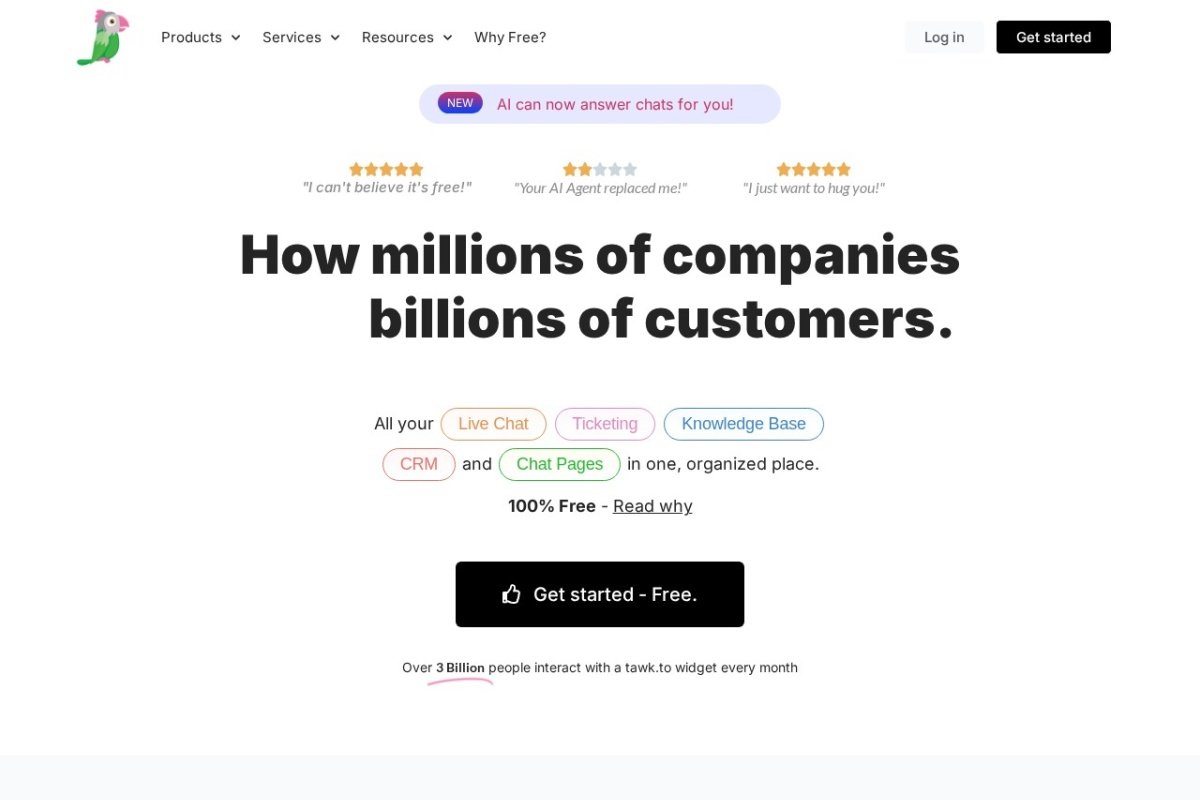
Price: Free forever. Unlimited agents, unlimited chat volume, unlimited sites. Paid add-ons: Remove branding (£24/month), AI Assist (from £24/month), Video/Voice/Screensharing (£24/month). Hired agents available from £0.80/hour.
Best for: Businesses testing whether live chat works before investing in paid tools
Whito stage: Start
Tawk.to is genuinely free, and not in the “free trial that expires” sense. The core product has no cap on agents, chat volume, or connected websites. You copy a line of JavaScript onto your site and you are live. This makes it the perfect tool for answering the most important question: do your customers actually want to chat?
Wht it does well:
- Completely free with no artificial limitations on core chat functionality
- Includes live chat, email ticketing, knowledge base builder, and basic CRM at zero cost
- Mobile apps for iOS and Android let you respond on the move
- Visitor monitoring shows who is on your site, what pages they are viewing, and how long they have been browsing
- Canned responses and shortcuts speed up common replies
- Hired agents (from £0.80/hour) let you outsource chat staffing if you cannot manage it in-house
What it cannot do:
- The interface feels dated compared to modern competitors. It works, but it does not impress.
- AI capabilities require a paid add-on (£24/month) and are basic compared to Tidio’s Lyro or Intercom’s Fin
- No native ecommerce integrations (Shopify, WooCommerce) without third-party workarounds
- Branding removal costs £24/month, which feels steep for something most paid tools include by default
- Reporting and analytics are limited on the free plan
The honest take: Tawk.to is not the best live chat software. It is the best way to find out if you need live chat software. Use it for 30 days. Track response times, conversation volume, and whether chat conversations convert to paying customers. If the answer is yes, upgrade to Tidio or LiveChat. If the answer is no, you have spent nothing finding out.
Recommended business types: Any business that has not used live chat before. Sole traders, tradespeople, local service businesses testing the waters.
2. HubSpot live chat: Best free option with CRM integration
Price: Free forever as part of HubSpot Free CRM. Paid Service Hub plans start from £15/month for additional features.
Best for: Businesses already using HubSpot, or wanting chat that automatically feeds a CRM
Whito stage: Start to Build
HubSpot’s live chat is free and connects directly to their free CRM. Every chat conversation automatically creates or updates a contact record, logs the conversation history, and can trigger follow-up workflows. If your sales process depends on knowing who visited what page before they chatted, HubSpot does this out of the box.
What it does well:
- Every chat conversation auto-logs into HubSpot CRM with full contact history
- Basic chatbot builder lets you create qualification flows without coding
- Chat routing based on team availability, page visited, or contact properties
- Integrates with HubSpot’s email marketing, so chat leads enter nurture sequences automatically
- Conversations appear in a universal inbox alongside email and form submissions
What it cannot do:
- The free chat widget is functional but basic. Advanced customisation requires paid plans.
- AI capabilities are limited compared to dedicated chat platforms like Tidio or Intercom
- If you are not using HubSpot CRM, the main advantage (auto-logging) disappears
- HubSpot’s paid plans escalate quickly. Service Hub Starter is £15/month, but Professional jumps to £90+/month.
- Chat widget branding on the free plan
The honest take: HubSpot Live Chat is the right choice if you are already in the HubSpot ecosystem or planning to adopt it. The CRM integration is the genuine differentiator, not the chat features themselves. If you use a different CRM (Monday.com, Pipedrive, Salesforce), HubSpot’s chat offers no meaningful advantage over Tawk.to or Tidio’s free plans.
Recommended business types: B2B service businesses, consultancies, agencies, professional services firms. Businesses where lead tracking and CRM data matter more than real-time ecommerce conversion.
3. Tidio: Best AI chatbot for businesses
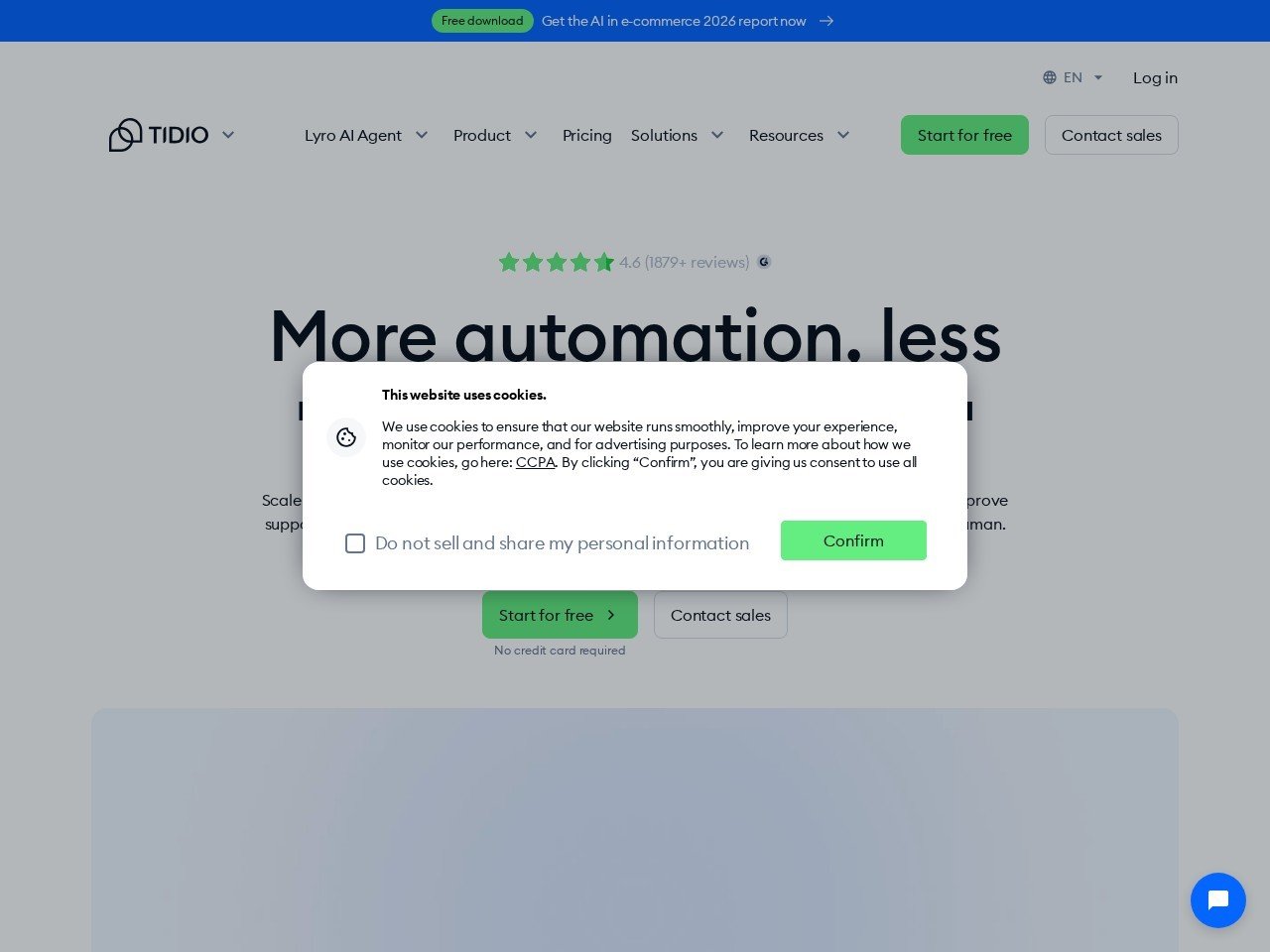
Price: Free plan available (50 live chat conversations/month). Customer Service plan from around £15/month. Lyro AI from around £25/month (included conversations vary by plan). Tidio Plus from around £590/month.
Best for: Ecommerce businesses, small teams wanting AI-powered chat without enterprise pricing
Whito stage: Build
Tidio wins the “best for business” category in 2026 because of Lyro, its AI agent powered by Anthropic’s Claude. Point Lyro at your website URL or upload your support documents, and within minutes it can answer customer questions about your products, pricing, shipping, and policies with genuine accuracy. For a UK business that cannot staff live chat during all working hours, Lyro handles the gap.
What it does well:
- Lyro AI agent indexes your website content automatically and answers questions in natural language
- Shopify and WooCommerce integrations are tight, showing order status, product info, and cart contents in the chat window
- Visual chatbot builder lets you create automated flows without coding (abandoned cart recovery, lead qualification, FAQ routing)
- Proactive chat triggers based on page visited, time on site, scroll depth, and exit intent
- Multi-channel: live chat, email, Instagram, Messenger, and WhatsApp from one dashboard
- Free plan includes 50 live chat conversations per month, enough to test viability
- A typical business pays £55 to £125/month for Tidio plus Lyro combined
What it cannot do:
- The free plan’s 50-conversation limit is restrictive for busier sites
- Lyro AI costs extra on top of the base chat plan, and per-conversation pricing can add up
- The number of features can feel overwhelming for businesses that just want basic chat
- Customer service plan pricing increases with operator count
- Not ideal for complex B2B sales cycles where conversations span multiple sessions over weeks
The honest take: Tidio is the standout choice for UK ecommerce businesses and small service teams in 2026. Lyro AI genuinely changes what a small team can achieve: 24/7 coverage, instant responses to common questions, and human handoff when the conversation needs personal attention. The pricing is fair for what you get. If you run a Shopify or WooCommerce store and want chat that does more than sit in the corner, Tidio should be your first serious consideration.
Recommended business types: Shopify and WooCommerce stores, D2C brands, small ecommerce retailers, service businesses with high website traffic, any business wanting AI chat without enterprise pricing.
4. Crisp: Best per-workspace pricing for growing teams
Price: Free plan for basic chat (2 seats). Pro from around £21/month per workspace. Unlimited from around £83/month per workspace. All plans are per-workspace, not per-agent.
Best for: Teams that will grow and want predictable costs regardless of headcount
Whito stage: Build
Crisp’s pricing model is its killer feature: you pay per workspace, not per agent. Every other platform on this list charges per seat, which means your costs scale linearly as your team grows. With Crisp, you add team members without increasing your bill. For a growing business adding its third, fourth, and fifth support person, this saves hundreds per month.
What it does well:
- Per-workspace pricing means unlimited agents at a flat monthly rate
- Multi-channel inbox combines live chat, email, Instagram, WhatsApp, and Telegram
- Built-in AI chatbot handles routine queries with knowledge base integration
- Co-browsing feature lets agents see exactly what the visitor sees on screen
- Video calls directly from the chat widget (no external tools needed)
- Clean, modern interface that both agents and customers enjoy using
What it cannot do:
- AI capabilities are competent but not as advanced as Tidio’s Lyro or Intercom’s Fin
- Ecommerce integrations (Shopify, WooCommerce) are functional but not as deep as Tidio’s
- The free plan is very limited (2 seats, basic features)
- Fewer automation options than dedicated platforms like Intercom
- Reporting is adequate but not enterprise-grade
The honest take: If you are building a team and want to avoid the “per-agent pricing trap” where costs balloon as you hire, Crisp is the smart choice. The Unlimited plan at around £83/month gives you every feature for every team member, forever. Compare that to LiveChat at £15-39/agent/month or Intercom at £23/seat on annual billing, and for a team of 5+, Crisp is significantly cheaper. The trade-off is less sophisticated AI and fewer ecommerce-specific features. If those matter more than pricing predictability, look at Tidio or LiveChat instead.
Recommended business types: Growing service businesses, agencies, SaaS companies, any business with 3+ team members handling customer conversations.
5. Olark: Best for simple, focused live chat
Price: Standard plan at around £24/agent/month. Pro plan with custom pricing. PowerUp add-ons (co-browsing, visitor insights, translations) at £24 to £82/month each. 21% discount for annual, 35% for 2-year billing.
Best for: Businesses that want straightforward live chat without complexity
Whito stage: Build
Olark does one thing well: live chat. It does not try to be an omnichannel platform, a CRM, or an AI chatbot. It gives you a chat widget, automation rules, and analytics. If “simple and effective” is what you want, Olark delivers.
What it does well:
- Clean, focused interface without feature bloat
- Automation rules trigger chat based on visitor behaviour (page views, time on site, referral source)
- Real-time visitor analytics show who is on your site and what they are doing
- Transcript search makes it easy to find past conversations
- Integrations with Salesforce, HubSpot, Slack, and major helpdesk tools
- WCAG 2.1 AA accessible chat widget, which matters for UK Equality Act compliance
What it cannot do:
- No built-in AI chatbot. You need human agents for every conversation.
- No multi-channel inbox (no email, no social media, no WhatsApp integration)
- PowerUp add-ons increase costs quickly. Co-browsing, visitor insights, and translation each add £24 to £82/month.
- Per-agent pricing means costs scale with team size
- No native ecommerce integrations
The honest take: Olark is for businesses that want live chat and nothing else. It does not try to be everything, which is both its strength and limitation. If your use case is “I want a chat widget on my website where a real person answers questions during business hours,” Olark does that reliably and affordably. If you want AI, multi-channel support, or ecommerce features, look elsewhere.
Recommended business types: Professional services firms, B2B companies, any business where human conversation quality matters more than automation volume.
6. LiveChat: Best chat interface and agent experience
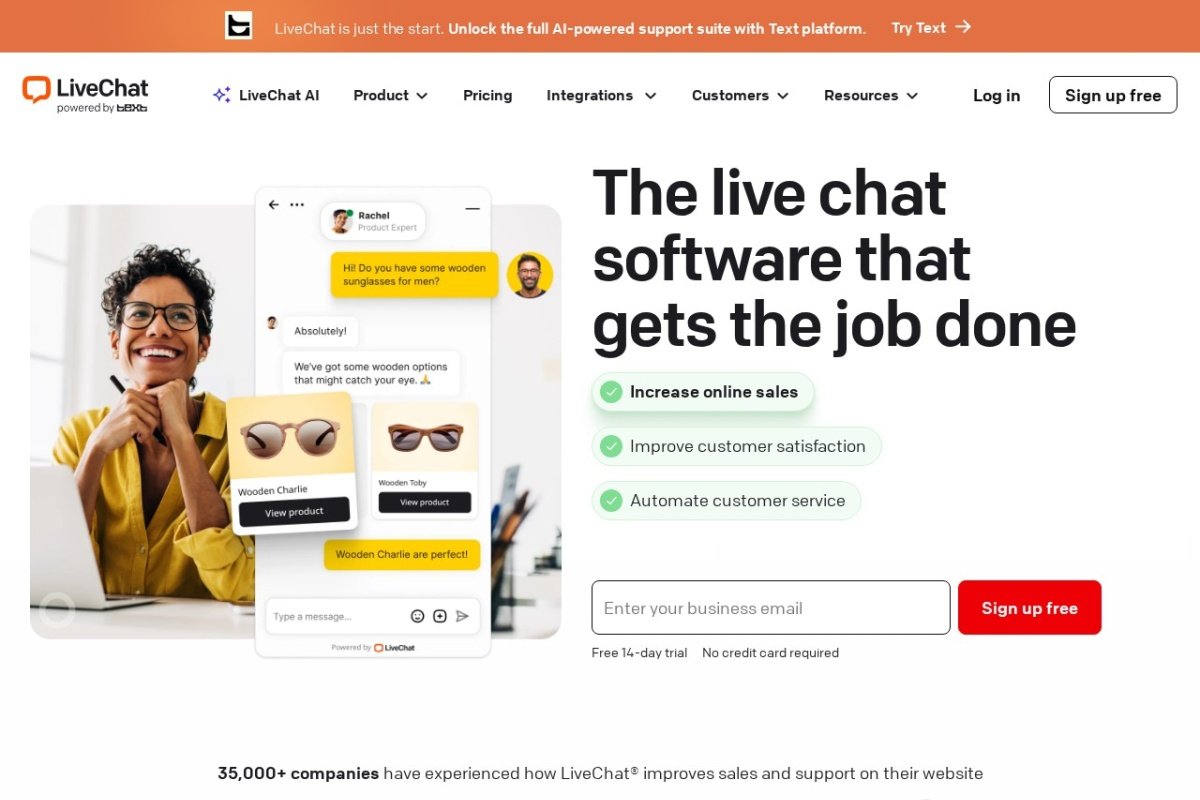
Price: Starter from around £13/agent/month. Team from around £39/agent/month. Business from around £62/agent/month. Enterprise custom pricing.
Best for: Customer service teams that want the best chat experience for both agents and customers
Whito stage: Build
LiveChat has been in the market since 2002, and it shows in the best possible way. The agent interface is polished, fast, and intuitive. Chat routing, tagging, and reporting are mature features that work reliably. If your primary concern is the quality of the chat experience itself, LiveChat sets the standard.
What it does well:
- Leading agent interface. Fast, intuitive, and designed for high-volume conversation handling.
- Sneak peek shows what visitors are typing before they send, giving agents time to prepare responses
- Complete reporting: agent performance, customer satisfaction, chat tags, response times
- Integrates with 200+ tools including Shopify, WordPress, Salesforce, and HubSpot
- Multi-channel: combines chat, email, SMS, Apple Messages, and social media into one inbox
- Separate ChatBot product (additional cost) for AI automation
What it cannot do:
- AI chatbot is a separate product (ChatBot) with its own pricing, unlike Tidio where it is integrated
- Per-agent pricing means costs scale linearly. A team of 5 on the Team plan costs around £170/month.
- Starter plan has limited features (60-day chat history, basic reporting, 1 automated greeting)
- The product ecosystem is split across LiveChat, ChatBot, HelpDesk, and KnowledgeBase, each with separate billing
The honest take: LiveChat is the choice for businesses where chat volume is high enough to justify dedicated agents. The interface genuinely makes agents more efficient, and the reporting helps you measure ROI properly. But the ecosystem fragmentation is frustrating. You might end up paying for LiveChat plus ChatBot plus HelpDesk plus KnowledgeBase, and the combined cost rivals Intercom. For smaller teams, Tidio or Crisp offers a more integrated experience at lower total cost.
Recommended business types: Ecommerce businesses with dedicated support teams, customer service departments, any operation handling 50+ chat conversations per day.
7. Intercom: Best AI-first platform for growing companies
Price: Essential from around £23/seat/month on annual billing. Advanced around £67/seat/month. Expert around £104/seat/month. Fin AI Agent billed at £0.82 per resolution.
Best for: SaaS companies, tech startups, growing businesses with dedicated support teams
Whito stage: Scale
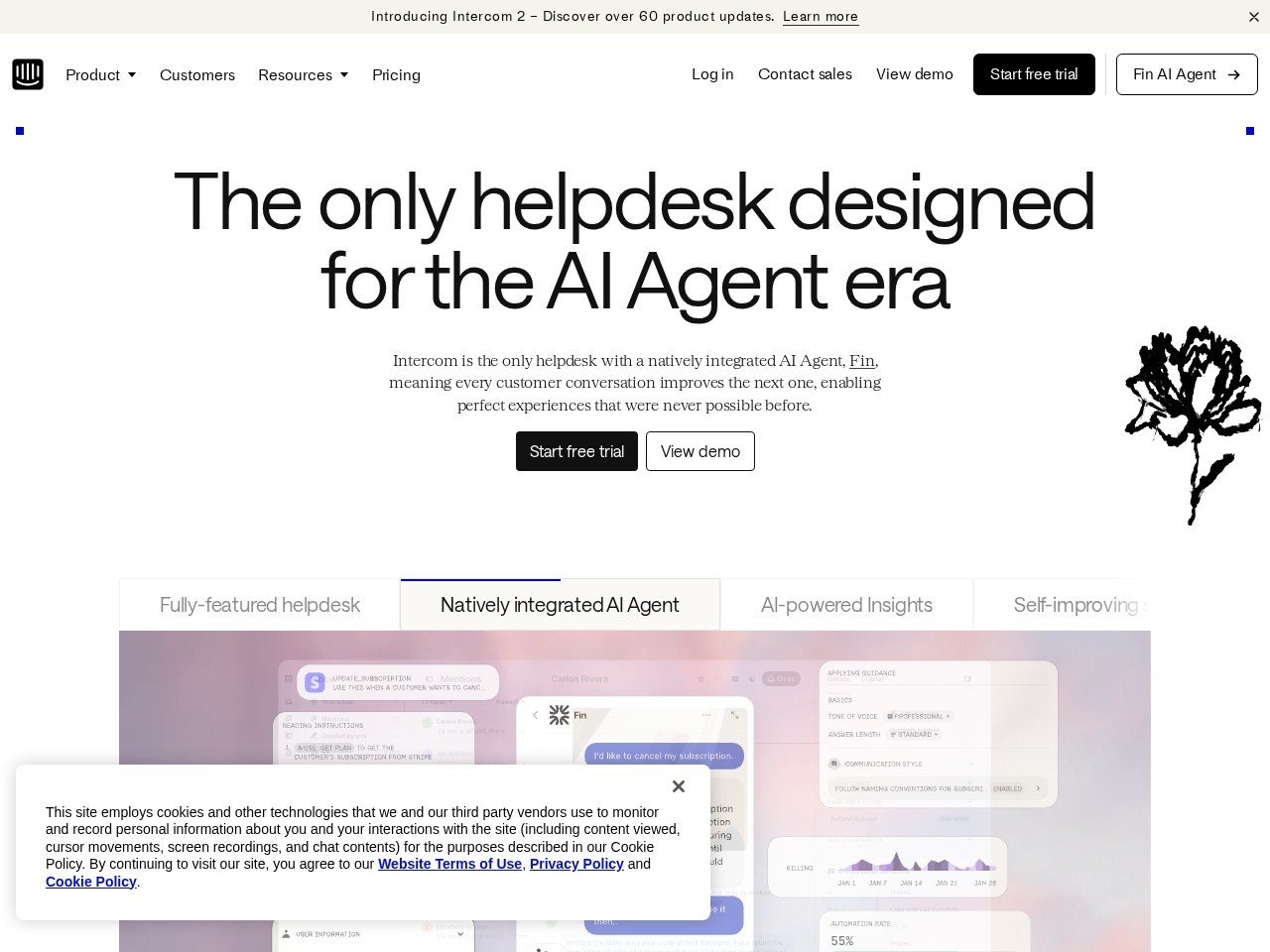
Intercom has positioned itself as “the helpdesk designed for the AI agent era,” and Fin, their AI agent, backs that claim up. Fin can resolve customer issues autonomously, not just deflect them to a human. It reads your help documentation, understands context from previous conversations, and can take actions (process refunds, update orders, check account status) without human intervention.
What it does well:
- Fin AI Agent is the most advanced customer service AI available to mid-size businesses
- Pay-per-resolution pricing (£0.82/resolution) means you only pay for AI when it actually solves a problem
- Product tours, in-app messaging, and onboarding flows for SaaS companies
- Advanced customer segmentation and targeting based on behaviour, plan type, and custom attributes
- Multi-channel: chat, email, SMS, WhatsApp, social media, in-app messaging
- Complete analytics and reporting across all channels
What it cannot do:
- Starting at about £23/seat/month on annual billing, with AI fees on top,, it is expensive for businesses. A 3-person team costs around £70/month on annual billing before AI costs.
- Fin AI resolution costs add up at scale. 1,000 resolutions/month adds £820 to your bill.
- The platform is complex. Expect a meaningful onboarding period before your team is productive.
- Overkill for simple chat needs. If you just want a “talk to us” button, you do not need Intercom.
- Per-seat pricing with AI resolution costs means budgeting is unpredictable
The honest take: Intercom is the future of customer service platforms, and Fin AI is genuinely impressive. But it is built for tech companies, SaaS businesses, and growing operations with enough volume to justify the investment. For a UK tradesperson, local service business, or small ecommerce store, Intercom is wildly over-specified and over-priced. You are paying for capabilities you will not use for years. Start with Tidio or LiveChat and migrate to Intercom when your customer service operation genuinely demands it.
Recommended business types: SaaS companies, tech startups, B2B platforms, subscription businesses, any company with 500+ customer conversations per month.
8. Zendesk: Best enterprise support platform
Price: Support Team from around £16/agent/month (email and social only, no chat). Suite Team from around £46/agent/month (includes chat). Suite Professional from around £96/agent/month. Suite Enterprise custom pricing.
Best for: Established businesses with complex support operations and existing ticketing needs
Whito stage: Scale
Zendesk is the industry standard for customer support ticketing. Their live chat is competent, but it is not the reason you choose Zendesk. You choose Zendesk when your support operation has outgrown simpler tools and you need proper ticketing, SLA management, multi-department routing, and enterprise-grade reporting.
What it does well:
- Industry-leading ticketing system with SLA management and escalation rules
- Multi-channel support: chat, email, phone, social media, and self-service portal
- Advanced routing rules based on skill, language, priority, and custom criteria
- Complete reporting and analytics for measuring team performance
- 1,500+ marketplace integrations
- AI-powered bots on higher-tier plans
What it cannot do:
- Live chat is not available on the cheapest plan (Support Team at £16/agent). You need Suite Team at £46/agent minimum.
- For a small 5-agent team, the real cost is £480 to £690/month including AI features
- The platform is complex and built for enterprises. Setup and customisation require significant time investment.
- Overkill for businesses handling fewer than 100 support conversations per month
- AI features are locked behind higher-tier plans
The honest take: Zendesk is for businesses that have already tried simpler tools and hit the ceiling. If you have a support team of 5+, handle hundreds of tickets monthly across multiple channels, and need proper SLA tracking, Zendesk is worth the investment. For everyone else, it is an expensive way to add a chat widget. Start with Tidio, LiveChat, or Crisp and only consider Zendesk when your support operation genuinely requires enterprise-grade ticketing.
Recommended business types: Established ecommerce businesses, SaaS companies with dedicated support teams, any business with 5+ support agents and complex routing needs.
Decision Flowchart: Which platform do you actually need?
Step 1: Have you ever used live chat before?
No → Start with Tawk.to (free) for 30 days. Test whether your customers use it and whether you can respond fast enough.
Step 2: Do you already use a CRM?
HubSpot → HubSpot Live Chat (free with CRM). The integration is the value.
Other CRM or no CRM → Continue to Step 3.
Step 3: What type of business are you?
Ecommerce (Shopify/WooCommerce) → Tidio (from £15/month) for AI + ecommerce integration
Service business wanting AI coverage → Tidio with Lyro AI (from £40/month combined)
Growing team (3+ agents) → Crisp (from £21/month per workspace, unlimited agents)
Simple human-only chat → Olark (from £24/agent/month) or LiveChat (from £13/agent/month)
Step 4: What is your monthly budget?
£0 → Tawk.to or HubSpot free chat
Under £50/month → Tidio free/starter or Crisp Mini
£50 to £150/month → Tidio with Lyro AI or LiveChat Team plan
£150 to £500/month → Intercom Essential or Zendesk Suite Team
£500+/month → Intercom Advanced or Zendesk Suite Professional
8 Live chat mistakes costing UK businesses money
- Installing chat and not staffing it. An “offline” chat widget is worse than no chat widget. Visitors see you offer chat, try to use it, and discover nobody is there. That is a broken promise. Either staff it during business hours or use AI to handle after-hours conversations.
- Slow response times. Consumers expect a response in under 30 seconds. If your average response time is 5 minutes, you are losing conversations to competitors who respond in 15 seconds. Track this metric religiously.
- Using chat for support when it should be sales. If your chat conversations are all “where is my order?” instead of “help me choose the right product,” you have a support tool, not a sales tool. Configure proactive triggers on high-intent pages (pricing, product, checkout) to flip this.
- No proactive chat triggers. Waiting for visitors to initiate chat misses the majority of the opportunity. Set up triggers: chat opens on pricing pages after 20 seconds, on checkout pages if the cart has been idle for 60 seconds, on high-bounce pages before the visitor leaves.
- Not integrating with your CRM. Every chat conversation should create or update a contact record. If your chat conversations disappear when the window closes, you are losing valuable lead data. Connect chat to your CRM or use a platform with built-in CRM (HubSpot, Tidio).
- Paying per agent when you should pay per workspace. If you have 4+ team members, per-agent pricing adds up fast. LiveChat at £39/agent for 5 agents is £170/month. Crisp Plus at £83/month covers your entire team. Do the maths before choosing.
- Ignoring mobile. Over 60% of UK web traffic is mobile. If your chat widget is clunky on mobile, covers the entire screen, or is difficult to type in, you are ruining the experience for the majority of your visitors. Test your chat widget on multiple phones before going live.
- Not measuring ROI. If you cannot answer “how many sales did live chat generate this month?” you are running chat on faith, not data. Track chat-assisted conversions, compare conversion rates for visitors who chat versus those who do not, and calculate cost per chat-sourced customer.
Live chat by business type: Specific recommendations
Tradespeople (plumbers, builders, electricians)
Start: Tawk.to (free). Test whether website visitors actually use chat. Most trade customers prefer calling directly.
Build: If chat converts, upgrade to Tidio with Lyro AI for after-hours lead capture. Most trade enquiries come evenings and weekends when you are on a job.
Skip: LiveChat, Intercom, Zendesk. Over-specified for trade businesses. Your phone is still your primary sales tool.
Local service businesses (cleaners, pest control, Locksmiths)
Start: Tawk.to or HubSpot free chat. Use proactive triggers on your services pages.
Build: Tidio (from £15/month) with automated lead qualification. “What service do you need? What area? When?” should be handled by a bot before a human picks up.
Skip: Anything over £100/month unless you are handling 100+ conversations per month.
Ecommerce (Shopify, WooCommerce, online retail)
Start: Tidio free plan to test conversion impact with 50 conversations/month.
Build: Tidio with Lyro AI (£55 to £125/month). The Shopify/WooCommerce integration showing cart contents and order status in the chat window is the genuine differentiator.
Scale: LiveChat Team plan (£39/agent) for high-volume operations, or Intercom if you have a dedicated support team.
Skip: Olark (no ecommerce integration). Zendesk (overkill unless you have 5+ agents).
Professional services (accountants, solicitors, consultants)
Start: HubSpot free chat with CRM. Every conversation creates a lead record automatically.
Build: Olark (£24/agent) if you want simple, human-only chat. Crisp (£38/workspace, billed in euros) if your team is growing.
Skip: AI chatbots for initial client conversations. Professional services clients expect to speak to a human. Use AI for FAQ and scheduling only.
SaaS and tech companies
Start: Intercom Essential (£62/seat) from day one. The product tours, in-app messaging, and Fin AI are designed for SaaS.
Build: Intercom Advanced (£142/seat) when you need custom bots, advanced reporting, and team performance metrics.
Scale: Zendesk when you need enterprise ticketing, SLA management, and multi-department routing.
Skip: Tawk.to, Olark. Too basic for SaaS customer success workflows.
Hospitality (hotels, restaurants, B&Bs)
Start: Tawk.to (free) for handling booking enquiries. Set up canned responses for “what are your check-in times?” and “do you have availability?”
Build: Tidio with AI to handle common booking questions 24/7. Hospitality enquiries peak outside business hours (evenings, weekends).
Skip: LiveChat per-agent pricing. Hospitality businesses need coverage across many hours but low conversation volume, so per-workspace (Crisp) or AI-first (Tidio) makes more financial sense.
How to measure whether live chat is working
- Chat-to-conversion rate: What percentage of chat conversations result in a sale or enquiry? Healthy benchmarks are 10 to 20% for sales chat, 60 to 80% resolution rate for support chat.
- First response time: How quickly does a visitor get their first response? Target under 30 seconds for human agents, under 5 seconds for AI. Anything over 60 seconds is losing you conversations.
- Chat volume trend: Is chat usage increasing month over month? If not, your chat widget may be poorly positioned, your triggers may not be firing, or your customers simply prefer other channels.
- Revenue attribution: Compare conversion rates for visitors who chatted versus those who did not. If chat users convert at 8% and non-chat users at 3%, your chat is contributing directly to revenue.
- Cost per chat-sourced customer: Divide your total chat costs (software plus staff time) by the number of customers sourced through chat. If this number exceeds your customer acquisition cost from other channels, chat is not pulling its weight.
- Customer satisfaction (CSAT): Most chat platforms include a post-chat rating. Track this weekly. A drop in satisfaction usually means response times are slipping or agent quality is inconsistent.
The UK reality check
| Tawk.to | HubSpot chat | Tidio | LiveChat | Intercom | |
|---|---|---|---|---|---|
| Billed in | Free (paid extras USD) | GBP | USD | USD | USD |
| VAT | n/a | Add 20% | Add 20% | Add 20% | Add 20% |
| Entry price today | Free | Free, Starter £15 | Starter about £23 | Starter about £15 | Essential about £23 per seat, annual |
| AI pricing | Hired agents from about 80p an hour | Included basics | Lyro about £31 a month extra | Add-on | Fin at about 82p per resolution |
| Trap to know | You get what you pay for on support | Free plan brands the widget | Top tier jumped to hundreds a month | Monthly billing costs about 25% more | Per-resolution AI fees stack on seat fees |
Live chat cost for your team
| Plan | Per agent | Monthly inc VAT | Year one inc VAT |
|---|---|---|---|
| Tawk.to | £0 | £0 | £0 |
| LiveChat Starter | £15 | £ | £ |
| Tidio Starter | £23 | £ | £ |
| Intercom Essential | £23 | £ | £ |
Live chat questions UK businesses actually ask
Is free live chat good enough?
Why did Intercom get so much cheaper than people say?
What is the real cost of AI chat answers?
Do these tools bill in pounds?
Will chat actually get me more enquiries?
The bottom line
Live chat works when it is fast, staffed, and configured for the right purpose. It fails when it is slow, unstaffed, and treated as an afterthought bolted onto a website that already has contact forms nobody fills in.
For most UK businesses, the right path is: test with Tawk.to for free, validate that your customers actually use chat, then invest in Tidio (for AI and ecommerce) or Crisp (for growing teams) when you have data proving chat converts. Do not start with Intercom or Zendesk unless you are already running a support operation that needs enterprise features.
The businesses making money from live chat in 2026 are not the ones with the fanciest widget. They are the ones who answer in under 30 seconds, use AI to handle the repetitive questions, and treat every chat as a potential sale rather than an interruption.
Structure before scale. Test before you invest. Measure before you expand.
Not sure if live chat is right for your business? Take the Whito Visibility Check and we will show you where your website is losing customers, and what to fix first.
Related guides:
- Conversion Optimisation for UK Businesses
- Best Website Builders for UK Businesses
- Best Reputation Management Tools for UK Businesses
- Best Analytics Tools for UK Businesses
- UK Marketing Research and Data
See how real UK businesses do this well
Our Stolen With Pride series breaks down smart marketing moves from real UK businesses. No theory, just practical ideas you can use. See how Surreal Cereal turned LinkedIn into a free marketing channel, how Bloom & Wild’s email opt-out built more loyalty than any campaign, and more.
Pricing reviewed June 2026. Tools change their prices often, so always confirm the current figure on the vendor site before you buy.
Frequently asked questions
Which live chat software is best for a UK business?
For a small team the priority is a tidy inbox and a chat widget that works on mobile, not a sprawling helpdesk. Tools that bundle chat with a shared inbox and basic automation suit most small sites. The best one is the tool your team can answer from quickly, because slow replies defeat the point of live chat.
Is the free version of live chat enough?
Free tiers are often fine for a single site with one or two people answering. You usually pay once you need multiple agents, chat history, or chatbots for out-of-hours cover. Begin free, and upgrade when you are missing genuine sales because nobody is at the keyboard.
What happens to live chat outside business hours?
Most tools let you switch to a contact form or a simple bot when you are offline, so enquiries are captured rather than lost. Set clear hours so visitors know when to expect a reply. Be honest about availability; a bot pretending to be a person frustrates customers fast.
How much should I expect to pay for live chat software?
Paid plans are typically per agent per month, starting from around a small per-seat fee. Costs climb with chatbots, automation, and integrations into your CRM. For a small team the spend is modest, so judge it against the value of the conversations you would otherwise miss.