Last Updated on October 19, 2026
Most owners read a story about Wayfair being fined and file it under “big company problem”. That is the mistake.
On 14 October the CMA fined three businesses £6 million between them for misleading sales tactics. One was Wayfair. One was a gym franchise running four sites in London.
The gym was fined £45,000 because a mandatory joining fee was not included in the total price shown for its annual and Direct Debit memberships, or was not shown clearly.
That is not a corporate compliance failure. That is a pricing page.
What the CMA actually fined
All three admitted breaking the law and settled early, which earned each of them a 40% reduction on the fine. These are the reduced figures.
| Business | Fine | What the CMA found |
|---|---|---|
| Wayfair | £4.8m | “Daily Deals” and 24-hour “Flash Deals” with countdown timers. Many products stayed at the same price, or a lower one, after the deadline passed. |
| Appliances Direct | £1.2m | Customers automatically opted into paid extras, old appliance removal and installation on delivery. Pop-up banners advertised £10 to £25 discounts as time-limited while the same codes recurred over many days. About £432,000 in refunds ordered, averaging £25 per customer. |
| Gold’s Gym (UK) | £45,000 | Joining fee left out of the total membership price, or shown unclearly. £9,220 refunded to 726 members, at £50 or £10 each depending on membership type. |
These are the tactics you were sold as best practice
Countdown timers. “Limited time” pop-ups. Pre-ticked add-ons at checkout. Every funnel course and most e-commerce plugins ship these as conversion features. The CMA has now put a price on them.
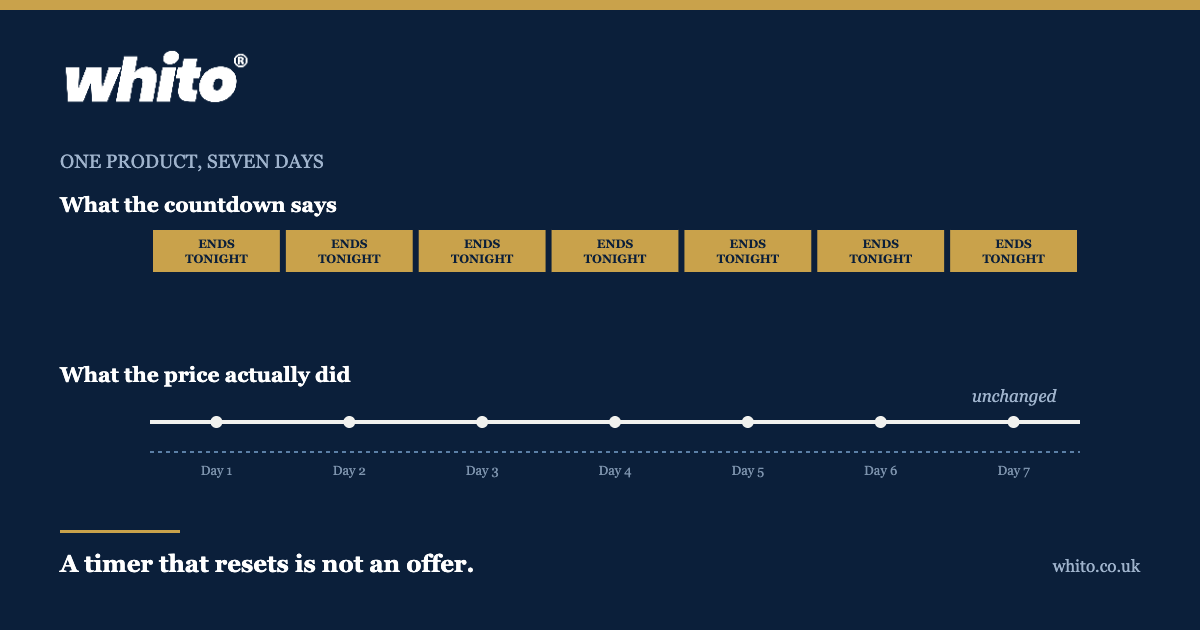
None of it needs a large marketing budget to replicate. A cheap plugin does the countdown by default, and resets it every morning by default, which is precisely the behaviour Wayfair was fined for.
The size of the fine tracks the size of the business. The behaviour does not.
The structural point most people miss
A countdown is a tactic. Whether it is legal is structural: does the price actually change when the timer runs out.
If the offer is genuine and dated, a timer is fine. If the deal resets every day because the software resets every day, you are describing something that is not happening. The claim is the problem, not the channel. The ASA has been making the same point about savings claims a company made on its own website rather than in a paid ad, and our tracker of 72 UK ad rulings tagged by claim type shows how consistently it is the wording of the claim that fails, not the media buy.
This is a Start problem, not a Scale one. Fixing it is not a growth tactic. It is foundations.
Three checks worth doing this week
1. Open your own site in a private window and buy something. Note the first price you see and the price at the payment step. If they differ because of a mandatory fee, that is the Gold’s Gym finding.
2. Find every countdown and ask what happens at zero. If the answer is “it starts again”, turn it off or give the offer a real end date you honour.
3. Check your checkout for anything pre-ticked. Delivery insurance, installation, recycling, a subscription. The CMA’s position is that you need express agreement before charging for an optional extra.
What the regulator is signalling
The CMA’s Senior Director for Consumer Protection, Hayley Fletcher, said people “should see genuine, accurate prices and offers” and that “the time is up for this kind of behaviour.”
On the same day, the CMA published a review of eighteen months of direct consumer enforcement. Since April it has opened six investigations, taking the total to twenty, settled seven cases, ordered over £2.3 million in redress and imposed over £11.8 million in fines. Its stated position on pricing is that “discounts must be genuine and businesses must show the total price clearly and throughout the purchasing journey”, and on timing, that “the rules are clear, and businesses have had ample time to comply.”
There is a second deadline behind this one. The CMA flagged in the same post that a new subscription contracts regime comes into force in January. If you sell anything on auto-renewal, that is the next thing on your list.
The commercial case, not just the legal one
Set the regulator aside for a moment. A permanent discount is not a discount, it is your price, and it is costing you margin every day while training customers to wait for the banner. Most businesses cannot say whether their promotions make money at all, which is the profit blind spot we wrote about last week.
A genuine, dated, properly measured offer converts. It also cannot be fined.
The takeaway
The cheapest compliance work you will ever do is making your pricing page say what actually happens. Show the total price including every mandatory fee, from the first screen. Give offers real end dates and honour them. Tick nothing on a customer’s behalf.
A four-gym operator was fined £45,000 for getting the first one wrong. You do not need to be Wayfair to be in scope.