
Last Updated on September 25, 2026
Eleven ASA rulings were published on Wednesday. Two of them were about ordinary business websites.
No media buy. No agency. No campaign. Just pages a company had put up on its own domain.
If you have been working on the assumption that the advertising rules only bite on things you pay to promote, that is the assumption worth losing this week.
What actually happened
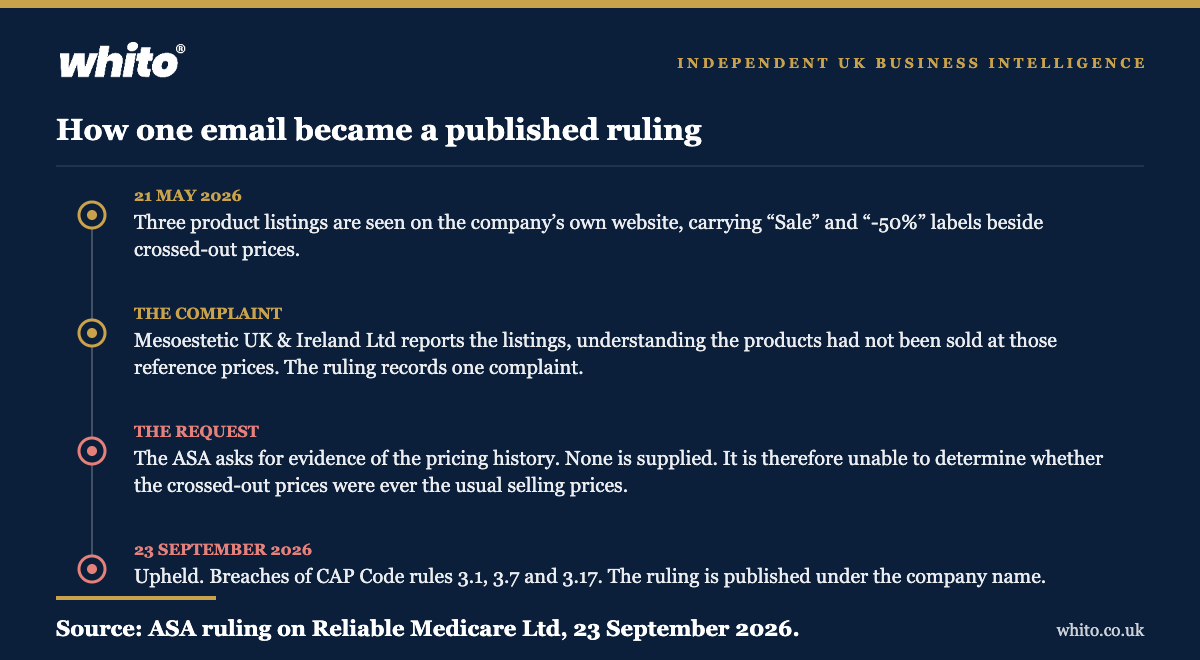
The ASA upheld a complaint against Reliable Medicare Ltd, a medical aesthetics and skincare supplier, over three product listings on its own website, seen on 21 May 2026.
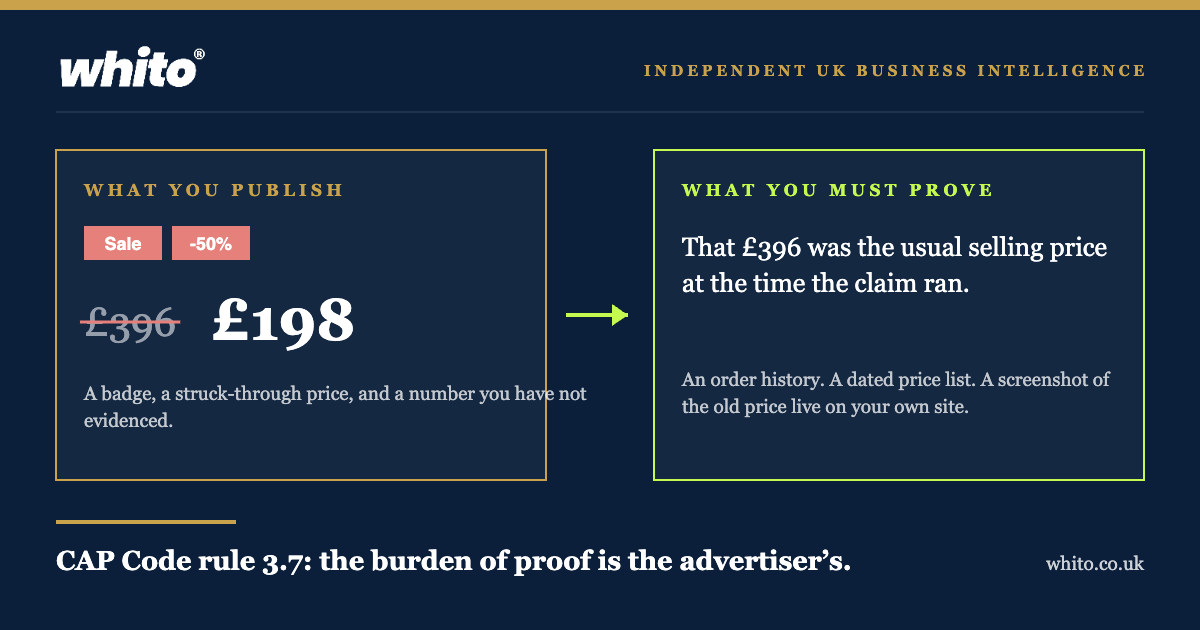
Each listing carried two red labels reading “Sale” and “-50%”. Each showed a promotional price sitting next to a crossed-out higher price. One pack, for instance, showed £198.00 excluding tax beside a struck-through £396.
The complaint did not come from a customer. It came from Mesoestetic UK & Ireland Ltd, which understood the products had not been sold at the crossed-out reference prices. The ruling records a single complaint. The agency field on the ruling reads “None, unconfirmed”.
The rule that caught them was not dishonesty
This is the part most owners misread, and it is the reason the case is worth twenty minutes of your attention.
The ASA did not find that the crossed-out prices were invented. It said something narrower and considerably more uncomfortable. It had received no evidence of the pricing history from Reliable Medicare, so it was unable to determine whether those crossed-out figures had ever been the usual selling prices at all.
The ASA did not prove the savings claim was false. The business failed to prove it was true.
Under CAP Code rule 3.7, substantiation is the advertiser’s job, not the regulator’s. If you cannot evidence the claim, the claim falls. That is the whole mechanism.
The listings breached three rules: 3.1 on misleading advertising, 3.7 on substantiation, and 3.17 on prices.
We wrote about the other side of this coin last week, when a rival reported a business to the ASA and twelve months of call logs were what saved them. Same rule. Opposite outcome. The only material difference was records.
What most owners assume, and what the rules actually require
| The assumption | What this ruling shows |
|---|---|
| “The ASA only polices paid ads.” | Your own website is advertising. Two of the eleven rulings published on 23 September were categorised “Website (own site)”. |
| “Nobody has complained, so we are fine.” | One complaint is enough. This ruling records exactly one, and it came from another business rather than a customer. |
| “It is obviously a genuine discount.” | You need evidence of the pricing history. Obvious is not substantiated, and the ASA asked for documents, not reassurance. |
| “We would get a quiet warning first.” | The ruling is published on the ASA website under your company name and registered address, permanently, where anyone searching your brand can find it. |
This lands hardest on regulated trades
If you work in a sector that already has a tighter rulebook on what you may say, price claims are simply one more surface where the same evidence standard applies. Aesthetics is the obvious example, and we have set out what a UK aesthetic clinic may and may not advertise in detail. Dentistry, health, finance and property all sit in the same position.
The practical effect is that the businesses most likely to be reported are the ones with an informed competitor watching. Which is most of them.
The direction of travel is not just the ASA
Price display is being policed from more than one direction, and the other direction has teeth.
On 23 June the CMA fined StubHub UK £889,200 and ordered more than £590,000 to be repaid to 51,350 customers, an average of around £10.33 per transaction, for adding mandatory fees late in the checkout process rather than showing them in the headline price. The company settled early and received a 40% reduction on the penalty. At that point the CMA stated that its new consumer enforcement powers had secured more than £1.95 million in refunds and levied fines exceeding £5.7 million.
Worth being precise here, because the two regulators work differently. The ASA does not fine. Its sanction is a published ruling and an instruction that the ad must not appear again. The CMA does fine, and can go up to 10% of global turnover. We covered that machinery in motion when the CMA ordered vets to publish price lists.
Two regulators, one principle: how you display a price is now a compliance surface, not a design choice.
What to do this week
This is a Start problem, not a Scale one. You do not need a campaign or a tool. You need your basics to survive one email from a competitor.
- List every price claim on your site. “Was”, “RRP”, “Sale”, “-50%”, “Save £X”, “From £X”, “Normally £X”. Include the ones buried in product listings, not just the banner on the homepage.
- Name the document that proves each one. An order history showing sales at the higher price. A dated price list. A screenshot of the old price live on your own site.
- Act on the blank spaces. If you cannot produce that document in ten minutes, either fix the record today or remove the claim today.
- Do the same sweep on your social proof. The identical evidence standard applies to your testimonials page, which is already in scope for the same reason.
None of this is paperwork for its own sake. A dated price record is the only thing standing between a rival’s email and a published ruling carrying your company name.
The takeaway
Your sale badge is an advertising claim, and your competitor can report it. When they do, the regulator will not ask whether you are honest. It will ask what you can prove.
Keep the receipts, or drop the claim.