
Last Updated on September 23, 2026
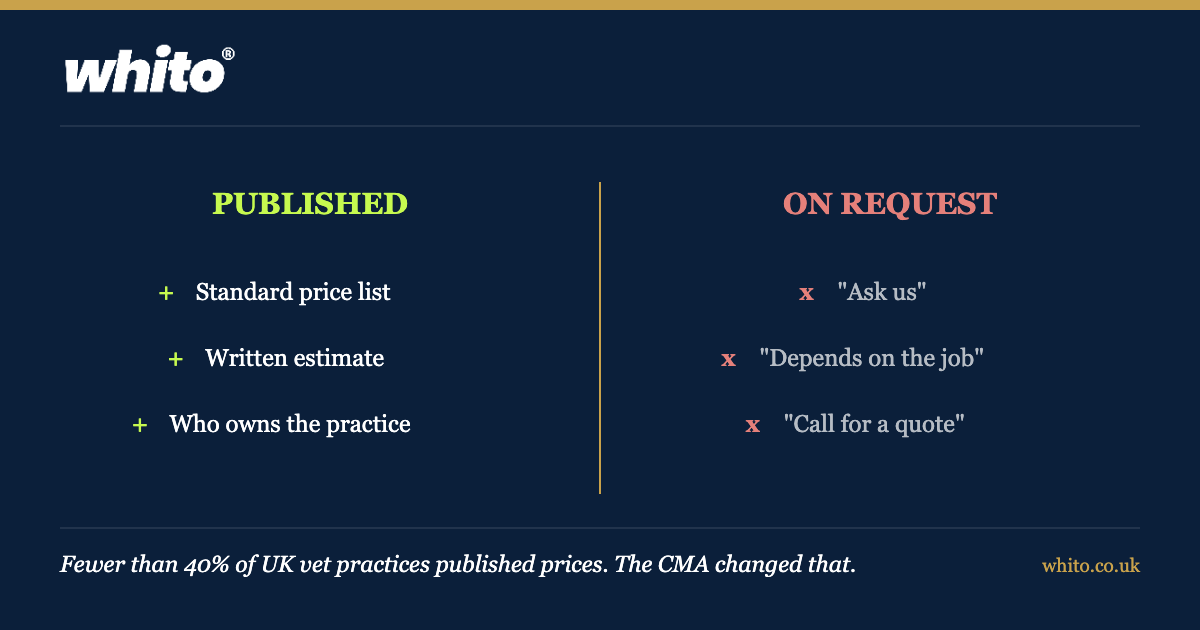
Most business owners treat published prices as a marketing preference. Something to argue about. Something the competition might use against you.
For one UK sector that argument ended this week.
What actually happened
The Competition and Markets Authority concluded its market investigation into veterinary services for household pets in March, and said its legally binding Orders would be in place by 23 September 2026. The CMA’s guidance page for veterinary businesses was updated on 22 September.
The headline everyone picked up was the price cap. Written prescription fees are capped at £21 for the first medicine and £12.50 for any additional ones. The CMA said many practices charge £30 or above for each prescription.
The cap is not the important part.
The important part is that vet practices must now publish a comprehensive price list for standard services, on their website and in the premises, including VAT. The CMA is specific about the format: the list has to be clearly identifiable and easily accessible, as a downloadable file, a static table or a searchable database. Prices have to be updated before new prices are charged. When someone books an appointment, the confirmation has to carry the consultation fee and a direct link to that list.
That is not a pricing rule. That is a website specification, written by a regulator.
The number that made it happen
The CMA found that fewer than 40% of practices had prices on their websites, and that the ones that did covered few services and were sometimes hard to find.
It also found that fewer than half of people using a practice owned by a large group knew it was part of a chain. Fewer than half of pet owners got any pricing information in advance of recent non-routine treatment, and only 29% of those got it in writing.
Read that as an owner rather than a vet. A whole sector decided, one business at a time, that not publishing prices was safer. Enough of them made the same decision that a regulator had to step in and make the decision for them.
| What the CMA found | What the Orders now require |
|---|---|
| Fewer than 40% of practices had prices on their website | A comprehensive price list for standard services, online and in the practice, including VAT |
| Fewer than half of clients knew their practice was part of a chain | Ownership shown on signage, at the premises and online |
| Only 29% of those given advance pricing got it in writing | A written estimate before any treatment expected to cost £500 or more including aftercare, plus an itemised bill. Emergencies are the only exception |
| Many practices charged £30 or more per written prescription | £21 for the first medicine, £12.50 for each additional one |
The dates, because they are not all the same
The CMA splits businesses by size. Larger means 15 or more first opinion practices. Smaller means fewer than 15, which is nearly every independent.
December 2026: larger businesses publish price lists.
March 2027: smaller businesses publish price lists, groups comply with ownership transparency, and larger businesses comply with the prescription fee cap.
June 2027: larger businesses provide written estimates and itemised bills.
September 2027: smaller businesses comply with everything.
An independent practice has until March 2027 to get a price list live. That sounds generous. It is not, because the six large groups go first, in December. From that month a pet owner in most towns can see one set of prices and not the other. We wrote up exactly what a vet practice has to publish and by when earlier this month.
If you are not a vet, this still concerns you
Nothing here binds a plumber, a solicitor or a salon. But the direction is worth reading honestly.
The CMA did not act because vets were expensive. It acted because buyers could not compare. Opacity was the finding. Price was the symptom. That is the same complaint customers make about builders, agencies, accountants and every trade where the answer to “how much” is “it depends”.
There is also a quieter reason to publish. AI assistants and comparison tools can only repeat what they can read. A price that lives in a quote you email out does not exist as far as they are concerned. Our own work on how accurate AI business recommendations actually are keeps landing on the same point: the firms that get named are the ones that published something checkable.
What to do this week
You do not need a regulator to start. Three jobs, in order.
One. Write down your ten most commonly sold things and what they actually cost a normal customer, including VAT. Not a range. A number, or a from-price you would honour.
Two. Put them on a page a stranger can find without asking you. A table is fine. A downloadable PDF is fine. Buried in a paragraph on page four is not.
Three. Put the same number in your booking confirmation and your quote. The CMA’s complaint was never that prices were high. It was that they turned up too late to be useful.
If publishing your prices would lose you work, the price is not the problem. The offer is. Wise built a business on publishing the price and let everyone else look expensive by comparison.
The takeaway
A sector worth over £6.7bn spent years deciding that silence about price was the safe option. It ended with a regulator writing the specification for their websites.
Publish your prices while it is still your decision.