
Finding
Asked for a trustworthy architect in 20 UK towns on 10 September 2026, Google AI Mode named 92 businesses. 53 are findable on the Architects Register under the name it gave. 39 are not, including every recommendation it made for Mansfield.
Source: Whito, whito.co.uk/architects/research/ai-architect-recommendations-arb-register. Free to quote with a link to this page.
Last Updated on September 10, 2026
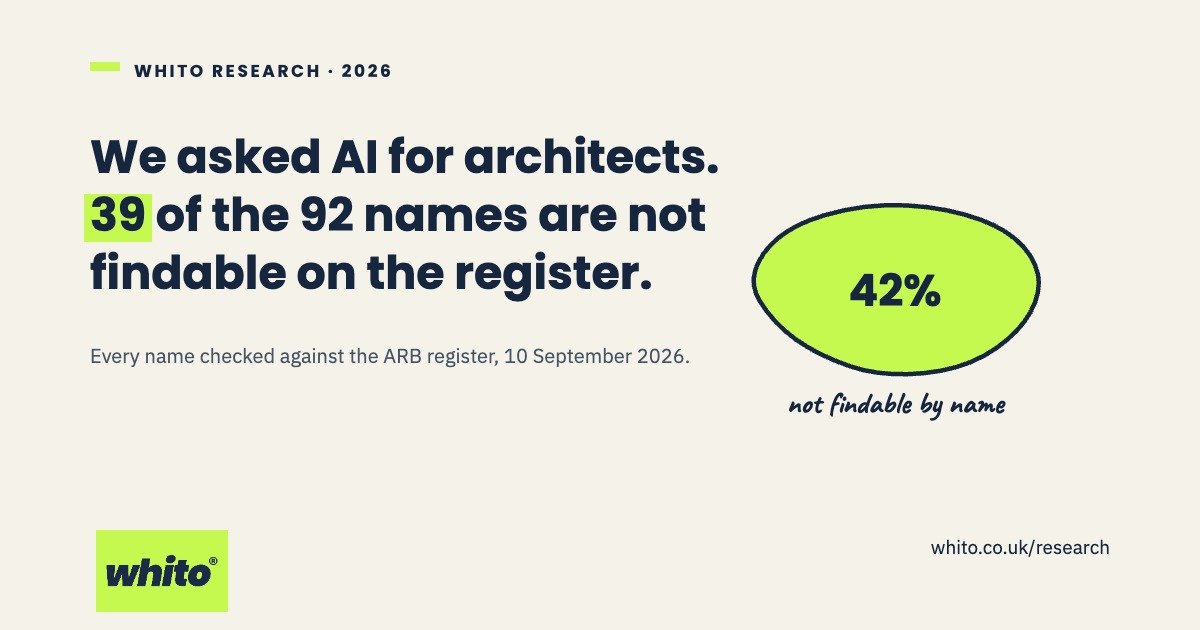
10 September 2026. We asked Google AI Mode to recommend a trustworthy architect in each of the 20 towns in the Whito AI Visibility Index, then checked every business it named against the Architects Register and Companies House. It named 92 businesses and individuals across 95 recommendations. 53 of the 92 have at least one registered architect findable on the ARB register under the name the answer gave. 39 do not. In Mansfield, none of the four recommendations could be verified on the register. In Milton Keynes it was one of six, in Luton one of five. Four recommended names matched companies that Companies House records as dissolved, one of them since 2019. And in Norwich, the answer described a named individual as a fully chartered RIBA and ARB architect on the strength of Facebook group posts. Nobody of that name appears on the register at all.
This matters more for architects than for any other trade we have measured, because architect is the one title in this series that is protected by law. The Architects Registration Board puts it plainly on the register itself, read on 10 September 2026: “The Architects Register is the definitive record of all UK architects. If someone is not on the Register, they are not an architect.” Anyone can design your extension. Only a registered person can be called an architect. So when an AI answer engine hands out the word architect, it is handing out a legal category, and the category is checkable in thirty seconds. We checked.
What we did
One engine, one prompt, one day. Google AI Mode, signed in, UK browser, 10 September 2026. The prompt was “Recommend a trustworthy architect in [town]”, worded identically for all 20 Index towns: Reading, Sunderland, Swansea, Leeds, Nottingham, Coventry, Luton, Bristol, Doncaster, Ipswich, Preston, Stoke-on-Trent, Milton Keynes, Norwich, Plymouth, Glasgow, Belfast, Mansfield, Blackpool and Wolverhampton. For each answer we expanded every source panel before capture and logged every recommended business, every source card and every credential or rating the answer displayed.
Then two register passes, both on the same day. First the Architects Register: a practice-name search for each business, with a surname and address search as a fallback where the firm carries a personal name and the practice search returned nothing. Second, Companies House: legal name, company number, status and registered office for every name that resolves to a company. Where a claim disagreed with the register, we re-ran the search before recording it. The full ledger, with registration numbers, is in the data file.
The register result
53 of 92 recommended businesses (58%) have at least one ARB-registered architect listing that practice on the register. 39 (42%) have none findable under the name the answer gave.
The spread by town is wide, and it is not random. Towns where the answer leaned on established practices verified well: Sunderland, Glasgow and Belfast all came back four out of four, Bristol seven out of eight. Towns where the answer was assembled from business listings verified badly: Mansfield zero out of four, Milton Keynes one of six, Luton one of five, Wolverhampton two of six.
| Town | Recommended | Findable on ARB register |
|---|---|---|
| Sunderland | 4 | 4 |
| Glasgow | 4 | 4 |
| Belfast | 4 | 4 |
| Bristol | 8 | 7 |
| Nottingham | 5 | 4 |
| Reading | 5 | 4 |
| Ipswich | 4 | 3 |
| Plymouth | 4 | 3 |
| Leeds | 5 | 3 |
| Stoke-on-Trent | 5 | 3 |
| Coventry | 3 | 2 |
| Swansea | 5 | 2 |
| Preston | 4 | 2 |
| Doncaster | 4 | 2 |
| Blackpool | 4 | 2 |
| Norwich | 6 | 2 |
| Wolverhampton | 6 | 2 |
| Luton | 5 | 1 |
| Milton Keynes | 6 | 1 |
| Mansfield | 4 | 0 |
A caution that cuts both ways. The register’s practice field is supplied by the registrants themselves, so a firm can employ a registered architect who lists a different practice name, or none. Absence from a practice search falls short of proof that no architect works there, and we do not claim any firm has broken the law. What it does establish is narrower and, for a consumer, more useful: if you follow the ARB’s own advice and search the register for the name the AI gave you, for 39 of these 92 businesses you will find nothing. For a title whose entire point is that you can check it, that is the number that counts.
The other side of the coin deserves stating just as plainly. Where the engine recommended established practices, the register agreed with it. Keenan Project Designs, presented in Reading as RIBA and ARB registered, has a registered architect at its Leamington Spa address. Johnson Design Partnership, presented in Wolverhampton as RIBA and ARB registered architects, has five. Joseph Boniface Architects in Blackpool, presented as a RIBA chartered architect, is Joseph Paul Boniface, 073942A, at the exact street address the answer gave. Nine of the eleven explicit credential claims the answers made checked out. The engine is not inventing architects. It is failing to tell architects apart from everyone else who draws plans.
Who the other 39 are
We are not naming the 39 on this page, because absence from a practice-name search is not the same as wrongdoing, and several will be sole traders or technologist practices operating entirely lawfully. The rates are the finding. Three patterns inside the 39 are worth knowing.
At least 16 of the 39 openly describe themselves as something other than an architect practice in the very text the engine served alongside the recommendation: architectural technician, architectural technologist, architectural designer, structural engineers, planning consultants, a fixed-fee plans service, design and build contractors. One Mansfield business’s own profile, quoted inside the answer, reads “Qualified Architectural Technician”. The answer’s heading above it read “Top Architects”. These are lawful, often excellent businesses. They are not what the prompt asked for, and in half the towns the answer never says so. Some answers did draw the distinction carefully: Leeds, Swansea, Doncaster and Blackpool all included a section explaining architect versus technologist. Mansfield, Milton Keynes and Luton did not; those are also the three worst-verifying towns. When the engine builds its answer from Google Business Profiles, the distinction disappears, because a business profile calls itself whatever it likes.
14 of the 39 trade under a name built on the words Architects or Architecture. Anyone reading the recommendation would take them for architect practices. The register does not know them by those names.
Four recommended names matched dissolved companies. Companies House, checked 10 September 2026: the company matching one Leeds recommendation was dissolved in April 2025, with the wider brand trading on through two active successor companies registered in East Yorkshire, which is where its registered architects now appear. The LLP matching the long-established Stoke firm the answer called the longest standing in North Staffordshire was dissolved in May 2026 in what the filings show as a restructure; three registered architects still list the practice, so the recommendation is sound even though the named entity is gone. A Norwich firm recommended on the strength of Facebook threads matches an LLP dissolved in April 2019. And a Wolverhampton listing card served inside the answer, address included, matches an LLP dissolved in January 2024. None of these businesses did anything wrong by restructuring or closing. The engine recommended register-dead names without noticing, because nothing in its source diet ever touches the register.
The Norwich answer
Norwich produced the most instructive answer of the twenty. Alongside four firms, it recommended two private individuals by name, sourced to threads in a local Facebook recommendations group, one thread dated November 2024. The first individual it described as “a fully chartered RIBA & ARB architect”. We searched the register for that name, then for each part of it separately. No registrant of that surname exists anywhere in the UK. The practice named alongside her is on the register, at a Norwich address, under a different personal name. So the credential is real at practice level, and the engine still printed a name that fails the only check the title supports. If she trades under one name and registers under another, entirely lawfully, every reader who does the right thing and checks the register will wrongly conclude she is not an architect. The second individual the answer recommended as a reliable designer, which was accurate, and which is exactly the point: a Facebook thread does not distinguish a designer from an architect, and an answer built on Facebook threads inherits that.
Where the answers came from
Across the 20 towns, the expanded source panels served 184 source cards. 116 of the 184 (63%) were Google Business Profile cards. Eight towns, Luton, Bristol, Preston, Milton Keynes, Glasgow, Belfast, Mansfield and Blackpool, were sourced from Google Business Profiles and nothing else: no portal, no press, no professional body, no firm’s own site. A third-party review or comparison portal appeared in 10 of 20 towns, 50% platform dependence, the same figure as care homes in the Q3 Index and half of what roofers show. Facebook community groups appeared as sources in two towns and supplied named individuals in one of them.
The number that should worry the profession: the ARB register and RIBA appeared as a cited source in zero towns out of twenty. The registers exist, they are public, and the answers never touch them. Where register advice did appear, it was sourced from an architect firm’s own location pages, served as the authority in two towns 200 miles apart. The engine knows to tell readers to verify ARB status. It has never once looked.
The trust evidence the answers printed instead was whatever the listings held. A 10.0 Checkatrade score. A Google rating of 5.0 built on two reviews, printed in a comparison table under the header “Google Rating”. A Certificate of Excellence that resolves to a Bark.com badge from 2019. First names of praised staff, lifted from review text. One firm’s own claim of a 95%+ planning success rate, printed as a differentiator. This is the standard trades-recommendation diet, and for most trades it is arguably the best available. Architecture is the one trade with a statutory register that settles the core question, and it is the one source the answers never used.
The source pools also leaked. Preston’s source cards included a practice in Torbay, 250 miles away. Blackpool’s included three Preston firms, a homeware and interiors shop, a CAD drafting agency and a firm of chartered surveyors. One Leamington Spa design firm surfaced in three different towns’ answers, via Checkatrade pages asserting it operates in each. One firm appeared twice in a single answer through two duplicate Google Business Profiles.
What this means if you are hiring
Do the check the answers tell you to do and never do themselves. Put the business name, and the individual’s name, into the Architects Register at architects-register.org.uk before you rely on the word architect. If you want an architect and the register comes back empty, ask the business directly for the registration number of the architect in charge of your project. If the answer is that they are a technologist or design practice, that may be fine for your job and often cheaper, but now you are choosing it rather than having it chosen for you by an answer engine that cannot tell the difference. For the company itself, Companies House shows in one search whether the entity is active and where it actually is; five minutes covers both registers.
What this means if you are an architect
Your register entry is doing silent work in AI answers and your Google Business Profile is doing loud work. The practices that verified cleanly here share one habit: the practice name on the ARB register matches the name on the profile, the site and the signage. Firms registered under a founder’s name but trading under a brand, or registered at an accountant’s address in another county, verified late or not at all, through no fault of their own. Eight of twenty towns were answered entirely from Business Profiles, so the profile text is the pitch: two of the recommendations here were grouped as chartered on no evidence beyond their own profile description. If your registration does not appear in your profile text and site footer with the practice name the register knows you by, an engine cannot see it and, on this evidence, will not go looking.
Limits
One engine, one run, one day. AI Mode answers are not deterministic; a re-run would name an overlapping but different set, and our earlier repeat-run work suggests roughly half the names recur. We measured Google AI Mode because it is the AI answer surface attached to the largest search engine, not because it is worst or best; the same audit against ChatGPT and Perplexity is future work. The ARB practice-name field is self-reported, so our findable-on-the-register measure understates true registration to an unknown degree; we mitigated with surname and address fallbacks and resolved two trading-name mismatches by address, but a firm whose architects all list other practice names would still show as not findable. Sole traders and partnerships lawfully absent from Companies House were not marked down for that. We claim no instance of unlawful title use, and this page names no business on the not-findable side of the ledger. The register searches were made on 10 September 2026 and registers change. Earlier the same day the ARB search reported a temporary outage; every search used for this page was made after service resumed and key zero-results were re-run to confirm.
How to cite this
Whito, “AI architect recommendations vs the Architects Register”, whito.co.uk, 10 September 2026. Free to quote with a link. The full dataset, the per-business ledger with company and registration numbers, the raw answer logs for all 20 towns and the source-card census are available as the paid intelligence file.
If we have got something wrong about your business, tell us at hello@whito.co.uk and we will check the register again and correct the page in public. If you are one of the 39 and hold ARB registration under a name we could not match, we want to know that most of all, because it sharpens the study’s central point: the register cannot protect a title it cannot be matched against.
Questions people ask
Is it illegal to call yourself an architect in the UK if you are not registered?
The title architect is protected under the Architects Act 1997 and business use of it is restricted to registered persons, with criminal penalties for misuse. Architectural designer, architectural technologist and architectural consultant are not protected titles, which is why so many recommended businesses lawfully carry them. This page reports register findability only and does not allege unlawful title use by anyone.
Did the AI invent any businesses?
No. All 92 names correspond to real, findable businesses or people. The failures were of category and currency, not existence: non-architects recommended under an architect prompt, dissolved entities recommended by name, credentials asserted from review-site strings, and one individual’s name printed in a form the register does not contain.
Which towns produced the most reliable answers?
Sunderland, Glasgow and Belfast: every recommendation verified against the register. The common factor was answers built on established practices rather than assembled from business listings. The towns answered entirely from Google Business Profiles, Mansfield and Milton Keynes worst among them, verified worst.
Can a good architectural designer be a better choice than an architect?
For plenty of domestic work, yes, and several answers said so clearly. The problem is the silence: in half the towns the answer never distinguished designers from architects, under a prompt that asked for an architect, in the one trade where the distinction is a legal line with a public register on it.
If your business is named here and you think we have a fact wrong, email hello@whito.co.uk and we will check it and correct it. If you want to respond, send us a statement and we will publish it alongside. Full detail: Corrections, right of reply and removals.