
Finding
Whito read the public pages of 25 UK sellers of small business marketing in one day in September 2026: 13 publish no usable price, and none publishes independently verified evidence of results a buyer could check before paying.
Source: Whito, whito.co.uk/research/uk-marketing-waste-report. Free to quote with a link to this page.
Last Updated on September 28, 2026
There is no shortage of advice telling businesses where to spend more on marketing. Very little of it says what to stop buying, so we spent a day reading what the sellers themselves put on their own pages before they take anyone’s money.
Across 25 UK sellers of the marketing small businesses most commonly buy, the answer is not much. Thirteen of the 25 publish no usable price, and not one of them publishes independently verified evidence of results that a buyer could check before paying.
Key findings
- We read the public pages of 25 UK sellers of small business marketing on 5 September 2026: business directories, business awards, press release wires, search engine optimisation packages sold with ranking guarantees, and one local print rate card.
- 13 of the 25 publish no usable price for the thing they sell. One lead generation platform has a page titled Pricing that contains no prices.
- 0 of the 25 publish independently verified evidence of results on the pages we read. Five publish self-written case studies or testimonials. None of it is audited or checkable beyond the seller’s own word.
- Google’s own documentation, updated June 2026, says “No one can guarantee a #1 ranking on Google”. We found UK sellers publishing ranking guarantees at £149 to £499 a month.
- Buying fake reviews has been explicitly illegal in the UK since 6 April 2025, with fines of up to 10% of global turnover. Cold-messaging bought consumer lists already was: the ICO fined one firm £300,000 in June 2026 for unlawful marketing texts.
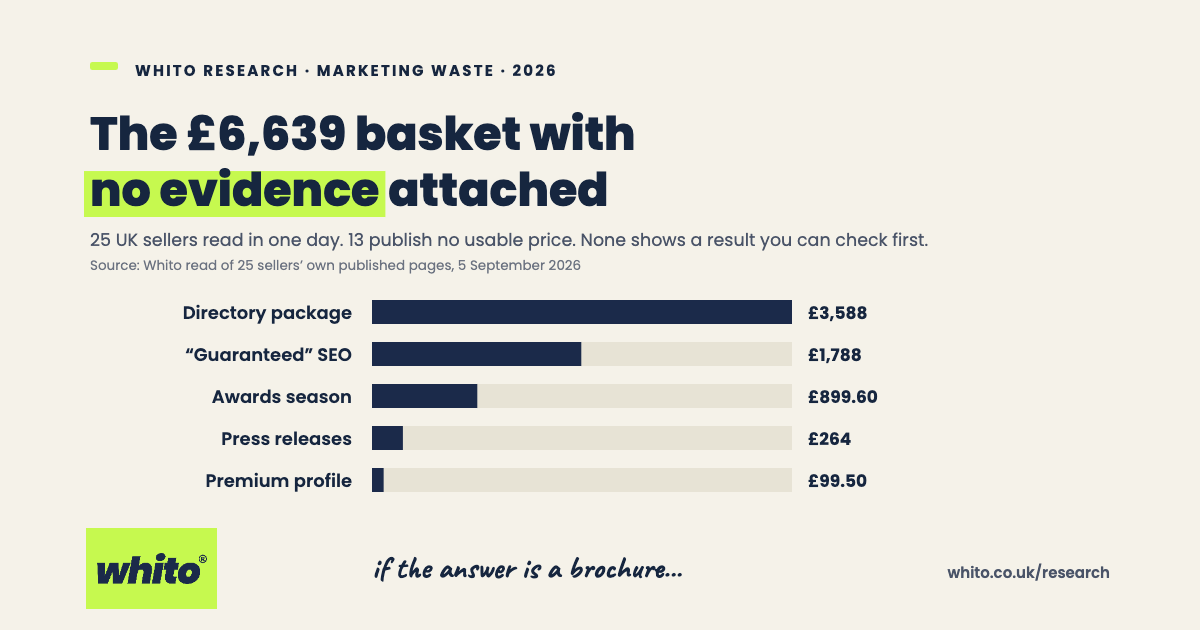
- A worked example basket of these purchases, at the sellers’ own published prices, comes to £6,639.10 a year, and not one line of it carries evidence a buyer could check first.
What we did
On 5 September 2026 we read the public websites of 25 UK-facing sellers across five categories of marketing spend that small businesses commonly buy: paid directory listings, business awards, press release distribution, SEO packages sold with guarantees, and local print advertising. For each seller we recorded the exact published price, whether VAT treatment was stated, and whether the seller publishes any evidence of results that a buyer could check before paying. A usable price means a figure in pounds, on the seller’s own page, for the thing being sold.
Every price in this report was read on the seller’s own page on that day. Where a page could not be read, we say so rather than quoting a number from somewhere else. Three further schemes were checked but their sites could not be read without a full browser, so they are excluded from every count.
This report is not a judgment on any named company. We make no finding about the quality of any seller’s product or the fairness of any awards scheme’s judging. What is recorded is what each seller publishes about prices and evidence, quoted from their own pages, with the date we read them. If a seller updates its pages, we will correct ours, with a dated note.
Free UK Marketing Budget Template (Excel)
Nine channels prefilled with Whito's UK planning bands, a budget-to-band check for any quote you have, and a monthly tracker. Enter your email and we send it straight away. Version 2026.10. See what is in it.
The unevidenced aisle
The unevidenced aisle is the set of marketing purchases where the seller publishes no independently verified evidence of results that a buyer could check before paying. Marketing copy does not count towards that. What is missing is an audited reach figure, an independently measured outcome, or any result confirmed by somebody other than the seller.
Of the 25 sellers we read, five publish some form of named-client evidence: two directories carry case studies or testimonials, two SEO sellers show named clients with claimed results, and one press release wire shows client logos. All of it is self-published and none of it is independently verifiable, and the other 20 publish nothing at all.
That is the test we suggest you apply before any marketing purchase this year. Ask the seller for one result you can check yourself before you pay. If the answer is a brochure, you are standing in the unevidenced aisle.
Directories: two of six publish a price
We checked six directory and lead generation platforms. Two publish UK prices.
| Seller | Published price | VAT stated? | Checkable evidence? |
|---|---|---|---|
| Yell | Packages including “from £299/month” and “from £699/month”; an FAQ on the same page says solutions start from £249 a month | No | Two self-published case studies |
| FreeIndex | Premium £9.95/month or £99.50/year | Yes, states it is no longer VAT registered | Three testimonials, unverifiable |
| Thomson Local | None published, across three pages checked | n/a | None |
| Scoot | None published | n/a | None |
| Bark | None. The page titled Pricing describes credit packs without pricing them | n/a | None |
| Yelp UK | No UK price obtainable from the pages we could read | n/a | None readable on UK pages |
Bark’s own pricing page carries two details that apply anywhere leads are sold by credit. Credits are “valid for 3 months from the date of purchase”, and the money-back guarantee on a first pack returns credits, not cash. Neither point is hidden, though both are easy to miss.
Paid listings do bring some businesses work, so this is not an argument against directories as such. The money goes to waste when a listing is bought without understanding the price, or on evidence the buyer never saw. If you already rank in the map results and your reviews are strong, a paid listing may be buying you visibility you have anyway, so it is worth checking before you commit. Our free Visibility Check shows you what you already have.
Business awards: the two business models
We read nine UK awards schemes. They split into two models, and knowing which one you are looking at is worth more than any shortlist.
The first model publishes its fees. One scheme sells entry for £35 per business, or £50 for its national awards. Another sells entry as a £12 product through an online checkout. A third is free to enter but charges winners a published £375 plus VAT “award acceptance fee”, which includes one trophy, with additional trophies at £99 plus VAT each. The black-tie end of the market publishes prices too: at one national final this November, a standard ticket is £280.80, a VIP table of ten is £2,808, and a full-page advert in the event programme is £1,080, all including VAT and all on the public booking page, with a 3.4% plus 20p booking fee on top.
The second model publishes no prices at all. Three separate awards operators we read carry near-identical wording: there are “no compulsory costs” in accepting a nomination or winning, alongside optional paid packages of trophies, certificates, plaques, magazine features and press releases, none of which has a published price. A further two publish neither fees nor package prices. So for five of the nine schemes, the cost only becomes discoverable after you have been told you won.
None of the nine publishes, on the pages we read, evidence of what winning did for any previous winner’s business. The best available research is thin and old: a peer-reviewed 1996 study in Management Science found that announcements of quality award wins moved the market value of listed US firms by well under 2%, with the effect concentrated in independent, rigorous awards. There is no UK small business equivalent. If you enter awards, enter the ones your customers have heard of, and decide what the trophy is worth to you before anyone tells you what it costs.
Guaranteed rankings: Google has already answered this
Google’s own documentation for businesses hiring SEO help, last updated 5 June 2026, says this, verbatim: “No one can guarantee a #1 ranking on Google.” It continues: beware of SEOs that “claim to guarantee rankings, allege a ‘special relationship’ with Google, or advertise a ‘priority submit’ to Google”.
We checked six UK sellers of SEO packages marketed with guarantees. Two publish both a monthly price and explicit ranking-guarantee wording, at £149 and £499 a month. A third asks for a £175 refundable deposit against reaching page one. The guarantee wording we found includes “Guaranteed in 90 Days or We Work Free” and a promise of a refund “if I don’t get you to Page 1”. We are not naming these sellers, since the individual firms are not the issue. The platform that controls the rankings has said in its own documentation that the promise cannot be made at all.
To be fair to the trade, we also found one UK agency, with published prices from £550 a month, that states plainly on its own site that a fixed number one position can never be 100% guaranteed, which tells you rather more about its competence than a guarantee would.
Refunds are also a smaller comfort than they look. What you hand over is months of budget and your site’s history in somebody else’s hands, and getting the fee back at the end returns neither of them.
Press release wires: one rate card in four
Of four press release distribution services we checked, one, Pressat, publishes a full UK rate card: £110 per release pay as you go, £290 a month for up to five, all excluding VAT. PRWeb publishes US dollar prices only. PR Newswire’s UK site publishes no prices and directs you to a sales conversation. The fourth could not be read. None of the four publishes audited reach figures on the pages we read. The one local print rate card in the dataset, a South Yorkshire community magazine, publishes every price with VAT treatment stated and an unaudited circulation figure, which made it the most price-transparent page we read all day.
Press releases earn their keep when there is genuine news in them. The waste comes when one is bought as a substitute for having something to say, which is how they tend to be sold to small businesses, and no wire buys you a journalist’s attention.
What the independent evidence says about paid clicks
The best-known numbers about wasted advertising money deserve their labels, so here they are with samples attached.
Juniper Research, a commercial forecaster, estimated in 2022 that £50.2 billion ($68 billion) of global digital ad spend would be lost to fraud that year, and named the UK among the five countries accounting for 60% of losses. That is a global model, not a UK measurement. Lunio, a vendor selling click fraud protection, reported in 2024 that 8.5% of online traffic in its data from May 2022 to May 2023 was invalid; TrafficGuard, another such vendor, states in an undated post that advertisers lose 10 to 25% of paid media budgets to invalid traffic. Both figures come from the vendors’ own data, with no UK breakdown. The US Association of National Advertisers found in a 2023 supply chain study of 21 large advertisers that only 36 cents of every dollar entering a programmatic ad platform effectively reaches a consumer.
Every one of those figures comes from either a vendor with a product to sell or a study of large advertisers. No one measures wasted ad spend in UK small business accounts. The honest conclusion is narrower than the headlines suggest. Some meaningful share of self-managed ad spend does not reach a human being, nobody can tell you what your own share is, and the only way to find out is to open your search terms report and see what you paid for clicks that never became customers. That check costs nothing beyond the time it takes.
The purchases the law has already decided on
Three things sold to businesses as marketing carry legal risk rather than any marketing benefit, and enforcement over the past two years has settled how much.
Bought reviews. Since 6 April 2025, under the Digital Markets, Competition and Consumers Act, UK law contains what the government’s own announcement calls “an explicit ban on the posting and commissioning of fake reviews”, with fines of up to 10% of global turnover. The CMA’s guidance defines a fake review as one that “purports to be, but is not, based on a person’s genuine experience”. Any seller offering you reviews, follows or engagement is selling you a liability at your expense.
Bought consumer lists. The ICO’s guidance on electronic marketing is blunt: you must not send marketing emails or texts to individuals without specific consent, and the soft opt-in exception “does not apply to prospective customers or new contacts (eg from bought-in lists)”. It is enforced, too. In June 2026 the ICO fined a Manchester firm £300,000 for over five and a half million unlawful marketing texts. In January 2024 it fined HelloFresh £140,000 over 80 million messages sent on bundled, unclear consent.
Fake invoices dressed as marketing. Action Fraud describes business directory fraud as being “offered free advertising by post, email or fax, but then billed for the service”, sometimes with fake debt collection pressure. Companies House warns of scam letters using its own “formatting and logos” with “demands for payment” and “pressure to act quickly”. Neither publishes a loss figure, so we will not invent one. The defence costs nothing, since nobody you have not contracted with is owed money for a listing.
The worked example basket: £6,639.10
This is a worked example, not a survey finding. No dataset of what UK small businesses buy in practice exists, and we checked for one. But every line below is a real published price, read on the seller’s own page on 5 September 2026.
| Purchase | Published price | A year | Checkable evidence? |
|---|---|---|---|
| Directory package, “from £299/month” | £299/month, VAT unstated | £3,588.00 | No |
| Guaranteed SEO package | £149/month, VAT unstated | £1,788.00 | No |
| One awards season: national entry, one final ticket, winner acceptance fee, one extra trophy | £50 + £280.80 + £450 + £118.80, VAT included where stated | £899.60 | No |
| Two press releases, pay as you go | £110 each + VAT | £264.00 | No |
| Premium directory profile, annual | £99.50/year, seller not VAT registered | £99.50 | No |
| Total | £6,639.10 | None |
To say it again: this basket is a worked example built from published prices, not an average of anyone’s real spending. Its point is the right-hand column. £6,639.10 a year is available to sign up for, at listed prices, without a single piece of evidence a buyer could check first.
Where the money goes instead
Structure before scale. In our framework that means Start money goes on being findable and trusted, Build money on converting what already comes in, and Scale money only arrives once the first two are measured and working.
Start. A Google Business Profile is free. That is Google’s own wording: “creating a Business Profile and listing your business on Google is free”. Claim it and keep the details current. Your Companies House record is also public and free; keep it accurate, because it is one of the few things about your business anyone can verify without asking you.
Build. Reviews now sit under specific consumer law, which has made genuine ones worth more. BrightLocal’s 2026 consumer survey, a vendor study of 1,002 US adults, found 97% of consumers read reviews for local businesses; there is no equivalent UK survey, so treat that as directional rather than as a UK figure. Ask every happy customer. It is free and it is legal, provided you never pay for the words. Email to people who already bought from you is the other underpriced channel: the UK Data & Marketing Association’s 2021 tracker reported marketers’ own estimate of up to £38.33 returned per £1 spent. It is a self-reported estimate and five years old, but even discounted heavily it beats anything in the basket above.
Scale. Paid clicks, done with a search terms report open and a conversion number defined, can work. Paid clicks bought as a package from a seller who will not show you the account tend to fail without anyone noticing for months, which is the expensive way to find out.
This report is a companion piece to our Software Waste Index, which prices what happens at month seven of software subscriptions, and our agency pricing study, which found 47 of 50 UK marketing agencies publish no price anywhere. The pattern across all three is the same: in this market, the seller who shows you the number before you commit is the exception.
What we will not claim
Several famous waste statistics did not survive checking, so they are not in this report.
“76% of ad spend is wasted” traces to a 2016 blog post by a US agency auditing 2,167 self-selected accounts, where the median account had spent 75.8% of budget on search terms that never converted. A decade old, one vendor, prospects seeking audits. “Email returns £42 for every £1” is real but it is the DMA’s 2019 self-reported marketer estimate, since superseded by its own lower figure. “46% of Google searches are local” traces to no Google publication we could find. And the “spend 7 to 10% of revenue on marketing” rule comes from surveys of the wrong companies entirely: Gartner’s 2025 CMO survey states its 402 respondents were mostly firms with revenue over £738 million ($1 billion). None of that transfers to a business with four staff in Derby.
We also looked for official UK data on small business marketing spend. The government’s Longitudinal Small Business Survey 2024, with 8,396 SME employer responses, does not measure it. As far as we can establish, no official UK statistic on small business marketing spend exists. Any benchmark you are quoted came from somewhere else.
Frequently asked questions
What is the unevidenced aisle?
The unevidenced aisle is Whito’s term for the set of marketing purchases where the seller publishes no evidence of results that a buyer could check before paying. In our September 2026 read of 25 UK sellers of small business marketing, all 25 were in it: five published self-written case studies or testimonials, and none published independently verified evidence on the pages we read.
Can anyone guarantee a number one Google ranking?
No. Google’s own documentation states “No one can guarantee a #1 ranking on Google” and warns businesses to beware of SEOs claiming otherwise. Any ranking guarantee is a marketing device of the seller, not a capability.
Are paid business awards worth entering?
Sometimes, but decide what the trophy is worth to you before anyone prices it for you. Check whether the scheme publishes its fees openly, whether your customers have heard of it, and what the winner package costs. Awards schemes split into those that publish entry fees up front and those that are free to win but sell unpriced trophy and promotion packages afterwards. No scheme we read publishes evidence of what winning did for past winners.
How much should a UK small business spend on marketing?
No official UK statistic on small business marketing spend exists, and the widely quoted 7 to 10% of revenue rule comes from surveys of companies mostly turning over more than £738 million ($1 billion). Spend nothing on the unevidenced aisle until the free foundations are done, then buy one measurable thing at a time and check it against revenue.
Sources for every figure in this report were read on the publisher’s or seller’s own pages on 5 September 2026: Google Search Central; GOV.UK and CMA announcements and guidance on the Digital Markets, Competition and Consumers Act; ICO enforcement notices and PECR guidance; Action Fraud; Companies House; Juniper Research; the ANA; and the published pages of the 25 sellers in the dataset. Corrections, with dates, will be noted here.
The structural checks behind this research run on any website in about twenty seconds. Enter yours and read the full result on the page. Free, and we do not ask for your email.
Run the free Visibility CheckIf your business is named here and you think we have a fact wrong, email hello@whito.co.uk and we will check it and correct it. If you want to respond, send us a statement and we will publish it alongside. Full detail: Corrections, right of reply and removals.