
Finding
Making Tax Digital compliance costs a simple sole trader between £0 and £144 a year, yet Xero's Grow plan costs £444 a year at full price, 4.8 times HMRC's £110 estimate, according to Whito's index priced on 1 September 2026.
Source: Whito, whito.co.uk/research/uk-software-waste-index, September 2026. Free to quote with a link to this page.
Last Updated on September 28, 2026
Published 1 September 2026. Every price in this piece was read on the vendor’s own UK pricing page on 1 September 2026, and every statistic carries its source, its sample and its country in the same sentence. Where a widely quoted number could not be traced to a primary source, it is named in the Do Not Claim section rather than used.
HMRC thinks digital tax will cost you £110 a year. The software industry has priced it rather differently.
Making Tax Digital for Income Tax went live on 6 April 2026 for sole traders and landlords with qualifying income over £50,000. HMRC’s own impact assessment puts the ongoing cost at an average of £110 a year per business (HMRC tax information and impact note, updated September 2025).
A standard mid-tier accounting subscription, Xero’s Grow plan, costs £444 a year at full price, £532.80 once VAT is added for the many mandated businesses that cannot reclaim it. That is 4.8 times HMRC’s estimate.
Meanwhile there are at least three routes to MTD compliance that cost nothing at all, and one that costs £20 a year. None of them is what most people will end up buying.
That gap, between what compliance requires and what the software industry sells alongside it, is what this index measures. MTD requires software. It does not require £500 a year of software. Those are different sentences, and a lot of money rests on keeping them apart.
What the law actually requires
Strip the vendor marketing away and the obligation is this:
- From 6 April 2026: sole traders and landlords with qualifying income over £50,000 in 2024 to 2025 keep digital records and file through compatible software. Qualifying income is turnover from self-employment and property before expenses, not profit (gov.uk eligibility guidance; qualifying income guidance).
- From 6 April 2027: the threshold drops to £30,000.
- From 6 April 2028: it drops again to £20,000.
- You send four quarterly updates a year for each business source, plus the year-end tax return. The updates are cumulative and the deadlines are 7 August, 7 November, 7 February and 7 May (gov.uk quarterly updates guidance). A sole trader who is also a landlord has two sources, so nine submissions a year.
The scale: HMRC expects around 780,000 people in the first wave and a further 970,000 from April 2027 (HMRC impact note). By 12 August 2026, more than 436,000 had filed their first quarterly update (HMRC, August 2026).
HMRC’s own cost estimates, from the same impact note: an average transitional cost of £320 and an average ongoing cost of £110 a year across the mandated population over £30,000. Across all mandated businesses that is a one-off burden of £561 million and a continuing net cost of £196 million a year. The later £20,000 wave adds an estimated £380 million of transitional cost on top (HMRC, March 2026).
Digitally excluded taxpayers can apply for an exemption by phone or post.
The compliance floor: what MTD costs if you buy nothing you don’t need
HMRC’s guidance says plainly that free products are available for those with simple tax affairs. On 1 September 2026 we verified these routes on the vendors’ or HMRC’s own pages:
| Route | Price | Where we read it |
|---|---|---|
| My Tax Digital, free version | £0 | Listed as ready now in HMRC’s own software finder. Covers sole trader, UK property and foreign property. English only, and partnership income support was still in development when we checked. |
| Sage Sole Trader Free | £0 | Sage’s MTD sole trader page. Limits: 25 auto-categorised transactions, one bank account, five invoices a month. |
| FreeAgent with a NatWest, RBS, Ulster Bank or Mettle business account | £0 | FreeAgent’s pricing page, which states the deal alongside the paid plans. Mettle’s version is subject to account activity. |
| Landlord Studio MTD Go | £0 plus £5 per MTD submission | Landlord Studio’s UK pricing page. For one to three properties. Four quarterly updates makes £20 a year, before the year-end return. |
| Sage Sole Trader (paid) | £7 a month plus VAT, £100.80 a year including it | Same Sage page. Full ongoing price, not the 90 per cent off intro figure. |
| QuickBooks Sole Trader Plus | £10 a month plus VAT, £144 a year including it | QuickBooks UK pricing page. Full ongoing price. |
So the compliance floor for a simple sole trader or small landlord sits between £0 and £144 a year. HMRC’s £110 estimate is not fantasy. It is roughly what the cheap end of the market charges.
Everything above that line is a choice. Some of those choices are good ones. Bank feeds, invoicing and a tidy audit trail have real value, and a VAT-registered business with staff has real needs. But the gap between the floor and the default is wide enough that it deserves to be measured, and nobody had priced it in one place. So we did.
The month-seven price
Here is the pattern almost nobody prices in. Every major UK accounting vendor is currently selling at a deep introductory discount, and every one of those discounts ends after six months. The price you see in the advert is not the price you will be paying at your first MTD year-end. We call the real figure the month-seven price, and it is the only price this index uses.
| Plan | Advertised intro price | Month-seven price | Multiple |
|---|---|---|---|
| QuickBooks Simple Start | £1.60 a month, 90% off for 6 months | £16 | 10x |
| QuickBooks Plus | £5.60 a month | £56 | 10x |
| Sage Accounting Standard | £4.30 a month, 90% off for 6 months | £43 | 10x |
| Xero Grow | £7.40 a month, 80% off for 6 months | £37 | 5x |
| FreeAgent Sole Trader | £9.50 a month, 50% off for 6 months | £19 | 2x |
All prices exclude VAT, read from QuickBooks, Sage, Xero and FreeAgent on 1 September 2026.
Worked through a full year on Xero Grow: £44.40 for the first six months, £222 for the next six, £266.40 in year one. Then £444 every year after. The advert you clicked showed £7.40.
Two more things the headline price hides:
VAT lands on top. Every accounting vendor above prices excluding VAT, and QuickBooks prints “All prices + VAT @20%” beside every figure. A VAT-registered business reclaims it. Everyone else pays it and keeps the receipt. Xero Grow’s real cost to them is £532.80 a year, not £444, and certainly not £88.80.
Not every vendor showed us a price in pounds. Several of the US-based tools we tried to price serve different currencies to different visitors, or reveal the sterling figure only late in checkout, and some pricing pages show no figure at all unless their scripts run. We priced only tools whose UK price in pounds we could read on the vendor’s own page, and excluded the rest rather than print converted guesses. You should be suspicious of any comparison page that does.
Correction, 1 September 2026: an earlier version of this paragraph named seven tools as not publishing a UK price at all. Their pages showed us no sterling figure when fetched for this index, but at least two of them display pounds in a normal UK browser, so the claim was too strong and the names have been removed.
The sector waste table: five stacks, priced at full rate
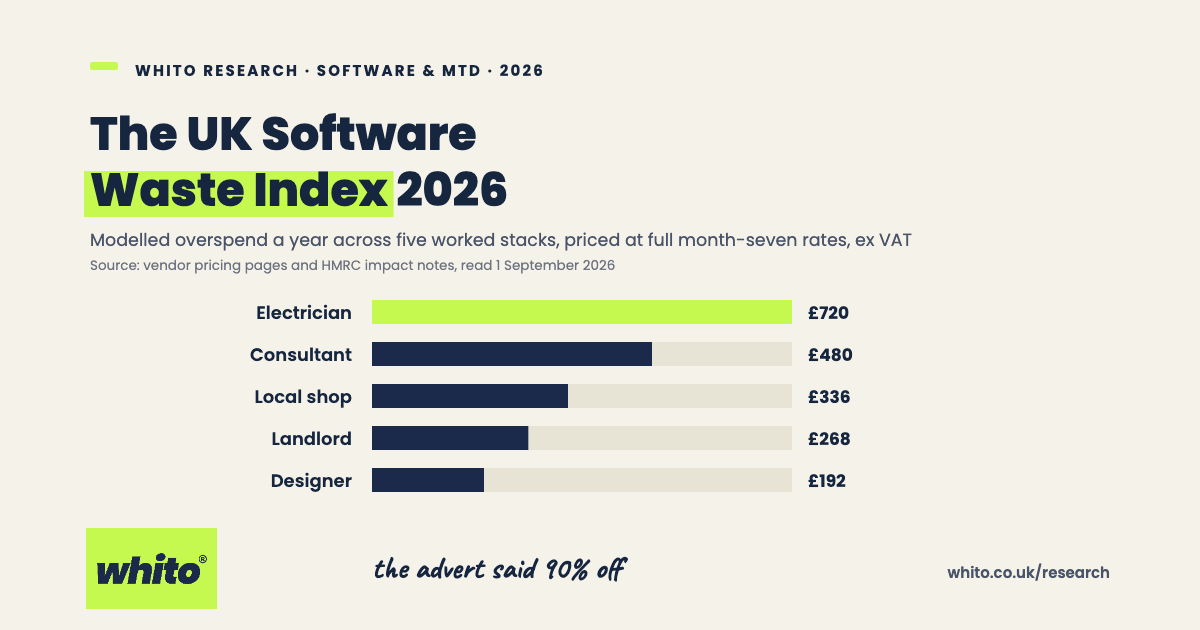
These are worked examples, not survey averages. No survey of what UK sole traders actually run exists, which is a finding in its own right and one we return to below. Each row prices a stack of the kind we see repeatedly in the sectors Whito audits, at month-seven prices excluding VAT, then prices the cheapest verified route that still meets the same compliance obligation. The difference is the modelled overspend. Your stack will differ. The method is the point: price yours the same way.
| Worked example | The stack we priced | Full price a year | The compliant floor | Modelled overspend a year | Primary culprit |
|---|---|---|---|---|---|
| Independent landlord, three properties, employed elsewhere | Xero Ignite £16 + Hammock Basic £8 | £288 | Landlord Studio MTD Go, £0 plus £5 a submission, about £20 | £268 | Two tools keeping one set of records |
| Electrician, VAT registered, one apprentice | Xero Grow £37 + Tradify Pro £37 + Checkatrade Growth from £59 + Tradify website £10 | £1,716 | Tradify Pro £37 + Xero Ignite £16 + Checkatrade Approved £30, £996 | £720 | An accounting tier that duplicates the invoicing the job platform already does |
| Freelance designer, not VAT registered | QuickBooks Simple Start £16 | £192 | Sage Sole Trader Free or My Tax Digital, £0 | £192 | A VAT-capable plan where there is no VAT to file |
| Local shop with an online store, VAT registered | Shopify Basic on monthly billing £25 + QuickBooks Essentials £38 | £756 | Shopify Basic on annual billing £19 + Simple Start £16, £420 | £336 | Monthly billing plus a three-user plan for one user |
| Solo consultant, limited company | QuickBooks Plus £56 | £672 | QuickBooks Simple Start £16, £192 | £480 | Five seats, one human |
Total modelled overspend across the five examples: £1,996 a year, before VAT, before any marketing subscriptions, and before a single tool that was bought and forgotten.
Read the culprit column again. Not one of these is an exotic mistake. They are the same three mechanisms every time: two tools doing one job, a tier bought for features that never get used, and billing settings nobody revisits. Fixing them requires no new software. It requires a list and an hour. One fairness note on the electrician row: the floor swaps Checkatrade Growth for Approved, and Growth carries lead volume that Approved does not, so treat that part of the gap as waste only if the extra leads are not being tracked through to won jobs.
What the waste research actually shows, with its samples attached
Software waste statistics get quoted constantly and sourced almost never. Here is what survives contact with the primary sources, base and country included, because a percentage without its sample is a rumour with a decimal point.
- 36% of paid SaaS licences go unused. Zylo, 2026 SaaS Management Index, from more than 40 million licences under management plus a survey of 218 IT leaders. Global, and skewed to companies big enough to buy licence-management software, so treat it as an upper bound on the seat problem, not a UK small business figure (Zylo, January 2026).
- 65% of SaaS licences are unused or underutilised. Vertice platform data, current to Q2 2026. A broader metric than Zylo’s, since it counts underused seats as well as untouched ones, which is why the number is bigger. Same caveat: customer-base data, not a survey, not UK-specific (Vertice, 2026).
- Roughly half of installed software went unused across more than 6 million monitored environments. Nexthink analysis published February 2023, enterprise, global (Nexthink).
- Only 45% of company apps are used regularly. Productiv platform data across more than 30,000 applications, 2021, US-skewed (Productiv, September 2021).
Notice what every one of those has in common: none of them sampled a UK small business. The best UK-sampled evidence on subscription waste is consumer-side, and it points the same way:
- £688 million spent on unused subscriptions in a year. Citizens Advice, Opinium survey of 3,000 UK adults, January to February 2024, nationally representative. 26% of UK adults had taken out a subscription by accident in twelve months; 40% of those through an auto-renewal they did not know about, 39% through a forgotten free trial (Citizens Advice, March 2024).
- 155 million active subscriptions in the UK, nearly 10 million of them believed to be unwanted. Government estimates published alongside the subscription-trap rules due under the DMCC Act, April 2026. The same release puts the saving from cancelling one unwanted subscription at around £14 a month (Department for Business and Trade, April 2026).
A sole trader’s software stack sits exactly where those two bodies of evidence meet: bought like a consumer, on a card, on auto-renew, with nobody in the business whose job is to cancel things. There is no reason to believe the waste mechanics stop applying at the point someone registers for Self Assessment. There is also, as the next section shows, no primary data on it at all.
Do not claim: the numbers we chased and could not stand up
Whito publishes what failed verification, because the failures are how you spot a page that has done no checking. If you see any of these cited as fact, the page you are reading copied it from another page that copied it from another page.
- “Gartner says 25% of SaaS is underutilised.” Quoted across dozens of vendor blogs. The Gartner document those citations point at now redirects to Gartner’s homepage, and no public Gartner page states the figure. If Gartner has ever published it, it is not public now, and every open-web citation of it is secondhand.
- “UK SMEs spend £4.8 billion a year on tax and accounting software.” Attributed to Monzo research in early 2026 press coverage. We could not find the figure, a sample size or a methodology anywhere Monzo publishes. Until the sample and method are published somewhere checkable, this number is unusable, which is a shame, because it is the only UK software-spend total anyone quotes.
- “UK SMEs waste £10,000 on unused software.” Traces to a web host’s press piece which itself describes the figure as a hypothetical calculation for an imaginary 15-person agency. Not a statistic.
- “Businesses use an average of 40 apps.” Appears in roundups with rotating attribution. The nearest real primary is Blissfully’s 2020 report putting businesses at 102 apps, which is US-skewed, six years old, and no longer hosted by the vendor itself.
- At least one 2026 “SaaS waste report” ranking in search describes itself, in its own text, as a synthesis with hypothetical examples and no survey. Estimates dressed as research are the supply chain most software-waste articles are built on.
And the finding underneath all of that: there is no primary source for what UK sole traders and micro businesses actually spend on software. We looked for one from the FSB, the ONS, the big accounting vendors and the banks. It does not exist in public. A compliance regime just made software mandatory for around 780,000 people, with 970,000 more to follow from April 2027, and nobody has published measured data on what they pay for it.
The one-hour audit
Structure before scale. Before any new tool, any new channel, any new subscription, run this against your last twelve months of bank statements:
- List every software line on the statement. Not from memory. Memory is how the £14 a month survives.
- Write the month-seven price next to each, from the vendor’s pricing page, not your welcome email. Anything still inside an intro period gets its real price, because that is what you are deciding to keep.
- Mark duplicates by function, not by name. If two tools can send an invoice, one of them is a duplicate, whatever else it does.
- Count seats against humans. Plans that include five users are not a bargain if you are one person.
- Check every annual-versus-monthly toggle. On Shopify Basic alone the difference is £72 a year for clicking a button.
Then cancel anything you cannot tie to revenue or to a filing deadline. If losing a tool tomorrow would not cost you a customer or a penalty, it is not infrastructure. It is a standing order with a logo.
Method
Every price above was read on the vendor’s own UK pricing page on 1 September 2026, at the full ongoing rate, with intro discounts recorded separately. VAT treatment is stated wherever the vendor states it. Vendors whose UK pages did not show us a sterling price were excluded rather than converted. Every statistic was traced to the organisation that produced it and is quoted with its sample, year and country; anything that would not trace is in the Do Not Claim section instead of the body. HMRC figures come from the published impact notes and gov.uk guidance linked beside each claim. It is the same discipline behind our UK trades marketing statistics, where all 92 figures carry their source. The five sector stacks are worked examples priced from these verified figures, and are labelled as such because no survey data on actual UK sole trader stacks exists. Prices change, and vendors are welcome to tell us when theirs do: corrections are noted on the page with a date, never quietly edited.
For the companies on the other side of this
If you sell software, banking or accountancy to UK small businesses, the gap this index documents is your market. The threshold drops to £30,000 in April 2027 and £20,000 in April 2028, which means the next two waves of mandated customers are smaller, more price-sensitive and less served by enterprise-shaped pricing than the current one, and there is no public data on what they currently pay.
Whito builds that data. We run structured audits of UK sectors, pricing, and AI recommendation behaviour, and we sell the files: published reports at £1,280, with single-sector files and multi-sector or ongoing coverage built to order and priced on enquiry. The method is the one you have just read. Details are on our Intelligence page.
The takeaway
MTD is not the villain here. The obligation costs somewhere between nothing and £144 a year to meet, which is close to what HMRC said it would. The villain is what gets sold in the confusion around an obligation: the 90% discount that expires before your first year-end, the ex-VAT price tag shown to people who cannot reclaim VAT, the five-seat plan sold to one person, and the second tool quietly keeping the same records as the first.
The fix is not better software. It is an hour with a bank statement and the month-seven prices. Structure before scale, in your software stack as everywhere else.
FAQ
When does Making Tax Digital for Income Tax apply to me?
From 6 April 2026 if your qualifying income was over £50,000 in 2024 to 2025, from 6 April 2027 if over £30,000 in 2025 to 2026, and from 6 April 2028 if over £20,000 in 2026 to 2027. Qualifying income is your combined turnover from self-employment and property before expenses.
Do I have to pay for software to comply with MTD?
No. HMRC’s guidance states free products are available for simple tax affairs, and on 1 September 2026 we verified free routes from My Tax Digital, Sage and FreeAgent (via certain business bank accounts), plus a £5 per submission option from Landlord Studio. Paid plans add convenience, not compliance.
What does HMRC estimate MTD will cost a business?
An average transitional cost of £320 and an average ongoing cost of £110 a year across the mandated population over £30,000, per HMRC’s published impact note.
What is a month-seven price?
The full ongoing price of a subscription after its introductory discount expires. UK accounting software intro discounts of 50% to 90% all currently end after six months, so month seven is the first month you pay what the product really costs. Always compare tools at their month-seven prices.
How to cite this page: Whito, UK Small Business Software Waste Index, September 2026, with a link to this URL. Corrections are noted on the page with a date.
The structural checks behind this research run on any website in about twenty seconds. Enter yours and read the full result on the page. Free, and we do not ask for your email.
Run the free Visibility CheckIf your business is named here and you think we have a fact wrong, email hello@whito.co.uk and we will check it and correct it. If you want to respond, send us a statement and we will publish it alongside. Full detail: Corrections, right of reply and removals.