
Finding
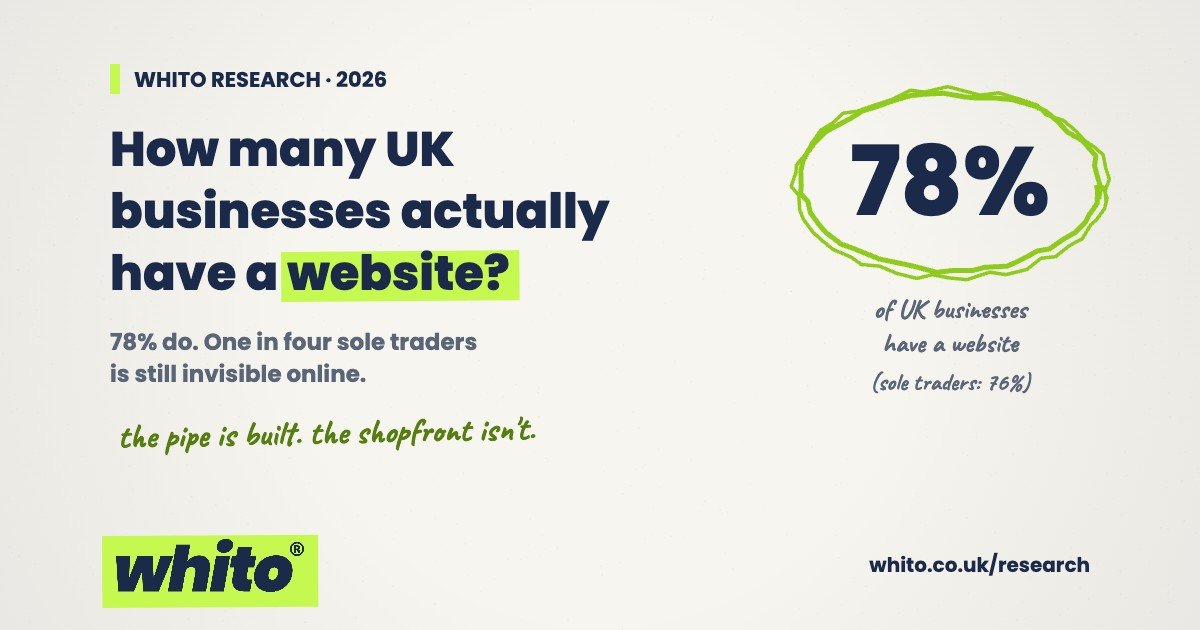
78% of UK businesses have a website, up from 68% two years earlier, according to the government's UK Business Data Survey published in June 2026 from fieldwork with 4,450 businesses. Sole traders sit at 76% and large businesses at 99%.
Source: Whito, whito.co.uk/research/uk-website-statistics, June 2026. Free to quote with a link to this page.
Last Updated on September 11, 2026
How many UK businesses actually have a website, who sells online, and where the real digital gaps are. Every figure sourced and dated.
Ask how many UK businesses have a website and you will get answers ranging from 60% to 95%, usually with no source, no date, and no explanation of who was counted.
Here is the problem. The UK’s main official survey on business websites stopped publishing after its 2019 edition. For half a decade, almost every “UK website statistic” you read was either recycled pre-pandemic data or a marketing survey dressed up as a census.
That has now changed. In June 2026 the government published fresh, official figures. We have pulled them together with the other numbers that actually hold up, checked each one against its source, and explained why the figures disagree with each other.
The mistake most people make
Quoting a website statistic without asking two questions: who was counted, and when.
A survey of employers will always show high website adoption, because businesses big enough to employ people are big enough to have a website. But three quarters of UK businesses employ nobody at all. Count the sole traders and the number drops sharply. Skip them and it soars. Neither figure is wrong. They are answers to different questions.
What we did
We took the newest official source, the UK Business Data Survey 2026 from the Department for Science, Innovation and Technology, published 18 June 2026 from fieldwork with 4,450 UK businesses. We set it alongside ONS retail data, Ofcom’s coverage figures, the Lloyds digital skills research and the main commercial surveys, and checked every number against the original publication.
How many UK businesses have a website in 2026
78% of UK businesses say they have a website. That is the official 2026 figure, up from 68% in the 2023 to 2024 survey.
The size gradient is the real story:
| Business size | Has a website (2026) |
|---|---|
| Large (250+ employees) | 99% |
| Medium (50 to 249 employees) | 97% |
| Small (10 to 49 employees) | 92% |
| Micro (1 to 9 employees) | 84% |
| All UK businesses | 78% |
| Sole traders | 76% |
Source: DSIT, UK Business Data Survey 2026. Fieldwork October 2025 to January 2026.
Put simply: virtually every employer of any size has a website. The gap is concentrated at the smallest end, where roughly one in four sole traders still has none.
Scale that up and the number gets large. The government’s own count, the DBT Business Population Estimates, puts the UK business population at 5.7 million at the start of 2025. If the survey proportions held across that population, well over a million UK businesses would have no website at all. Treat that as a rough Whito estimate combining two different sources, not an official count. Either way, the invisible minority is measured in seven figures.
Why the website numbers disagree
Every popular “how many businesses have a website” figure is answering a slightly different question. Here they are side by side:
| Source | Figure | Who was actually counted |
|---|---|---|
| DSIT UK Business Data Survey, June 2026 | 78% | All UK businesses including sole traders, 4,450 surveyed |
| DSIT UK Business Data Survey, 2024 | 68% | Same survey, 2023 to 2024 fieldwork |
| ONS E-commerce and ICT survey, 2019 | 81.4% | Small businesses with 10 to 49 employees only. The last ONS edition |
| Forbes Advisor survey, 2025 | 78% | Small business owners, commercial online panel |
| LOCALiQ UK report, 2026 | 66% | A different question: businesses that include their website or app in their marketing strategy |
None of these contradict each other once you read the small print. The lesson is not “pick the biggest number”. It is that population and question wording move the answer by 15 points, so any statistic quoted without them is decoration.
The official count went dark for five years
The ONS survey that used to measure this properly, E-commerce and ICT activity, published its last edition for 2019, released in February 2021. No edition has appeared since.
That gap matters. It is why so many articles still quote 2019 website and e-commerce figures as if they were current, and why the June 2026 DSIT survey is the first proper official refresh most of these statistics have had.
Online sales: 28% of UK retail and holding
Internet sales were 28.3% of total UK retail sales in June 2026, according to the ONS retail sales series. The monthly figures have sat between 27% and 28.5% for the whole of 2026 so far.
For context, the share briefly passed 37% at the height of the pandemic, then settled. It did not fall back to the roughly 20% of early 2020. More than a quarter of UK retail is now permanently online.
Note what this series does and does not measure. It is the share of retailer takings, not the share of businesses selling online. But if you sell anything physical and take no orders online, this is the share of the market you are not competing for.
Which channels UK businesses actually use
The LOCALiQ UK State of Digital Marketing report, from a survey of over 500 UK businesses published in January 2026, gives the clearest recent picture of channel use:
| Channel | Share of UK businesses using it |
|---|---|
| Organic social media | 84% |
| Website or app in marketing strategy | 66% |
| Email marketing | 61% |
| Paid social advertising | 57% |
| SEO | 48% |
| PPC search advertising | 31% |
Notice the shape. Social media use (84%) now runs ahead of website use. Posting is easy and free, so it gets done. The channels that compound, a findable website, a mailing list, search visibility, sit further down the list.
The audience is already there. Constant Contact’s 2026 research found that 47.7% of UK shoppers use social media to discover local businesses, and that once they find you, reviews and clear pricing are the first things they look for.
Cloud, connectivity and the infrastructure excuse
Cloud. 31% of UK businesses use a public cloud provider such as AWS, Microsoft Azure or Google Cloud. Large businesses lead at 60%; sole traders sit at 30% (DSIT, 2026).
Connectivity. Full fibre now reaches 82% of UK homes, and gigabit-capable broadband 89%, according to Ofcom’s Connected Nations update published in May 2026 with data from January 2026.
Ten years ago, slow broadband was a legitimate reason a rural trades business had no proper web presence. That excuse has largely gone. The pipe is there. What is missing, where anything is missing, is the structure at the business end of it.
Skills: the constraint nobody budgets for
The Lloyds Essential Digital Skills research for 2025, run by Ipsos with 4,175 UK adults, found that 83% of the UK labour force has the full set of essential digital skills for work. That leaves 17%, roughly one working adult in six, without them.
For a sole trader, the owner’s digital skills are the business’s digital skills. The website gap and the skills gap are substantially the same gap.
On AI, the picture changes by the quarter. Our separate, regularly updated page on UK business AI adoption statistics reconciles the official surveys, which currently range from 25% (ONS) to 71% depending on who is asked.
The pattern worth noticing
This is our reading of the data, not something any of the surveys say.
Every layer of the stack is more built-out than the layer above it. Nearly nine in ten homes can get gigabit broadband. More than a quarter of retail spending is online. Yet only 78% of businesses have a website, fewer put it to work in their marketing, and fewer still have the search visibility or the mailing list that turn a website into revenue.
The constraint on UK small business digital adoption is not infrastructure and it is not tools. It is structure: the unglamorous work of being findable, credible and easy to buy from. The businesses closing the gap fastest, the 68% to 78% jump in two years, are doing that work.
What a business owner should do with this
Three things, all of them boring and all of them worth money.
Be countable. If you are in the website-less minority, fix it. Not because a survey says so, but because 28% of retail spending and nearly half of local discovery now starts online, and a business that cannot be found does not get shortlisted.
Finish the stack you started. If you are among the 84% posting on social but not the 61% with an email list or the 48% doing SEO, you are renting your audience rather than owning it. One owned channel beats three rented ones.
Stop benchmarking against the wrong number. If you employ staff, “78% of businesses have a website” is not your peer group. Yours is 92% and up. At that point a website is not an advantage, it is the ticket to entry, and the advantage comes from what sits on top of it.
The sharp takeaway
The UK does not have a technology gap. It has a structure gap, concentrated almost entirely in its smallest businesses, and it is measured in seven figures.
The pipe is built. The customers moved online years ago. The only question left is whether your business is visible where they are looking.
Is your business one of the invisible ones?
The free Whito Visibility Check checks how findable and trustworthy your business looks online, and tells you the one thing to fix first. It takes about two minutes.
Method, definitions and what this data does not say
Sources. Website, data and cloud figures: DSIT, UK Business Data Survey 2026, published 18 June 2026, fieldwork October 2025 to January 2026, 4,450 UK businesses. Online retail share: ONS, E-commerce and ICT activity (2019 edition, the most recent) and the ONS internet sales as a percentage of total retail sales series, latest month June 2026. Coverage: Ofcom, Connected Nations update, Spring 2026. Skills: Lloyds Essential Digital Skills 2025, run by Ipsos. Channel use: LOCALiQ UK State of Digital Marketing 2026. Consumer behaviour: Constant Contact Small Business Now, 2026. Official statistics are used under the Open Government Licence v3.0. Analysis and interpretation are Whito’s own, not the statistics producers’.
Survey versus census. The DSIT figures are weighted survey estimates, not a register count. Different populations and question wording explain most differences between sources, as set out in the comparison table above.
Commercial surveys. Forbes Advisor, LOCALiQ and Constant Contact figures come from commercial research with self-selected or panel samples. We label them as such and use them only where no official equivalent exists.
Derived figures. The “over a million businesses without a website” figure is Whito’s own estimate, combining the DSIT survey proportion with the DBT business population estimate of 5.7 million. The two sources use different definitions, so it is indicative, not precise.
This article is general information about official and published statistics, not advice for any specific business. Figures are correct as published at the time of writing and may be revised by their producers.
Common questions
How many UK businesses have a website?
78% of UK businesses have a website, according to the government’s UK Business Data Survey published in June 2026. That is up from 68% in the 2023 to 2024 survey.
What percentage of UK small businesses have no website?
Among sole traders, 24% have no website. For micro businesses with 1 to 9 employees the figure is 16%, and for small businesses with 10 to 49 employees it is 8% (DSIT, 2026).
What percentage of UK retail sales are online?
28.3% as of June 2026, according to the ONS internet sales series. The share has held between 27% and 28.5% throughout 2026.
How many UK businesses use social media?
84% of UK businesses include organic social media in their marketing, according to LOCALiQ’s 2026 UK survey, making it the most-used channel, ahead of websites, email and SEO.
How many UK businesses use cloud computing?
31% of UK businesses use a public cloud provider such as AWS, Azure or Google Cloud. Adoption doubles with size: 60% of large businesses against 30% of sole traders (DSIT, 2026).
- UK Business Statistics 2026: population, survival and growth
- AI adoption statistics for UK businesses, updated as new waves publish
- How AI search is changing UK website traffic
The structural checks behind this research run on any website in about twenty seconds. Enter yours and read the full result on the page. Free, and we do not ask for your email.
Run the free Visibility CheckIf your business is named here and you think we have a fact wrong, email hello@whito.co.uk and we will check it and correct it. If you want to respond, send us a statement and we will publish it alongside. Full detail: Corrections, right of reply and removals.