
Last Updated on September 17, 2026
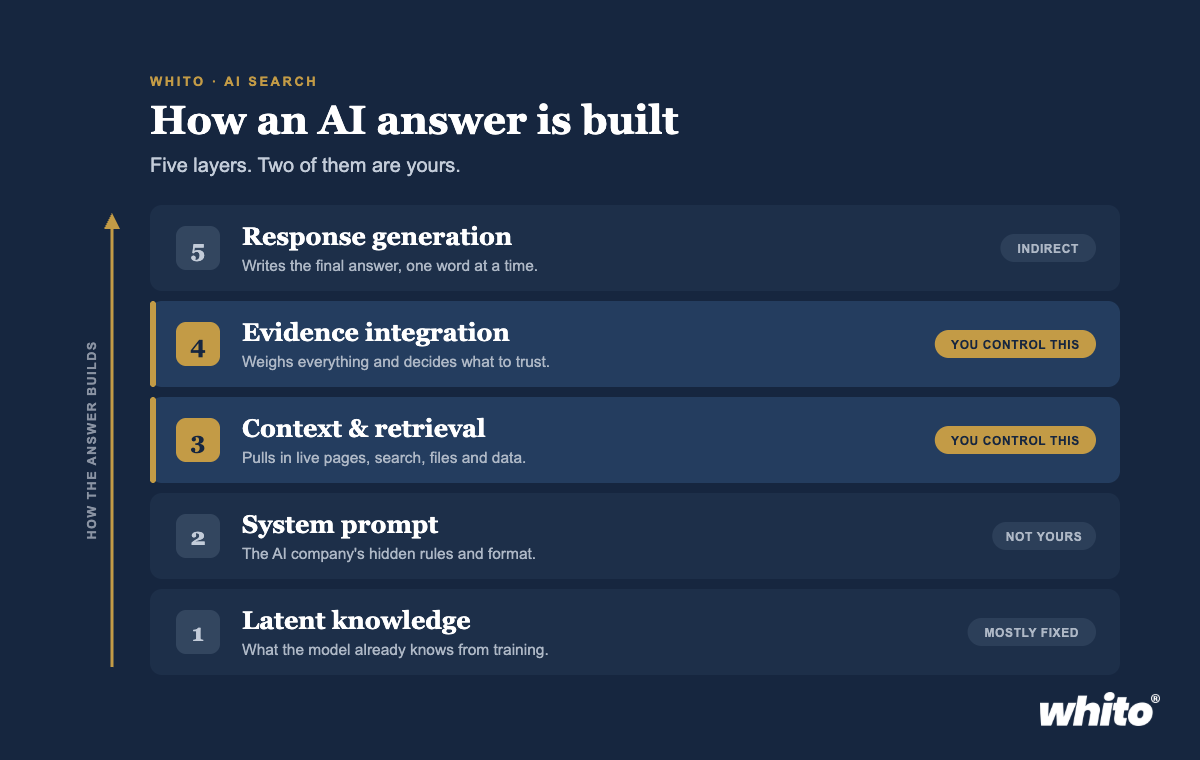
When an AI tool recommends a business, it is not guessing. It builds the answer in stages, and two of those stages are ones you can influence.
Ask ChatGPT, Gemini or an AI search box “what CRM should an accounting firm use” and you get a clean, confident answer in seconds. It feels like magic, or like luck. It is neither. The answer is assembled in stages, and if you understand the stages you can see exactly where a business gets picked or passed over. Most of the panic about AI search comes from treating it as a black box. It is not. Here is what happens under the surface, and where your work actually lands.
The mistake most businesses make
The common reaction to AI search is to look for a trick. A phrase to add, a tag to insert, a way to “rank” the way you once did on Google. So businesses either chase the trick, or decide the whole thing is random and give up.
Both are wrong for the same reason. An AI answer is not one thing, it is five stages stacked on top of each other. Some of those stages are fixed and have nothing to do with you. A couple of them are decided by what you publish and how it is set up. Once you can tell which is which, the work becomes obvious and quite small.
How an AI answer is actually built
Think of it as five layers, from the bottom up. The model starts with what it already knows, adds the rules it has been given, pulls in outside information, weighs that information, and only then writes the reply. This is a simplified working model rather than a wiring diagram, but it holds up well enough to make good decisions from.
1. Latent knowledge Mostly fixed
The facts, concepts and patterns baked into the model during training. This is where general knowledge lives: what a CRM is, what accountants do, which brands come up often in that context.
You cannot edit this layer. But it is shaped over time by how often and how consistently your business is described across the web. A company mentioned the same way in many trusted places is more likely to already be “known”. A company with a thin, inconsistent footprint is not.
2. System prompt Not yours
Hidden instructions from the AI company that set the tone, the safety rules, the format and which tools the model may use. This is why the same question gives a different style of answer in different tools.
You have no access to this layer, and no legitimate way to influence it. Anyone selling you a “prompt hack” to get around it is selling smoke. Skip it and spend your effort where it counts.
3. Context and active retrieval You control this
Here the model reaches outside itself: live search results, pages it can crawl, files, APIs and other current sources. For any question about specific, up to date businesses, this is where your website either shows up or does not.
This is the single biggest lever you have. If your site cannot be crawled, has no clear structure, and gives an AI tool nothing clean to read, you are invisible at exactly the moment it goes looking. We tested this directly in our AI door test, and looked at where the answers actually come from in our study on the sources AI trusts for local recommendations.
4. Evidence integration You control this
The model now weighs everything it has gathered against the question and decides what to trust. Clear, consistent, verifiable information wins. Vague or contradictory information gets dropped, even if it was retrieved.
This is where trust signals earn their keep: plain answers to real questions, structured data an AI can parse, consistent business details, and proof you are a real, checkable company. Most UK sites still fail the basics here, as our AI-readiness study found, and being verifiable on Companies House is one of the strongest signals you can offer.
5. Response generation Indirect
The model writes the final answer one word at a time, drawing on all four layers below. This is the part you see.
You cannot write this sentence, but you can decide what it has to work with. If your page answers the question plainly, in words a customer would use, the model has something clean to lift. If your page buries the answer, it writes around you.
The two layers you actually control
Look back at the five and a pattern appears. Layers one, two and five are largely out of your hands. Layers three and four are not. Retrieval decides whether your business is in the room. Evidence decides whether it gets chosen once it is. Nearly all the useful work of AI visibility sits in those two layers, and both come down to the same thing: publish clear, structured, checkable information on a site an AI can read.
So what do you actually do
None of this needs a big spend. It needs the foundations in the right order.
- Make sure an AI can reach your site: crawlable pages, a sensible structure, nothing important hidden behind scripts. Start with our guide on how UK businesses get found by AI search.
- Answer real questions in plain words, on the page, using the phrasing your customers use. This feeds both retrieval and the final answer.
- Add structured data and FAQ markup so an AI can parse your answers rather than guess at them.
- Keep your business details identical everywhere: name, address, services. Contradictions get you dropped at the evidence stage.
- Be verifiable. A registered, checkable company is a trust signal an AI can lean on, which is a large part of why we built an honest, verified business directory.
The takeaway
An AI answer is built, not guessed. You cannot touch the model or its hidden rules, and you do not need to. Win the two layers you control, retrieval and evidence, and you are in the answer. Ignore them and no clever prompt will put you there.
Common questions
Can I change what an AI model already knows about my business?
Not directly. The trained “latent knowledge” layer is fixed between model updates. What you can do is shape it slowly, by being described clearly and consistently across many trusted sources over time. The faster wins are in retrieval and evidence, where your live website is read on the spot.
Is there a prompt trick that makes AI recommend my business?
No. The instructions that steer an AI tool sit in its system prompt, which you cannot access. Anything sold as a hack to override it does not work. Your influence comes from being easy to find and easy to trust when the model looks outward.
Which of the five layers should a business focus on?
Layers three and four: context and retrieval, and evidence integration. Retrieval decides whether your site is pulled in at all. Evidence decides whether the information is trusted once it is. Both are controlled by clear, structured, checkable content on a crawlable site.
Why does the same question give different answers in ChatGPT and Gemini?
Mostly the system prompt and the retrieval sources differ between tools, so each builds on slightly different material. You cannot control that difference. You can make sure that whichever tool goes looking, it finds a clear, consistent version of your business.
Is this how the models literally work inside?
It is a simplified model, not an engineering blueprint. Real systems vary and overlap these stages. But as a way to decide where to spend your effort, the five-layer view is accurate enough: some layers are fixed, and the ones you can move are retrieval and evidence.
Method and sources
This guide draws on Whito’s own testing of how UK business websites are read by AI tools, alongside published documentation from the major AI providers on retrieval-augmented generation and system prompting. Our related studies are linked throughout.
- Whito, AI door test: what UK business sites allow AI crawlers to see.
- Whito, the sources AI trusts for local recommendations.
- Whito, AI-readiness of UK business websites.
- Whito, verifying UK businesses against Companies House.
This is a general explainer for UK business owners. The five-layer model is a simplified description of how modern AI systems assemble answers, intended to guide practical decisions rather than to describe any single product’s internal architecture.