
Last Updated on September 8, 2026

On 3 June 2026, the UK’s competition regulator forced Google to do something new. Website owners can now stop Google using their content to power AI Overviews, the summaries that sit at the top of search results, without losing their normal place in search.
The big news sites called it a win. And for them, it might be. But if you run a business and you read that headline, here is the trap. You assume their move is your move. It is not.
What actually happened
The Competition and Markets Authority published a binding decision under the UK’s new digital markets rules. Three parts matter.
Publishers can refuse to let their content feed Google’s AI answers. They can do this and still rank normally in standard search. And Google is banned from punishing anyone who opts out.
The controls arrive in stages. The main ones land in Google Search Console by December 2026, with finer page-level controls following by March 2027.
So the option to disappear from AI answers is coming. The question is whether you should take it.
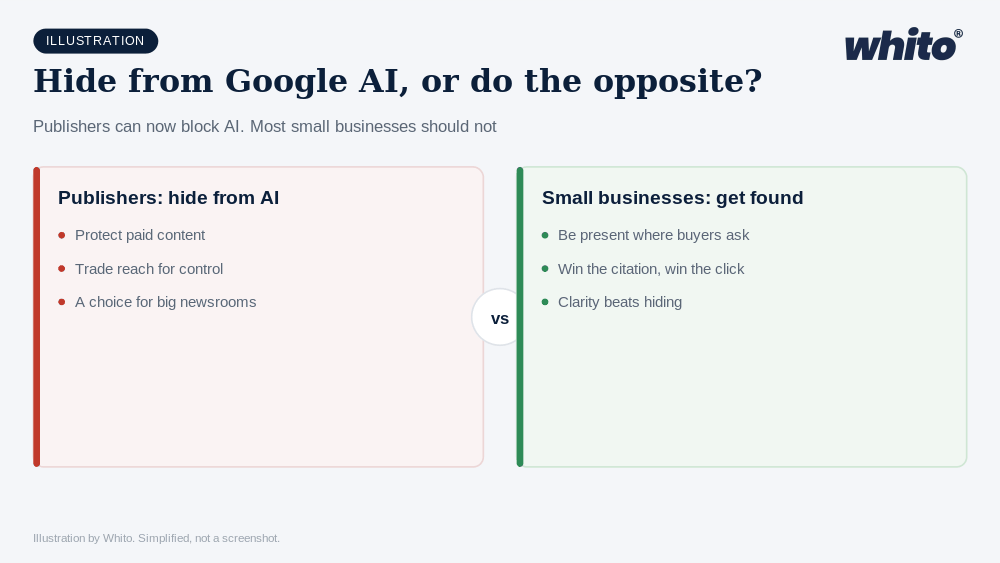
Why the big sites want out
National newspapers live on clicks and ad views. When Google answers a question inside the search page, the reader gets what they came for and never visits the site. The publisher does the work and Google keeps the visit. For a business built on traffic volume, that is a real problem worth fighting.
Your business almost certainly does not work that way.
Why most businesses should stay in
You do not sell page views. You sell a service or a product. You need the right person to find you, trust you, and get in touch. AI answers are quickly becoming the place that introduction happens.
When someone asks Google’s AI, or ChatGPT, “who does emergency boiler repairs in Leeds,” you want to be the name it gives. Opting out of AI answers to protect ad revenue you do not earn is solving a problem you do not have. You would be hiding from the exact moment a customer is ready to choose.
The newspapers are protecting clicks. You should be chasing recommendations. Different game, different move.
Where this sits in the Whito framework
This is a Build problem, not a Start one. It only matters once your basics are sorted: a clear offer, a working Google Business Profile, content that explains what you do in plain words.
If those foundations are weak, AI visibility will not save you. The AI can only recommend a business it can understand. Fix the structure first, then worry about being cited.
For businesses with the basics in place, here is the practical split.
| If you are a… | The CMA opt-out is… | Do this instead |
|---|---|---|
| News or content site living on ad clicks | Worth considering | Weigh lost traffic against control |
| Local service business | Not for you | Make your services easy for AI to quote |
| Product or ecommerce shop | Not for you | Get clear specs and prices on the page |
What to do this week
You do not need new tools or a budget. You need to be quotable.
Check that every key page answers one clear question in plain English near the top. AI summaries lift clean, direct answers, not clever intros. Put your location, services, and prices in text, not buried in an image. Make sure your Google Business Profile is complete and current, because that is one of the first places AI checks. And when December comes and the opt-out appears in Search Console, leave it switched on unless you can name a real reason to vanish.
The takeaway
A rule built to protect newspapers is being read as advice for everyone. It is not. The big sites are fighting to keep clicks. You are trying to be found and recommended. Hiding from the AI answer would be hiding from your next customer. Stay visible, stay clear, and make your business the easy thing to recommend.