Last Updated on September 8, 2026
From 17 June, you will be able to stop Google’s AI from showing your content in its answers with a single toggle. It sounds like taking back control. For most UK businesses, it would be quietly switching off a growing source of customers.
Here is what has actually changed, and what to do about it.
What Google announced
In early June, Google launched new Search Generative AI performance reports in Search Console. For the first time, you can see how often your site appears inside AI Overviews and AI Mode, the AI-generated answers that now sit at the top of many Google searches.
Two details matter for UK businesses.
First, the rollout is UK-first. Google is releasing these reports to a subset of UK website owners before anywhere else in the world, a direct result of the Competition and Markets Authority placing new requirements on Google Search.
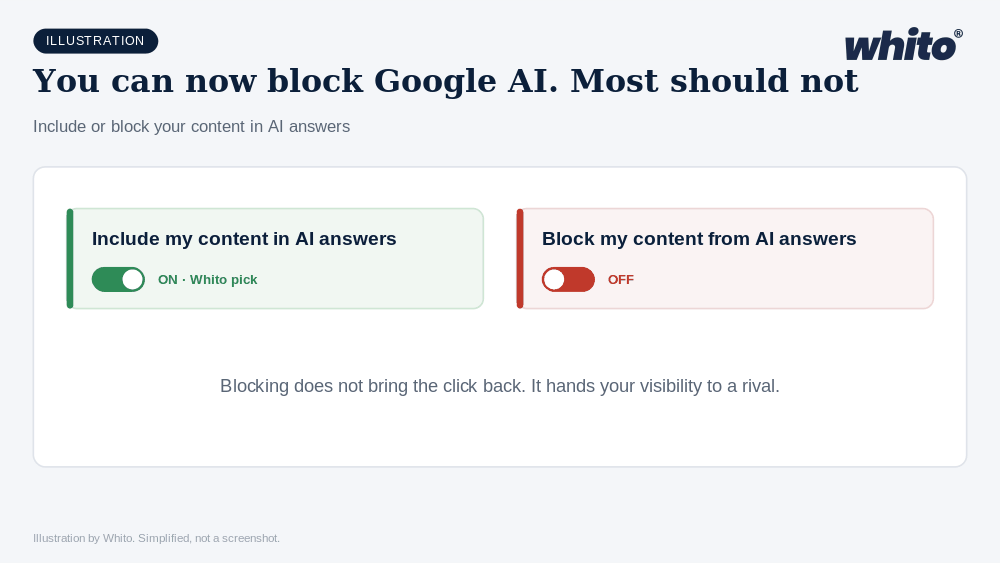
Second, Google is adding a control that lets you block your content from appearing in AI Overviews and AI Mode entirely. That toggle takes effect on 17 June.
Why the block toggle is tempting, and usually wrong
The frustration is real. A recent study covered by Search Engine Land found 68% of Google searches now end without a click. People get their answer from the AI summary and never visit the site that provided it.
So the toggle feels like justice. Google takes your content, you take it back.
But think about who that logic serves. Here is the honest split:
| Your situation | Block AI? | Why |
|---|---|---|
| You sell content itself (publisher, paid research, courses) | Consider it | AI summaries can replace the thing you charge for |
| You sell services (trades, professional services, agencies) | No | AI answers are where customers now find providers |
| You sell products (shops, e-commerce) | No | Blocking removes you from buying-intent answers |
| You rely on local customers | No | Local AI recommendations will name someone. Make it you |
When someone asks Google “best accountant for small limited companies” and the AI builds an answer, you want to be in that answer. Opting out does not slow AI search down. It just hands your spot to a competitor.
What the new report actually tells you
Keep your expectations straight. The report shows impressions, pages, countries and devices for AI features. It does not show clicks.
That makes it a visibility report, not a performance report. Use it to answer one question: is my site part of the answers Google’s AI gives, or invisible to them?
If your AI impressions are near zero while classic search impressions are healthy, that is a signal. AI answers tend to pull from content that demonstrates first-hand experience, clear structure and specific data. Thin service pages rarely make the cut.
What to do this week
1. Log in to Search Console. If you see the new AI performance report, you are in the UK test group. Have a look before you change anything.
2. Compare AI impressions to classic search impressions on your top ten pages. Note which pages appear in AI features and which do not.
3. Leave the block toggle alone unless you sell content itself. For service businesses, shops and local firms, staying visible in AI answers is the whole game.
If you are weighing up whether to invest more in search at all, our UK SEO pricing research covers what businesses actually pay, and our guide to the best SEO tools for UK businesses covers what you can do yourself.
The takeaway
Google has given UK businesses something nobody else in the world has yet: actual data on AI search visibility. Most owners will either ignore it or panic and hit the block toggle.
Do neither. Read the data, find out whether AI answers mention you, and fix the content that is being skipped. Control is not blocking Google. Control is knowing where you stand.