
Last Updated on October 1, 2026
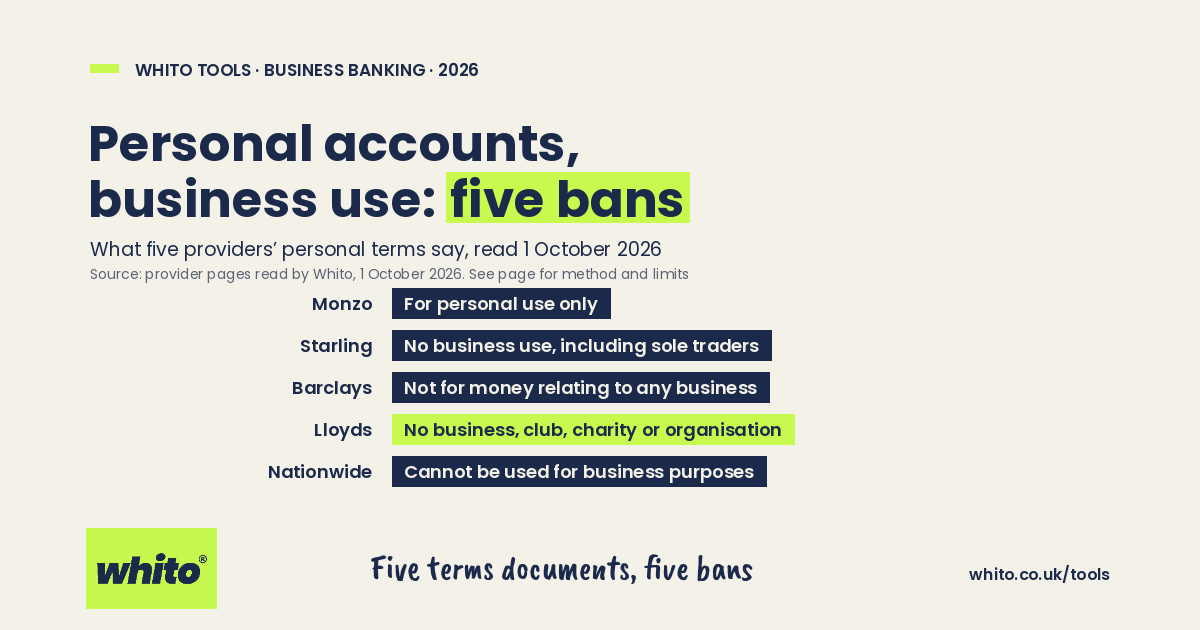
Plenty of new businesses run their first year through a personal current account. Every personal account we checked has a clause that says they should not.
We read the personal current account terms of five UK current account providers on 1 October 2026. We read the personal account terms of five UK current account providers on 1 October 2026 and all five ban business use; Lloyds’s wording shuts out clubs and charities as well.
What the terms actually say
| Provider | The clause, from its personal terms |
|---|---|
| Monzo | “Your Monzo Current Account and linked Pots are for personal use only and mustn’t be used for business purposes.” |
| Starling | “Only use this account for personal purposes. This means you can’t use it for any business purposes (including as a sole trader).” |
| Barclays | “The terms in this booklet cover only accounts for personal use. They’re not for money relating to any business you run.” |
| Lloyds | “Our accounts are for personal customers and must not be used by a business, club, charity or other organisation.” |
| Nationwide | “The account is for personal use and it cannot be used for business purposes.” |
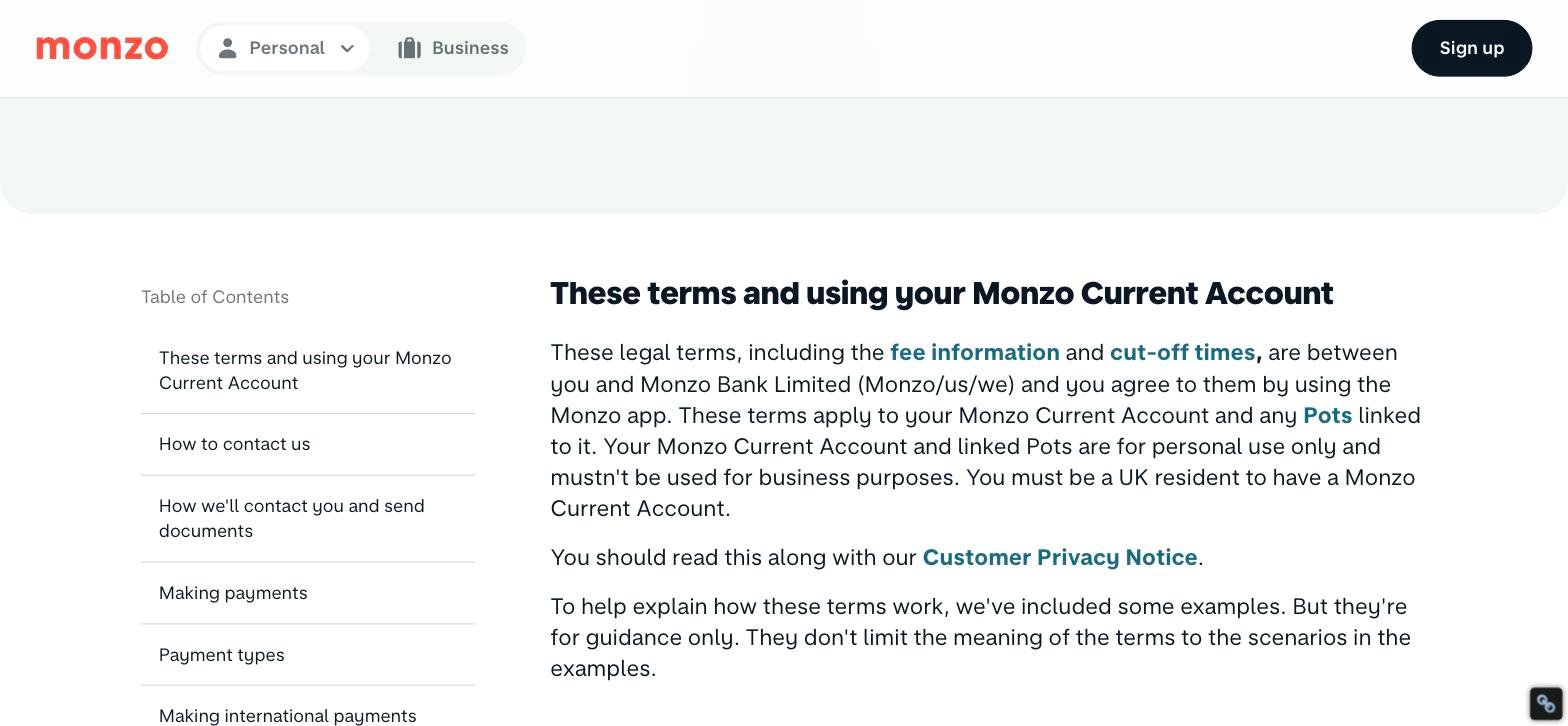
Breaching the terms is the bank’s business as much as yours: the clause is what it points to if it reviews the account.
Limited companies have a harder rule
A company’s money is the company’s, and gov.uk’s guidance on company and accounting records says “your company’s banking must be separate from your personal banking” and that “The simplest way to keep your finances separate is to open a business bank account.” Paying company income into a director’s personal account muddles dividends, loans and salary, and your accountant will charge you to unmuddle it.
Sole traders: no law, two problems
No statute tells a sole trader to open a business account. The two practical problems are the terms above, which cover sole traders explicitly at some banks, and records: gov.uk says you must keep records of your business income and expenses for your Self Assessment tax return if you are a sole trader or partner. A separate account turns that record into a bank statement.
The cost argument has gone
The reason people risk it is price, and the price is now zero at several providers. Six accounts cost our model online sole trader nothing at all in a standard year; our free business bank accounts page lists them, and best business bank accounts UK prices the full set. If cash or clients push you toward a particular provider, the trade pages linked from it go deeper.
Open the business account before the bank reads your statements for you. It costs nothing at several providers, and it makes January’s Self Assessment an export instead of an archaeology dig.
Questions
Is it illegal to use a personal account for business?
For a limited company the money belongs to the company, and gov.uk says the company’s banking must be separate from your personal banking. For a sole trader no law names a bank account. Every personal account we checked bans business use in its terms.
Can a sole trader use a personal bank account?
HMRC requires records of business income and expenses for Self Assessment, and a mixed account makes those records harder. The bigger problem is the account terms: Starling’s personal terms say you cannot use the account for any business purposes, including as a sole trader.
What happens if I run a business through my personal account?
You are outside the account’s terms, which the bank can act on. Lloyds’s personal terms say the accounts must not be used by a business, club, charity or other organisation. Free business accounts exist, so the saving is smaller than it looks.