
Finding
69.5% of UK Google searches ended without a click to any website between January and April 2026, the highest rate of six countries measured, and the UK sent just 232 clicks to the open web per 1,000 searches, according to SparkToro's analysis of Similarweb data.
Source: Whito, whito.co.uk/research/uk-search-engine-statistics, April 2026. Free to quote with a link to this page.
Last Updated on September 15, 2026
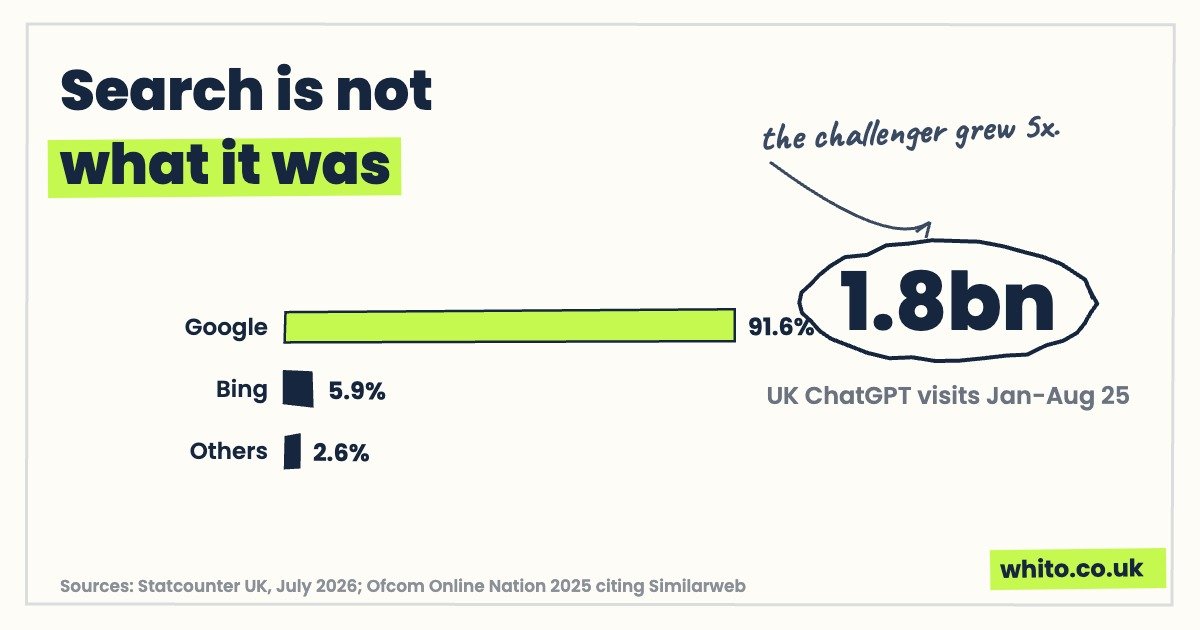
The UK now has the highest zero-click search rate of any country measured. In the first four months of 2026, 69.5% of UK Google searches ended without a single click to any website, the highest figure across the six countries in SparkToro’s analysis of Similarweb panel data.
Most UK businesses are still optimising for a click. The data says the click is increasingly not coming.
That changes the question. It is no longer “do we rank”. It is “are we the answer”. This page pulls together the verified numbers on who runs UK search, how much of it happens, how often it ends in a click, and how fast AI tools are taking a share of it. Every figure is dated, sourced and labelled by geography, because most search statistics floating around are not.
Key UK search statistics
91.56% of UK search traffic goes through Google (Statcounter, July 2026).
69.5% of UK Google searches end without a click, the highest of six countries measured (SparkToro/Similarweb, Jan to Apr 2026).
The UK sends just 232 clicks to the open web per 1,000 Google searches, the lowest of the six (SparkToro/Similarweb, Jan to Apr 2026).
UK users run around 3 billion Google searches a month (Ofcom Online Nation, Dec 2025).
Around 30% of UK searches now show an AI Overview (Ofcom, Dec 2025).
ChatGPT had 1.8 billion UK visits in the first eight months of 2025, roughly five times the same period of 2024 (Ofcom, citing Similarweb).
Ofcom describes ChatGPT as “already the second-largest search service” in the UK (Ofcom, Dec 2025).
Over 200,000 UK firms spent more than £10 billion on Google search advertising in 2024 (CMA, Oct 2025).
Google was the first firm designated with Strategic Market Status under the UK’s new digital markets regime, on 10 October 2025 (CMA).
In the US, clicks on traditional results roughly halve when an AI summary appears, 8% versus 15% (Pew Research Center, March 2025, US data).
For AI search figures Whito counted itself, from AI answers it collected and registers it checked, see UK AI search and trust statistics: 55 figures, each with its date and method.
Who runs UK search
Google holds 91.56% of UK search traffic (Statcounter, July 2026), and the CMA’s official finding is that Google accounts for more than 90% of all general search queries in the UK. Nobody disputes it, and it is not close.
Statcounter’s tracker, which measures pageview referrals rather than people, puts Google at 91.56% of UK search traffic in July 2026. Bing is a distant second at 5.87%. Everything else is a rounding error.
UK search engine market share, July 2026
Source: Statcounter Global Stats, July 2026, United Kingdom. Commercial tracker; measures share of pageview referrals, not share of people.
The official view matches the commercial one. In its final decision of 10 October 2025, the Competition and Markets Authority stated that “Google Search accounts for more than 90% of all general search queries in the UK”.
That decision mattered for another reason. It made Google the first firm ever designated with Strategic Market Status under the Digital Markets, Competition and Consumers Act. Conduct requirements, the rules that come with the designation, began in June 2026.
The CMA’s paperwork also puts hard commercial numbers on the dependency. Google Search receives 5 to 10 daily queries per UK citizen (the CMA publishes this as a bracketed range). And over 200,000 UK firms collectively spent more than £10 billion on Google search advertising in 2024.
So the market is concentrated, regulated, and expensive to advertise in. What it is not, any longer, is a reliable pipe of clicks.
How much searching does the UK actually do
Ofcom’s Online Nation 2025 report, published in December 2025, gives the clearest official picture of UK search behaviour.
82%
of UK online adults used Google Search in a month
~3bn
UK Google searches every month
5 to 10
daily Google queries per UK citizen (CMA published range)
£10bn+
spent on Google search ads by 200,000+ UK firms in 2024 (CMA)
Sources: Ofcom Online Nation 2025 (published Dec 2025, UK); CMA final decision, Oct 2025.
Three billion searches a month is an enormous amount of demand. People have not stopped asking questions. That point matters, because the rest of this page is about where the answers now come from.
Demand is intact. Distribution is what changed.
The zero-click reality
69.5% of UK Google searches now end without a click to any website, the highest rate of any country SparkToro analysed. It is the number that should reset how UK businesses think about search.
SparkToro’s June 2026 analysis of Similarweb panel data, covering January to April 2026 across six countries, found that 69.5% of UK Google searches ended without a click. That is the highest zero-click rate of the six countries measured: UK, US, Canada, France, Italy and Germany.
The UK also sends the fewest clicks to the open web of the six: just 232 clicks per 1,000 searches.
Share of Google searches ending without a click
Source: SparkToro analysis of Similarweb panel data, Jan to Apr 2026, published June 2026. Base: desktop and mobile web panel across six countries; excludes the Google mobile app.
The direction of travel is as important as the level. In the US, the zero-click rate rose from 60.45% in 2024 to 68.01% in 2026 on the same panel. The UK sits above even that.
Pew Research Center measured what actually happens on the results page. Its US study of 900 adults and 68,879 searches in March 2025 found that when an AI summary appeared, users clicked a traditional result on just 8% of visits, against 15% when no summary appeared. Links inside the AI summary itself were clicked on just 1% of visits.
How often US users clicked, by results page type
Source: Pew Research Center, March 2025. Base: 900 US adults, 68,879 searches. US data, shown for behaviour comparison only; bars scaled to the largest value.
Pew also found that users ended their browsing session entirely after 26% of pages with an AI summary, against 16% without one. The summary is often the destination.
This is the mistake most UK businesses are still making. They measure rankings and pay for clicks, in a market where seven in ten searches produce no click at all. We cover what that means for SEO specifically in our sister report, UK SEO Statistics 2026, published alongside this page.
The question is no longer whether you rank. It is whether you are the answer when nobody clicks.
AI Overviews in the UK
Google’s AI Overviews, the generated summaries at the top of results, launched in the UK on 15 August 2024, per Google’s own announcement.
Two years on, they are no longer an experiment. Ofcom reports that around 30% of UK searches now show an AI Overview, and 53% of UK adults say they often see AI summaries in results.
15 Aug 2024
AI Overviews launched in the UK (Google)
~30%
of UK searches now show an AI Overview (Ofcom)
53%
of UK adults often see AI summaries in results (Ofcom)
Sources: Google blog, Aug 2024; Ofcom Online Nation 2025, published Dec 2025, UK.
What do those summaries do to traffic? The cleanest evidence is American, so treat it as directional for the UK rather than a UK measurement. On SparkToro’s US panel, AI Overviews appear on more than 20% of US searches, and where they appear, click-through drops by nearly 60%.
Put the two together. Roughly three in ten UK searches now open with an answer Google wrote itself, drawing on pages it chose to cite. If your business is not in the pool being cited, you are absent from the part of the page most people read first.
Being cited is not the same skill as ranking. It rewards clear, specific, well-sourced pages that answer one question properly, which is a structural job, not a tactical one.
The challengers: ChatGPT and the rest
The second shift is happening off Google entirely.
Ofcom, citing Similarweb, reports that ChatGPT had 1.8 billion UK visits in the first eight months of 2025, up from 368 million in the same period of 2024. That is roughly five times as many in a year.
368m
UK ChatGPT visits, Jan to Aug 2024
1.8bn
UK ChatGPT visits, Jan to Aug 2025, roughly five times more
252m
UK web visits in August 2025 alone, up 156% year on year
Source: Ofcom Online Nation 2025, citing Similarweb. UK web visits; the Similarweb panel measures web traffic.
Ofcom’s own words are worth quoting: it describes ChatGPT as “already the second-largest search service” in the UK. Not the second-largest chatbot. The second-largest search service.
The rest of the field is growing fast from smaller bases. Ofcom’s year-on-year UK visit growth figures: Gemini up 146%, Claude up 138%, Perplexity up 100%. Ofcom publishes these as growth rates only, without absolute visit numbers.
Year-on-year growth in UK web visits, AI tools
Source: Ofcom Online Nation 2025, citing Similarweb. UK, year on year. Growth rates only; Ofcom does not publish absolute figures for Gemini, Claude or Perplexity. Bars scaled to the largest value.
None of this dethrones Google. It does something more awkward: it adds a second front. Customers now ask an AI tool “who should I use for X near me” and get a shortlist of three or four names, with no results page at all.
Whito’s ongoing research programme tests exactly this, asking AI engines how they recommend UK businesses across sectors and recording which firms get named and why. Those studies live on our research hub, and our report on which AI tools UK businesses actually use covers the adoption side.
Is search shrinking or growing?
Given all of the above, you might expect Google to be losing volume. Google says the opposite. Treat this section with the label it deserves: these are the company’s own claims, made in earnings remarks, about global figures.
| Claim | Scope | Who says so |
|---|---|---|
| Overall queries and commercial queries on Search continued to grow year on year | Global | Alphabet Q2 2025 earnings remarks (company’s own claim) |
| AI Overviews drive over 10% more queries for the query types that show them | Global | Alphabet Q2 2025 earnings remarks (company’s own claim) |
| AI Overviews have over 2 billion monthly users | Global | Alphabet Q2 2025 earnings remarks (company’s own claim) |
Source: Alphabet Q2 2025 earnings remarks, July 2025. Global, unaudited product claims by the company.
Both things can be true at once, and the panel data suggests they are. People are searching more, and clicking less. Queries grow while the open web’s share of the outcome shrinks.
For Google, that is a fine trade. For a UK business whose plan is “rank, get the click, convert the visit”, it is a slow leak in the middle of the funnel.
Over 200,000 UK firms spent more than £10 billion on Google search ads in 2024, much of it chasing a click that is quietly disappearing.
What this means for being found
The old model was simple. Rank on page one, earn the click, do the selling on your own site.
The numbers on this page describe a different machine. Around 30% of UK searches open with a generated answer. Seven in ten UK searches end without any click. And the second-largest search service in the country, on Ofcom’s description, does not have a results page at all.
| Old assumption | What the 2026 data shows |
|---|---|
| Ranking well means getting traffic | 69.5% of UK searches end with no click at all (SparkToro/Similarweb) |
| The results page is a list of links | Around 30% of UK searches open with an AI Overview (Ofcom) |
| Search means Google | ChatGPT is “already the second-largest search service” in the UK (Ofcom) |
| More ad spend fixes visibility | UK firms already spend £10bn+ a year on Google search ads (CMA) |
The practical response is not panic, and it is not abandoning search. Three billion monthly searches is still where UK demand lives. The response is to stop optimising only for the click and start optimising to be the answer.
In plain terms, that means three things.
- Be citable. AI Overviews and AI assistants quote pages that answer a specific question clearly, with evidence. Vague brochure pages do not get cited.
- Be findable off Google. If customers ask ChatGPT for recommendations, your visibility inside those answers is now a commercial asset. Check what the engines currently say about your market before spending anything.
- Measure what still converts. Fewer clicks means each one is worth more. Track enquiries and revenue by source, not rankings.
This sits squarely in the order Whito always argues for: structure before scale. Fix what the engines can find and cite about you before buying more traffic on top of a weak base.
Methodology and sources
All figures on this page come from the sources below, with dates and geography as stated. Where a figure is a company’s own claim, it is labelled as such in the text.
- Statcounter Global Stats, UK search engine market share (commercial tracker, July 2026, UK).
- CMA final decision, Strategic Market Status investigation into Google’s general search services (official, 10 October 2025, UK).
- CMA blog, improving the way Google delivers search services in the UK (official, January 2026, UK).
- Ofcom, Online Nation 2025 (official, published December 2025, UK; AI tool visit figures cite Similarweb).
- Pew Research Center, Google users and AI summaries (independent, July 2025, US data: 900 adults, 68,879 searches, March 2025).
- SparkToro, zero-click searches highest in the UK (commercial, June 2026; Similarweb panel, Jan to Apr 2026, six countries).
- SparkToro, US zero-click analysis 2026 (commercial, June 2026, US).
- Google, AI Overviews UK launch announcement (company, August 2024).
- Alphabet Q2 2025 earnings remarks (company, July 2025, global claims).
Known limits. Statcounter measures pageview referrals rather than people, so heavy searchers count more than light ones. The SparkToro zero-click analysis covers six countries on a Similarweb web panel that excludes the Google mobile app, so true zero-click rates may differ. Pew’s click-rate study is US data and is presented here as behavioural evidence, not as a UK measurement. Google’s query-growth figures are the company’s own claims from earnings remarks and are not independently audited. The CMA’s queries-per-citizen figure is published as a bracketed range, 5 to 10, and is quoted as such.
A statistic we refuse to use. You will often read that “46% of searches are local”. That number has no primary source. It traces back to a 2018 conference tweet and has been recycled ever since. It does not appear on this page, and we would treat any report that leans on it with caution.
How to cite this page
Whito, “UK Search Engine Statistics 2026”, whito.co.uk, updated 21 August 2026. Reuse of these figures is permitted with attribution and a link to this page.
Frequently asked questions
What percentage of UK searches go through Google?
Statcounter puts Google at 91.56% of UK search traffic in July 2026, measured by pageview referrals. The CMA’s official finding is that Google accounts for more than 90% of all general search queries in the UK.
What is a zero-click search, and how common is it in the UK?
A zero-click search is one that ends without the user clicking through to any website. SparkToro’s analysis of Similarweb panel data for January to April 2026 found 69.5% of UK Google searches ended without a click, the highest rate of the six countries measured.
Is ChatGPT really the second-largest search service in the UK?
That is Ofcom’s description, not ours. Ofcom, citing Similarweb, reports 1.8 billion UK ChatGPT visits in the first eight months of 2025, roughly five times the same period of 2024, and calls it already the second-largest search service in the UK.
Do AI Overviews reduce clicks to websites?
The best evidence says yes. Pew’s US study found users clicked a traditional result on 8% of visits when an AI summary appeared, versus 15% without one, and SparkToro’s US data shows click-through dropping by nearly 60% where AI Overviews appear. Both are US studies, but around 30% of UK searches now show an AI Overview.
Is Google search shrinking?
Not by volume. Google’s own Q2 2025 earnings remarks, a company claim, say overall and commercial queries continued to grow globally. What is shrinking is the share of searches that send a click to the open web, which is the part most businesses depend on.
The takeaway
UK search demand is enormous and still growing: around 3 billion Google searches a month, plus the fastest-growing AI search audience Ofcom has measured. But 69.5% of those Google searches now end without a click, the highest rate of any country in the data.
Revenue no longer follows rankings by default. It follows whoever the answer names. Audit what Google’s AI Overviews and tools like ChatGPT currently say about your market, make your pages specific enough to be cited, and judge every pound of search spend by enquiries, not clicks.
Rank if you can. Be the answer either way.
The structural checks behind this research run on any website in about twenty seconds. Enter yours and read the full result on the page. Free, and we do not ask for your email.
Run the free Visibility CheckIf your business is named here and you think we have a fact wrong, email hello@whito.co.uk and we will check it and correct it. If you want to respond, send us a statement and we will publish it alongside. Full detail: Corrections, right of reply and removals.