
Data last verified: 20 October 2026. Figures re-checked against their primary sources under the Whito rolling re-verification programme.
Finding
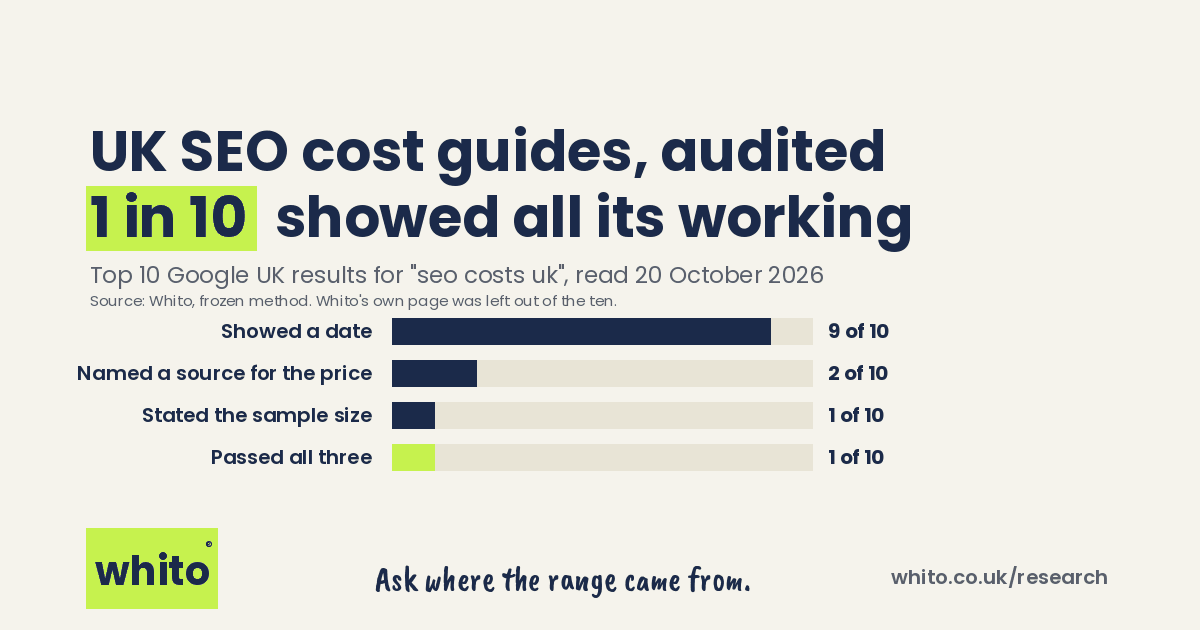
On 20 October 2026, 1 of the top 10 Google UK results for “seo costs uk” showed a date, named a source for its headline price and stated how many prices that source was built on.
Source: Whito, whito.co.uk/research/seo-cost-guides-audit, 2026-10-20. Free to quote with a link to this page.
Last Updated on October 20, 2026
Reading 1 of a quarterly series. Read on 20 October 2026. Next reading: January 2027. Same search, same ten-result rule, same three tests every time, so the numbers can be compared from one quarter to the next.
If you search Google for what SEO costs in the UK, you get ten confident price ranges. We wanted to know how many of them show where their numbers come from.
On 20 October 2026, 1 of the top 10 Google UK results for “seo costs uk” showed a date, named a source for its headline price and stated how many prices that source was built on.
The short answer
- Dates are common. 9 of the 10 pages showed a date. 5 of the 10 showed a separate “updated” date.
- Sources are rare. 2 of the 10 named a source for their headline monthly price. 3 more described a basis, such as “our own experience”, without naming one. 5 gave no basis at all.
- Sample sizes are rarer still. 1 of the 10 said how many prices or agencies its figures were built on.
- 9 of the 10 pages were written by agencies that sell SEO. That does not make their numbers wrong. It does mean the reader is getting the seller’s view of the price.
The three tests
Each page was scored yes or no on three tests. The tests are fixed and will not change between readings.
| Test | A page passes if | Passed |
|---|---|---|
| Dated | A reader can see a publish or update date on the page. A year in the title does not count. | 9 of 10 |
| Sourced | The headline monthly price range is tied to a named source: a named survey, dataset or publisher, or the page’s own stated collection of prices. | 2 of 10 |
| Sample stated | The page says how many prices, agencies or people sit behind that headline range. | 1 of 10 |
| All three | Passes every test above. | 1 of 10 |
We call this the Frozen Ten: the same query, the same three tests, re-read every quarter. Freezing the method is the point. If a page adds a source next quarter, the series records it.
Where the headline price came from
| Basis given for the headline monthly price | Pages |
|---|---|
| Named a source | 2 |
| Described a basis but named no source (for example “personal experience” or “published price guides”) | 3 |
| Gave no basis | 5 |
| Total | 10 |
What else we counted
- A sources list is not the same as a source. 4 of the 10 pages carried a list of sources. On 2 of those 4, none of the listed sources was a source for the headline price. They supported other figures on the page.
- The sources often loop back. Both pages that named a source for the headline price listed at least one SEO agency’s own price guide among those sources. One listed a guide that sat in this same top 10.
- Percentages without a source. 4 of the 10 pages stated at least one percentage as fact, such as a share of agencies or a price rise since 2024, with no source given for it.
- The date in the code does not always match the date on the page. 8 of the 10 pages carried a modified date in their structured data. On 2 of those 8, that date was not a date shown to readers. One showed no date at all.
Why this matters if you are buying SEO
Most business owners use a price guide to check whether a quote is fair. That only works if the guide’s range is built on something you could check.
A range with no source is one company’s opinion of the market. It may be a good opinion. But when the company writing it also sells the service, the range tends to start where its own prices start.
Before you use a price guide to judge a quote, ask three questions:
- When was this written? Look for a date on the page, not a year in the title.
- Where does the range come from? Look for a named survey, dataset or list of prices. “Industry data” is not a source.
- How many prices is it built on? A range built on 400 agencies tells you more than a range built on one agency’s price list.
If a guide fails all three, treat its range as a starting point for questions, not as a benchmark.
Our own page
Whito publishes an SEO cost page of its own, UK SEO costs. On 20 October it appeared in the results at the point where the tenth slot would have been. We left it out and took the next result, so we were not scoring ourselves inside the ten.
Scored on the same three tests, our page passes all three: it shows a date, names its source (Whito’s own file of published UK SEO prices, June 2026) and states its sample (45 published prices). It also shows two different update dates in two places, which is the kind of thing this audit counts. We have flagged it for correction.
How we did it
- Search: “seo costs uk” on google.co.uk, English (UK), with personalisation off. Google confirmed “Results are not personalised” and a United Kingdom location. Read on the morning of 20 October 2026.
- The ten: the first ten organic web results, in order, across pages 1 and 2. Ads, AI summaries, “People also ask”, video and forum results were skipped. Whito’s own page was skipped and the next result taken.
- Scoring: each page was read in full on the same morning and scored on the three tests above. The headline price is the main monthly figure the page gives in its opening answer or first price table.
- Evidence: screenshots of the results pages and of the date, price basis and sources on each page are kept on file.
- Naming: we publish counts, not a list of pages that failed. The method is public, so anyone can run the same search and score the same pages.
What this does not prove
- Ten pages on one day. Search results move. We re-ran the page 2 search later the same morning and the order below our tenth result had shifted.
- A page with no source can still give an accurate range. These tests measure whether a reader can check the number, not whether the number is right.
- A named source can still be weak. The one page that passed the sample test used polls that were not limited to the UK. The test asks whether a sample is stated, not whether it is a good one.
- We scored the headline monthly range only. Two pages sourced other figures, such as day rates or traffic shares, and did not source the headline price.
Download the data
The scores for all ten pages, one row each, with the pages shown as Guide A to Guide J: whito-seo-cost-guides-audit-2026-10-20.csv. Free to reuse with a link to this page.
If you want the price ranges themselves, read our UK SEO costs page and the UK Marketing Cost Index. If you are holding a quote, the marketing cost calculator shows where it sits.
Cite this research
Whito Research (2026). UK SEO Cost Guides Audit: the Frozen Ten. Whito. https://whito.co.uk/research/seo-cost-guides-audit/
Key finding: On 20 October 2026, 1 of the top 10 Google UK results for “seo costs uk” showed a date, named a source for its headline price and stated how many prices that source was built on. 9 showed a date and 2 named a source.
The structural checks behind this research run on any website in about twenty seconds. Enter yours and read the full result on the page. Free, and we do not ask for your email.
Run the free Visibility CheckIf your business is named here and you think we have a fact wrong, email hello@whito.co.uk and we will check it and correct it. If you want to respond, send us a statement and we will publish it alongside. Full detail: Corrections, right of reply and removals.