
Last Updated on October 1, 2026
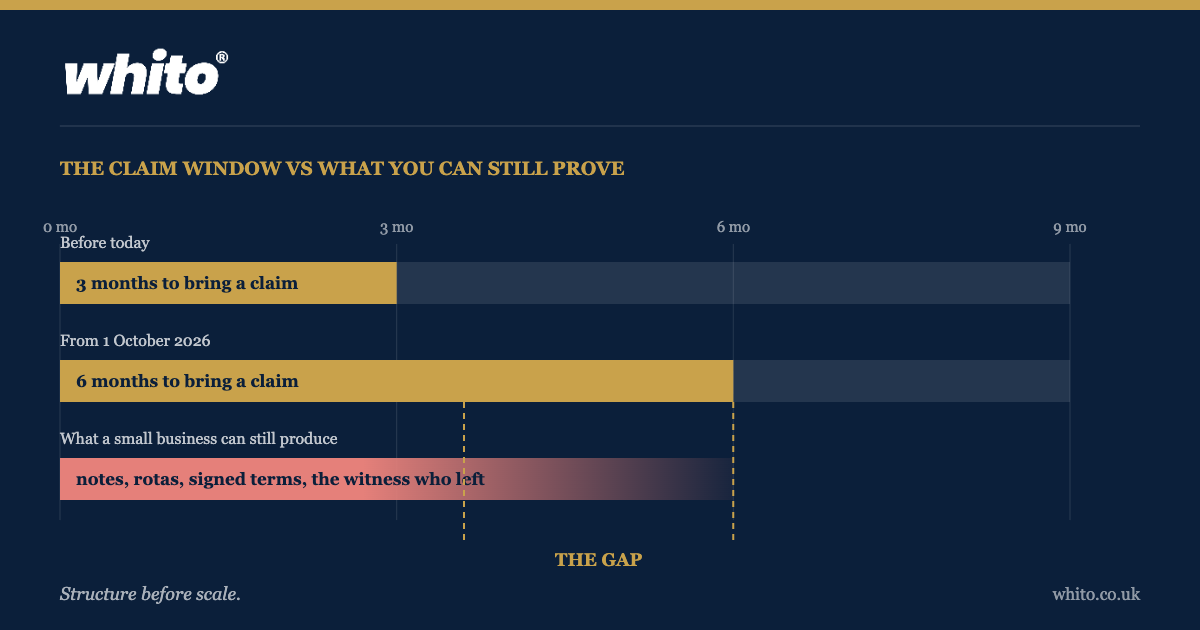
From today, an employment tribunal claim can be brought up to six months after the event instead of three. Most coverage will file this under employment law. It is really a record-keeping story, and it lands on every business in the UK that pays anybody to do anything.
What changed at midnight
The Employment Rights Act 2025 (Commencement No. 5 and Transitional Provisions) (Amendment) Regulations 2026 brought section 152 and Schedule 12 of the Employment Rights Act 2025 into force on 1 October 2026. The explanatory note to the regulations says what they do without any hedging: they “extend time limits for instituting claims to employment tribunals from three to six months”.
The Schedule to the regulations lists the claims affected and the date each clock starts from. Unfair dismissal is in there, running from the effective date of termination. So is an unauthorised deduction from wages, running from the date of the payment.
It is not retrospective. Regulation 4 restricts the longer window to cases where the relevant date, meaning the date of the thing being complained about, falls on or after today. Anything that happened in September keeps the old three-month clock.
Nothing you have already done got riskier overnight. Everything you do from this morning has a tail twice as long.
The mistake most owners make
Small firms treat the three-month limit as a survival clock. Let someone go in March, hear nothing by June, stop thinking about it.
That instinct was never quite right, because early conciliation already paused the clock in practice. From today it is wrong by twice as much. A falling-out in October can arrive as a claim the following April, by which point the business has had two quarters, a Christmas and probably a staff change.
The question a tribunal answers is not whether you were right. It is whether you can still show it.
Six months is the awkward number
Three months sits roughly inside working memory. Most owners can still picture the conversation, find the message thread, name who else was in the room.
Six months is past that line. The colleague who witnessed it has moved on. The phone has been replaced. The rota was overwritten in the app. The invoice is in an email account nobody checks.
Small businesses rarely lose these things on the merits. They lose them on retrieval.
| What most small firms actually keep | What still exists after six months |
|---|---|
| The conversation, in your head | A dated note you emailed to yourself that evening |
| WhatsApp messages on a personal phone | An exported thread saved with the staff file |
| A rota in an app that rolls forward | A monthly export, stored once, somewhere searchable |
| A contract template, somewhere | The signed version that person actually agreed to |
| “We paid them what they were owed” | The final pay calculation, with the dates on it |
The thirty minute version
You do not need an HR system for this. You need three things to exist somewhere you can find them in April.
One. Date the difficult conversations. Two lines, emailed to yourself the same day. The timestamp is the point, not the prose.
Two. Keep the signed version, not the template. Written terms only help you if you can produce the one that person agreed to. This is the same failure we found outside employment: our read of 39 UK agency pricing pages against their own contract terms turned up 19 that never say how you leave. The clause nobody looked at is reliably the clause that gets quoted back.
Three. Build a leaver file. Final pay calculation, dates, who decided what and when. Keep it for a year, not a quarter.
The one-line test. Pick someone who left your business six months ago. Can you produce their signed terms, their final pay calculation and the date they were told, in under ten minutes, without ringing anybody? If not, that is the gap the new window just doubled in size.
It is not the only clock that moved today
Right to work checks widened this morning as well, reaching people engaged under a worker’s contract, individual subcontractors and online matching platforms. We covered what that means if you do not think of yourself as an employer last week. With 4.57 million self-employed people in the UK, “we do not employ anyone” protects fewer businesses than it used to.
Two separate rule changes, one morning, both landing on the same weak point. Not whether you behaved properly. Whether you can produce the document when somebody asks.
The takeaway
Nothing about your business became less lawful today. The window in which someone can test it got twice as long. That is a filing problem, not a policy problem, and it is cheaper to fix this week than to explain next April.
Structure before scale. The structure here is a folder and a habit.