
Last Updated on September 27, 2026
Most owners have a settled answer to right to work checks: “that is an employer thing, and I do not employ anyone.”
On Thursday 1 October that answer stops working. Not because the law covers everyone now, but because the question changes. It is no longer whether you employ people. It is what you do with the work.
What actually comes into force
Section 48 of the Border Security, Asylum and Immigration Act 2025 comes into force on 1 October 2026. The commencement regulations, made 24 June, do one thing: widen who counts as an employer for right to work purposes.
Until Thursday the duty bites on contracts of employment. From Thursday it also covers engaging an individual under a worker’s contract, engaging an individual subcontractor, and running an online matching service that puts individual providers in front of customers for a fee.
The Home Office announced the policy in March 2025, framed around food delivery, construction, beauty salons and courier work. That is why most small firms filed it as somebody else’s story. The draft guidance, updated 11 September 2026, is broader.
One word carries the whole thing
The word is “individual”. The new duty lands on engaging a person. It does not land on buying a service from a business.
The guidance is clear here. It does not apply to “individuals who are operating an independent business either in their own name or through their own company and who contract directly with clients or customers”. Its own examples: a self-employed plumber who advertises publicly and works for many customers needs no check, and nor does a client paying a personal service company.
| Arrangement | Check needed from 1 October? |
|---|---|
| You pay a limited company for a service you use in your own business | No |
| A genuinely independent tradesperson quotes you and works for many customers | No |
| You engage an individual under a worker’s contract | Yes |
| You engage an individual subcontractor to help deliver a job you owe a client | Yes |
| You run a platform that matches individual providers to customers for a fee | Yes |
So the job is not learning immigration law. It is knowing whether the party you pay is a business or a person. Most owners assume the trading name tells them. It does not. When we checked 164 UK trade names against Companies House, 48 failed to match a live company record.
The part that catches ordinary service businesses
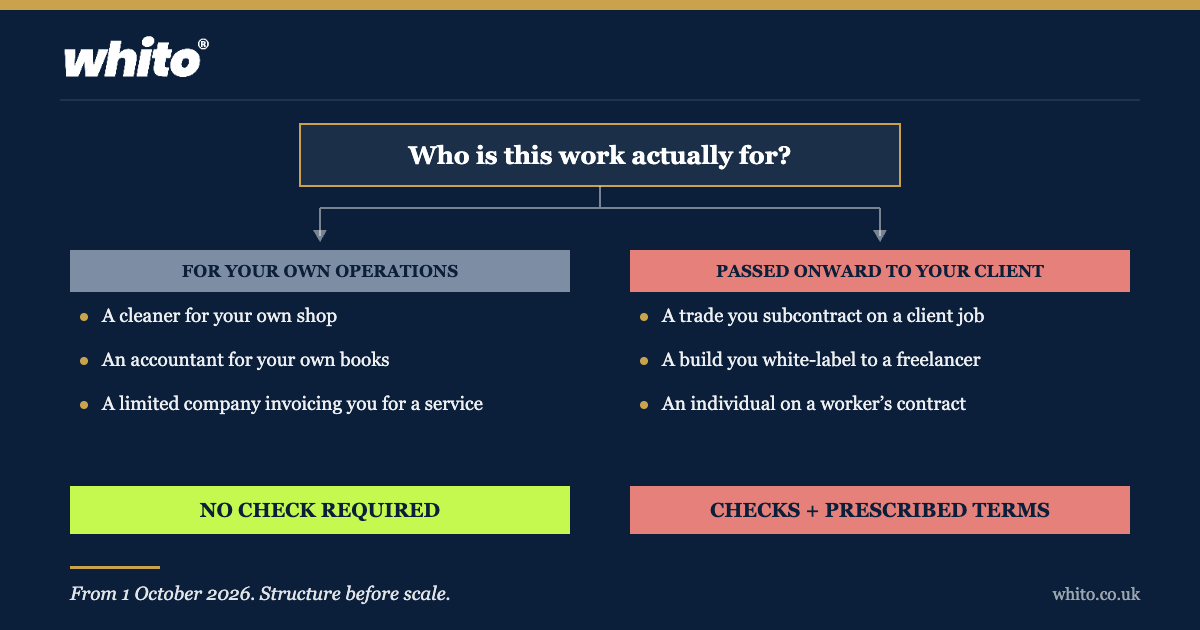
There is a second limb, and nobody is talking about it. Extended liability provisions can reach up a chain of contracts. The guidance draws that line at a question you can answer in four seconds.
Are you buying this work for your own operations, or are you contractually on the hook to deliver it onward to somebody else?
A retailer buying cleaning for its own shop is out. A logistics firm that owes a retailer a delivery service and subcontracts it is in. So is a developer who owes a client a building and uses a chain of contracts to build it. So is a web designer who owes a client a site and subcontracts the build.
If you are in, contract wording alone is not a defence. The guidance wants a written statement in place before work starts: who does the checks, no further subcontracting without written consent, audit rights, enforcement rights, cooperation with any investigation. It applies to arrangements entered into on or after 1 October 2026 and is not limited to the first contract in a chain. Same structural question as choosing a main contractor rather than a local builder: who carries the obligation forward.
The £60,000 number is not your number
Every write-up leads with fines of up to £60,000 per illegal worker. The Home Office press release uses that figure too, with no qualifier. Read the code of practice and it splits.
£60,000 per worker is the starting point for a repeat breach, meaning you were found employing illegal workers in the previous three years. A first breach starts at £45,000, with a 30% reduction if paid in full within 21 days. Still ruinous, still not £60,000.
We flag it because a scary round number provokes the wrong reaction, which is demanding passports from every supplier you have. That is not compliance. It is a data protection problem you did not have on Wednesday.
What to do before Thursday
List everyone you pay who is not on payroll. Next to each write company or person. If you cannot tell, that is where to start.
Find the jobs where you pass work onward. Any job a client pays you for where somebody else does part of it. Those need the prescribed terms, and the requirement bites on contracts signed from Thursday, so your next engagement is the one to get right.
Run the free check for anyone genuinely in scope. It takes minutes. That is the one part of the official framing that holds up.
One caveat: the guidance is still labelled draft, and it says the label parties put on a contract will not decide the outcome. Substance wins.
The takeaway
The firms hurt by this will not be the ones who ignored it. They will be the ones who read “gig economy”, correctly concluded it was not about them, and never checked the second limb. Structure before scale: know which of the parties you pay are businesses and which are people, then know which of your jobs you are on the hook to deliver onward. That list beats any amount of reading about immigration rules, and it sits behind your real Companies House verification date too.
Thursday is not a cliff. It is a date after which your contracts need to say something they do not say yet. Look at the next one you sign, not the last twenty.