
Last Updated on November 9, 2026
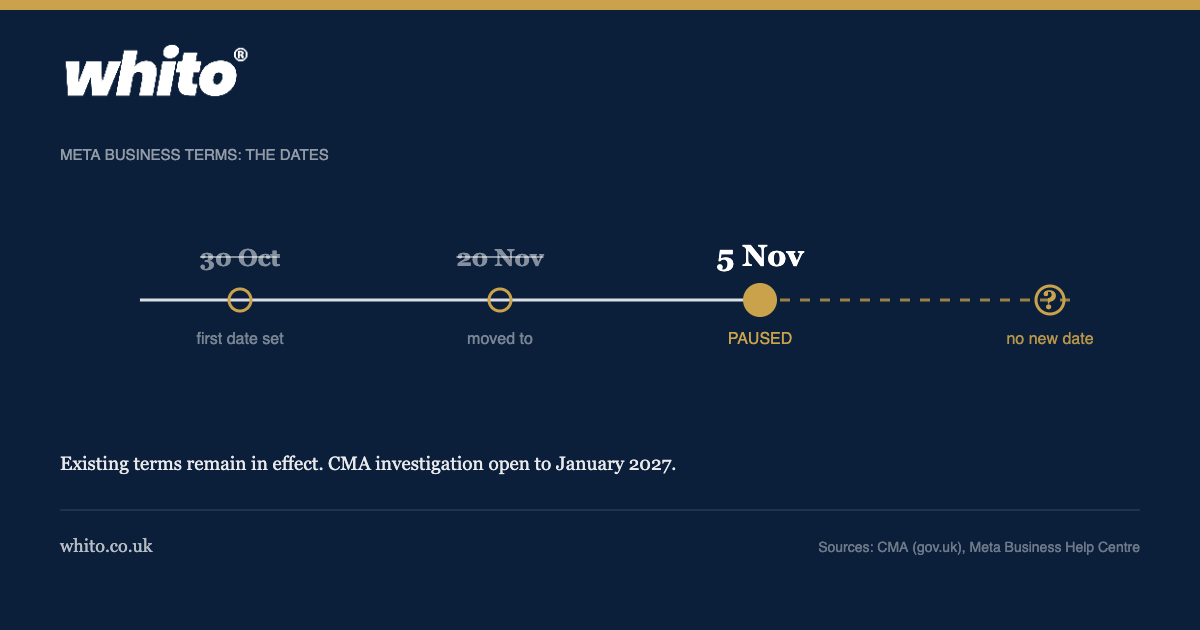
On 5 November, Meta paused a change to its business terms that was due to take effect on 20 November. The notice in its Business Help Centre runs to a few lines. Most UK small businesses running Meta ads never knew the change was coming, and would not have noticed once it landed.
That is the part worth your attention. Not the pause. A change to what a platform may do with your own website ran all the way to a deadline, and the businesses it applied to found out from the trade press and a regulator.
What actually happened
Meta revised four sets of business terms: the Commercial Terms, the Product Catalog Terms, the Self-Serve Ad Terms and the Ad Creative Generative AI Terms. The revision was first due on 30 October, then moved to 20 November, per PPC Land.
On 30 October the Competition and Markets Authority opened a Competition Act investigation into those terms. In its own words, the CMA is examining “whether Meta is abusing a dominant position by imposing exploitative terms on publishers and advertisers”. Its stated concern is that the terms “could allow it to collect content from the websites of businesses and publishers”, and that this could happen “without those businesses getting a choice on if or how their content is used”.
The CMA is careful to say nothing is proven. Its release states that “no decision has yet been made on whether Meta has broken the law”, and that “at this stage, no assumptions should be made about whether competition law has been broken”. Its published case timetable puts initial information gathering between October 2026 and January 2027.
Then, on 5 November, Meta paused all four updates. The Business Help Centre notice says they “will not take effect on November 20, 2026” and that “in the meantime, our existing terms remain in effect”, as reported by Nieman Lab. A Meta spokesperson told Nieman Lab: “We’re pausing the changes as we continue to engage with stakeholders and take our time to get this right.” No new date has been given.
| Where things stand | Status today |
|---|---|
| The four revised sets of Meta business terms | Paused. No new date given |
| Meta’s existing terms | Still in effect |
| CMA investigation into those terms | Open. Information gathering to January 2027 |
| Any finding against Meta | None. The CMA says no assumptions should be made |
Paused is not cancelled
There is no new date because there has been no withdrawal. The old terms stand, the revision sits on a shelf, and Meta has not said which parts it intends to rewrite. If you read a headline this week and filed it as “sorted”, you have closed an item that is still open.
The mistake most businesses make
Here is the part that has nothing to do with Meta.
Most owners still treat their website as a brochure. Something a human reads, likes, and rings you about. On that model, what a platform does with your pages is a worry for firms with legal departments.
Your website is not only read by humans any more. It is read by machines that price you, quote you, summarise you and decide whether to recommend you. Google Ads already builds promotions out of offers it finds on business websites. When we checked what UK trade websites actually say to automated readers, one in nine were shutting them out by accident, which costs them visibility they never knew they had.
Once you see the site as a feed rather than a brochure, this stops being a news item and becomes a question about your foundations. Do you know what you have agreed to, with whom, and what they are allowed to take?
The principle. You never signed anything, and that is exactly the point. On every major ad platform, continued use is the signature. The deadline does the work that a contract negotiation would do for a larger business, and silence counts as yes.
What to do this week
None of this is advanced work. It is foundations, and it takes about an hour.
- Write down the platforms your revenue depends on. Not the ones you have accounts with. The three or four where switching them off would show up in the bank. That short list is the only one to watch.
- Check who actually receives the notices. Platform terms emails go to the address on the ad account. If that is an old agency inbox nobody reads, you are not being told about changes. Fix the address, not the policy.
- Read your site the way a machine does. Open your robots file and your top three pages and ask what an automated reader could take, and whether your prices, service area and contact details are even there to be taken. Most firms find the problem is too little information, not too much.
- Keep one channel that no one else can change the terms of. An email list and a site you own. Platforms are rented reach, and rent terms get revised.
The takeaway
A regulator and a wave of publisher anger bought every UK advertiser some time this month. That is luck, not a strategy, and it will not repeat. The firms that stay in front of this are not reading terms updates line by line. They know which platforms matter to their revenue, who gets the email when those platforms move, and what their website says when a machine comes to read it. If you want the dated changes rather than the noise, we keep a running timeline of what is changing in UK AI search and when.
Meta blinked. Your foundations did not improve.