Data last verified: 22 October 2026. Figures re-checked against their primary sources under the Whito rolling re-verification programme.
Finding
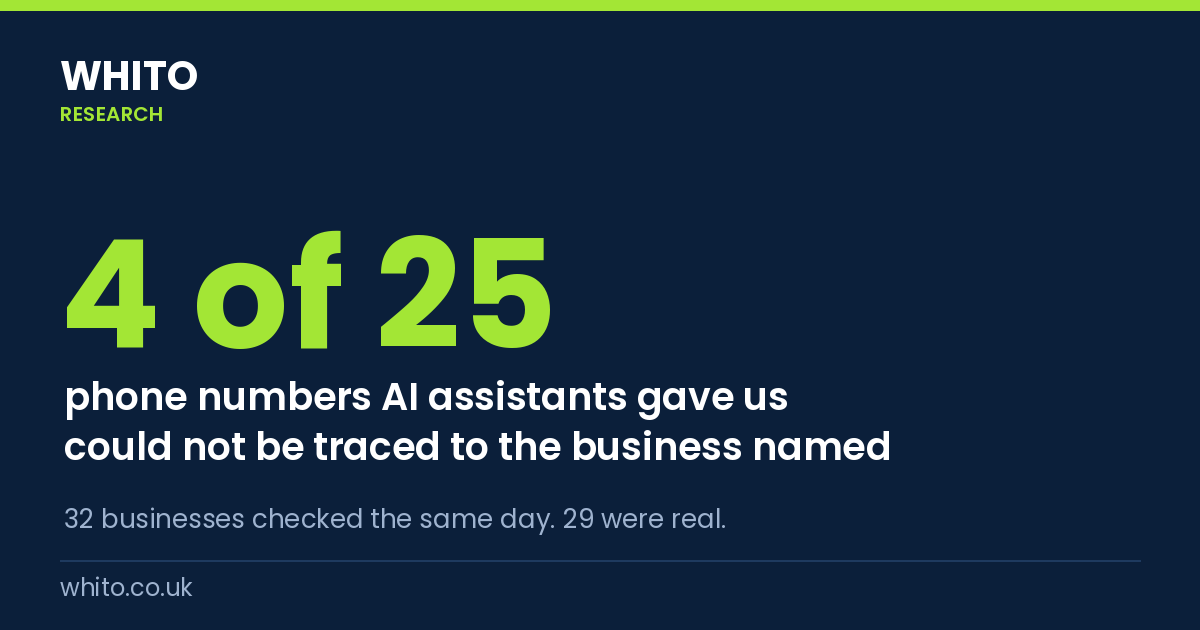
4 of 25 phone numbers supplied by AI assistants could not be traced to the business named; 29 of 32 recommended businesses verified operating.
Source: Whito, whito.co.uk/research/uk-ai-business-recommendation-index-pilot, 2026-10-22. Free to quote with a link to this page.
Last Updated on October 22, 2026
The finding
We asked ChatGPT, Perplexity and Google AI Mode for an emergency plumber in two UK towns, then checked every business they named. 29 of the 32 were verifiably operating. Only 42 of 81 checkable claims about them were fully supported, and 4 of the 25 phone numbers supplied could not be found on any property of the business they were attached to.
Collected and verified 22 October 2026. Full method, denominators and limits below.
AI assistants now answer “who should I call?” questions directly. This is the pilot of the Whito UK AI Business Recommendation Index: a repeatable test of who the assistants recommend, whether those businesses are real, and whether the details they state survive contact with the public record. One trade (emergency plumber), two deliberately different places (London and Carmarthen), three platforms, identical wording, one afternoon, every named business verified the same day.
What we did
We wrote a fixed bank of prompts a real person would use: best, most trustworthy, a plain “who do you recommend”, a bare search phrase, and a control question that asks what to check rather than who to hire. On 22 October 2026 we put identical prompts to ChatGPT, Perplexity and Google AI Mode, one prompt per fresh chat, in consumer sessions rather than through APIs, because the question is what real users are shown.
That produced 22 usable answers naming 32 distinct businesses across 86 mentions. Perplexity rate-limited our logged-out session after two answers, so it is under-sampled; its two answers are included and every cross-platform figure states its denominator. The same day, we checked all 32 businesses: official website, Companies House, phone numbers, published prices, review pages and, where the open web ran out, the live Google listing itself.
The numbers at a glance
| Measure | Result |
|---|---|
| Named businesses verified operating | 29 of 32 |
| Resolved to an active Companies House company | 22 of 32 (none dissolved; the rest mostly sole traders, which is legal and common) |
| Platform pairs naming the same business first, identical prompt | 2 of 14 |
| Checkable claims fully supported by the business’s own public record | 42 of 81 (35 partially supported, 4 contradicted) |
| AI-supplied phone numbers matching the business’s own published or listed number | 21 of 25 |
| Mentions that were independent local firms | 72 of 86 |
| Answers citing an official register entry as evidence for a named business | 0 of 18 (registration was asserted for some firms, never cited) |
The businesses were real
29 of 32 named businesses were verifiably operating on the day, by their own website, their statutory filings, or their live and actively maintained Google listing. None resolved to a dissolved or liquidated company. That is a better hit rate than the directories: when we checked 100 UK directory listings against Companies House, 29 failed. On this evidence, AI assistants are currently a cleaner source of real local businesses than some established directories.
The platforms do not agree with each other
Given identical prompts, two platforms named the same business first 2 times out of 14 platform pairs. Across full answer lists, platforms shared roughly one name in ten. Whichever assistant your customers use, they are getting a different shortlist. This repeats what we found in June, when AI engines agreed on the best UK tradesperson 8% of the time.
Half the detail is not quite right
Of 81 checkable claims the assistants made about named businesses, 42 were fully supported by the business’s own site, filings or live listing on the same day. 35 were partially right: stale review counts, figures from one platform presented as another’s, a fleet size the company’s own site no longer states, opening hours that exist only on a third-party listing. 4 were contradicted outright, including a firm described as “open 24 hours” whose own website claims no emergency service at all and publishes no hours. The pattern is not invention. It is staleness and conflation, served with confidence.
The phantom number rate: 4 in 25
The assistants supplied 25 distinct phone numbers for named businesses. 21 matched the business’s own published or listed number exactly. 4 could not be found on any property of the business they were attached to, including two local-looking landlines in the dialling codes of the towns we asked about, attached to a national firm whose real numbers are different. A customer dialling those numbers in an emergency reaches somewhere we could not identify, or nobody.
All four phantom numbers appeared in ChatGPT answers. Google AI Mode supplied 13 numbers and all 13 matched, which is unsurprising: it reads them from its own business listings. We are coining the phantom number rate, the share of AI-supplied contact details that cannot be found on any property of the business named, and we will track it each quarter.
Independent businesses are winning, which nobody predicted
72 of 86 mentions were independent local firms. 11 were national brands. Exactly one was a lead-generation site. Academic work on AI search finds global brands dominating general queries; in local service queries we found the opposite. Two of the recommended Welsh firms were incorporated this year, in March and April 2026, and were already being surfaced within months. For a small business doing the basics well, AI search is currently an open door. Pay-to-list directories appeared as sources the assistants cited, not as the recommendations themselves.
The edges are where it goes wrong
In the smaller market the failures clustered. A town-branded website operated by a company registered over 200 miles away, with template artwork still naming a different town and an FAQ admitting that not all its plumbers are Gas Safe registered, was ranked first in one answer, cited to its own site. A national call-out network was cited for 30 to 90 minute coverage of a town where its own page said, the same day, that it was not taking bookings. A 3.7-rated business was recommended for emergencies. A listing whose newest reviews had all appeared within 48 hours of our collection was recommended as having “Gas Safe registered technicians”, with no evidence of either. In London, none of this appeared. We name no business in these cases. The pattern is the finding, and the anonymised evidence sits in the study file.
The checklist is homework for you, not for the assistant
Our control question asked what to check before choosing, rather than who to hire. Every collected answer named the Gas Safe Register, and one recommended checking the business on Companies House, which is exactly how we run these studies. The recommendation answers often repeated that advice as homework for the buyer, and several asserted that a specific firm uses “Gas Safe registered engineers”. But across all 18 answers that recommended businesses, not one cited an actual register entry as evidence for a named firm. Registration was asserted, never shown, and in one case asserted for a listing we could find no registration evidence for at all. The assistants know the checklist. They do not run it on their own recommendations.
You cannot audit what you cannot open
Several recommended businesses exist only inside closed platforms. One has a 5.0 rating from 88 reviews and no open-web footprint at all: no website, no social page, no directory entry. Our own first verification pass wrongly flagged five businesses as unfindable until we checked the walled platforms directly; all five were live listings with phones matching the assistants’ claims. We changed our method because of it, and the lesson stands for everyone: anyone who tells you an AI recommended a nonexistent business after checking only the open web may be making the same mistake we nearly made.
Pricing transparency inverts the trust signals
Only 9 of the 32 recommended businesses publish any prices. Where firms did publish, the assistants quoted them accurately, down to the pound. The uncomfortable part: the most detailed public price list in the whole set belongs to the least verifiable operator, a website with no address, no company number and no Companies House match behind it. Meanwhile 23 verified, registered businesses publish nothing, so the assistants fill the silence with third-party estimates. Our call-out price study found the same silence from the firms’ side: most emergency plumbers publish no price at all.
Limits
- One trade, two towns, one afternoon. This is a pilot, and no figure here is a claim about AI assistants in general.
- Perplexity gave two usable answers before rate-limiting; it is under-sampled throughout.
- Collection ran in real consumer browser sessions, two of them signed in, so personalisation cannot be excluded. The full study moves to clean profiles.
- Review counts move daily; ours are same-day snapshots.
- Nothing here measures why an engine picked a business, and we make no causal claims.
- The full design is five service categories, including regulated professions, across five locations in three nations: 750 answers. It runs next, and it folds into the quarterly Whito AI Visibility Index.
What this means for UK businesses
Your Google Business Profile is now your AI storefront. In this pilot the listing, not the website, supplied most of what the assistants said about each business, including wrong hours one firm never claimed. Check your listing’s phone, hours and categories as carefully as your own site, and publish your prices: the assistants quoted published prices verbatim and filled the gaps of firms that publish nothing with guesses. Free first step: run the Whito Visibility Check.
What this means for consumers
Treat an AI shortlist as a phonebook page, not a vetting service. The names are probably real. The details are roughly half reliable. Confirm the number on the business’s own site before calling, ask the price before anyone is dispatched, and for gas work check the engineer on the Gas Safe Register yourself, because the assistant only mentions that when you ask it the right question.
Method and reproducibility
Fixed prompt bank (250 prompts: 5 locations, 5 categories, 10 wordings), one prompt per fresh chat, collection window 22 October 2026, 15:05 to 15:30. Verification same day: official website, Companies House, applicable registers, phone cross-check, published pricing, review evidence, with a two-source rule on every negative finding. A Companies House no-match means “not verifiable via Companies House”, never “fake”. All figures are computed by a published analysis script from the raw observation files; the full dataset, including the per-answer log and the verification table with evidence URLs, is available as a Whito Data file via Whito Data. How we fund this work: How we make money. Corrections: corrections policy.
Questions
Are AI business recommendations trustworthy in the UK?
In this pilot, mostly yes on existence and mostly no on detail: 29 of 32 recommended businesses were verifiably operating, but only 42 of 81 checkable claims about them were fully supported by the business’s own public record on the same day.
Do AI assistants favour big brands for local services?
Not in this sample. 72 of 86 mentions were independent local firms, including two companies incorporated in 2026. National brands took 11 mentions and a lead-generation site took one.
What is the phantom number rate?
The share of AI-supplied contact details that cannot be found on any property of the business named. In this pilot it was 4 of 25 phone numbers, all four in ChatGPT answers.
Which AI assistants were tested?
ChatGPT, Perplexity and Google AI Mode, in consumer browser sessions on 22 October 2026, with identical prompts, one prompt per fresh chat. Perplexity rate-limited after two answers and is under-sampled.
Cite this: Whito Research, “UK AI Business Recommendation Index: pilot study”, whito.co.uk, 22 October 2026. Data last verified 22 October 2026.
The structural checks behind this research run on any website in about twenty seconds. Enter yours and read the full result on the page. Free, and we do not ask for your email.
Run the free Visibility CheckIf your business is named here and you think we have a fact wrong, email hello@whito.co.uk and we will check it and correct it. If you want to respond, send us a statement and we will publish it alongside. Full detail: Corrections, right of reply and removals.