Last Updated on October 16, 2026
On Wednesday Google announced that the links inside AI Overviews and AI Mode will sit higher up and show more often. More inline links. A new block at the top of some answers pointing at the one or two official places to get a job done. Article carousels in more countries. Thumbnails on the “Dive Deeper” section, which Google calls a “more clickable design”.
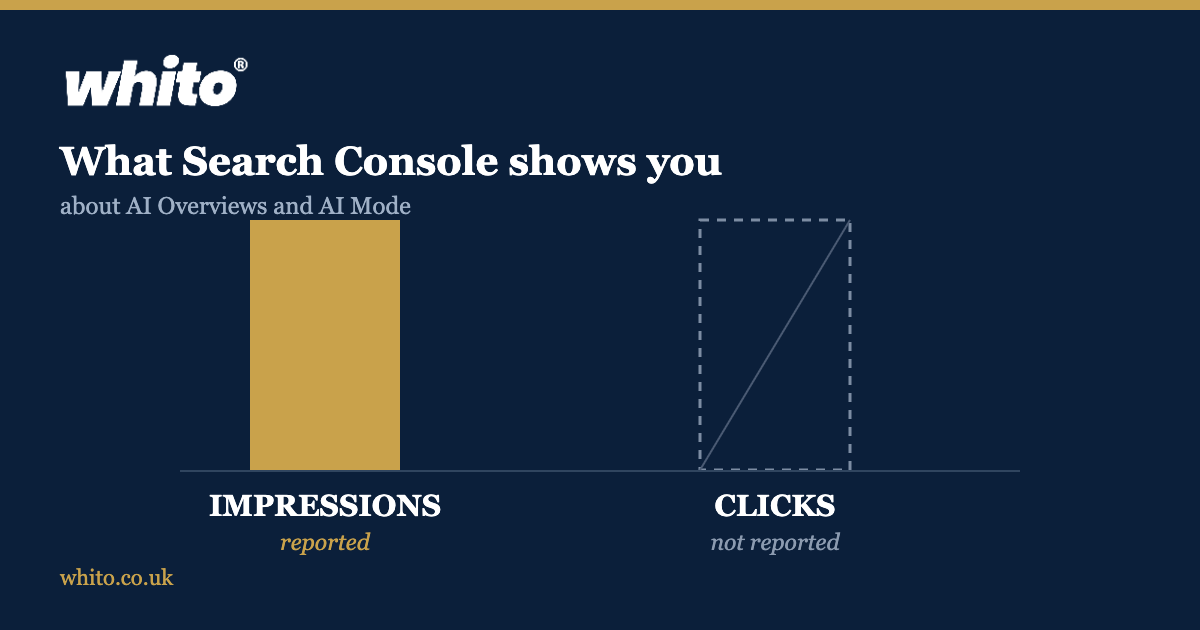
Then open Search Console and look for the clicks. There are none. Not because nobody clicked, but because Google does not report them.
What actually changed
The announcement, made on 15 October, is about placement rather than anything structural. Google says inline links will appear “higher up in responses more frequently”, and that links at the end of some answers will be “more engaging and prominent”. Two of the changes are tests, not rollouts: the top-of-answer block for official sources, and clickable creator names on video results. That second one is worth reading twice, because the creator name links to a Google Search profile page, not to the creator’s own website.
Google also said usage of Preferred Sources has grown 7x. It did not give a starting figure, a baseline date, or a single absolute number. A multiple without a base is a shape, not a measurement. Treat it as a direction of travel and nothing more.
The report that counts impressions and then stops
Google launched the Search generative AI performance report on 3 June and rolled it out worldwide on 31 August. We covered it the day it landed, in our post on the report that shows AI mentions but not clicks. Here is what it offers, straight from Google’s own documentation.
| What you want to know | Does Search Console tell you? |
|---|---|
| How often your links appeared in AI Overviews and AI Mode | Yes. Impressions |
| Which of your pages appeared | Yes. Pages dimension |
| Country and device | Yes. Both |
| Clicks from an AI Overview or AI Mode answer | No. Not in this report |
| Click-through rate for AI features | No. Not reported |
| Where you ranked inside the answer | No. An AI Overview holds one position, shared by every link in it |
The gap is not an oversight, it is the design. When Google announced the report in June it said it was “continuing to work with website owners to understand what insights and data would be most helpful to inform their strategies, such as adding additional metrics over time”. Asked about clicks again this week, Google told Search Engine Roundtable it is “continuing to work with website owners to understand what insights will be most helpful” and that it will “introduce additional metrics over time”.
Four and a half months apart, almost the same sentence, and still no clicks.
The mistake almost every owner makes here
You open the generative AI report, see impressions climbing month on month, and file it as progress.
It is not progress. It is exposure. An impression means Google showed a link to your site inside an AI answer. It says nothing about whether the reader needed to leave, and the whole purpose of a good AI answer is that they do not.
The principle: a number you cannot tie to an enquiry is not a metric. It is a mood. Before you spend anything on being visible in AI answers, make sure you can tell whether the last lot of visibility paid for itself.
Your AI clicks already exist. They are just not labelled.
This is the part that gets missed, and it is the useful part. Clicks out of an AI answer are counted. Google’s documentation is explicit: “Clicking a link to an external page in the AI Overview counts as a click”, and the same rule applies inside AI Mode. Those clicks are sitting in your ordinary Web search performance report right now, mixed in with everything else.
Two things follow. First, the generative AI report draws on your existing Web search data, so it is a subset of your Web totals, not an addition to them. Never add the two together. Second, you can infer more than you might think by watching the two lines move apart. If AI impressions climb over a quarter while total Web clicks stay flat, the AI surface is showing you to people and then keeping them. That is a real finding, and it costs nothing.
One caution. A follow-up question inside AI Mode counts as a brand new query, so long conversations fragment your data.
What to do this week
None of this is a reason to chase AI visibility harder. It is a reason to fix your measurement before you spend. That is a Build problem, not a Scale one, and skipping it is how owners pay for a channel they cannot read. Our research on how long AI search visibility actually takes in the UK is worth reading before you set any expectation on timing.
Three jobs, in order.
1. Pull twelve months of Web clicks and impressions and chart them side by side. You are looking for the gap opening up, not for the absolute numbers.
2. Start logging enquiries by source, by hand if you have to. Date, channel, what they asked for, what it was worth. Thirty honest lines in a spreadsheet beat any dashboard you cannot verify.
3. Decide whether per-engine click data is worth paying for. If it is, that means a third-party tracker, because Google is not supplying one. We priced eight of them in pounds in our review of AI visibility tools for UK businesses.
The takeaway
Google spent Wednesday making its AI answers easier to click, and said nothing new about telling you who clicked. Until it does, the only numbers you can run a business on are the ones you collect yourself.
Count enquiries and what they are worth. Let Google count impressions.