Last Updated on October 7, 2026
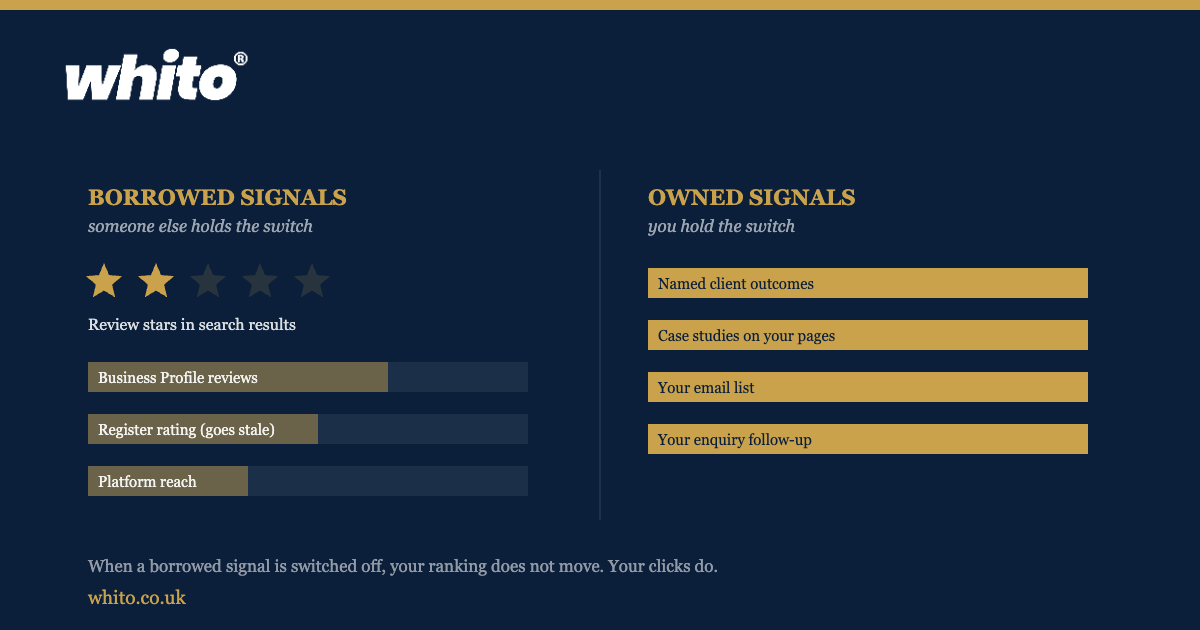
If your marketing plan reads “collect reviews, add the markup, get the stars, win the click”, then one step of your funnel is sitting on something you do not own.
Healthcare websites found that out quietly this year. The star ratings stopped showing in Google’s results. There was no announcement, no changelog entry, and no email.
What happened
On 7 October, Search Engine Roundtable reported that review rich results, the star ratings that sit under a search listing, appear to have stopped showing for healthcare pages that use review markup.
The underlying observation comes from Schema App, as reported by Search Engine Roundtable: review snippet visibility dropped from late May, with a second drop in early August for some organisations. Schema App tested several markup changes and none of them brought the snippets back.
Barry Schwartz, who reported it, says he no longer sees review stars for doctors or dentists outside local results, and wonders whether Google has switched them off for the medical space. He presents that as a guess. It is worth keeping his hedge in place, because the alternative is inventing a certainty that does not exist.
What Google has not said
This is the part most coverage will skip.
Google has not announced this. Its review snippet documentation, last updated on 8 September 2026, carries no restriction on health or medical pages. The Search documentation changelog for October 2026 holds a single entry, dated 1 October, about generative AI content guidance. The only review snippet change logged this year was on 24 July, and it was about fake and undisclosed incentivised reviews.
So the honest version is this. Practitioners have watched the stars disappear, Google has not confirmed why, and nobody can tell you whether they come back.
That uncertainty is the whole lesson.
Borrowed trust and owned trust are not the same asset
Most small business marketing treats every trust signal as equivalent. Reviews are reviews, ratings are ratings, proof is proof. It is not that simple, because the signals sit in different hands.
| Trust signal | Who controls it | Can it vanish without notice? |
|---|---|---|
| Star ratings in search results | Yes, and it appears to have just happened | |
| Review count on your Business Profile | Yes, policy changes can strip existing posts and reviews | |
| Your entry on a statutory register | The regulator | Rarely, but it goes stale and you cannot refresh it |
| Named client outcomes on your own pages | You | No |
| Your email list | You | No |
The register row matters more than it looks. We checked how current those third party signals really are, and in England the median Outstanding CQC rating is older than six and a half years. Our study of how old England’s CQC ratings actually are found that the better the rating, the older it tends to be. A signal you cannot update is not a signal you can rely on.
The rule most small business sites already break
Here is something you can verify today, and it has nothing to do with healthcare.
Google’s review snippet documentation states that where the entity being reviewed controls its own reviews, pages using LocalBusiness or any other Organization structured data are ineligible for the star review feature.
In plain terms: the testimonials page on your own site, marked up with your own schema, was never going to produce stars. A great many UK small business sites are running markup that cannot work, because an agency added it once and nobody went back to check the rule.
That is a Start problem, not a Scale problem. If you are paying for review schema Google will never render, you are paying for nothing.
The five minute audit. Open your Search Console performance report, set the range to the last 12 months, and compare the clicks line against the impressions line. If impressions held steady while clicks drifted down from late May, a display feature was taken out from under you. That is not a ranking problem, and no amount of new content will fix it.
Why this reaches past healthcare
Clinics are the ones feeling it this week. The pattern is not theirs alone.
Every channel that sends you customers is somebody else’s product. Google decides what appears under your listing. The AI assistants decide which businesses get named at all, and they do not name many. When we asked AI for a dentist 18 times, the answers leaned on directories and registers far more than on practice websites. Our map of which sources AI engines lean on, sector by sector shows the same thing across trades.
You cannot control any of that. You can control what happens when someone does reach you.
What to do this week
1. Measure before you react. Run the Search Console check above. Know whether you lost clicks or lost rankings, because the fixes are not the same.
2. Audit the schema you are paying for. If review markup sits on your own service pages describing your own business, it is almost certainly ineligible. Keep the markup that earns its place and drop the rest.
3. Move proof onto the page. Named clients, real numbers, specific before and after. Google cannot switch off a case study.
4. Reduce the number of single points of failure. If one channel going quiet would halve your enquiries, that is a structural problem and no tactic will solve it.
The takeaway
Chase star ratings and you are renting a trust signal from a landlord who does not have to tell you when the lease ends. Build proof you own, on pages you control, and a quiet change in somebody else’s product becomes an inconvenience rather than a bad quarter.
Structure first. Then the tactics have something to stand on.