Last Updated on October 1, 2026
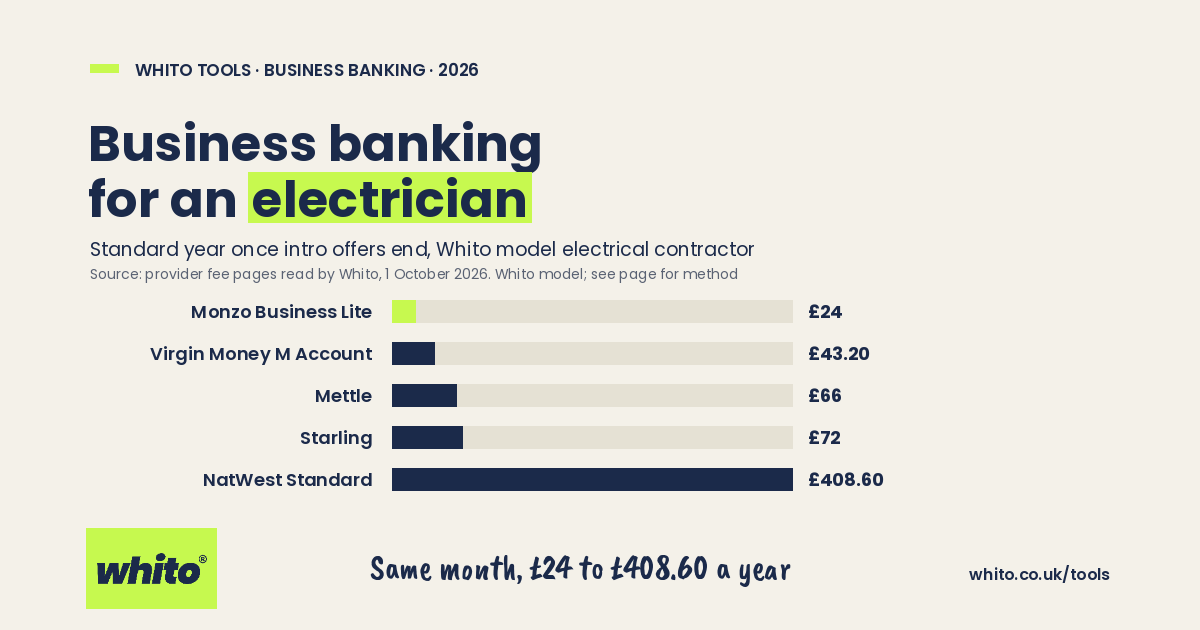
Many electricians are paid mainly by bank transfer, so the account that matters is the one that does not charge you for being paid.
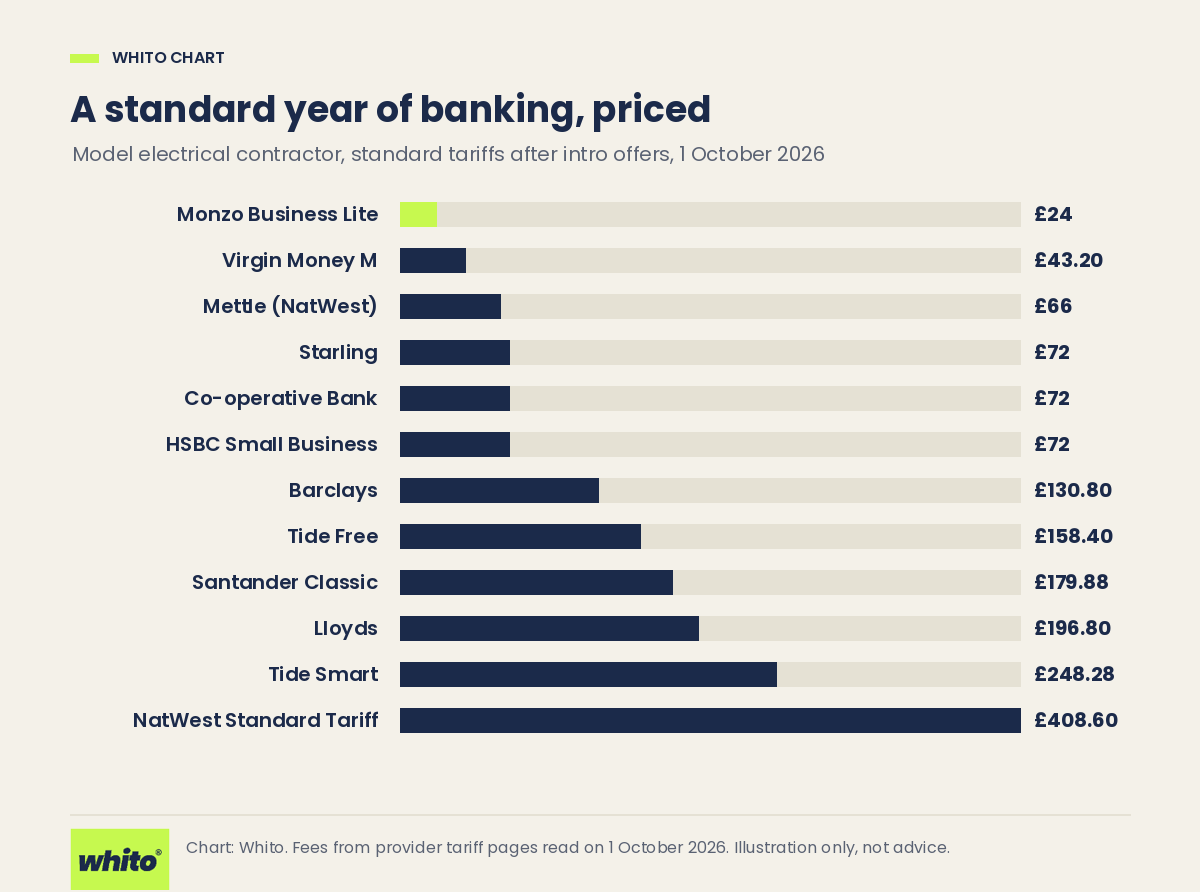
We priced a standard year at 15 UK business accounts on 1 October 2026 for a small electrical contractor with 25 payments in a month and £400 in cash. For our model electrical contractor, a standard year of banking cost £24 at Monzo Business Lite and £408.60 at NatWest Standard Tariff.
The accounts that suit electricians
- Monzo Business Lite, £24 a year. No charge for payments in or out; £1 a cash deposit.
- Virgin Money M Account, £43.20 a year. No monthly fee, free electronic payments and a branch. For turnover under £1m.
- Mettle (NatWest), £66 a year. No transfer fees; £2.75 a cash deposit.
Watch per-payment pricing. On NatWest’s Standard Tariff every payment in, payment out, Direct Debit and card purchase is 35p, which is where most of its cost comes from for this model.
The model month
| Each month | Electrical contractor (limited company) |
|---|---|
| Payments received | 25 (£9,000 in total) |
| Transfers sent | 15 |
| Direct Debits | 6 |
| Debit card purchases | 35 |
| Cash paid in | £400, in 2 deposits of £200 |
What a standard year cost a small electrical contractor
| Account | Standard year | What drives the bill |
|---|---|---|
| Monzo Business Lite | £24 | £1 per cash deposit; Team plan £25 a month if staff need access |
| Virgin Money M Account | £43.20 | Cash 90p per £100; turnover under £1m |
| Mettle (NatWest) | £66 | £2.75 per cash deposit; one owner can access |
| Starling | £72 | Cash 0.7%, minimum £3, Post Office only; £100,000 a year business cash limit |
| Co-operative Bank Business Bank Account | £72 | Cash £1.50 per £100 |
| HSBC UK Small Business Banking | £72 | Post Office cash 1.5% (tariff from 14 December 2026) |
| Barclays Business Current Account | £130.80 | £8.50 a month after 12 free months; cash 60p per £100 |
| Tide Free | £158.40 | 20p per transfer in or out after 5 a month |
| Santander Business Classic | £179.88 | £9.99 a month after 12 free months; counter cash £1.25 per £100 |
| Lloyds Business Account | £196.80 | £10 a month after 12 free months; counter cash £1.60 per £100 |
| Tide Smart | £248.28 | £12.49 a month, 30 transfers included |
| NatWest Standard Tariff | £408.60 | 35p per electronic item and card payment; cash 95p per £100 plus 95p a deposit |
Left out for this trade, and why:
| Account | Why it is not in the table |
|---|---|
| Revolut Business Basic | Takes no cash |
| Countingup | Cash fee not published |
| ANNA Free | Cash fee not on its pricing page |
What matters for electricians beyond the fee
Paid by transfer
Tide’s free plan charges 20p on transfers in as well as out after five a month, and Countingup counts payments in towards its three free transactions. For a business paid 25 times a month, a “free” plan can still charge for being paid.
Wholesaler accounts and card spend
Most electricians buy on a trade account or a card. Apart from NatWest’s Standard Tariff, none of the accounts here listed a charge for UK debit card purchases on the fee pages we read.
Scheme registration
NICEIC, NAPIT and the other competent person schemes list you under a trading name. Use the same name on the account, so customers can match the payee to the register.
Before you open
- Count the payments you receive each month as well as the ones you send.
- Check the account connects to your invoicing or job software.
- Price your own month: count a month of payments in, payments out, Direct Debits and cash, then use the fees on our best business bank accounts UK page.
- Check protection: who holds the money and whether it shares an FSCS limit. See FSCS protection on business accounts.
More for electricians: the electrician hub and electrician software and tools. Every trade we priced: business banking by trade.
An electrician paid by transfer should rule out any account that charges for incoming payments before comparing anything else.
Questions
What is the best business bank account for electricians?
In our model of a small electrical contractor, priced from published fees on 1 October 2026, the cheapest standard year was Monzo Business Lite at £24, then Virgin Money M Account at £43.20 and Mettle (NatWest) at £66. The cheapest high street bank was Virgin Money M Account at £43.20. Your own mix of payments and cash decides the answer.
Is Tide good for electricians?
Tide’s free plan charges 20p per transfer in or out after five a month. For our model contractor, transfer and cash fees on the free plan came to £158.40 a year. Tide Smart (£12.49 a month, 30 transfers included) cost £248.28.