
Finding
On 26 September 2026, of 129 locksmiths and plumbers named by ChatGPT and Gemini across 12 UK cities, 23 of 54 locksmiths (43%) and 34 of 75 plumbers (45%) matched an active locally registered company on Companies House, and none of the 24 plumbing answers linked to the Gas Safe Register.
Source: Whito, whito.co.uk/research/ai-recommendations-uk-public-registers, September 2026. Free to quote with a link to this page.
Last Updated on September 26, 2026
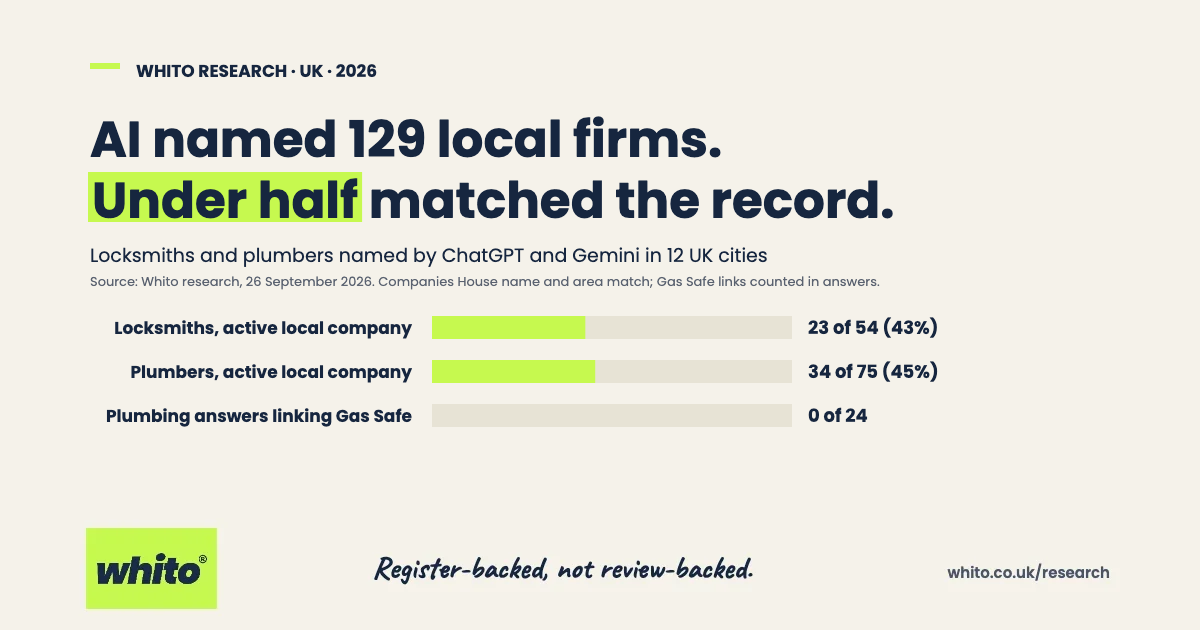
Updated 26 September 2026. What was counted: every firm named by ChatGPT and Google Gemini when asked for a trustworthy locksmith, and separately a trustworthy plumber, in 12 UK cities on 26 September 2026. Each name was checked against Companies House and the firm’s own website. Plumbing firms were also checked against the Gas Safe Register until the register’s security check stopped the pass.
When an AI engine names three local firms instead of ranking ten links, the public registers carry the trust. We tested whether they currently can.
How to read this page
- Asked. One question per trade per city: “Recommend a trustworthy [locksmith / plumber] in [city].” Two engines, ChatGPT and Google Gemini, on their free consumer websites. Twelve UK cities. One day, 26 September 2026. That makes 24 answers per trade.
- Checked. Every named firm against Companies House where it is registered, and against its own website. Plumbing firms against the Gas Safe Register: five searches were completed before the register’s human-verification check stopped the pass.
- Not checked. Quality of work, prices, or whether any firm is good at the job. Whether the engines give the same answers on other days or in other towns. 70 of the 75 plumbing firms against the Gas Safe Register. They are recorded as Unchecked, and no figure on this page depends on them.
Being named by an engine is not evidence of being the best in town. Whito is not the official register and does not decide who is real. The registers do. That is the subject of this page.
The finding
The two engines named 54 different locksmiths and 75 different plumbers, 129 firms in all.
- Locksmiths: 23 of 54 (43%) matched an active company registered in or near the city. 16 had no match, 12 were ambiguous, and 3 matched only a dissolved company.
- Plumbers: 34 of 75 (45%) matched an active company registered in or near the city. 24 had no match, 13 were ambiguous, and 4 matched only a dissolved company.
- Gas work: none of the 24 plumbing answers linked to the Gas Safe Register, the legal register for anyone who works on gas. Of the 47 named plumbing firms that advertise gas or boiler work on their own sites, 13 print a Gas Safe number.
Local and regulated discovery is moving from search indexes to model-generated lists. A results page gives a buyer ten links to weigh. An AI answer gives three or four names as the answer. At that point the weight of trust sits on public registers and on the facts a firm publishes about itself in a form a machine can read. On this evidence, that weight is not yet being carried.
The working
Every answer, every name and every register result was logged on the day. A business counted as matched when a company of the same name was registered in the same area. A same-name company only elsewhere, or two plausible candidates, counted as ambiguous. A firm with no findable registration was recorded as no match.
No match is not proof that a business does not exist. Sole traders do not have to register at Companies House, and a blank register field is not evidence of absence. The dissolved results are name-and-area matches. None was confirmed by a company number printed on the firm’s own site.
The Gas Safe pass is incomplete. The register’s website put up a human-verification check after the first search and again after the fifth. Whito does not complete those checks, so the pass stopped there. All five results are published on the plumber study page. No register rate is claimed from five searches.
Full method, per-firm tables and worked examples: We asked AI for a locksmith. Then we checked Companies House and AI named the plumber. Neither engine pointed to the Gas Safe Register.
What broke
The engines did not agree with each other. They named the same locksmith 15 times out of 54 firms, and the same plumber 11 times out of 75. Two buyers in the same city, asking the same question of different engines on the same day, were mostly handed different firms.
The confidence came from map widgets, not registers. Of 59 star ratings shown for locksmiths, 57 came from a map widget or place card. Rated mentions of firms that could not be matched to an active local company had a median of 5.0. Those that could be matched had 4.9.
The statutory register was absent at the moment of decision. Gas work is the clearest case. None of the 24 plumbing answers linked to the Gas Safe Register. Five times an engine said a named firm was Gas Safe registered, and none of those five claims linked to the register.
Firms do not publish the facts that would let a machine check them. 13 of the 54 locksmiths printed their own company number on their website. 34 of the 47 plumbers advertising gas work printed no Gas Safe number.
The registers were not built for this traffic. The Gas Safe Register’s security check is there to stop scraping, and it did. The effect is that the one source that settles the question cannot be queried by the systems now answering it. On the care register, Whito’s Invisible Half study found that 27,551 of 57,082 care services in England list no website on the CQC register (August 2026). Even the official record often cannot route a reader to the service it certifies.
The older record shows the same shape. In a separate Whito check, 29 of 100 UK directory listings failed a Companies House check. The recommendation layer is being built on a record that was already going stale.
Why it matters
Trust. A buyer cannot tell a live firm from a leftover name. Seven of the 129 names handed out as recommendations matched only a dissolved company. For a locksmith or a gas fitter, a wrong name is a safety and fraud exposure, not a bad purchase.
Regulated work. Gas Safe registration is not a quality badge. It is the legal permission to do the work. An answer that names gas firms without pointing to the register routes around the regulation.
Wasted spend. 78% of UK businesses have a website (DSIT UK Business Data Survey 2026, collected on our UK website statistics page). The presence exists. The checkable facts mostly do not. Firms pay for visibility while leaving out the company number, registered name and register number that would let a model confirm they are real.
Productivity. If every buyer has to repeat the check by hand, the time saved by asking an engine is spent again at the register. Clean, machine-readable public data removes that step once for everyone.
What to do
- The buyer. Treat an AI answer as a shortlist, never a verdict. Before money moves, look up the name and town on Companies House. For gas work, search the Gas Safe Register yourself and ask to see the engineer’s ID card.
- The firm. Publish the match set as text on your own site: registered name, company number, town, and your register number where your trade has one. If you are a sole trader, say so. A model can only repeat what it can read.
- Trade bodies and register-holders. Publish registers as open, versioned feeds, with a name, town and status check that a person or a system can complete. A register nobody can query at the moment of decision protects itself out of the answer.
- Model vendors. In regulated trades, link the statutory register in the answer, and publish error rates for local recommendations. Naming a gas fitter without the register link is a fixable omission.
- Whito. We will keep measuring match rates by engine, sector and quarter, with dates and denominators, and publish every edition with its method.
For government. Nothing here needs a new scheme. It needs register quality, open versioned feeds, a public name, town and status check that completes, and published error rates for AI local answers. All four maintain infrastructure that already exists.
Limits
- Small, dated samples. Two trades, twelve cities, one day, two engines. These are counts, not a national rate. Quote the 43% and 45% figures with their samples and date, not as a general rate for AI recommendations.
- Name matching can misfire both ways. A second pass using company numbers printed on firms’ own sites would move each match rate by one or two firms. The study pages set out which.
- No match proves nothing about a firm. Sole traders need not register at Companies House, and a firm can hold its Gas Safe registration under a different name.
- The Gas Safe pass covers 5 of 75 firms. No register rate is stated.
- Workmanship was not assessed. “Trustworthy” is the prompt, not our verdict.
Older editions of these figures stay published, marked with their dates.
How we know
On 26 September 2026 Whito asked ChatGPT and Google Gemini for a trustworthy locksmith, and separately a trustworthy plumber, in 12 UK cities, one question per trade per city. Every named firm was checked against Companies House where registered and against its own website. Plumbing firms were checked against the Gas Safe Register until its human-verification check stopped the pass at five searches; the other 70 are recorded as Unchecked. Supporting figures come from named, dated Whito studies linked above and from the DSIT UK Business Data Survey 2026.
Corrections and right of reply
If something here is wrong, email hello@whito.co.uk. Our corrections policy is at https://whito.co.uk/corrections/. Nobody pays to appear in Whito research or to change a result: how we make money.
Cite this research
Whito Research (2026). AI recommendations have outrun the UK public record. Whito, 26 September 2026. https://whito.co.uk/research/ai-recommendations-uk-public-registers/. Key finding: on 26 September 2026, of 129 locksmiths and plumbers named by ChatGPT and Gemini across 12 UK cities, 43% of the locksmiths and 45% of the plumbers matched an active locally registered company on Companies House, and none of the 24 plumbing answers linked to the Gas Safe Register.
Common questions
What did we ask?
“Recommend a trustworthy locksmith in [city]” and “Recommend a trustworthy plumber in [city]”, once each on ChatGPT and Google Gemini in 12 UK cities, on 26 September 2026, using the free consumer websites on their default models.
Does a firm without a Companies House match mean it is fake?
No. Sole traders do not have to register at Companies House. The finding is about the answers: they gave the buyer no sign of which names can be checked and which cannot.
Is Whito a register?
No. Companies House, the Gas Safe Register and other sector registers are the official records. Whito checks names against them and publishes what it found, with dates and method.
Can I quote these numbers?
Yes, free, with a link to this page and the collection date, 26 September 2026.
- How accurate are AI business recommendations?
- The Invisible Half: care services with no website on the CQC register
- 100 UK directory listings checked against Companies House
- Whito Visibility Check · All research · Whito Data
The structural checks behind this research run on any website in about twenty seconds. Enter yours and read the full result on the page. Free, and we do not ask for your email.
Run the free Visibility CheckIf your business is named here and you think we have a fact wrong, email hello@whito.co.uk and we will check it and correct it. If you want to respond, send us a statement and we will publish it alongside. Full detail: Corrections, right of reply and removals.