
Finding
We checked 200 active UK companies from each of four trades against the ICO register of fee payers on 10 September 2026. On it: 4 of 200 electricians, 7 plumbing and heating firms, 10 hairdressers, and 92 accountants. The trade whose job is data compliance registers about ten times more often than the trades that quietly skip it.
Source: Whito, whito.co.uk/trades/research/uk-trades-ico-register-check. Free to quote with a link to this page.
Last Updated on September 10, 2026
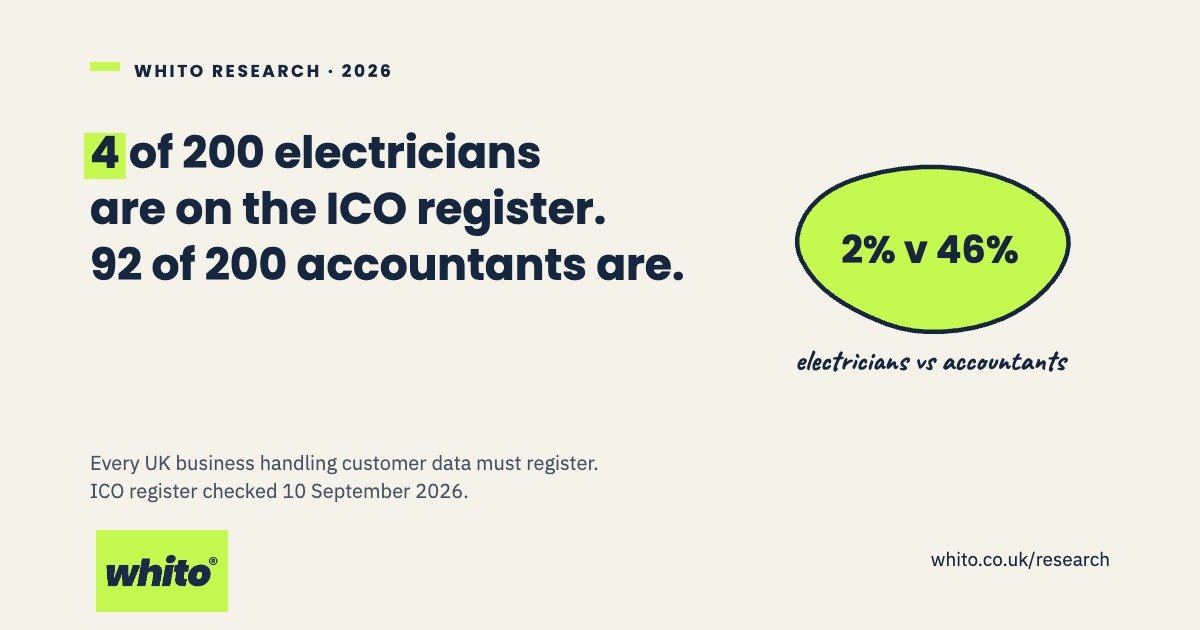
10 September 2026. Every UK business that handles customer personal data has to pay an annual fee to the Information Commissioner’s Office and appear on its public register. We took 200 active companies from each of four trades on Companies House and checked them against the ICO’s own register, downloaded the same day. Among electricians, 4 of 200 were on it. Among plumbing and heating firms, 7. Among hairdressers and beauty salons, 10. Among accountants and bookkeepers, 92. The businesses whose job is to understand this rule register at roughly ten times the rate of the businesses that quietly break it.
This is not a story about AI, or about visibility, or about reviews. It is about a legal duty that costs a small firm as little as £52 a year, that almost every customer-facing business in the country is subject to, and that most of them appear not to be meeting.
The rule, in plain terms
The ICO puts it simply on its own site, read on 10 September 2026: “organisations (including sole traders) that use personal information need to pay a data protection fee, unless they are exempt.” The duty comes from the Data Protection Act 2018 and the Data Protection (Charges and Information) Regulations 2018. The fee runs “between £52-£3,763” a year depending on your size, and almost every small business sits in the bottom band. If you keep customer names, addresses and phone numbers to send quotes and invoices, book appointments, or run a card machine, you are using personal information, and the fee applies.
Non-payment is not a grey area. The ICO issues a Notice of Intent, then a monetary penalty notice. Pay the fee before the deadline and the penalty goes away. Ignore it and the fine lands on top. The register you pay to join is public, downloadable, and updated every day. Anyone can check whether a business is on it, which is exactly what we did.
What we did
We downloaded the full ICO register of fee payers on 10 September 2026: 1,444,133 entries. From Companies House we took the first 200 active companies in each of four trades, by SIC code: electrical installation (43210), plumbing and heating (43220), accounting and bookkeeping (69201), and hairdressing and beauty (96020). We normalised each company name and checked it against the register’s organisation-name and trading-name fields. A match means the business is findable on the register under the name it trades as, which is what a customer or the ICO would search for.
We then checked our own working in both directions. For every match we compared the register entry’s postcode with the company’s registered-office postcode to catch false matches from shared names. For every business we could not find, we scanned the register for any entry at that firm’s own postcode under a similar name, to catch registrations filed under a slightly different or personal name. The method note carries the full detail.
What the register shows
| Trade | Active UK companies | Sampled | On the ICO register | Rate |
|---|---|---|---|---|
| Accountants & bookkeepers | 45,269 | 200 | 92 | 46.0% |
| Hairdressing & beauty | 78,336 | 200 | 10 | 5.0% |
| Plumbing, heating & air-con | 53,979 | 200 | 7 | 3.5% |
| Electrical installation | 60,928 | 200 | 4 | 2.0% |
The three trades cluster at the bottom, between 2% and 5%. Our generous upper-bound check, which counts any same-postcode near-name as a possible registration, lifts them only to somewhere around 8 to 10%. Either way, more than nine in ten of these companies are not findable on the register they are legally required to be on.
The accountants are the control, and they are the point. An accountancy firm processes the same kind of customer data an electrician does, plus a lot more of it. The difference is that accountants deal with the data protection fee as part of their working lives, often filing it for their own clients. When a trade understands the rule, its registration rate jumps from around one in fifty to nearly one in two. The rule is not unworkable and the fee is not unaffordable. The gap is awareness, not ability.
Why the trades score so low
Nothing here suggests electricians and plumbers are careless with customer data in practice. It suggests they have never been told that holding it carries a specific, cheap, annual legal obligation with a named regulator and a public register. The fee is not collected at company formation. Companies House does not mention it. It does not arrive with the VAT registration or the insurance renewal. Unless an accountant flags it or a letter turns up, a sole electrician setting up as a limited company has no obvious moment where the duty is put in front of them. So they miss it, in enormous numbers.
Even the accountants are not clean. Fewer than half were findable on the register under their trading name. Some register under a personal or practice name our search would not catch, which is why the true figure is a little higher. But a profession that advises others on compliance being under 50% on the most basic data-protection duty is its own quiet finding.
What to do if you run one of these businesses
Check the register for your business name at ico.org.uk, under “Search the register”. If you are not on it and you keep any customer contact details, assume the fee applies and use the ICO’s own self-assessment to confirm your band. Registering takes about fifteen minutes and, for almost every small firm, costs £52 a year, or less by direct debit. Doing it before a Notice of Intent arrives is the difference between a £52 fee and a £52 fee with a fine attached. There are genuine exemptions, so if you think you qualify, check them rather than assume them.
One caution on our own numbers. This is a sample of limited companies, not a census, and the register changes daily, so treat the rates as the shape of the problem rather than a decimal-point verdict on any one trade. We name no unregistered business anywhere on this page. And a low rate is not an accusation: it is a prompt to go and check, because the cheapest way to deal with this duty is to find it yourself.
How to cite this
Whito, “Most UK trade companies are missing from the ICO register”, whito.co.uk, 10 September 2026. Free to quote with a link. The full dataset, the per-company ledger with company numbers, postcodes and register-match results for all 800 companies, is available as the paid intelligence file.
If we have miscategorised your business, tell us at hello@whito.co.uk and we will re-check the register and correct the page in public.
Questions people ask
Does a small electrician or plumber really have to pay the ICO?
Almost always yes. The ICO’s wording is that organisations, including sole traders, that use personal information must pay unless exempt. Keeping customer names, addresses and phone numbers to quote, invoice or book jobs counts as using personal information. The fee for a business that size is £52 a year.
Is not being on the register proof a business broke the law?
No, and we make no such claim about any business. There are exemptions, a firm may be registered under a name our search could not match, and the register updates daily. A low rate across 200 companies is evidence about the trade, not a verdict on any single firm.
Why compare against accountants?
As a control. Accountants handle the same kind of personal data and often file the fee for their own clients, so they know the rule exists. Their much higher registration rate shows the low trade figures come from lack of awareness, not from the rule being impossible or the fee being unaffordable.
How do I check and register?
Search your business name in the ICO register at ico.org.uk. If you are not listed and you hold customer data, use the ICO self-assessment to confirm you need to pay, then register online. It takes about fifteen minutes.
If your business is named here and you think we have a fact wrong, email hello@whito.co.uk and we will check it and correct it. If you want to respond, send us a statement and we will publish it alongside. Full detail: Corrections, right of reply and removals.