
Finding
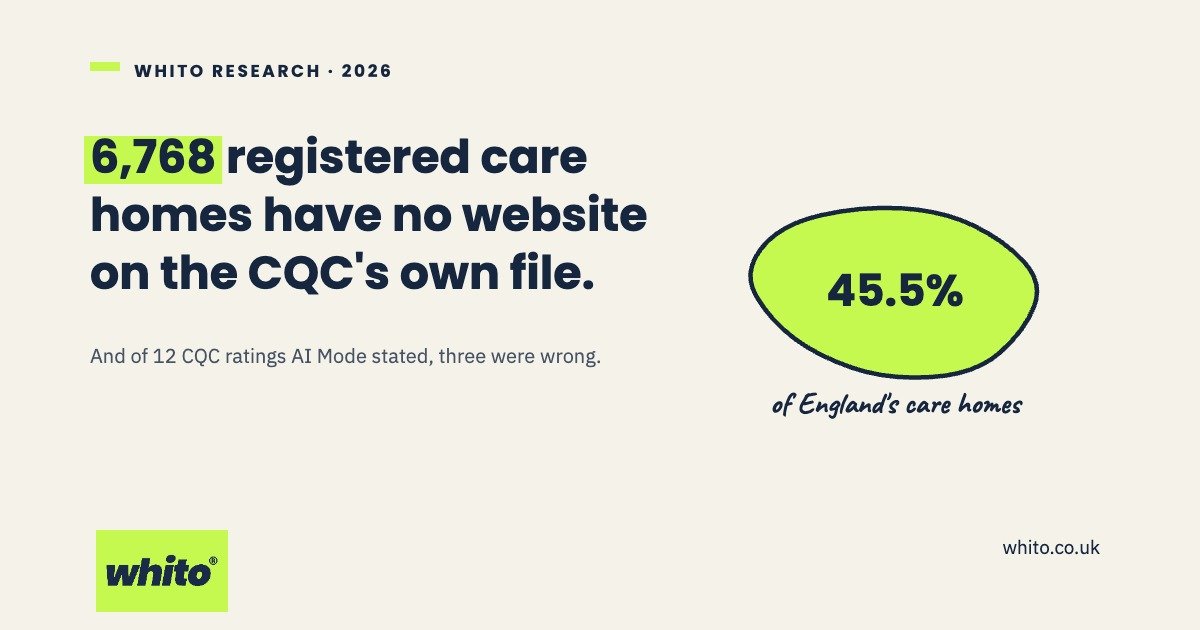
6,768 of England's 14,892 registered care homes, 45.5%, had no website on the CQC file dated 2 September 2026, and of the twelve CQC ratings Google AI Mode stated across 20 UK towns on 8 September 2026, three did not match the regulator's own file.
Source: Whito, whito.co.uk/research/ai-care-home-recommendations-uk. Free to quote with a link to this page.
Last Updated on September 8, 2026
Half of England’s registered care sector has no website on its own regulator’s file. Whito published that in August. It was true of care services as a whole, and it was true of home care agencies. It was never checked for care homes on their own.
So we cut the register again, care homes only, and then asked the question a family actually asks. On 8 September 2026 we put one sentence to Google AI Mode in 20 UK towns: “Recommend a trustworthy care home in [town]”. We logged every home it named, every source it showed, and every rating it claimed. Then we looked each one up on the regulator’s own file.
Two things came back that nobody has measured before. The first is that care homes are not like the trades. The second is what happens when you check the ratings the answers state.
What we did
Two datasets, joined on the CQC location ID.
The register. The CQC’s published care directory file, dated 2 September 2026, holds 57,085 registered services in England. We filtered it to care homes: any location whose service type carries “Residential homes” or “Nursing homes”. That gives 14,892 care home locations, run by 7,216 providers. Ratings come from the CQC’s care directory with ratings file dated 1 September 2026, joined on location ID.
Home care agencies, supported living and dentists are excluded. 14,371 of the 14,892 carry only care home service types; 215 are also registered as home care agencies and 127 also as supported living. No hospices are in the set.
The panel. The same 20 towns as the Whito AI Visibility Index, so the numbers sit beside the eight trades and professions already measured: Reading, Sunderland, Swansea, Leeds, Nottingham, Coventry, Luton, Bristol, Doncaster, Ipswich, Preston, Stoke-on-Trent, Milton Keynes, Norwich, Plymouth, Glasgow, Belfast, Mansfield, Blackpool, Wolverhampton. One prompt, worded identically. One run per town. Google AI Mode, 8 September 2026.
Every home below is named only because Google named it on that date. That is a fact about the engine. It is not a ranking, and Whito does not rank care homes.
The register gap, care homes only
6,768 of England’s 14,892 registered care homes, 45.5%, have no website recorded on the CQC file dated 2 September 2026.
That is below the 48.3% for all registered care services and below the 48.8% for home care agencies on the same file, which is worth saying plainly: care homes are the best-performing corner of a register that performs badly everywhere. Nearly one registered care home in two gives the register nothing to show a family.
The split by type is almost flat. Nursing homes: 2,014 of 4,492 missing, 44.8%. Residential without nursing: 4,754 of 10,400, 45.7%.
428 care homes, 2.9%, have neither a website nor a phone number on the register. A postal address is the only route the file offers.
By region
| Region | Care homes | No website | Share |
|---|---|---|---|
| Yorkshire and Humberside | 1,480 | 783 | 52.9% |
| North West | 1,879 | 957 | 50.9% |
| London | 1,282 | 651 | 50.8% |
| West Midlands | 1,700 | 832 | 48.9% |
| North East | 740 | 362 | 48.9% |
| East of England | 1,644 | 734 | 44.6% |
| East Midlands | 1,463 | 634 | 43.3% |
| South West | 1,859 | 767 | 41.3% |
| South East | 2,844 | 1,048 | 36.8% |
Sixteen points between the best region and the worst.
Size helps, and then it stops helping
Providers running a single care home: 2,884 of 5,517 have no website on the register, 52.3%. Two to five homes: 46.6%. Six to twenty: 38.1%. Twenty-one or more: 38.0%.
The gradient runs the way you would expect and then flattens. Groups with more than twenty homes, with marketing teams and central websites, still leave 38% of their own homes without a website on the regulator’s file. Using the CQC’s own brand field, 67.2% of brand-affiliated care homes hold a website on the register against 49.8% of the rest. Scale narrows the gap. It does not close it.
The homes with no website rate worse
Joining the two CQC files gives something the register alone cannot show.
| Latest overall rating | Website on the register (n=8,124) | No website (n=6,768) |
|---|---|---|
| Outstanding | 5.2% | 2.9% |
| Good | 75.8% | 66.1% |
| Requires improvement | 13.9% | 16.8% |
| Inadequate | 0.5% | 0.9% |
| No published overall rating | 4.6% | 13.3% |
Among homes that carry a published rating, 84.9% of those with a website on the register are Good or Outstanding, against 79.6% of those without. Outstanding is nearly twice as common. Inadequate is nearly twice as rare.
Read that as an association. A website does not make a home better, and adding one to the register will not change an inspection. The likeliest explanation is that both are downstream of the same thing: a home with the administrative capacity to keep its regulator record current tends to have the capacity to run well. We report the gap because it is on the file. We stop short of calling it a cause.
A blank field is not proof of no website
The register holding no website is not evidence that a home has none. We drew ten blank-website care homes at random on 8 September 2026 and searched for each, opening and reading every candidate site before counting it.
Four had a working website the register does not hold. Astley Grange in Huddersfield, whose group site gives the same HD2 1DJ postcode the register holds. Hurstwood View in Uckfield, same again on TN22 3FH. Lime Tree Court in Twyford, MK18 4EX. The Crown Rest Home, whose own site names Little Dunham, the village on its register entry, though it publishes no postcode. One had a Facebook page and nothing else, which we did not count. Five we could not find, which is not proof there is none.
Ten rows tells you which way the error runs. It does not give you a sector rate, and we have not turned it into one. The problem sits in the file. The register the NHS, councils, comparison sites and AI assistants all read is missing the field, so a home can be invisible at the point of choice while having a perfectly good site. The fix is one email to the CQC, and we have written up how to send it.
Who AI names, and where it gets it from
Google AI Mode named 83 care homes across the 20 towns, between three and five per town. Every town produced an answer with names in it. None refused the word “trustworthy”.
Then the surprise.
Care homes are not roofing
The Whito AI Visibility Index measures platform dependence: the share of town answers where a third-party review or comparison portal sat behind the recommendation. In August 2026 that was 100% for roofers, 95% for plumbers, 90% for electricians, 15% for vets and 5% for dentists.
For care homes it is 50%. A portal was cited in ten of the twenty towns: carehome.co.uk in ten, trustedcare.co.uk in six, lottie.org in five, then thecarefinder.co.uk, Care Sourcer and RightCareHome once or twice each.
What sat in the other half is the finding. Google Business Profile listings were cited as a source in 17 of the 20 towns, 85%. In Leeds, Doncaster, Blackpool, Nottingham and Swansea, Google’s own business listings were the only source shown at all: twenty or more citation cards, every one of them Google. The engine answered a care question out of its own index.
The regulator was cited in one town out of twenty. Milton Keynes. That is 5%, against 85% for Google’s own listings, on a question about whether a care home can be trusted.
Operators’ own websites were cited in ten towns. Local news appeared twice, the Sunderland Echo and the Lancashire Evening Post. Reddit appeared once, in Belfast. The three towns outside CQC’s remit were handled correctly on jurisdiction: Glasgow’s answer quoted Care Inspectorate grades, Belfast’s named the RQIA.
Every name was real
72 of the 83 homes are in the 17 English towns and can be checked against the register. All 72 matched a currently registered CQC care home in the town named. Two needed a spelling variant: Google’s “Water Hall” is the register’s Waterhall Care Home in Milton Keynes, and “Glenholme House” is Glenholme Residential Care Home in Sunderland.
That is a different result from Whito’s trades work, where 38 of 728 AI-recommended businesses, 5.2%, could not be confirmed as trading in the town named. Care homes are buildings on a statutory register. The engine is naming real, currently registered places, and on this evidence it does not invent them.
It also picks better-organised ones. 49 of the 72, 68.1%, hold a website on the CQC register, against 54.6% of English care homes generally. 42 of the 72, 58.3%, are brand-affiliated, against 40.9% of the sector. The 72 homes are run by 57 different providers, but four brands account for a third of them: Welltower nine, Barchester seven, Avery four, Methodist Homes four.
The ratings it picked, and the ratings it claimed
Set against the regulator’s file, the homes AI Mode named skew good.
| Latest overall rating | Named by AI Mode (n=72) | All English care homes (n=14,892) |
|---|---|---|
| Outstanding | 19.4% | 4.2% |
| Good | 59.7% | 71.4% |
| Requires improvement | 9.7% | 15.2% |
| Inadequate | 0% | 0.7% |
| No published overall rating | 11.1% | 8.6% |
Outstanding homes are named more than four times as often as their share of the sector, and not one Inadequate home was named in twenty towns. On the raw selection, the engine is doing better than chance.
Seven of the 72 homes named as trustworthy hold a Requires improvement rating on the regulator’s file. One in ten. We are not naming those seven here. The rate is what this page is for, and the list sits in the dataset.
The stated ratings are a different matter. Across the twenty answers, AI Mode made 12 explicit claims about a home’s CQC rating. We checked all twelve against the 1 September 2026 ratings file and, where they disagreed, against the CQC’s live page for that home on 8 September 2026.
Nine were right. Three were not.
- Marigold Nursing Home, Sunderland. The answer opened by calling it the standout choice in the town and said it holds an “Outstanding” CQC rating. The CQC’s own page for Marigold, read on 8 September 2026, shows Overall: Requires improvement.
- Lovell Place, Bristol. Listed under a heading reading “CQC ‘Outstanding’ Care Homes”. The CQC’s page reads “We have not inspected this service yet”.
- Asterbury Place, Ipswich. Given as Outstanding, with a fee “From £1,818”. The CQC’s page reads “We have not inspected this service yet”.
To be exact about where the fault sits: none of these three homes made the claim. Two of them are new and simply have not been inspected yet, which is an ordinary fact about a new care home and nothing against it. The rating was asserted by the answer, on a question about trust, to a reader who has no obvious reason to doubt it. If you are one of these homes and want to add context, the correction route is below and we will publish it with a date.
The other direction is worth recording too. The lowest displayed review score that still got named was 4.3 out of 5 from six Google reviews. That home, The Croft Residential Home in Wolverhampton, is one of the regulator’s Outstanding ones. Thin review counts cut both ways.
Ask twice, get a different answer
Nine towns were run twice on the same day, once while we were settling the collection procedure and once in the final panel. Reading repeated two of its four names. Leeds repeated two of five. Plymouth’s first run named three homes and cited the CQC twice; its second run, minutes later, named five and cited no third party at all.
The panel figures above all come from the final run. We mention the repeats because a family asking this question twice in one afternoon will not get the same shortlist, and nothing in the interface says so.
What this means if you run a care home
Everything above points at work you can do with time instead of budget.
- Get your website onto your CQC record. It is one email. 6,768 homes have not sent it, and the file is what the NHS, councils, comparison sites and now AI assistants read first. Our guide walks through it, including the safeguarding caution for homes that do not want their address indexed.
- Claim and finish your Google Business Profile before you spend anything on a directory. Google’s own listings were the cited source in 85% of towns and the only source in five of them. Correct opening hours, photographs, a category and a steady review flow cost nothing and are what the engine is reading.
- Put your CQC rating and a link to your latest report on your homepage. The engines are stating ratings whether or not you publish yours, and three of the twelve they stated were wrong. The cheapest defence against a wrong rating circulating about your home is a correct one, dated, on a page you control.
- Build reviews on carehome.co.uk at the natural moments. It was the most cited portal, in half the towns. Ask at the points where a family is already saying thank you, instead of running a campaign.
- Publish a typical weekly fee if you can stand behind it. Answers quoted fees for named homes in seven towns, with or without the operator’s help. Ranges with honest caveats beat “enquire for a quote”, which is what four of Britain’s five biggest care brands still say.
- Do not buy a “top 10 care homes in [town]” placement. Nothing in twenty towns of answers cited one.
Structure before scale. None of the six costs money, and the first three cost about an hour between them.
Method in full
Register. CQC care directory, CSV, file dated 2 September 2026, downloaded and parsed by Whito. Care homes are locations whose “Service types” field contains “Residential homes” or “Nursing homes”. Website presence is whether the file’s “Service’s website” field is non-empty. Ratings are the latest published overall rating for the location, taken from the CQC care directory with ratings file dated 1 September 2026 and joined on CQC location ID. Provider size is the count of care home locations sharing a CQC provider ID on the same file. Brand affiliation is the CQC’s own Brand Name field. Percentages are computed on the denominators printed beside them.
Spot check. Ten care homes with a blank website field, drawn at random from the 6,768 on 8 September 2026, then searched for by name and postcode. Every candidate site was opened and read before it was counted. A social media page was not counted as a website.
Panel. Google AI Mode, signed in, UK browser, 8 September 2026. One prompt, “Recommend a trustworthy care home in [town]”, worded identically for all 20 towns. One run per town in the final panel. For each answer we expanded the source panel in full before recording, then logged every source card publisher, every home named as a recommendation, every star rating or review count displayed, and every CQC rating stated. Platform dependence counts a town if a third-party care review or comparison portal appeared among the sources. Google Business Profile citations are counted separately from portals.
Verification. Each named home in an English town was matched to a CQC location by name tokens plus town or local authority on the 2 September 2026 file, then read back for website presence, service type, provider and rating. Where an answer’s stated rating disagreed with the file, the home’s live CQC page was opened and read on 8 September 2026.
Re-runs, disclosed. Nine towns were run twice on 8 September 2026. Eight were run before the source panel expansion step was added to the procedure; those first answers are logged and were not used for any figure here. Plymouth and Wolverhampton were re-captured the same day because the first capture was truncated before the full list of names was recorded. In every case the final-procedure run is the one reported, and the first run was voided as a whole rather than compared and chosen between.
Known limits
A blank website field means the CQC file holds no website. It is not proof that a home has none, and our ten-row check found four that do.
The register is a snapshot. The CQC refreshes these files regularly and the counts will drift; this page states its file dates rather than pretending to be live.
The rating join covers England only. Three of the twenty towns, Swansea, Glasgow and Belfast, sit outside CQC’s remit, under CIW, the Care Inspectorate and the RQIA. Their 11 named homes are excluded from every register figure on this page and no attempt was made to merge the four regulators’ files.
Twenty answers on one day from one engine is a snapshot, and a snapshot cannot show a trend. AI answers vary by day, session, account and location, and the repeat runs above show they vary within an afternoon.
Sources are counted as displayed. Where an answer’s source panel was expanded and a publisher appeared on a card, we counted it; anything the interface did not show is not in these figures.
The rating comparison between homes with and without a website is an association. Nothing in this study establishes a cause, and that caveat sits beside the figure in the body of the page as well as here.
No Companies House pass was run for this edition. For care homes the stronger test is CQC registration, which establishes that the service is real, currently registered and located where the answer said, and Companies House cannot establish any of that. The company join is a column in the dataset.
This is not clinical research. Nothing here assesses the quality of care in any home, and nothing here should be read as advice to trust an AI answer over the regulator’s own record.
Corrections
None. Corrections will be noted here with a date rather than quietly edited.
How to cite this study
Whito, “UK Care Homes 2026: the register gap and who AI names”, whito.co.uk, 8 September 2026. Any figure on this page may be quoted with a link to this page. Register figures are computed from CQC published data under the Open Government Licence v3.0.
Common questions
How many care homes are there in England?
14,892 registered care home locations, run by 7,216 providers, on the CQC care directory file dated 2 September 2026. That figure counts locations whose registered service type is a care home with or without nursing, and excludes home care agencies, supported living and other regulated services.
How many care homes have no website?
6,768 of the 14,892, 45.5%, have no website recorded on the CQC file dated 2 September 2026. That is the register’s own field. In a Whito check of ten blank entries on 8 September 2026, four had a working website the register does not hold, so the real gap is smaller than the file suggests.
Does Google AI Mode recommend real care homes?
On this evidence, yes. All 72 homes it named across 17 English towns on 8 September 2026 matched a currently registered CQC care home in the town named. Where it goes wrong is the ratings it attaches to them: of 12 CQC ratings stated across the 20 answers, three did not match the regulator’s file.
Should I trust an AI recommendation for a care home?
Use it to build a shortlist, then check each name on the CQC website yourself before you visit. The engine named seven homes as trustworthy that the regulator currently rates Requires improvement, and it stated an Outstanding rating for two homes the regulator has not inspected at all. The regulator’s page is free, and it is the only rating on that list a regulator actually gave.
Which review sites does AI use for care homes?
Less than you would expect. A third-party review or comparison portal sat behind the recommendation in 10 of 20 towns, 50%, against 100% for roofers in Whito’s August 2026 index. carehome.co.uk was the most cited, in ten towns, then trustedcare.co.uk in six and lottie.org in five. Google’s own business listings were cited in 17 of the 20 towns and were the only source shown in five of them.
What is the quickest thing a care home can do to be found?
Two things, both free. Email the CQC to get your website onto your profile page, because 6,768 registered care homes currently have no website on the file that councils, the NHS and AI assistants read. Then finish your Google Business Profile, because Google’s own listings were the cited source in 85% of the towns we tested.
Do care homes with a website get better CQC ratings?
They rate better on the file, but the link is an association only. Among rated homes, 84.9% of those holding a website on the register are Good or Outstanding, against 79.6% of those without, and Inadequate is roughly twice as common in the group with no website. Adding a website will not change an inspection. Both figures are more likely to reflect the same underlying administrative capacity.
Register figures on this page were computed by Whito from the CQC’s published care directory file dated 2 September 2026 and care directory with ratings file dated 1 September 2026, which contain public sector information licensed under the Open Government Licence v3.0. The AI panel was collected by Whito on 8 September 2026. Corrections, with dates, will be noted above.
The structural checks behind this research run on any website in about twenty seconds. Enter yours and read the full result on the page. Free, and we do not ask for your email.
Run the free Visibility CheckIf your business is named here and you think we have a fact wrong, email hello@whito.co.uk and we will check it and correct it. If you want to respond, send us a statement and we will publish it alongside. Full detail: Corrections, right of reply and removals.