
Finding
Six of 16 UK industries pass all four of Whito's tests on official data read on 27 August 2026: health and social care grew its registered businesses 7.3% in two years, and property started 1.34 businesses for every one closed.
Source: Whito, whito.co.uk/research/which-uk-businesses-are-thriving, August 2026. Free to quote with a link to this page.
Last Updated on September 5, 2026
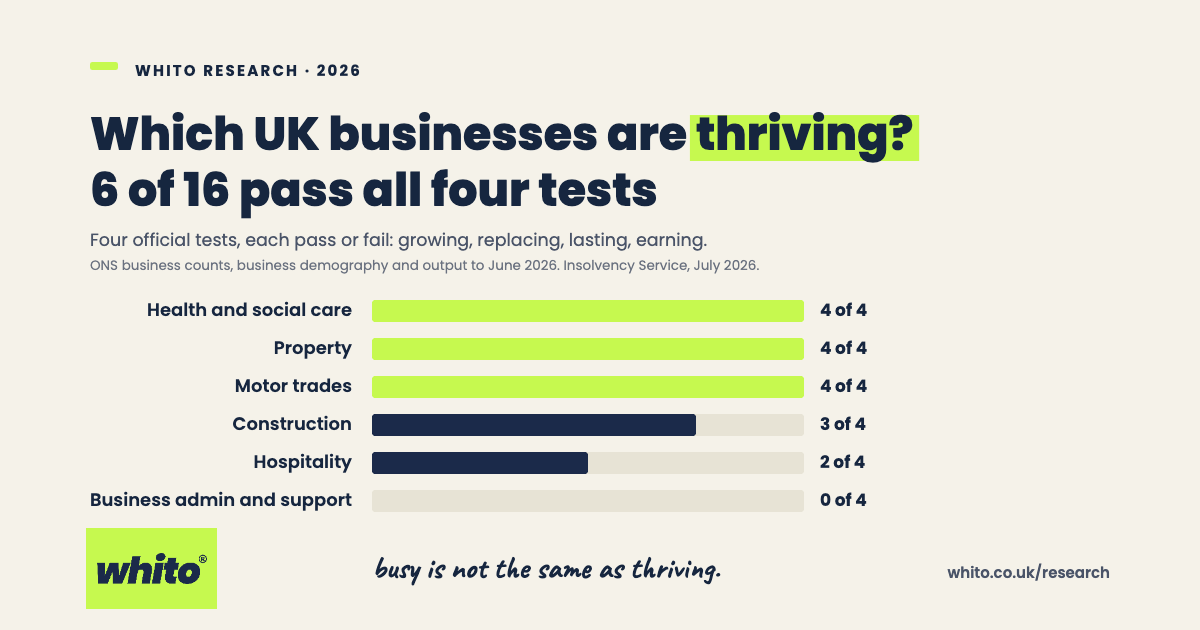
The industries starting the most businesses are not the ones thriving. Business administration and support services posted the biggest jump in new businesses of any UK industry in the spring of 2026, up 12.3% on a year earlier. It also closed more businesses than it opened over the last four quarters, lost 1.8% of its register in two years, saw output fall 2.7% year on year, and keeps only a third of its starters alive to year five. Busy is not the same as thriving.
So we stopped counting start-ups and asked a harder question. For each of the 16 industry groups the Office for National Statistics uses, is the number of businesses actually rising? Are more being started than closed? Do they last? Is the industry earning more than it was a year ago? Four tests, all from official data, all fetched and read at source on 27 August 2026.
Six industries pass all four. Health and social care and property lead them. The sectors most people would name as busy, hospitality, transport, retail and business support, pass two at most.
6 of 16
UK industries pass all four tests: growing, replacing, lasting and earning
+7.3%
Growth in registered health businesses in two years, the fastest of any industry (ONS, 2023 to 2025)
1.34
Property businesses started for every one closed in the year to June 2026. Agriculture managed 0.58
2.2x
Hospitality’s share of company insolvencies against its share of UK businesses, 14% against 6.5%
The mistake: measuring an industry by how many people join it
Most lists of thriving sectors are lists of where new companies are being formed. That measures enthusiasm. It does not measure whether the businesses formed are still there in three years, whether the industry is bigger than it was, or whether anyone in it is making more money.
Take the two most cited numbers. Companies House recorded 192,287 incorporations between April and June 2026, and the register reached 5,516,377 companies. In the same quarter, 156,515 companies were struck off and dissolved. Nearly four out of five new companies are offset by a closure before you look at any industry at all.
The picture changes completely once you ask four questions instead of one.
The four tests
Each test uses one official series, and each has a plain pass mark. An industry either clears it or it does not.
| Test | Question | Pass mark | Source |
|---|---|---|---|
| Growing | Are there more registered businesses than two years ago? | 2025 count above 2023 | ONS, UK business: activity, size and location 2025, Table 3 |
| Replacing | Were more businesses started than closed in the last four quarters? | Births above closures, July 2025 to June 2026 | ONS, Business demography quarterly, April to June 2026, industry sheets |
| Lasting | Do its businesses survive better than average? | Five-year survival above the UK’s 38.4% | ONS 2019 cohort, via our survival study |
| Earning | Is the industry producing more than a year ago? | Output in April to June 2026 above April to June 2025 | ONS Index of Services and GDP first quarterly estimate, Q2 2026 |
Register counts are VAT and PAYE registered businesses, so the smallest sole traders are outside all four tests. The Earning test for services is our own calculation from ONS monthly output indices, method in the notes below.
The league table: 16 UK industries, four tests each
Sorted by tests passed, then by how many businesses were started for every one closed.
| Industry | Growing 2023 to 2025 | Replacing started per closure | Lasting 5-year survival | Earning output, year on year | Score |
|---|---|---|---|---|---|
| Property | +7.0% | 1.34 | 52.4% | +1.1% | 4 of 4 |
| Health and social care | +7.3% | 1.15 | 56.1% | +1.1% | 4 of 4 |
| Education | +4.3% | 1.26 | 52.3% | +0.3% | 4 of 4 |
| Motor trades | +2.5% | 1.19 | 46.4% | +3.3% | 4 of 4 |
| Arts, entertainment, recreation and other services | +4.3% | 1.05 | 50.0% | +1.5% | 4 of 4 |
| Professional, scientific and technical | +1.2% | 1.03 | 40.1% | +1.7% | 4 of 4 |
| Construction | +1.9% | 1.05 | 43.3% | -2.0% | 3 of 4 |
| Transport and storage | -11.6% | 1.17 | 20.5% | +5.8% | 2 of 4 |
| Retail | -1.8% | 1.08 | 34.5% | +2.6% | 2 of 4 |
| Accommodation and food services | +1.1% | 1.07 | 38.1% | -0.4% | 2 of 4 |
| Finance and insurance | -5.1%* | 0.95 | 50.2% | +1.6% | 2 of 4 |
| Information and communication | +0.5% | 0.93 | 37.0% | +5.1% | 2 of 4 |
| Wholesale | -2.9% | 0.88 | 41.7% | +1.3% | 2 of 4 |
| Production (manufacturing, mining, utilities) | -3.3% | 0.88 | 41.1% | +0.3% | 2 of 4 |
| Business administration and support services | -1.8% | 0.98 | 32.7% | -2.7% | 0 of 4 |
| Agriculture, forestry and fishing | 0.0% | 0.58 | not published | not scored | 0 of 2 |
Sources: ONS Table 3 counts in thousands, two-year change computed from the rounded table; ONS quarterly business demography workbook for April to June 2026, four quarters summed; ONS 2019 birth cohort five-year survival; ONS Index of Services monthly indices averaged by quarter, with construction and production taken from the GDP bulletin. *ONS says the finance fall is caused by removing just over 5,000 pension scheme VAT registrations from the register and the count would otherwise have risen. Agriculture has no published survival figure in the broad industry table and no separate output figure was used, so it is scored on two tests only.
Six industries pass every test. None of them is the one people mean when they say “everyone is starting a business in that”.
The six that pass
Health and social care
The quiet winner. Registered health businesses grew 7.3% between March 2023 and March 2025, more than any other industry, and the Department for Business and Trade’s wider count, which includes unregistered businesses, put human health and social work up 12% in a single year. Its 2024 death rate of 6.5% is the second lowest of any industry, and its five-year survival of 56.1% is the best in the country. It started 1.15 businesses for every one it closed in the year to June 2026. Output rose 1.1% year on year.
What that looks like on the ground: physiotherapists, dental practices, care providers, private clinics. Regulated, qualified, hard to replace, and paid for by need rather than mood.
Property
The best replacement ratio in the table. Property started 13,335 businesses and closed 9,965 in the four quarters to June 2026, which is 1.34 started for every one closed. ONS notes the number of property businesses “has risen every year since 2012”, and the 2025 rise was driven by buying and selling of own real estate (up 1,735 businesses) and renting and operating of own or leased real estate (up 1,615). Its 2024 death rate of 6.2% was the lowest of any industry. Five-year survival 52.4%.
A caution on what this measures. A large share of these are holding companies and landlords rather than trading businesses. It passes the tests because it is an asset-backed industry, not because estate agency is booming.
Education
Up 4.3% on the register in two years, 1.26 started per closure, 52.3% five-year survival. Tutors, training providers, driving schools, nurseries. Output growth of 0.3% is the thinnest pass in the six, and the output series is dominated by state education, so read that column for education with care.
Motor trades
The one nobody puts on a thriving list. Garages, MOT centres, parts and vehicle sales grew 2.5% on the register, started 1.19 businesses per closure, keep 46.4% of starters to year five and grew output 3.3% year on year. It is a repair economy: cars are older, and a car that needs fixing is not a discretionary purchase.
Arts, entertainment, recreation and other services
This ONS group is wider than it sounds. It holds hairdressers, barbers, beauty salons, gyms, sports clubs, repair shops and personal services alongside arts and entertainment. Up 4.3% on the register, 50.0% five-year survival, output up 1.5% year on year across the combined R to T sections. Its margin on the Replacing test is narrow: 1.05 started per closure, down from a net of nearly 4,000 in the previous year to just over 1,000.
Professional, scientific and technical
The largest industry in the country, 420,000 registered businesses, and the one the Department for Business and Trade found added the most businesses in a year, 65,000 across registered and unregistered. It passes all four tests, but only just on two of them. In the four quarters to June 2026 it started 44,990 businesses and closed 43,555, so 1.03 per closure. In April to June 2026 alone the net was five businesses. Five-year survival of 40.1% is barely above the national 38.4%. Output is strong, up 1.7% on the quarter with advertising and market research up 4.3% and legal activities up 2.5%. This is a thriving industry that is also the easiest one in the country to enter, which is why the margins are thin.
Busy, not thriving
Four industries dominate the “where are people starting businesses” lists and none of them clears more than two tests.
Business administration and support services: zero of four
This group holds cleaning companies, recruitment, security, office support, call centres and facilities services. It had the largest rise in new businesses of any industry in April to June 2026, up 12.3% on a year earlier. It also failed every test. The register fell 1.8% over two years, the wider DBT count fell by 20,000 in one year, closures outnumbered starts over the last four quarters, five-year survival is 32.7%, and output fell 2.7% year on year, with office administration down 2.8% and security and investigation down 7.9% in a single quarter. It supplied 10% of company insolvencies in the year to July 2026.
ONS also notes that over a quarter of the UK’s entire fall in sole proprietors in 2025 came from this one industry. A lot of people enter it. Not many stay.
Transport and storage: two of four
Couriers, hauliers, taxi firms, removals. The register has fallen 11.6% in two years, the sharpest fall of any industry, and ONS traces the drop to single-employee limited companies in road freight, down 6.1% in 2025 alone. It has had the highest birth rate and the highest death rate in the country for seven years running, 15.6% and 16.5% in 2024, and the worst five-year survival anywhere at 20.5%. It did pass two tests: births beat closures in the last four quarters, with a net of 3,175 after a negative year before, and output was up 5.8%. The work is there. The businesses doing it keep being replaced.
Accommodation and food services: two of four
Pubs, restaurants, cafes, takeaways and hotels. The register edged up 1.1%, and 29,625 businesses were started against 27,575 closed. But five-year survival is 38.1%, just under the national average, output fell 0.4% year on year with food and beverage service down 1.7%, and the industry supplied 14% of company insolvencies in England and Wales with about 6.5% of the UK’s registered businesses. More than double its weight. Hotels are doing better than restaurants: accommodation output rose 3.9% in the quarter while food and beverage fell 1.6%.
Retail: two of four
Register down 1.8% in two years, five-year survival 34.5%, though births beat closures and output rose 2.6%. Our survival study found the gap inside retail is the story: non-specialised shops reach five years at 53.5%, online-only retail at 17.7%.
Growing in output, shrinking in number
Two industries are having a good year that most of the businesses in them are not sharing.
Information and communication had the fastest output growth of any services sector in April to June 2026, up 2.7% on the quarter and 5.1% on the year, driven by computer programming and consultancy up 3.7%. It also has the highest rate of high-growth businesses in the country, 9.2% of firms with ten or more staff against a 4.9% average. Yet the register is flat, 188,000 in both 2024 and 2025, and closures outnumbered starts by 1,550 in the last four quarters. Five-year survival is 37.0%. The growth is real and it is concentrating in fewer, larger firms.
Manufacturing output rose 1.0% in the quarter, with pharmaceuticals up 4.2% and computer and electronic products up 3.0%. The number of manufacturing businesses fell 4.4% over two years, and manufacturing supplied 8% of insolvencies with 4.8% of businesses.
If you are a small business in either, the sector headline is not your headline.
Started for every one closed, by industry
The Replacing test on its own, for the four quarters from July 2025 to June 2026. This is the cleanest single measure of whether an industry is drawing people in faster than it is losing them.
Businesses started per business closed, July 2025 to June 2026
1.34
1.26
1.19
1.17
1.15
1.08
1.07
1.05
1.05
1.03
0.98
0.95
0.93
0.88
0.88
0.58
Source: ONS Business demography quarterly, April to June 2026, Births Industry Counts and Deaths Industry Counts sheets, four quarters summed by Whito. Counts are control rounded to base 5 and recent quarters are provisional. Lime bars are the six industries that pass all four tests. UK total: 300,845 started, 289,410 closed, 1.04 per closure.
Across the whole economy, 300,845 businesses were started and 289,410 closed in those four quarters, a net gain of 11,435. The previous four quarters gained 12,940. The UK is still adding businesses, slowly, and most of the gain sits in property, transport, hospitality and retail, three of which fail at least two of the other tests.
Where the failures are
Closure is not failure. Most businesses that leave the register do so quietly. Insolvency is the hard measure, and the Insolvency Service publishes it by industry for England and Wales. One in 199 companies entered insolvency in the 12 months to 31 July 2026, down from the previous year. Here are the six industries with the most, set against each industry’s share of the UK business register.
| Industry | Insolvencies, 12 months to July 2026 | Share of insolvencies | Share of registered businesses | Ratio |
|---|---|---|---|---|
| Accommodation and food services | 3,221 | 14% | 6.5% | 2.2x |
| Manufacturing | 1,858 | 8% | 4.8% | 1.7x |
| Construction | 3,841 | 17% | 14.1% | 1.2x |
| Administrative and support services | 2,212 | 10% | 8.1% | 1.2x |
| Wholesale, retail and motor trades | 3,422 | 15% | 14.5% | 1.0x |
| Professional, scientific and technical | 1,909 | 8% | 15.3% | 0.5x |
Sources: Insolvency Service, company insolvency statistics July 2026, England and Wales, shares of cases with industry captured; ONS Table 3 shares of UK VAT and PAYE registered businesses, March 2025. The two bases differ (registered companies in England and Wales against all registered businesses in the UK), so treat the ratio as indicative. All six industries had fewer insolvencies than in the previous 12 months.
Construction is the most-cited insolvency industry because it is the biggest, and 17% of insolvencies from 14.1% of businesses is only mildly over weight. Hospitality is the real outlier. The professional services figure is the reverse story: 15.3% of businesses, 8% of insolvencies.
What this means for your business
You do not get to pick a sector after the fact. You are in one. What the tests tell you is which problem you have.
If you are in a four-of-four industry (health, property, education, motor trades, personal services, professional services), your problem is not demand. It is that the same data is pulling more competitors in, and health and property are adding them faster than anyone. Being findable and checkable beats being cheaper. See what Google’s AI actually recommends in your sector before you spend on anything.
If you are in a churn industry (hospitality, transport, business support, retail), your problem is durability. The businesses that survive in these sectors are the ones that are hard to replace: a named owner, a checkable record, reviews with dates on them, customers who come back without being chased. Our survival study found the pattern holds across every industry.
If you are in an output-up, numbers-down industry (information and communication, manufacturing), the growth is going to firms bigger than you. Specialise. A generalist small firm in a consolidating sector is the one that gets absorbed or outbid.
By stage
Start. Before anything else, check where your industry sits in the table above. If it is a churn sector, plan for year three, which is when most closures happen, not year one. Make your offer specific enough that a customer can explain it to a friend.
Build. Get the checkable basics right: a complete Google Business Profile, a Companies House record that matches your website, reviews you ask for after every job. In a churn sector this is what separates the 38% from the 62%. In a thriving sector it is what gets you chosen from a longer list.
Scale. Only worth discussing once you know your cost per customer. In a sector where output is rising and business numbers are falling, scaling means specialising, not spreading.
The rule, in one line
Do not judge an industry by how many people are starting businesses in it. Judge it by how many are still there, and whether it is earning more than last year. On that test, health, property, education, motor trades, personal services and professional services are thriving. Hospitality, transport and business support are busy.
Methodology and sources
Every figure on this page was opened and read at its original source on 27 August 2026. Two ONS spreadsheets were downloaded and read directly rather than taken from the bulletin text. Nothing here comes from a summary, an aggregator or a search result.
Official statistics
- Office for National Statistics, UK business: activity, size and location: 2025, released 24 September 2025, reference date 14 March 2025. Table 3, number of VAT and/or PAYE businesses by broad industry group, 2023 to 2025. Used for the Growing test and business shares.
- Office for National Statistics, Business demography, quarterly, UK: April to June 2026, released 30 July 2026, official statistics in development. Workbook finalq22026qdemtables.xlsx, sheets Births Industry Counts and Deaths Industry Counts, four quarters from July 2025 to June 2026 summed. Used for the Replacing test.
- Office for National Statistics, Business demography, UK: 2024, released 20 November 2025. Table 2, birth and death rates by broad industry group; Table 7, high growth rates by broad industry group.
- Office for National Statistics, GDP first quarterly estimate, UK: April to June 2026, released 13 August 2026. Sector and sub-industry growth, construction and production year on year.
- Office for National Statistics, GDP monthly estimate, UK: June 2026, released 13 August 2026. Manufacturing sub-industry growth for the three months to June 2026.
- Office for National Statistics, Index of Services time series, June 2026 edition. Monthly chained volume indices by section. Used for the Earning test for services.
- Department for Business and Trade, Business population estimates for the UK and regions 2025, published 2 October 2025. Includes unregistered businesses, so it moves differently from the ONS register.
- The Insolvency Service, Company insolvency statistics, July 2026, published 18 August 2026. Industry counts for England and Wales, 12 months to 31 July 2026.
- Companies House, Incorporated companies in the UK: April to June 2026, published 30 July 2026.
Whito research
- UK business survival rates by industry, five-year survival of the 2019 birth cohort from ONS Business Demography 2024, Table 4.2. Used for the Lasting test.
The Earning test, in detail. ONS publishes quarter on quarter growth by section in its bulletin but not a year on year table by section. We averaged the April, May and June 2026 monthly Index of Services values for each section and divided by the average of April, May and June 2025. As a check, the same method for quarter on quarter reproduces the bulletin’s figures to within a tenth of a point (information and communication 2.7%, professional 1.7%, education minus 0.4%, administrative minus 0.8% against the bulletin’s minus 0.9%). Construction (minus 2.0%) and production (plus 0.3%) year on year are the bulletin’s own figures. Arts and other services uses the combined R to T series. Wholesale, retail and motor trades use the ONS sub-sections 46, 47 and 45.
ONS, DBT, Insolvency Service and Companies House data are used under the Open Government Licence v3.0. The four tests, the scoring and the interpretation are Whito’s own and not those of any of the publishers. This page is analysis, not advice.
Known limits
- Registered businesses only. Three of the four tests use the VAT and PAYE register, which holds 2.73 million businesses. The DBT counts 5.7 million including unregistered sole traders. The smallest businesses are not in these tables.
- The quarterly demography is provisional. ONS labels it official statistics in development and revises earlier quarters. ONS revised its January to March 2026 closures figure upward within a quarter of first publishing it.
- The Earning test is our computation from monthly indices, not an ONS published growth rate. The method and its check against the bulletin are set out above.
- The finance fall is a register change. ONS removed just over 5,000 pension scheme VAT registrations in 2025 and says the count would otherwise have risen. We have left finance’s fail on the Growing test in the table with an asterisk rather than override the data.
- Education output is mostly the state sector. The section index covers schools and universities as well as private providers. A pass of 0.3% says little about tutors and training companies.
- Property includes holding companies and landlords. Its strong scores reflect an asset-backed industry, not necessarily trading agencies.
- Insolvency shares and business shares have different bases. England and Wales companies against UK registered businesses. The ratios are indicative only.
- Agriculture is scored on two tests. The ONS broad industry survival table does not include it and we used no output figure for it.
- Survival is the 2019 cohort. Businesses born in 2019 traded through the pandemic. A later cohort may look different, and ONS’s 2021 cohort three-year figure was more than two points lower.
- The register counts to March 2025 are the latest ONS industry counts. The next edition is due in autumn 2026 and this table will be re-run when it lands.
How to cite this
Whito (2026). Which UK businesses are thriving in 2026? 16 industries put through four tests. Published 27 August 2026. https://whito.co.uk/research/which-uk-businesses-are-thriving/
Journalists and researchers are welcome to reuse the tables with attribution. Every source is linked above so you can check the figures yourself rather than taking ours.
Questions people ask
Which industries are growing fastest in the UK in 2026?
By number of registered businesses, health (up 7.3% between March 2023 and March 2025), property (up 7.0%), education and arts, recreation and other services (both up 4.3%). By output, information and communication grew fastest in April to June 2026, up 2.7% on the quarter and 5.1% on the year, followed by professional, scientific and technical activities. The two lists do not overlap much, which is the point of this page.
What is the most successful type of small business in the UK?
On four official tests, health and social care. It has the best five-year survival rate of any industry at 56.1%, the second lowest death rate, the fastest register growth and rising output. Property scores as well but a large share of it is landlords and holding companies rather than trading businesses.
Which UK businesses fail the most?
Transport and storage has the worst five-year survival at 20.5% and the highest death rate, 16.5% in 2024. By insolvency, construction has the most cases (3,841 in the year to July 2026) but hospitality is the most over-represented, supplying 14% of insolvencies from about 6.5% of registered businesses.
Are more businesses opening or closing in the UK?
Opening, narrowly. In the four quarters to June 2026, 300,845 businesses were added to the ONS register and 289,410 removed, a net gain of 11,435. Six of the 16 industry groups closed more than they opened: agriculture, production, wholesale, information and communication, finance and insurance, and business administration and support.
Is hospitality a good business to start in 2026?
The data says it is a hard one. Accommodation and food services started 29,625 businesses in the year to June 2026, more than almost any other industry, but five-year survival is 38.1%, output fell 0.4% year on year and the sector supplied 14% of company insolvencies with about 6.5% of businesses. Hotels are doing better than food service: accommodation output rose 3.9% in the quarter while food and beverage fell 1.6%.
Why does business administration score zero when it had the biggest rise in new businesses?
Because starts are not the same as survival. Its new businesses rose 12.3% in April to June 2026, but over the last four quarters it closed 560 more than it opened, its register fell 1.8% in two years, output fell 2.7% on the year and only 32.7% of its starters reach year five. High entry, high exit.
The sharp takeaway
Every list of thriving UK sectors you have read counts the front door. This one counts the back door too, and then asks whether anyone inside is earning more than last year.
On that measure the winners are unglamorous: clinics, care providers, landlords, tutors, garages, salons, accountants and solicitors. The industries with the most new businesses, hospitality, couriers, cleaning and recruitment, are the ones replacing their members fastest.
An industry is thriving when its businesses stay. Yours will, or will not, for the same reason: whether a customer can find you, check you and come back. Fix that before you worry about which sector you are in.
Whichever sector you are in
The free Whito Visibility Check checks 17 things that decide whether customers and AI search engines can find, check and trust your business. It takes about two minutes, there is no sign up, and it tells you the one thing to fix first.
In a churn sector it is the difference between the 38% and the 62%. In a thriving one it is how you get picked from a longer list.
- UK business survival rates by industry. The Lasting test in full: five-year survival by industry and sub-industry, from couriers at 13.7% to medical and dental practices at 66.4%.
- UK business statistics 2026: population, survival and growth. The whole-economy numbers this page sits inside, including the high-growth and scaleup counts.
- Where UK businesses close fastest. The same demography by town rather than by industry.
- UK self-employment statistics 2026. The 4.4 million people outside the register this page cannot see.
- UK marketing budgets by revenue. What to spend once you know which problem your sector gives you.
The structural checks behind this research run on any website in about twenty seconds. Enter yours and read the full result on the page. Free, and we do not ask for your email.
Run the free Visibility CheckIf your business is named here and you think we have a fact wrong, email hello@whito.co.uk and we will check it and correct it. If you want to respond, send us a statement and we will publish it alongside. Full detail: Corrections, right of reply and removals.