Finding
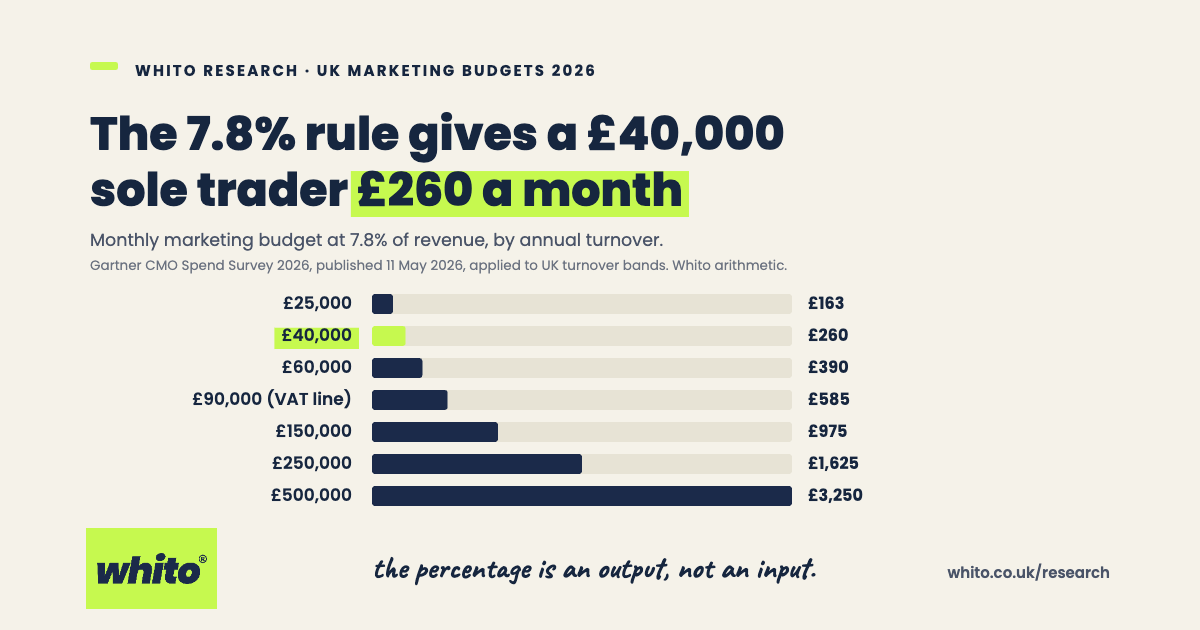
The 7.8% corporate marketing rule gives a UK sole trader on £40,000 turnover £260 a month, yet the cheapest strategy led social media retainer Whito found published in the UK costs £290 a month, on 82 provider price pages verified 13 August 2026.
Source: Whito, whito.co.uk/research/uk-marketing-budget-by-revenue, August 2026. Free to quote with a link to this page.
Last Updated on September 28, 2026
The marketing budget tables in circulation start at a revenue level most UK businesses will never reach. Ours did too: our own budget page begins at £250,000 turnover, and so do most of the others. Seventy five per cent of UK private sector businesses employ nobody except their owners, and only 12% of sole proprietorships are registered for VAT or PAYE at all.
So this page does the arithmetic nobody publishes. It takes the percentage rules and applies them down the scale, from £25,000 turnover upward, in pounds per month. Then it puts those figures next to what marketing services actually cost in the UK, which is where the whole approach comes apart.
The short version: below the VAT threshold the percentage produces a number too small to buy the thing the advice recommends, and the honest answer is a floor cost plus time. We have already shown in detail why no UK small business benchmark exists. This page is about what to do given that it does not.
£260
A month. What the 7.8% corporate rule prescribes for a business turning over £40,000
£290
A month. The cheapest strategy led social media retainer we found published in the UK
41%
Of UK businesses surveyed budget under £5,000 a year for all marketing
£1.89
Profit returned per £1 of advertising by micro and small businesses, against £4.11 for medium and large
Who the percentage rule was measured on
Two studies produce almost every marketing budget percentage in circulation, and it is worth being precise about who answered them.
| Source | Headline figure | Who was actually surveyed |
|---|---|---|
|
Gartner CMO Spend Survey 2026 11 May 2026 | 7.8% of company revenue in 2026, up from 7.7% in 2025 | 401 CMOs and marketing leaders in North America, the UK and Europe, “with the vast majority of respondents reporting annual revenue of over $1 billion” (about £738 million) |
|
The CMO Survey (Deloitte, Duke Fuqua, AMA), 35th edition fieldwork 7 to 29 January 2026 | Marketing expenses are a mean 8.96% of revenues and 9.64% of overall budget | 2,111 marketing leaders at US for-profit companies, 308 responded. “97% of respondents are VP-level or above” |
Source: each organisation’s own published methodology, read at source 25 August 2026. Every respondent in both surveys works somewhere large enough to employ a senior marketing executive. Our companion study sets out why no UK equivalent exists, including what the IPA Bellwether does and does not measure.
One correction worth making, because it is everywhere. The claim that the US Small Business Administration recommends 7 to 8% of revenue traces to a guest blog post on the SBA site dated 9 July 2019. It contains no SBA research. It cites a marketing agency called Web Strategies for “average marketing spending in 2018 was 7.9% of revenues”, and the agency page it links to sits at a URL reading how-much-budget-for-online-marketing-in-2014. There is no SBA benchmark.
What the corporate percentage prescribes in pounds
Take Gartner’s 7.8% at face value and apply it down the revenue scale, with a lower bracket of 4% and an upper bracket of 12% so you can substitute your own assumption. All figures are monthly, before VAT. This is the table the published benchmarks stop short of, because they begin at the bottom row.
| Annual turnover | Typical business | At 4% | At 7.8% | At 12% |
|---|---|---|---|---|
| £25,000 | Sole trader, part time or first year | £83 | £163 | £250 |
| £40,000 | Sole trader, established | £133 | £260 | £400 |
| £60,000 | Sole trader, busy | £200 | £390 | £600 |
| £90,000 (VAT registration threshold) | Sole trader or first hire | £300 | £585 | £900 |
| £150,000 | Micro business, 1 to 3 people | £500 | £975 | £1,500 |
| £250,000 | Micro business, 3 to 5 people | £833 | £1,625 | £2,500 |
| £500,000 | Micro to small, 5 to 10 people | £1,667 | £3,250 | £5,000 |
| £1,000,000 | Business, 10 or more | £3,333 | £6,500 | £10,000 |
Whito calculation. Turnover multiplied by the percentage, divided by twelve, rounded to the nearest pound. Business descriptions are indicative only. The 7.8% column is Gartner’s 2026 figure applied outside its sample, which is exactly the thing this page is arguing against. It is here so you can see the size of the number, not because it is a recommendation.
For scale, the average non-employing UK business turns over roughly £94,200 a year. That is Whito arithmetic from Table C of the government’s Business population estimates 2025: £402,611 million of turnover shared across 4,272,535 businesses with no employees. Treat it gently. It is a mean rather than a median, so larger single-director companies drag it upward, and the government’s own methodology note says “turnover data in the BPE are indicative” and that turnover for unregistered businesses is imputed by halving a registered average and then capped “just below the VAT threshold”.
What that money buys at published UK prices
This is the part the percentage rule never addresses. A budget is only meaningful against what things cost.
Whito verified 82 published UK provider price pages across twelve sectors on 13 August 2026. That dataset is not yet published as a study, so the figures below are given with their collection date rather than a link. Here is what the monthly figures above collide with.
| What you might buy | Verified published UK price | What it costs a business on £40,000 turnover (£260 a month at 7.8%) |
|---|---|---|
| Productised social media management | £49 to £299 a month, several plus VAT | The whole budget, or most of it, for one channel posted on your behalf |
| Strategy led social media management | £290 to £1,025 a month | Out of reach. The cheapest option is above the entire budget |
| A business website, fixed price package | £299 to £1,199 one off | One to five months of the entire annual budget, in year one |
| Google Business Profile | Free | Costs time, not budget |
| Asking customers for reviews | Free | Costs time, not budget |
| A free directory listing and a visibility check | Free | Costs time, not budget |
Prices from Whito price research, 82 UK provider price pages verified 13 August 2026, dataset not yet published as a study. Ranges are published list prices, not quotes. VAT treatment varies and is stated on only 18 of the 82 pages checked.
Below the VAT threshold, the percentage rule does not produce a marketing budget. It produces the price of one thin retainer, and then runs out.
What UK businesses actually budget
LOCALiQ surveyed more than 500 UK businesses and published the distribution of annual marketing budgets in January 2026. It reports pounds rather than percentages, which makes it the most useful UK number available even though it cannot be converted into a share of revenue.
Annual marketing budget, UK businesses, 2026
Source: LOCALiQ UK digital marketing statistics, published 12 January 2026, more than 500 UK businesses. Base 500+. Percentages as published; they include an 11% do not know response. LOCALiQ does not publish the turnover profile of the panel, so these figures cannot be converted into a share of revenue.
Forty one per cent of the panel budget under £5,000 a year for all marketing. One in five budget under £1,000, which is less than £84 a month. Meanwhile 11% do not know what they spend, which is its own finding.
Set that against the table above. A business on £90,000 turnover following the 7.8% rule would spend £7,020 a year, which puts it in the top third of this panel. The rule is not describing what small businesses do. It is prescribing what a minority already spend.
The same pound works less hard at the small end
There is one more reason copying the corporate percentage is wrong, and it is the one that ought to change the decision.
Credos, the advertising industry’s own research body, published Advertising Pays 2025 on 14 May 2025. It found that £1 spent on advertising generates a profit return of £4.11 for medium and large businesses, and £1.89 for micro and small businesses.
So the businesses setting the 7.8% benchmark get more than twice the profit out of every pound. Copying their percentage means spending like a company whose marketing is more than twice as productive as yours. That is not a rounding error. It is the difference between an investment and a leak.
This is not an argument for spending nothing. It is an argument that the size of the budget is the wrong lever to pull first. If your pound returns £1.89 and theirs returns £4.11, the gap is not in the budget. It is in the structure the budget is spent through.
The honest answer, by stage
Whito sorts marketing into three stages, and the budget question has a different answer in each. Almost every wasted pound comes from running a later stage on an earlier stage’s foundation.
Start: under roughly £90,000 turnover. The budget is close to zero. The cost is time.
At this stage the things that decide whether customers find you and trust you are free. A complete and correct Google Business Profile. The same business name, address and phone number everywhere it appears. Reviews asked for and answered. A website that says what you do, where you do it, and roughly what it costs, in plain words.
Your only real cash line is a domain and hosting, which runs to somewhere around £100 to £200 a year, and a one off website build if you are not making your own. The percentage rule at £60,000 turnover gives you £390 a month and no instruction about what to do with it, which is how that £390 ends up as a retainer nobody can measure.
Ask this instead: can a stranger find you, check you, and work out what you charge, in under two minutes? If not, no budget fixes it.
Build: roughly £90,000 to £250,000. The percentage becomes usable, and buys one channel done properly.
At £150,000 turnover, 7.8% is £975 a month. At published UK prices that is one channel run seriously, or a modest paid budget plus the tools to track it. It is not a mix of channels, and treating it as one is how it gets spread too thin to read.
The thing that has to exist before this money is spent is a record of where enquiries come from. Not an estimate. A record.
Ask this instead: can you name where your last ten customers came from? If you cannot, you cannot tell which channel to fund.
Scale: above roughly £250,000. The benchmarks start describing something recognisable, and the question changes.
Above this line the corporate percentages stop being absurd. At £500,000 turnover, 7.8% is £3,250 a month, which is a real multi-channel budget. But by the time you are here, the percentage has stopped being the interesting number.
The interesting numbers are what a customer is worth, what you pay to acquire one, and how long they stay. Whito’s break even lead pricing study sets out the arithmetic: break even lead price equals job value multiplied by marketing share multiplied by win rate.
Ask this instead: what is a customer worth, and what are you paying for one? Once you know both, the percentage is an output, not an input.
The rule, in one line
Below the VAT threshold, budget a floor and spend time. Between £90,000 and £250,000, fund one channel properly. Above £250,000, stop asking about percentages and start measuring cost per customer.
Methodology and sources
Every figure on this page was fetched and read at its original source on 25 August 2026. Nothing here is taken from a summary, an aggregator or a search result. Where a source could not be opened, it is named in the limits section below rather than cited.
Official statistics
- Business population estimates for the UK and regions 2025, Department for Business and Trade, published 2 October 2025, data at start of 2025. Business counts, legal form, registration status and Table C turnover. gov.uk
- Business population estimates 2025 methodology note, Department for Business and Trade, 2 October 2025. Turnover imputation and the “indicative” caveat. gov.uk
- Annual UK VAT statistics 2024 to 2025 commentary, HM Revenue and Customs, last updated 3 December 2025. VAT population of 2,330,400 traders, and 38% declaring turnover up to the £90,000 threshold. gov.uk
- VAT registration threshold of £90,000, in effect from 1 April 2024 and unchanged at the time of writing. gov.uk
Industry research, labelled by type
- Analyst. Gartner 2026 CMO Spend Survey press release, 11 May 2026. 7.8% of company revenue, sample of 401, “vast majority of respondents reporting annual revenue of over $1 billion” (about £738 million). gartner.com
- Academic and industry. The CMO Survey Topline Report, 35th edition, fieldwork 7 to 29 January 2026, Deloitte, Duke Fuqua and the American Marketing Association. 8.96% of revenues, 9.64% of overall budget, 308 US respondents, 97% VP-level or above. cmosurvey.org
- Trade body. IPA Bellwether Report Q2 2026, researched and published by S&P Global for the Institute of Practitioners in Advertising. Net balance +6.9%, panel of around 300 drawn primarily from the top 1,000 UK companies. ipa.co.uk
- Trade body research. Advertising Pays 2025, Credos for the Advertising Association, 14 May 2025. Profit return of £4.11 per £1 for medium and large businesses, £1.89 for micro and small. adassoc.org.uk
- Commercial survey. LOCALiQ UK digital marketing statistics, published 12 January 2026, more than 500 UK businesses. Annual marketing budget distribution. localiq.co.uk
- Commercial blog, cited to correct it. “How to Get the Most From Your Marketing Budget”, US Business Administration blog, Rieva Lesonsky, 9 July 2019. sba.gov
Whito research used
- Marketing ROI benchmarks UK 2026: why the benchmark does not exist. 19 August 2026. The full sourcing argument this page rests on, including the IPA Bellwether and the official UK surveys that do not ask the question.
- Whito price research, 82 UK provider price pages across twelve sectors, verified 13 August 2026. Source of every published price in the second table. This dataset has not yet been published as a study.
- We checked 200 UK small business websites for prices. Why published prices are a minority of the market, which is the sampling caveat on the price table.
- What a UK trade should pay for a lead. 25 August 2026. Break even lead pricing arithmetic.
Known limits
- No UK small business benchmark exists, and this page does not create one. We looked. The Longitudinal Small Business Survey 2024, the largest official UK survey of small businesses at 8,396 SME employers, does not ask about marketing spend at all. Nothing here should be read as a new UK percentage.
- The £94,200 mean turnover figure is soft. It is Whito arithmetic on BPE Table C, it is a mean rather than a median, and the underlying turnover for unregistered businesses is imputed and capped by the method itself.
- LOCALiQ’s panel profile is not published. We do not know the turnover mix of the 500 businesses, so the budget bands cannot be converted into percentages of revenue.
- The full LOCALiQ report is gated behind a form and we did not complete it. Only figures from the free article are used.
- The CMO Survey Firm and Industry Breakout Report is blocked to us by robots.txt. It would show what the sub £18.4m ($25m) firms in that sample report. We have not read it and have cited nothing from it.
- The Gartner figure is a single self reported percentage. Gartner does not publish a breakout by company size, so we cannot say how many respondents sit below the billion dollar line.
- The price dataset behind the second table is not published. It was collected on 13 August 2026 across 82 UK provider price pages and is held in our research files. Until it is published you cannot check it yourself, which is a real limitation on that table and we would rather say so than leave it implied.
- Published prices are list prices. Providers who publish prices at all are a minority of the UK market, and the ones who do skew towards productised, better marketed firms.
- The £100 to £200 a year domain and hosting figure is a working estimate, not a verified price survey. Treat it as an order of magnitude.
How to cite this
Whito (2026). UK marketing budgets by revenue: what sole traders and micro businesses should actually spend in 2026. Published 25 August 2026. https://whito.co.uk/research/uk-marketing-budget-by-revenue/
Journalists and researchers are welcome to reuse the tables with attribution. Every source is linked above so you can check the figures yourself rather than taking ours.
Questions people ask
What percentage of revenue should a UK small business spend on marketing?
There is no UK published benchmark for small businesses, as our companion study sets out. The 7 to 10% range in general circulation comes from Gartner and The CMO Survey, whose respondents are billion dollar corporations and US firms with a marketing VP. Below the VAT threshold of £90,000, a percentage is the wrong instrument. Budget a small floor for a domain, hosting and a website, and spend time on the free things that decide whether customers find and trust you.
Is the 7 to 8% rule really from the Small Business Administration?
No. It traces to a guest blog post on the SBA site from 9 July 2019, which cites a marketing agency’s blog about 2018 spending, itself published at a URL referring to 2014. There is no SBA benchmark study behind it.
How much do UK businesses actually spend on marketing?
LOCALiQ surveyed more than 500 UK businesses in January 2026. Twenty per cent budget less than £1,000 a year, and a further 21% budget between £1,000 and £4,999, so 41% budget under £5,000 a year in total. Nine per cent budget £120,000 or more, and 11% do not know.
Does the IPA Bellwether Report tell me what UK companies spend?
No. Bellwether measures the direction of budget revisions as a net balance, which is the share of the panel revising budgets up minus the share revising them down. It does not measure spend levels or spend as a share of revenue, and its panel is drawn primarily from the top 1,000 UK companies.
Why does the same marketing pound return less for a small business?
Credos, researching for the Advertising Association in Advertising Pays 2025, found £1 of advertising generates £4.11 of profit for medium and large businesses and £1.89 for micro and small ones. That gap is usually a structural one rather than a budget one, which is why fixing what the money is spent through matters more than raising the amount.
When should I start spending real money on marketing?
When you can name where your last ten customers came from. Until you can, extra spend buys activity you cannot attribute, and you will not know which part to keep.
The sharp takeaway
The percentage of revenue question feels like the responsible one to ask. It is not. It is a corporate metric that arrived in business advice without anyone checking whether businesses were in the sample, and they were not.
Below the VAT threshold the honest budget is small, and the honest cost is time spent on things that are free. In the middle it funds one channel done properly. Above it, the question stops being what percentage and starts being what a customer is worth.
Do not ask what percentage. Ask where your last ten customers came from. If you cannot answer that, no budget will save you, and a bigger one will just lose you money faster.
Before you set a budget
The free Whito Visibility Check checks 17 things that decide whether customers and AI search engines can find, check and trust your business. It takes about two minutes, there is no sign up, and it tells you the one thing to fix first.
Most of what it finds costs nothing to fix, which is rather the point of this page.
- Marketing ROI benchmarks UK 2026: why the benchmark does not exist. The companion study. Why no UK survey measures small business marketing spend, and what you can benchmark for free instead.
- How much should marketing cost a UK business. The same question from £250,000 turnover upward, with allocation splits by stage.
- What a UK trade should actually pay for a lead. Break even lead pricing across twelve job types.
- SEO costs in the UK. Published retainer ranges by provider type and business size.
- Cost per lead in the UK. What businesses pay for enquiries by channel.
The structural checks behind this research run on any website in about twenty seconds. Enter yours and read the full result on the page. Free, and we do not ask for your email.
Run the free Visibility CheckIf your business is named here and you think we have a fact wrong, email hello@whito.co.uk and we will check it and correct it. If you want to respond, send us a statement and we will publish it alongside. Full detail: Corrections, right of reply and removals.