

Last Updated on August 25, 2026
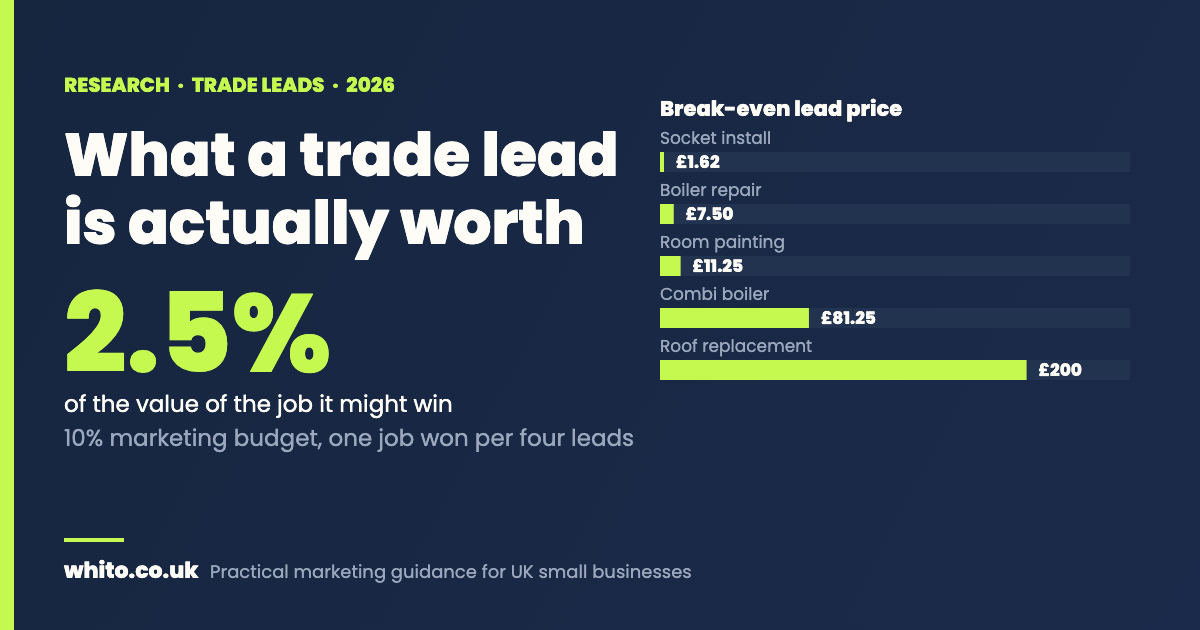
A trade lead is worth 2.5% of the value of the job it might win, on the central assumptions used throughout this study: a marketing budget set at 10% of revenue, and a win rate of one job in every four leads bought.
On an average £300 boiler repair that is £7.50. On an average £8,000 roof replacement it is £200. On a £65 socket installation it is £1.62.
That spread is the finding. Across twelve everyday UK trade jobs priced from published cost guides, the break-even price of a single lead runs from £1.62 to £1,200. The same lead fee that is a bargain on a bathroom is a loss on a boiler service, and no platform prices leads by what the job is worth to the trade buying it.
2.5%
of job value is what a lead is worth in the central case
740x
spread between the cheapest and dearest break-even price across 12 jobs
2 of 12
jobs cannot carry even the cheapest lead price MyBuilder publishes
0 of 10
trading UK platforms publish a win rate, so cost per won job cannot be benchmarked
The formula, and why it is not a benchmark
The break-even price of a lead is the point at which buying it stops making money. It is set by three numbers and only three:
Break-even lead price
Job value x marketing share x win rate
Job value is what the work pays. Marketing share is the proportion of revenue the business is willing to spend on winning work. Win rate is the share of purchased leads that turn into paid jobs.
Two of those three are knowable. Published cost guides give job values. The business itself sets the marketing share. The third one, the win rate, is the problem, and it is the reason this page is a model rather than a benchmark.
Whito checked every trade-facing page, help centre, pricing page and set of terms published by the major UK lead platforms. Not one of them publishes a win rate, a conversion rate, or a leads-per-job-won figure. Checkatrade told the Competition and Markets Authority that homeowners “instruct and complete around three million jobs per year through our platform”, but it does not disclose how many leads were issued to produce them, so the ratio cannot be derived. Bark and MyBuilder both explicitly disclaim any guarantee of work at all.
Cost per lead can be sourced. Cost per won job cannot, because the denominator has never been published by anyone who has it.
So the win rate here is a stated assumption, not a measured figure. One in four is used as the central case because it sits in the middle of the range that shared-lead platforms make arithmetically possible: Rated People caps competition at three trades per lead, Bark at five. Every table below shows the answer at other win rates too, because your own number is the only one that matters.
What a lead is actually worth, by job
Twelve common domestic jobs, priced from published UK cost guides, with the break-even lead price at three win rates. Marketing share is held at 10% of job value throughout.
| Job | Job value | Win 1 in 10 | Win 1 in 4 | Win 1 in 2 |
|---|---|---|---|---|
| Socket installation | £65 | £0.65 | £1.62 | £3.25 |
| Weekly domestic clean, 3 hours | £75 | £0.75 | £1.88 | £3.75 |
| Electrical safety certificate | £212.50 | £2.12 | £5.31 | £10.62 |
| Boiler repair | £300 | £3 | £7.50 | £15 |
| End of tenancy clean | £300 | £3 | £7.50 | £15 |
| Painting a medium room, 18m2 | £450 | £4.50 | £11.25 | £22.50 |
| Exterior painting, 3-bed semi | £1,300 | £13 | £32.50 | £65 |
| Combi boiler replacement | £3,250 | £32.50 | £81.25 | £162.50 |
| Rewire, 3-bed house | £6,225 | £62.25 | £155.63 | £311.25 |
| New bathroom | £7,000 | £70 | £175 | £350 |
| Roof replacement | £8,000 | £80 | £200 | £400 |
| Single storey extension, 20m2 | £48,000 | £480 | £1,200 | £2,400 |
Base: 12 job types. Job values are midpoints or stated averages from Checkatrade cost guides, updated between March 2026 and June 2026, except the extension, which is from a guide last updated May 2024. Marketing share held at 10% of job value. Break-even lead price calculated by Whito as job value x 0.10 x win rate. Full sources and dates below.
Break-even lead price at a one in four win rate
Bars scaled against the roof replacement at £200. The 20m2 extension is left off the chart at £1,200, six times the longest bar shown. Marketing share 10%, win rate one in four.
What the platforms actually charge
Only two of the platforms below publish a per-lead price on their own site. Setting that price against the table above is the whole exercise.
| Platform | Model | Published price, in the platform’s own words | VAT stated |
|---|---|---|---|
| MyBuilder | Pay per shortlist | “Our shortlist fees typically range from £2 to £35 depending on the size of the job.” Live examples on the page ran from “£4.90 lead” to “£30.00 lead” | No |
| Bark | Pay per lead, via credits | “Current credit price: £1.80 per credit” in the help centre. The pricing page itself publishes no figure, and credits required per lead are not published | No |
| Checkatrade | Monthly subscription | “£0/month” free, “£30/month” Approved, “Prices from £59/mo” Growth. “Memberships are for 12 months” | Not on the pricing page. Its own blog says “£30 + VAT per month” |
| Which? Trusted Traders | Assessment plus subscription | “£248” assessment, then “£66” monthly or “£797” annually for 0 to 3 employees, rising to “£114” monthly or “£1,363” annually for 10 to 19 | Yes. “Non-refundable assessment fee (inc VAT)” |
| Yell | Marketing package | “Starting at £299 per month” for Amplify and “Starting at £699 per month” for Accelerate. The same page also states Amplify “starts from £249 per month” | No |
| Airtasker UK | Commission | “The service fee can range from 12.5 to 20% of the task price.” | Partly. “Tax is then also added to the fee” |
| Rated People | Subscription | No price published. “One fee. Unlimited leads” | Not stated |
| TrustATrader | Annual membership | No price published. “We charge a yearly fee for membership” | Not stated |
| Plentific | Contractor marketplace | No price published on any page checked | Not stated |
| TaskRabbit UK | Commission | No current figure retrievable. The only figure on TaskRabbit’s own UK estate is “30% to 15%” in a press release dated June 2018 | Not stated |
Base: 10 trading UK platforms, all pages opened and read on 25 August 2026. Two further platforms were checked and are no longer trading: Local Heroes “stopped accepting new jobs on 20th October, 2023” per British Gas, and Bidvine “has gone into administration” per Bark, which absorbed it. Quotes are verbatim from the platform’s own pages.
The most transparent pricing in the set belongs to the consumer champion, not the marketplaces. Which? Trusted Traders publishes every fee, banded by business size, with VAT treatment stated and a validity date on the prices. Four of the ten trading platforms publish no price at all.
Where the published prices stop paying
MyBuilder is the only platform publishing a straightforward per-lead range, so it is the only one that can be tested directly against break-even. At a 10% marketing share and a one in four win rate:
- Its cheapest published fee, £2, breaks even on a job worth £80.
- Its cheapest live example, £4.90, breaks even on a job worth £196.
- Its dearest published fee, £35, breaks even on a job worth £1,400.
So the published range works on jobs worth roughly £80 to £1,400, and is generous above that. Below £80 it cannot work at all. The socket installation at £65 and the weekly clean at £75 sit under the floor: there is no lead on the board cheap enough for those jobs to carry at these assumptions.
This is not an accusation of overcharging. A £30 lead on a driveway is priced sensibly. It is a warning about mix. A trade whose work is mostly small callouts is buying from a price list built for larger jobs, and the arithmetic does not care how good the platform is.
Subscriptions invert the question
A monthly fee has no per-lead price at all. What it has is a cost per won job that falls as you win more, which means the same membership is cheap or expensive depending entirely on volume.
| Jobs won from the platform in a year | Checkatrade Approved, £30/mo | Checkatrade Growth, from £59/mo | Which? Trusted Traders, 0 to 3 staff |
|---|---|---|---|
| 6 | £60 | £118 | £174 in year one, £133 after |
| 12 | £30 | £59 | £87 in year one, £66 after |
| 24 | £15 | £29.50 | £44 in year one, £33 after |
| 52 | £6.92 | £13.62 | £20 in year one, £15 after |
Base: published annual fees divided by jobs won. Checkatrade at £360 and £708 a year from its published monthly prices. Which? Trusted Traders at £797 a year plus the £248 assessment fee in year one. VAT treatment differs between these platforms and is not normalised here. Calculated by Whito.
Read that against the break-even table. Checkatrade Approved at twelve jobs a year costs £30 per won job, which a £1,300 exterior painting job carries comfortably and a £300 boiler repair does not. At 52 jobs a year it costs £6.92 per won job, and the boiler repair carries it with room to spare.
Subscriptions reward volume. Pay per lead rewards accuracy. Neither rewards a business that does not know which it is.
Run it on your own numbers
This page cannot tell you what your leads are worth, because it does not know your win rate and neither does anybody else. What it can do is show you the sum.
The five minute self audit
1. Take the last three months. Count the leads you paid for. Count the jobs you won from them.
2. Divide jobs by leads. That is your win rate, and it is the number no platform will give you.
3. Take your average job value and multiply it by the share of revenue you are willing to spend on marketing. Ten per cent is a common starting point.
4. Multiply that by your win rate. That is the most you can pay for a lead.
5. Compare it against what you actually paid.
Most trades have never done this, because platform spend arrives as dozens of small charges rather than one bill. The total is invisible until you add it up on purpose.
This sits in the Start stage of the Whito framework, not Scale. Buying more leads is a scale decision, and it cannot be made sensibly until the number above exists. If the foundations are not in place, more spend simply finds the leak faster.
Two practical next steps. Run the free Whito Scorecard to see how findable your business already is without paying for introductions, since every job that arrives direct costs nothing per lead and lifts every figure on this page. And check whether your business is already in the Whito directory, which is free to be listed in and free to claim.
Methodology and sources
Two datasets, both collected on 25 August 2026, plus one calculation.
Platform pricing. Every platform’s own trade-facing pricing page, help centre, signup page and terms were opened and read directly. Nothing is taken from a third-party summary or a search result. Where a platform publishes no price, that is recorded as published nothing rather than filled in from elsewhere.
Job values. Taken from published UK cost guides. These are commercial sources, not official statistics. Checkatrade describes its figures as “ballpark averages” and states that “Data verified by our professional estimators. Estimators are CIOB & RICS members.” No cost guide in the set publishes a sample size. The rewire guide is the only one claiming any underlying job data, stating that the price is “generated using AI based on past Checkatrade jobs”, and it does not quantify that either.
The calculation. Break-even lead price is job value multiplied by marketing share multiplied by win rate. Marketing share and win rate are stated assumptions, varied across every table so the reader can pick their own. No figure on this page is presented as a measured industry average.
Platform sources, all read 25 August 2026.
Checkatrade pricing and Checkatrade on membership cost (commercial).
MyBuilder trade signup (commercial).
Bark credit pricing, Bark seller pricing and Bark terms (commercial).
Rated People signup and Rated People on how the service works (commercial).
Which? Trusted Traders join page and trader FAQs (industry scheme).
TrustATrader FAQs (commercial).
Yell marketing packages (commercial).
Airtasker service fee (commercial).
British Gas on the closure of Local Heroes (commercial).
Bark on Bidvine entering administration (commercial).
Job value sources, all read 25 August 2026, all Checkatrade cost guides (commercial).
Electrician rates, updated May 2026, for the socket installation and the electrical safety certificate.
House cleaning costs, updated April 2026, for the weekly clean and the end of tenancy clean.
Boiler repair costs, updated May 2026.
Painter and decorator prices, updated June 2026.
New boiler costs, updated March 2026, for the combi replacement.
Rewiring costs, updated June 2026.
New bathroom costs, updated March 2026.
Roof replacement costs, updated March 2026.
House extension costs, last updated May 2024.
Known limits
This is a model built on published inputs, and it should be read as one.
- The win rate is assumed, not measured. No UK platform, regulator or survey publishes one. The CMA examined trader recommendation platforms in 2024 and its remit covered consumer representations, vetting and reviews, not lead economics. Any cost per won job in circulation, including on this page, is arithmetic on an assumption.
- Job values come from commercial cost guides with no published sample size. They are the best available published UK figures and they are not official statistics. The extension figure is from a guide last updated May 2024 and is the oldest input here.
- Marketing share is a choice, not a rule. Ten per cent is used as a central case. A business with high gross margin can carry more, one with thin margins less. The tables vary it so you can substitute your own.
- VAT is not normalised. Platforms state VAT treatment inconsistently, and two of them contradict themselves between pages. Comparisons across platforms are therefore approximate.
- Job value is not profit. Break-even here is measured against revenue, in line with how marketing budgets are normally set. A business that prefers to work from gross profit should substitute that figure and will get a lower number.
- Prices change. Every figure is dated. Check the source before relying on it.
How to cite this page
Whito, “How Much Should a UK Trade Pay for a Lead? Break-Even Prices for 12 Jobs”, whito.co.uk, published 25 August 2026. Reuse of these figures is permitted with attribution and a link to this page.
Frequently asked questions
How much should a tradesperson pay for a lead?
On the central assumptions used here, a marketing budget of 10% of revenue and a win rate of one job per four leads, a lead is worth 2.5% of the value of the job. That is £7.50 on an average £300 boiler repair and £200 on an average £8,000 roof replacement. Substitute your own win rate and the answer changes proportionally.
What is the average cost per won job for UK trades?
No defensible figure exists. None of the ten trading UK lead platforms publishes a win rate or a leads-per-job-won figure, and no regulator or independent survey has measured one. Cost per won job can only be worked out from your own records: leads bought and jobs won over a stated period.
How many other tradespeople get the same lead?
It varies by platform and most do not say. Rated People states that “a max of 3 tradespeople can give quotes for each job lead”. Bark’s terms state that “a maximum of five Professionals will contact you directly”. Checkatrade describes quote requests going to “multiple trades at once” without publishing a cap, and MyBuilder publishes no cap.
Is Checkatrade or MyBuilder cheaper?
They are not comparable without knowing your volume. MyBuilder charges “£2 to £35” per shortlist, so cost scales with leads bought. Checkatrade charges a fixed “£30/month” on its Approved tier with memberships running for 12 months, so cost per won job falls as you win more. At twelve jobs a year Checkatrade Approved works out at £30 per won job, and at 52 jobs a year it is £6.92.
Which UK trade platforms publish their prices?
Of ten trading platforms checked in August 2026, Checkatrade, MyBuilder, Which? Trusted Traders, Yell and Airtasker publish a numeric price, though Yell states two different prices for the same package on one page. Bark publishes a credit price in its help centre but not the credits required per lead. Rated People, TrustATrader, Plentific and TaskRabbit UK publish no current price on their own pages.
- UK Trade Directory Costs, the companion study on what each platform charges and how the contracts work.
- How Much Does a Lead Cost in the UK, cost per lead across industries beyond the trades.
- What Trade Lead Generation Really Costs, on shared leads and owned channels.
- The Whito AI Visibility Index, on which businesses Google’s AI Mode actually recommends for local work.
- The Whito Scorecard, a free check on how findable your business already is.
- The Whito directory, free to be listed in and free to claim.
The takeaway
Stop asking whether leads are expensive. Ask what a job is worth to you, what share of it you are willing to spend, and how often you win. Those three numbers set the price, and two of them are yours.
Every platform in this study prices leads by what the market will bear. None of them prices by what the job is worth to the trade buying it. That gap is not a scandal, it is an arithmetic problem, and it belongs to the buyer.
The structural checks behind this research run on any website in about twenty seconds. Enter yours and read the full result on the page. Free, and we do not ask for your email.
Check your business freeIf your business is named here and you think we have a fact wrong, email hello@whito.co.uk and we will check it and correct it. If you want to respond, send us a statement and we will publish it alongside. Full detail: Corrections, right of reply and removals.