Finding
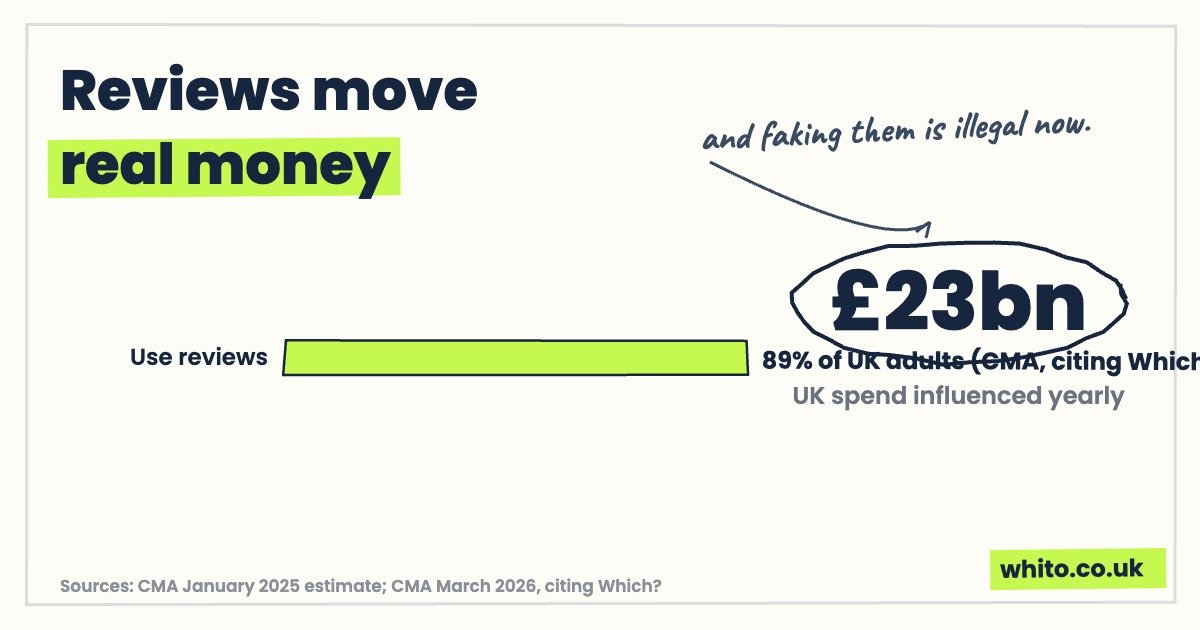
89% of UK adults use online reviews when researching a product or service, per Which? figures cited by the CMA in March 2026, and since 6 April 2025 fake reviews have been a banned UK practice with fines of up to 10% of global turnover.
Source: Whito, whito.co.uk/research/uk-online-review-statistics, March 2026. Free to quote with a link to this page.
Last Updated on September 8, 2026
Most business owners still think of reviews as a popularity contest. Get a few stars, look respectable, move on.
That thinking is now out of date twice over. First, your reviews are being read by AI tools that decide whether to recommend you at all, not just by customers scrolling on their phones. Second, since 6 April 2025, faking reviews is a banned practice under UK law, with fines of up to 10% of global turnover.
The mistake is treating reviews as decoration. Businesses either ignore them, or try to game them. Both are now expensive errors. Reviews have become infrastructure: they influence an estimated £23 billion of UK consumer spending a year, they feed the recommendation engines, and they sit under active regulator scrutiny.
This page gathers the verified numbers in one place, with sources, dates and honest labels on what each figure actually measures.
Key UK review statistics
As much as £23 billion of UK consumer spending is potentially influenced by online reviews each year, according to a CMA estimate (January 2025).
89% of UK adults use online customer reviews when researching a product or service (Which?, cited by the CMA, March 2026).
An estimated 11% to 15% of reviews in three product categories studied are likely fake (Department for Business and Trade research, April 2023).
Fake reviews increased the share of consumers choosing a known-poor product by 120% in a Which? experiment with 9,988 consumers (2023).
Fake reviews became a banned practice under the DMCC Act on 6 April 2025, with fines of up to 10% of global turnover.
The CMA opened consumer law investigations into five businesses over reviews on 27 March 2026 (open investigations, not findings).
Google blocked or removed over 292 million policy-violating reviews in 2025 (platform-reported, global).
Amazon proactively blocked over 275 million suspected fake reviews in 2024 (platform-reported, global).
Trustpilot removed 4.5 million fake reviews in 2024, 7.4% of all reviews submitted that year (platform-reported, global).
Use of ChatGPT and other AI tools for local business recommendations jumped from 6% to 45% in a year (BrightLocal survey of 1,002 US adults, February 2026).
How much reviews actually move
As much as £23 billion of UK consumer spending is potentially influenced by online reviews each year, per a January 2025 CMA estimate. Note the hedging: “as much as” and “potentially influenced”. It is an estimate of exposure, not a measured effect. Even so, the scale is the point.
Usage figures back it up. In March 2026 the CMA, citing Which?, put the share of UK adults who use online customer reviews when researching a product or service at 89%. The Department for Business and Trade said in April 2025 that reviews are used by 90% of consumers, feeding into the £217 billion spent in UK online retail markets in 2023.
For context from across the Atlantic, BrightLocal’s 2026 survey of 1,002 US adults found 97% read reviews for local businesses, and 49% trust reviews as much as recommendations from people they know. That is US data, but it shows where consumer habits sit at the top end.
How widely reviews are used when researching purchases
UK adults who use reviews when researching (Which?, via CMA)
Consumers who use reviews (DBT)
US consumers who read reviews for local businesses (BrightLocal, US data)
Sources: CMA citing Which? (March 2026, UK adults); Department for Business and Trade (April 2025, UK); BrightLocal Local Consumer Review Survey (February 2026, 1,002 US adults). The BrightLocal figure is US data and covers local businesses specifically.
The threshold effects matter more than the averages. In the same BrightLocal survey (US data), 68% of consumers said they will only use a business rated four stars or higher, and 31% demand 4.5 or higher. A rating is not a vanity number. It is a filter you either pass or fail.
How many reviews are fake
You will see claims online that “up to 50% of reviews are fake”. Ignore them. There is no verifiable methodology behind that number. The best UK evidence is narrower and more careful.
DBT research published in April 2023 examined three product categories: consumer electronics, home and kitchen, and sports and outdoors. It estimated that 11% to 15% of reviews in those categories are likely fake. The same research estimated that fake review text alone causes £50 million to £312 million of yearly harm to UK consumers.
The persuasion effect was measurable too. Well-written fake reviews made consumers 3.1% more likely to buy, rising to 9.2% for products costing over £80. The more expensive the product, the more a fabricated review moves the sale.
Which? and The Behaviouralist went further with an experiment in 2023. They put 9,988 consumers in front of screens designed to resemble Amazon and measured what fake reviews did to choices.
Which? experiment: share of consumers choosing a known-poor product
Control group (no fake reviews)
Exposed to fake reviews
Fake reviews plus a warning banner
Source: Which? and The Behaviouralist experiment, 2023. Base: 9,988 consumers viewing screens designed to resemble Amazon. Fake reviews took the share choosing a known-poor product from just over 10% to 23.1%, a 120% increase. A warning banner only cut it to 19%, still 81% above the control.
Two lessons sit in that chart. Fake reviews work, which is exactly why they were banned. And warning labels barely help, which is why regulators moved to prevention and penalties rather than disclaimers.
The clean-up at platform scale
The platforms publish their own enforcement numbers. They are worth reading, but only with each platform’s definition attached, because they are not measuring the same thing.
Platform enforcement in one year, each by its own definition
Google: policy-violating reviews blocked or removed, 2025 (broader than fake)
Amazon: suspected fake reviews proactively blocked, 2024
Trustpilot: fake reviews removed, 2024
Sources: Google (platform-reported, global, 2025 data); Amazon (platform-reported, global, 2024); Trustpilot Trust Report 2025 (platform-reported, global, 2024 data). Definitions differ by platform: Google counts all policy violations, not just fakes; Amazon counts suspected fakes blocked before publication; Trustpilot counts fakes removed. The bars are not directly comparable.
Trustpilot’s figures give the clearest ratio. It removed 4.5 million fake reviews in 2024, which was 7.4% of all reviews submitted that year, up from a 6.1% removal rate in 2023. 90% were removed automatically. For scale, 61 million reviews were published on the platform in 2024, and it passed 300 million total reviews.
Google reported blocking or removing over 292 million policy-violating reviews in 2025, a category that includes spam and off-topic content as well as fakes. It also removed over 13 million fake Business Profiles and put posting restrictions on more than 782,000 accounts. Amazon reported proactively blocking over 275 million suspected fake reviews in 2024, meaning most never appeared at all.
The takeaway for a business is simple. The platforms are filtering at industrial scale, and their systems now flag suspicious review patterns automatically. A sudden burst of five-star reviews from new accounts does not look like success to these systems. It looks like a signal.
The law now: fake reviews are a banned practice
On 6 April 2025, fake reviews became a banned practice in the UK under the Digital Markets, Competition and Consumers Act 2024. CMA guidance defines a fake review as one that “purports to be, but is not, based on a person’s genuine experience”. Concealed incentivised reviews are banned too: if a review was paid for or rewarded, that must be disclosed.
The duty does not stop at the person writing the fake. Businesses that publish reviews must take reasonable and proportionate steps to prevent and remove banned reviews. Hosting reviews now carries responsibility.
The penalties are serious: fines of up to 10% of global turnover for infringements, and 5% for breaching undertakings given to the CMA. We cover the full detail, including what counts as an incentivised review and what “reasonable and proportionate steps” means in practice, in our explainer on why fake reviews are now illegal in the UK.
Enforcement has started. On 27 March 2026 the CMA opened consumer law investigations into five businesses over reviews: Autotrader, Feefo, Dignity, Just Eat and Pasta Evangelists. These are open investigations. The CMA is investigating whether consumer law has been broken; no findings have been made and no wrongdoing has been established.
“Fake reviews strike at the heart of consumer trust.”
Sarah Cardell, CMA chief executive, March 2026
| What changed | Detail | Source and date |
|---|---|---|
| Fake reviews banned | A review that “purports to be, but is not, based on a person’s genuine experience” is a banned practice from 6 April 2025 | DMCC Act 2024; CMA208 guidance, April 2025 |
| Concealed incentives banned | Incentivised reviews must be disclosed, not hidden | CMA208 guidance, April 2025 |
| Publisher duties | Businesses publishing reviews must take reasonable and proportionate steps to prevent and remove banned reviews | CMA208 guidance, April 2025 |
| Fines | Up to 10% of global turnover for infringements; 5% for breaching undertakings | DMCC Act 2024 |
| Google warning alerts (UK) | Businesses found boosting their star rating with fake reviews will get warning alerts on their Google profiles; repeat fake reviewers will be banned and their reviews deleted | CMA and Google undertakings, January 2025 |
| First investigations opened | The CMA is investigating whether five businesses have complied with consumer law on reviews (open investigations, no findings) | CMA, 27 March 2026 |
The January 2025 undertakings from Google are worth a second look because they are UK-specific and visible to customers. A business caught boosting its star rating with fake reviews will get a warning alert shown on its Google profile. That is a public mark, in the exact place customers look before choosing you.
Reviews are feeding AI now
Reviews used to persuade people. Now they also feed machines. It is the shift most owners have not clocked.
BrightLocal’s 2026 survey of 1,002 US adults, published in February 2026, found that use of ChatGPT and other AI tools for local business recommendations jumped from 6% to 45% in a single year. That is US data, but the direction of travel is unmistakable. Over the same period, Google’s share as a review source dipped from 83% to 71% in that survey.
The one-year shift in where recommendations come from (US data)
Use AI tools for local business recommendations, 2025
Use AI tools for local business recommendations, 2026
Google as a review source, 2025
Google as a review source, 2026
Source: BrightLocal Local Consumer Review Survey 2026, published February 2026. Base: 1,002 US adults. These are US figures; comparable UK survey data is not yet available.
Why does this matter for your reviews? AI tools do not have opinions of their own. When someone asks an AI assistant for a good plumber or a reliable accountant, the answer is assembled from what is written about you online, and reviews are one of the richest sources of that text.
A thin, stale or suspicious review profile does not just look weak to a human scrolling past. It gives the recommendation engines nothing credible to work with. This connects directly to the wider shift in how people find businesses, which we cover in our sister report on UK search engine statistics, published the same day as this page.
Reviews are no longer just marketing. They are infrastructure. They feed the systems that decide whether you get recommended at all.
What responding to reviews is worth
The evidence on ratings and revenue is older than most people realise, so label it clearly and use it as direction, not gospel.
The best-known figure comes from Michael Luca’s Harvard Business School working paper on US restaurants using Yelp data, first published in 2011 and revised in 2016. It found a one-star increase in Yelp rating leads to a 5% to 9% increase in revenue. It is a dated academic study, US-based and restaurant-specific, but it remains the most cited estimate of what a star is worth.
On responding specifically, Proserpio and Zervas studied US hotels on TripAdvisor in research published in 2018. Hotels that started responding to reviews received 12% more reviews, and their ratings rose by an average of 0.12 stars. Responding did not just look polite. It changed both the volume and the tone of what came next.
Consumer expectations point the same way. In BrightLocal’s 2026 survey (1,002 US adults), 89% of consumers expect owners to respond to reviews, and 80% say they are likely to use a business that responds to all its reviews.
| Finding | Figure | Study, geography and date |
|---|---|---|
| Revenue lift per extra star on Yelp | 5% to 9% | Luca, Harvard Business School working paper, US restaurants, Yelp data, 2011 revised 2016 (dated academic study) |
| Extra reviews after starting to respond | 12% more | Proserpio and Zervas, US hotels, TripAdvisor data, published 2018 |
| Average rating rise after starting to respond | 0.12 stars | Proserpio and Zervas, US hotels, TripAdvisor data, published 2018 |
| Consumers who expect owners to respond | 89% | BrightLocal, 1,002 US adults, February 2026 (US data) |
| Likely to use a business that responds to all reviews | 80% | BrightLocal, 1,002 US adults, February 2026 (US data) |
None of these studies is UK-specific, and the academic ones predate the AI shift. But the mechanism they describe, that visible engagement earns more and better feedback, is not tied to one country or one platform.
What to do about it
Everything above points to the same short list. No tricks, no tools you do not need.
- Stop anything that could look like gaming. No bought reviews, no review swaps, no undisclosed incentives, no asking staff or family to post. Since 6 April 2025 this is not a grey area, it is a banned practice.
- Ask every happy customer, at the moment of satisfaction. A steady trickle of real reviews beats a burst of anything. Steady and real is also what the platform filters are built to trust.
- Respond to every review, good and bad. The Proserpio and Zervas evidence (US hotels, 2018) suggests responding lifts both review volume and ratings, and BrightLocal’s US survey shows customers now expect it.
- Watch your rating against the four-star threshold. If you sit below 4.0, fixing the underlying service problem is your highest-return marketing task, because a large share of customers filter you out before reading a word.
- If you display reviews on your own site, check your process. The duty to take reasonable and proportionate steps to prevent and remove banned reviews applies to businesses that publish them.
- Audit before you spend. An hour reading your own reviews, your response rate and your rating trend will tell you more than most paid reports. More research to work from is in our research hub.
Methodology and sources
Every figure on this page comes from a named source with a date, geography and definition. Where a source is a platform reporting on itself, or a survey from another country, we say so. Estimates are presented with the original hedges intact.
- CMA: changes secured from Google to tackle fake reviews (official, January 2025). Source of the £23 billion estimate and the Google undertakings.
- CMA: five businesses under investigation over reviews (official, March 2026). Source of the 89% figure (citing Which?) and the open investigations.
- Department for Business and Trade: fake reviews banned (official, April 2025). Source of the 90% usage and £217 billion figures.
- CMA208 fake reviews guidance (official, April 2025). Source of the legal definitions and business duties.
- DBT: investigating the prevalence and impact of fake reviews (official, April 2023). Source of the 11% to 15% prevalence, harm and persuasion figures.
- Which?: the real impact of fake reviews (consumer body, May 2023). Source of the 9,988-consumer experiment.
- Trustpilot Trust Report 2025 (platform-reported, global, May 2025). Source of the 4.5 million removals and related figures.
- Google: protecting businesses on Maps (platform-reported, global, April 2026). Source of the 292 million policy-violating reviews figure.
- Amazon: actions against fake review brokers (platform-reported, global, October 2025). Source of the 275 million suspected fakes figure.
- BrightLocal Local Consumer Review Survey (commercial, US, February 2026). Source of all consumer behaviour and AI adoption figures marked as US data.
- Luca: Reviews, Reputation, and Revenue (academic, 2016 revision). Source of the 5% to 9% revenue figure.
- Proserpio and Zervas in Harvard Business Review (academic, 2018). Source of the responding figures.
Known limits. BrightLocal’s 2026 survey covers 1,002 US adults, so every figure from it is US data, not UK; we label it as such wherever it appears. The platform enforcement numbers from Google, Amazon and Trustpilot are global, self-reported, and use each platform’s own definitions, so they are not directly comparable with each other: Google counts policy-violating reviews, a broader category than fake; Amazon counts suspected fake reviews blocked before publication; Trustpilot counts fake reviews removed. The DBT prevalence estimate of 11% to 15% covers three product categories only (consumer electronics, home and kitchen, sports and outdoors) and should not be read as a figure for all reviews everywhere. The Luca and Proserpio and Zervas studies are US-based academic work from 2016 and 2018 respectively, and predate both the DMCC Act and the shift to AI-assisted discovery. The CMA investigations opened in March 2026 are open investigations; no findings have been made against any of the businesses named.
How to cite this page
Whito, “UK Online Review Statistics 2026”, whito.co.uk, updated 21 August 2026. Reuse of the figures and charts on this page is permitted with attribution and a link to this page.
Frequently asked questions
Are fake reviews illegal in the UK?
Yes. Fake reviews became a banned practice under the DMCC Act 2024 on 6 April 2025. CMA guidance defines a fake review as one that “purports to be, but is not, based on a person’s genuine experience”. Concealed incentivised reviews are also banned, and fines can reach 10% of global turnover.
How many online reviews are fake?
There is no reliable figure for all reviews everywhere. The best UK evidence, DBT research from April 2023 covering consumer electronics, home and kitchen, and sports and outdoors, estimated 11% to 15% of reviews in those categories are likely fake. Claims like “up to 50% are fake” have no verifiable methodology behind them.
Do customers expect businesses to respond to reviews?
The available survey evidence says yes. In BrightLocal’s 2026 survey of 1,002 US adults, 89% expect owners to respond to reviews and 80% say they are likely to use a business that responds to all its reviews. That is US data, but there is no reason to think UK expectations run the other way.
Can my business be punished for fake reviews someone else posts?
The law places duties on businesses that publish reviews: they must take reasonable and proportionate steps to prevent and remove banned reviews. Separately, under the January 2025 CMA and Google undertakings, a business found boosting its star rating with fake reviews will get a warning alert shown on its Google profile.
Do reviews still matter now that people use AI tools like ChatGPT?
More than before. AI tools assemble recommendations from what is written about a business online, and reviews are a major source. BrightLocal’s 2026 US survey found use of AI tools for local business recommendations jumped from 6% to 45% in a year, so your review profile is now feeding the systems that decide whether you get suggested at all.
The takeaway
Reviews are infrastructure, not decoration.
They influence an estimated £23 billion of UK spending a year, they feed the AI tools that nearly half of surveyed US consumers now use for recommendations, and since April 2025 faking them can cost you up to 10% of global turnover.
The revenue play is unglamorous: earn real reviews steadily, respond to all of them, and fix whatever is holding your rating below four stars. That work compounds. Shortcuts are now evidence.
The structural checks behind this research run on any website in about twenty seconds. Enter yours and read the full result on the page. Free, and we do not ask for your email.
Run the free Visibility CheckIf your business is named here and you think we have a fact wrong, email hello@whito.co.uk and we will check it and correct it. If you want to respond, send us a statement and we will publish it alongside. Full detail: Corrections, right of reply and removals.