
Finding
UK freelance SEO consultants average £374 a day and the median advertised UK SEO Manager salary is £50,000, up 11.11% year on year to August 2026, in a market where 69.5% of UK Google searches end without a click, in Whito's sourced 2026 figures.
Source: Whito, whito.co.uk/research/uk-seo-statistics, August 2026. Free to quote with a link to this page.
Last Updated on September 28, 2026
Most UK businesses are still buying SEO as if it is 2019. Pick keywords, climb the rankings, collect the clicks. Job done.
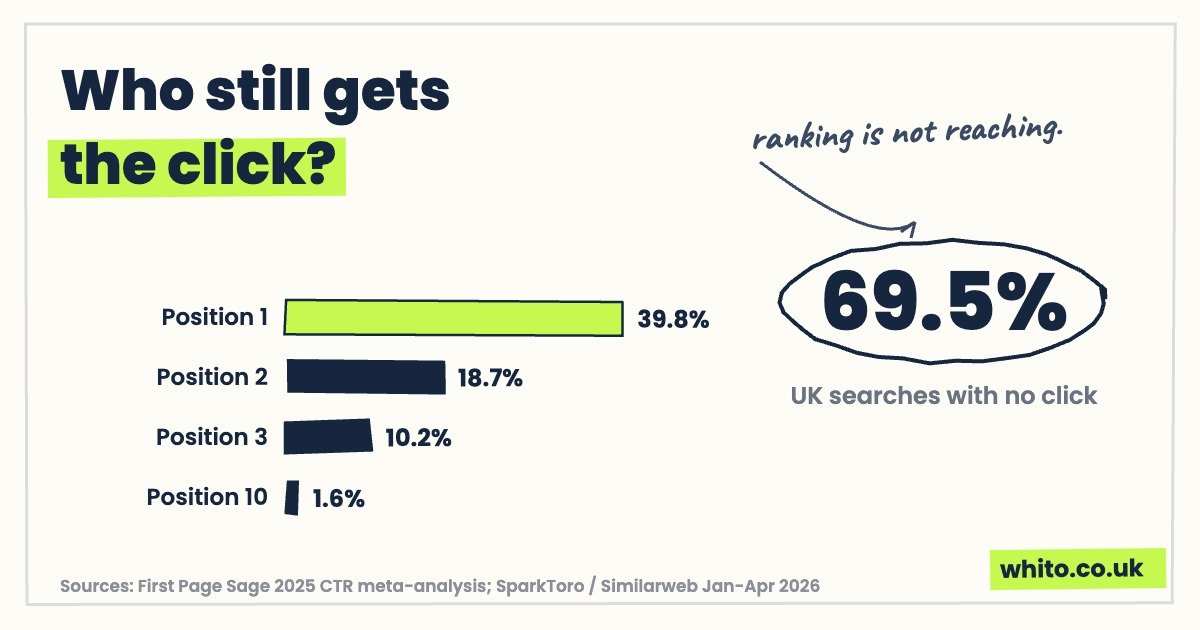
That chain is broken. In the UK, 69.5% of Google searches now end without a click to any website at all, the highest rate of the six countries SparkToro analysed. Google answers more questions itself, AI Overviews sit on top of the results, and ranking first no longer means getting the visit.
The mistake is not doing SEO. The mistake is paying for rankings while nobody checks what those rankings are worth in clicks, enquiries and revenue. This page pulls together the verified UK numbers so you can make that judgement with evidence rather than an agency slide deck.
Key UK SEO statistics
Google holds 91.56% of UK search engine market share; Bing is second on 5.87% (Statcounter, July 2026)
82% of UK adults use Google Search, running around 3 billion UK Google searches a month (Ofcom, Dec 2025)
About 30% of searches now show an AI Overview, and 53% of UK adults say they see AI summaries often (Ofcom, Dec 2025)
69.5% of UK Google searches end without a click, the highest of six countries analysed (SparkToro / Similarweb, June 2026)
Organic click-through on queries with an AI Overview fell from 1.76% to 0.61%, a 61% decline (Seer Interactive, Nov 2025, client data, not UK-specific)
With an AI summary present, US users clicked a traditional result on 8% of visits versus 15% without (Pew Research Center, 2025, US study)
The UK SEO and internet marketing consultancy industry turned over £24.6 billion in 2025-26 (The SEO Works citing IBISWorld, 2026)
UK businesses spent £17.9 billion on paid search in 2025, 44% of all digital ad spend (IAB UK, March 2026)
UK freelance SEO consultants average £374 a day (YunoJuno, 2026)
Median advertised UK SEO Manager salary is £50,000, up 11.11% year on year (ITJobsWatch, Aug 2026)
Who actually has UK search traffic
Google holds 91.56% of UK search engine market share, with Bing second on 5.87% (Statcounter, July 2026). In the UK, search means Google.
Statcounter’s tracker put Google at 91.56% of UK search engine market share in July 2026. Bing held 5.87%, Yahoo 1.29% and DuckDuckGo 0.69%. Statcounter measures pageview referrals rather than surveying people, so treat it as a strong signal rather than a census, but no other measure tells a different story.
Source: Statcounter, UK search engine market share, July 2026. Base: UK pageview referrals tracked across Statcounter’s network.
Ofcom’s Online Nation research backs this up from the people side: 82% of UK adults use Google Search, and UK users run around 3 billion Google searches every month.
The practical point for a small business is simple. If your SEO plan involves optimising for anything other than Google first, someone needs to explain why. We cover the full engine-by-engine picture in our sister report on UK search engine statistics.
How UK searching is changing
About 30% of UK searches now show an AI Overview, and 53% of UK adults say they see AI summaries often (Ofcom, December 2025). Google’s grip has not loosened, but what it shows has changed a great deal, and quickly.
Ofcom’s Online Nation 2025 report, published in December 2025, found that about 30% of searches now show an AI Overview, the generated summary that sits above the traditional results. And 53% of UK adults say they see AI summaries often. This is not a niche feature any more. It is roughly a third of the results your customers see.
Source: Ofcom Online Nation 2025, published December 2025. Base: UK adults and UK usage data.
People are also going around search entirely. Ofcom recorded 1.8 billion UK visits to ChatGPT between January and August 2025, up from 368 million in the same period the year before. That is nearly a fivefold rise in a year.
Then there is the zero-click problem. SparkToro’s analysis of Similarweb panel data covering January to April 2026 found that 69.5% of UK Google searches end without a click to the open web. That was the highest of the six countries analysed: the UK, US, Canada, France, Italy and Germany. The UK sends just 232 clicks to the open web per 1,000 searches.
One caveat worth knowing: the Similarweb panel excludes the Google mobile app, so the true picture may differ somewhat. But the direction is not in doubt.
“69.5% of UK Google searches end without a click to the open web, the highest rate of the six countries analysed. The UK sends just 232 clicks to the open web per 1,000 searches.”
Source: SparkToro analysis of Similarweb panel data, January to April 2026, published June 2026.
What happens to clicks when AI answers first
When an AI summary sits above the results, clicks to websites fall sharply. Two serious datasets have now measured it. Neither is UK-specific, so read them as directional, but they point the same way.
Pew Research Center studied 900 US adults and 68,879 real searches in March 2025. When an AI summary appeared, users clicked a traditional result on just 8% of visits, against 15% when there was no summary. Links inside the AI summary itself were clicked on only 1% of visits. And users ended their session entirely after 26% of pages with an AI summary, versus 16% of traditional results pages. In their sample, 18% of searches generated an AI summary.
Seer Interactive measured the same effect from the website side, using client data: 3,119 search terms across 42 organisations and 25.1 million organic impressions, from June 2024 to September 2025.
| Situation | Click-through rate | What it means |
|---|---|---|
| Organic result, query shows an AI Overview | 0.61% (down from 1.76%) | A 61% decline in organic CTR |
| Organic result, no AI Overview on the query | 1.45% | Still low, but more than double the AI Overview figure |
| Page cited inside the AI Overview | 0.70% vs 0.52% when not cited | Being cited earns roughly 35% more organic clicks |
| Paid ads on queries with an AI Overview | 6.34% (down from 19.70%) | Paid clicks fall too, not just organic |
Source: Seer Interactive client dataset, June 2024 to September 2025, published November 2025. Base: 3,119 search terms, 42 organisations, 25.1m organic impressions. Not UK-specific.
Note that last row. Paid search suffers under AI Overviews as well, which matters given how much UK money flows into it. See our companion report on UK PPC statistics for that side of the ledger.
Position still matters where traditional results do get clicked. First Page Sage’s meta-analysis, updated May 2025, puts the first Google position at 39.8% CTR, falling away sharply below it. The sample is undisclosed, so treat these as indicative rather than definitive.
Source: First Page Sage meta-analysis of Google CTR by position, updated May 2025. Sample undisclosed; figures are indicative. Bars scaled to position 1.
Put the three studies together and the pattern is clear. Ranking well still pays, but each ranking is worth fewer clicks than it used to be, and on queries where Google answers directly, far fewer. Anyone selling you rankings without talking about clicks and enquiries is selling you 2019.
“When Google shows an AI Overview, organic click-through falls from 1.76% to 0.61%, a 61% decline. Pages cited inside the Overview earn roughly 35% more organic clicks than pages that are not.”
Source: Seer Interactive client dataset of 25.1m organic impressions, June 2024 to September 2025. Not UK-specific.
What SEO actually costs
There is no verified UK-wide primary survey of what UK businesses pay for SEO. Most cost guides will not tell you that. Every neat sterling figure you have seen for “average UK SEO cost” is either a conversion from a global survey, an agency’s own price list, or a guess. We are not going to invent one.
What does exist is a set of honest partial measures. Here is what they say.
| Source | What it measured | Headline figure |
|---|---|---|
| SE Ranking and Duda, Dec 2024 | 260 agencies globally, 53 of them UK; priced in dollars, no separate UK breakdown | Most common retainer £369 to £738 ($500 to $1,000) a month; 64% of agencies charge under £738 ($1,000); 45% set hourly rates at £37 to £74 ($50 to $100) |
| Ahrefs, Dec 2023 | 439 SEO providers, global | Most common retainer £370 to £738 ($501 to $1,000) a month (20.4%); most common hourly rate £55 to £74 ($75 to $100) (24%); most common project fee £1,850 to £3,690 ($2,501 to $5,000) (21.2%) |
| YunoJuno, 2026 report | UK-centred freelance platform booking data, 2024-25 | Freelance SEO consultants average £374 a day |
| ITJobsWatch, Aug 2026 | UK job ads, six months to 21 Aug 2026 | Median advertised SEO Manager salary £50,000, up 11.11% year on year; range £40,000 (10th percentile) to £75,000 (90th) |
Sources and bases as listed per row. The two pricing surveys are global and priced in dollars; only YunoJuno and ITJobsWatch are UK-specific measures.
Read together, a sensible picture emerges. Entry-level agency retainers cluster in the low hundreds of pounds a month once you allow for exchange rates. Competent UK freelancers cost £374 a day on average through YunoJuno’s platform. Hiring in-house means £50,000 or so for a mid-level manager before employment costs, and that salary rose 11% in a year.
The useful question is not “what does SEO cost”. It is “what does each option cost per enquiry it produces”. A £500 monthly retainer that produces nothing is more expensive than a £2,000 one that fills your diary.
The UK SEO industry you are buying from
The supply side is enormous, which is part of the problem when you are choosing a provider.
Source: The SEO Works UK SEO Industry Report 2026, using IBISWorld data. The industry category is wider than pure SEO, covering internet marketing consultancy broadly.
The SEO Works’ 2026 industry report, drawing on IBISWorld data, puts UK SEO and internet marketing consultancy revenue at £24.6 billion in 2025-26, after five years of 6.6% compound annual growth, spread across 35,088 businesses averaging around £700,000 each. One honest note: that IBISWorld category is wider than pure SEO, so the true SEO-only figure is smaller.
For context on the alternative, IAB UK and Oliver Wyman put UK paid search adspend at £17.9 billion for full-year 2025, which is 44% of all UK digital ad spend. That is, broadly, what UK businesses pay Google when they cannot or will not rank. It is the price of skipping the organic queue, and it explains why decent SEO keeps its value even in a zero-click world: the paid alternative is not cheap either.
With 35,000 firms competing for your budget, most of them small, quality varies wildly. The market is too big for reputation alone to filter it. You need your own measure of whether the work is paying, which brings us to the money.
What this means for your money
Three numbers should drive your next SEO decision, and none of them is a ranking.
Sources: SparkToro / Similarweb (Jan to Apr 2026); Seer Interactive (June 2024 to Sept 2025); YunoJuno (2024-25 booking data).
First, judge SEO by enquiries and revenue, not positions. A ranking report tells you almost nothing when two thirds of UK searches end without a click. Ask any provider to show clicks, enquiries and sales attributed to their work, and to show them monthly.
Second, aim to be the business AI summaries cite. Seer’s data shows cited pages earn roughly 35% more organic clicks than uncited ones. Clear structure, direct answers, named sources and real expertise on the page are what earn citations. That is standard good SEO done properly, not a new discipline with a new invoice.
Third, get the foundations right before spending on anything clever. If your website is slow, your service pages are vague, or your Google Business Profile is half-empty, no retainer will save you. Structure before scale. Fix the base, then measure, then spend.
And keep some scepticism about any figure without a source. Our research hub exists precisely because so much marketing “data” aimed at small businesses is recycled guesswork.
Methodology and sources
Every figure on this page comes from one of the sources below, checked against the original publication. Where a source is not UK-specific, or uses a category wider than pure SEO, we say so in the text rather than quietly converting it into a UK claim.
- Statcounter, UK search engine market share, commercial tracker, July 2026. Measures pageview referrals, not a survey.
- Ofcom Online Nation 2025, official regulator research, published December 2025. UK adults.
- SparkToro analysis of Similarweb panel data, commercial, published June 2026. Covers January to April 2026; panel excludes the Google mobile app.
- Pew Research Center, independent, July 2025. US study: 900 US adults, 68,879 searches, March 2025 fieldwork.
- Seer Interactive, commercial, published November 2025. Client dataset of 3,119 terms across 42 organisations; not UK-specific.
- First Page Sage, commercial, updated May 2025. Sample undisclosed; figures indicative.
- The SEO Works UK SEO Industry Report 2026, commercial, citing IBISWorld. Category is wider than pure SEO.
- IAB UK Digital Adspend 2025, industry body, with Oliver Wyman, published March 2026.
- SE Ranking and Duda agency pricing survey, commercial, December 2024. 260 agencies globally, 53 UK; dollars, no separate UK breakdown.
- Ahrefs pricing survey, commercial, December 2023. 439 SEO providers, global.
- YunoJuno 2026 rates report, commercial, UK-centred platform booking data, 2024-25.
- ITJobsWatch, UK SEO Manager salaries, commercial, six months to 21 August 2026. UK job ads.
Known limits. No verified UK-wide primary survey of what UK businesses pay for SEO exists, so this page gives ranges from global surveys plus UK day-rate and salary data instead of a single invented sterling average. We also make no claim about the percentage of UK businesses that invest in SEO, because no primary source measures it, and we do not use the widely repeated claim that 53% of website traffic is organic, which does not trace to current verifiable data. The Pew and Seer click studies are US and multi-market respectively; UK behaviour is likely similar but has not been measured to the same standard.
How to cite this page
You are welcome to reuse any statistic on this page, with attribution and a link.
Whito, “UK SEO Statistics 2026”, whito.co.uk, updated 21 August 2026.
Where a figure originates from a third party listed above, please credit the original source as well.
FAQ
How much does SEO cost in the UK in 2026?
There is no verified UK-wide survey of SEO prices. Global surveys by SE Ranking and Ahrefs both find the most common agency retainer is £369 to £738 ($500 to $1,000) a month, UK freelance SEO consultants average £374 a day (YunoJuno), and a UK in-house SEO Manager has a median advertised salary of £50,000 (ITJobsWatch, Aug 2026).
What share of UK searches does Google have?
Statcounter puts Google at 91.56% of UK search engine market share in July 2026, with Bing at 5.87%, Yahoo at 1.29% and DuckDuckGo at 0.69%. Ofcom finds 82% of UK adults use Google Search.
What are zero-click searches and how common are they in the UK?
A zero-click search ends without the user visiting any website. SparkToro’s analysis of Similarweb data found 69.5% of UK Google searches ended without a click between January and April 2026, the highest of the six countries analysed.
Do AI Overviews reduce clicks to websites?
Yes. Seer Interactive measured organic click-through falling from 1.76% to 0.61% on queries with an AI Overview, a 61% decline, and Pew found US users clicked a traditional result on only 8% of visits when an AI summary appeared, versus 15% without.
Is SEO still worth paying for in 2026?
It can be, if you judge it on enquiries and revenue rather than rankings. Pages cited inside AI Overviews earn roughly 35% more organic clicks, and the paid alternative cost UK businesses £17.9 billion in 2025. SEO that is measured on business results still pays; SEO measured on positions often does not.
The takeaway
UK search is one company, answering more questions itself, sending fewer clicks out. Stop buying rankings and start buying measured enquiries: ask every provider what their work returned in revenue last month, and walk away from anyone who answers with positions.
Fix your foundations first, measure everything second, and only then spend more. Structure before scale.
The structural checks behind this research run on any website in about twenty seconds. Enter yours and read the full result on the page. Free, and we do not ask for your email.
Run the free Visibility CheckIf your business is named here and you think we have a fact wrong, email hello@whito.co.uk and we will check it and correct it. If you want to respond, send us a statement and we will publish it alongside. Full detail: Corrections, right of reply and removals.