Finding
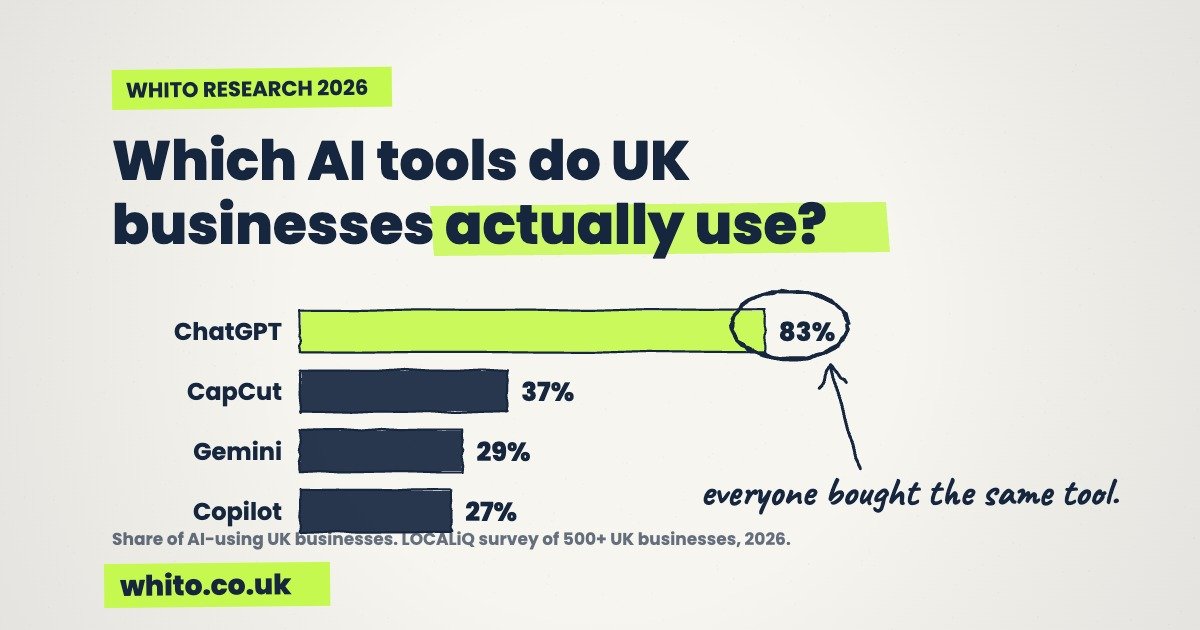
83% of UK businesses using AI in their marketing use ChatGPT, with CapCut next at 37%, according to LOCALiQ's January 2026 survey of 500+ UK businesses, while the ONS put AI adoption at 35% of businesses with 10 or more employees in June 2026.
Source: Whito, whito.co.uk/research/uk-ai-tools-statistics, January 2026. Free to quote with a link to this page.
Last Updated on September 11, 2026
Whito Research, August 2026. What the official statistics and major UK surveys show about which AI tools UK businesses actually use, what they use them for, and what they pay. Every figure is sourced and dated. You are welcome to cite this page with a link, and the citation box at the end makes that easy.
Every week another list appears: the 50 AI tools your business needs in 2026.
Here is what the data actually shows. Most UK businesses using AI are using one tool. It is usually ChatGPT. It is usually the free version. And the average business has barely added a second tool in three years.
That is not a failure. It is a clue about what actually matters.
- 83% of AI-using UK businesses use ChatGPT. The next most used tool, CapCut, sits at 37%. (LOCALiQ survey of 500+ UK businesses, January 2026)
- AI adoption has roughly tripled since 2023: from around 12% to around 35% of businesses with 10 or more employees on the official ONS measure (June 2026), and to 54% or 55% in business-network surveys by the BCC and FSB.
- Adoption is wide, not deep. The average adopting business uses 1.6 AI technologies, up from 1.4 in late 2023. Only 10% of adopters report extensive use. (ONS)
- Writing dominates. 90% of AI-using businesses generate written content with it. Customer service AI is still a minority use at 20%. (LOCALiQ)
- The free tier is the front door. Free-to-use software is the most common adoption route in retail, accommodation and manufacturing. (ONS)
How many UK businesses use AI in 2026
AI use in UK businesses has grown fast, however you measure it. The three most credible measures disagree on the level but agree on the direction.
| Survey | Who is measured | 2023 | Latest (2026) |
|---|---|---|---|
| ONS Business Insights and Conditions Survey (official) | Businesses with 10+ employees | ~12% | ~35% (June 2026) |
| ONS, smallest businesses (official) | Businesses with 0 to 9 employees | n/a | 28% (June 2026) |
| British Chambers of Commerce with Atos (network survey) | BCC network, ~94% SMEs | 23% | 54% (published March 2026) |
| Federation of Small Businesses (member survey) | 904 small business owners | 20% | 55% (fieldwork November 2025) |
AI adoption has roughly tripled on every measure
Share of businesses using AI, 2023 baseline (navy) vs latest reading (lime)
ONS covers businesses with 10+ employees. BCC and FSB survey their own networks, which skew towards engaged, established firms. Sources and dates in the methodology section.
The gap between 28% and 55% is mostly about who gets asked and how the question is worded. Chamber and FSB members skew towards engaged, established businesses. The ONS asks a stricter question of a broader sample. We covered why the surveys disagree in our UK AI adoption statistics research.
Whichever number you trust, the direction is the same. Using AI no longer makes a business unusual. It makes it normal.
Adoption is wide. It is not deep.
The more useful ONS finding gets less attention.
So the typical picture is not a business running a stack of AI tools. It is a business that has picked up one chatbot and uses it a bit.
The ONS also breaks down what kind of AI businesses use, as of June 2026:
| AI technology | Share of businesses using it |
|---|---|
| Large language models (chatbots such as ChatGPT) | 18% |
| Visual content creation | 16% |
| Data processing using machine learning | 12% |
| Image processing using machine learning | 6% |
| Robotics | 2% |
Chatbots and content tools lead. The heavier machine learning uses sit well behind. And the most common route in for sectors such as retail, accommodation and manufacturing is free-to-use software, not purchased systems.
The AI tools UK businesses actually use, by name
Official statistics track categories, not brands. For named tools the best UK evidence is LOCALiQ’s UK State of Digital Marketing Report 2026, a commercial survey of more than 500 UK businesses about their marketing. Half of those businesses (50%) were using AI in their marketing.
Tool use among AI-using UK businesses
Share of businesses using AI in their marketing that use each tool. Multiple answers allowed. LOCALiQ, 500+ UK businesses, January 2026.
Survey labels were “Google Bard/Gemini” and “Bing AI/Co-Pilot”; both products have since been renamed. The survey covers marketing use, where most small business AI activity currently sits.
The scale of the habit shows in Ofcom’s traffic data: 1.8 billion UK visits to ChatGPT in the first eight months of 2025, up from 368 million in the same period of 2024.
What are businesses doing with these tools?
What AI-using UK businesses use it for
Share of AI-using businesses applying AI to each task. LOCALiQ, January 2026.
In plain terms: UK businesses use AI to write things and make pictures. The deeper uses, automation and customer service, are still minority pursuits.
The market is moving under your feet
Two things changed in the last year that affect which tool you would pick today.
ChatGPT’s lead is narrowing. Similarweb’s global traffic data shows ChatGPT’s share of generative AI website visits falling while Google’s Gemini rises. That is worldwide website traffic, not UK business usage, but the direction is clear. YouGov’s UK tracking shows the same pattern among consumers: ChatGPT still leads by a distance, but Gemini gained more ground than any other AI brand between March and July 2026.
| Assistant | Share of global gen AI website visits, June 2025 | Share, May 2026 |
|---|---|---|
| ChatGPT | ~76% | ~53% |
| Google Gemini | under 9% | ~27% |
| Claude | ~2% | ~9% |
AI is being bundled into software you already pay for. Google now includes Gemini in its Workspace business plans rather than selling it as an add-on. Microsoft sells Copilot inside Microsoft 365. If your business already runs on Google Workspace or Microsoft 365, you may already be paying for an AI assistant you have never opened.
The practical consequence: the “which tool” decision matters less every month. The big assistants are converging on the same abilities, and at least one of them is probably already in your software.
What the main AI tools cost UK businesses
Prices checked August 2026. They move often, so treat these as a guide and check before you buy. Business prices exclude VAT.
| Tool | Free version | Paid, per person per month |
|---|---|---|
| ChatGPT | Yes, capable | Plus at roughly £16 plus VAT |
| Google Gemini | Yes | Included in Google Workspace business plans |
| Microsoft Copilot | Yes (basic) | Microsoft 365 Copilot from £13.80 plus VAT on an annual plan |
| CapCut | Yes | Pro tier available |
| Canva (includes AI image tools) | Yes | Pro tier available |
For most small businesses the honest answer is that the free tiers are enough to find out whether AI helps you at all. The ONS data backs this up: free-to-use software is the most common way businesses adopt AI in retail, accommodation and manufacturing.
Spend money on a subscription when you hit the free tier’s limits doing real work, not before.
Why half of UK businesses still don’t use AI
The FSB’s November 2025 survey found 92% of small businesses concerned about AI risks, up from 73% in 2023. More than half (54%) specifically worry about AI producing inaccurate answers, known as hallucination.
That concern is rational. These tools do make things up. Any business publishing AI-written content without checking it is taking a real risk with its reputation, and with Google’s spam policies besides.
The ONS found the main barrier among larger businesses is lack of expertise, not cost. And notably, 41% of businesses reported no barriers at all. They have simply not seen a reason to bother.
The FSB estimates that closing the adoption gap could add £42 billion a year to the UK economy. Treat that number with care: it is a modelled scenario, not a measurement. But the findings underneath it are more grounded: 59% of AI-using small firms reported improved productivity, and the BCC found 95% of AI-using SMEs saw no impact on workforce size, with 86% saying job roles were unchanged.
The Whito view: the tool is not the bottleneck
Here is the trap in every “best AI tools” list. It assumes the tool is what is holding your marketing back.
It almost never is.
If your offer is unclear, ChatGPT will help you produce unclear content faster. If your website does not convert, AI-written blog posts will send traffic to a page that loses it. AI multiplies whatever structure you already have, including the problems.
Structure before scale. In practice:
Start stage. Do not buy anything. Use free ChatGPT or the Gemini already in your Google account for the thinking work: drafting your positioning, describing your ideal customer, tidying up page copy. AI as a sounding board, not a content factory.
Build stage. Once your offer and website are sound, use AI to keep consistency you could not otherwise afford: drafting the monthly email, repurposing one good piece of content into five formats, first-draft replies to common enquiries. This is where a paid tier starts paying for itself, because the time saved is time you actually reuse.
Scale stage. Only now do the automation tools (Zapier and its kind) and customer service AI earn their place, because you have enough volume for the saving to show up in the numbers.
Every stage has the same test: can you point to the hour saved or the pound earned? If not, the subscription is a cost, not an investment.
Methodology and sources
This page synthesises the most recent credible UK evidence, fetched and verified on 20 August 2026. Official statistics and commercial surveys are labelled throughout, because they measure different populations and should not be averaged together.
- ONS, Artificial intelligence in UK businesses: 2023 to 2026 (Business Insights and Conditions Survey, Wave 159). Official statistics. Published 20 July 2026, fieldwork 5 to 28 June 2026. Source.
- British Chambers of Commerce with Atos, AI adoption research, published March 2026. Network survey, around 94% SMEs. Source.
- Federation of Small Businesses AI survey, 904 small business owners, fieldwork 11 to 24 November 2025. Member survey.
- LOCALiQ UK State of Digital Marketing Report 2026, 500+ UK businesses, published January 2026. Commercial survey; the named-tools and task figures above are shares of AI-using businesses, marketing context. Source.
- Similarweb generative AI traffic analysis, published July 2026, covering June 2025 to May 2026. Global website visits, excludes app usage. Source.
- YouGov UK AI Rankings Report 2026, fieldwork March to July 2026, 6,740+ UK AI users. Consumer preference, not business usage. Source.
- Ofcom Online Nation 2025, published December 2025. Visit counts, not user counts. Source.
- Prices: Microsoft 365 Copilot from Microsoft’s UK pricing page, 20 August 2026. ChatGPT GBP pricing is not published on OpenAI’s public pricing page; the figure above is from third-party price tracking, April 2026, and is deliberately stated as approximate.
Known limits, stated plainly: the ONS headline covers businesses with 10 or more employees; the smallest businesses sit lower at 28%. The LOCALiQ tool percentages are shares of AI-using businesses, not of all UK businesses, and respondents could pick multiple tools. The Similarweb shares are global website traffic. The FSB £42 billion figure is a modelled scenario. None of these figures should be quoted without those bases.
Official statistics are used under the Open Government Licence v3.0. Analysis and interpretation are Whito’s own. This is general information, not advice for your specific business.
How to cite this page
Citation: Whito (2026). Which AI tools are UK businesses actually using? Whito Research, August 2026. https://whito.co.uk/research/uk-ai-tools-statistics/
You are welcome to quote any figure or chart on this page, in print or online, with attribution to Whito and a link to this page. If you need the underlying source list for fact checking, it is all in the methodology section above. Journalists can reach us via the contact page for comment.
This page is updated as new waves of the source surveys are published. Last updated 20 August 2026.
Questions this research answers
What is the most used AI tool by UK businesses? ChatGPT, by a wide margin. In LOCALiQ’s 2026 survey of over 500 UK businesses, 83% of those using AI in their marketing used ChatGPT. The next closest tools were CapCut at 37% and Google Gemini at 29%.
What percentage of UK businesses use AI in 2026? It depends on the survey. The ONS puts it at 35% of businesses with 10 or more employees, and 28% for the smallest businesses. Surveys of business networks such as the British Chambers of Commerce (54%) and the FSB (55%) find higher rates because their samples skew towards engaged, established firms.
Do small businesses need to pay for AI tools? Usually not at first. The free tiers of ChatGPT, Gemini and Copilot handle most small business tasks, and ONS data shows free software is the most common adoption route in sectors such as retail and accommodation. Pay when you hit the limits doing real work.
What do UK businesses actually use AI for? Mostly writing. 90% of AI-using businesses in the LOCALiQ survey generate written content with it. Image and video creation (39%), graphic design (37%), campaign optimisation (37%) and marketing automation (35%) follow. Customer service is still a minority use at 20%.
Is ChatGPT still the best AI tool for small businesses? It is still the most used, but its lead is shrinking. Gemini gained more ground than any other AI brand among UK consumers between March and July 2026, and both Google and Microsoft now bundle AI assistants into their office software. For most tasks the leading assistants are close enough that the tool matters less than what you use it for.
The takeaway
UK businesses have answered the “which AI tool” question already. Most use ChatGPT, most use it free, and most use it to write things.
So the competitive edge is not access to AI. Everyone has that now. The edge is what you point it at. A business with a clear offer, a converting website and a consistent channel will get more from a free chatbot than a confused business will get from ten subscriptions.
Fix the structure. Then let the tools multiply it.
Using AI on top of weak foundations?
The free Whito Visibility Check checks your marketing foundations in ten minutes and shows you what to fix first, before any tool can help.
Related Whito research: UK business AI adoption statistics, how many UK companies have AI in their name, and how many UK businesses have a website.
The structural checks behind this research run on any website in about twenty seconds. Enter yours and read the full result on the page. Free, and we do not ask for your email.
Run the free Visibility CheckIf your business is named here and you think we have a fact wrong, email hello@whito.co.uk and we will check it and correct it. If you want to respond, send us a statement and we will publish it alongside. Full detail: Corrections, right of reply and removals.