

Last Updated on August 19, 2026
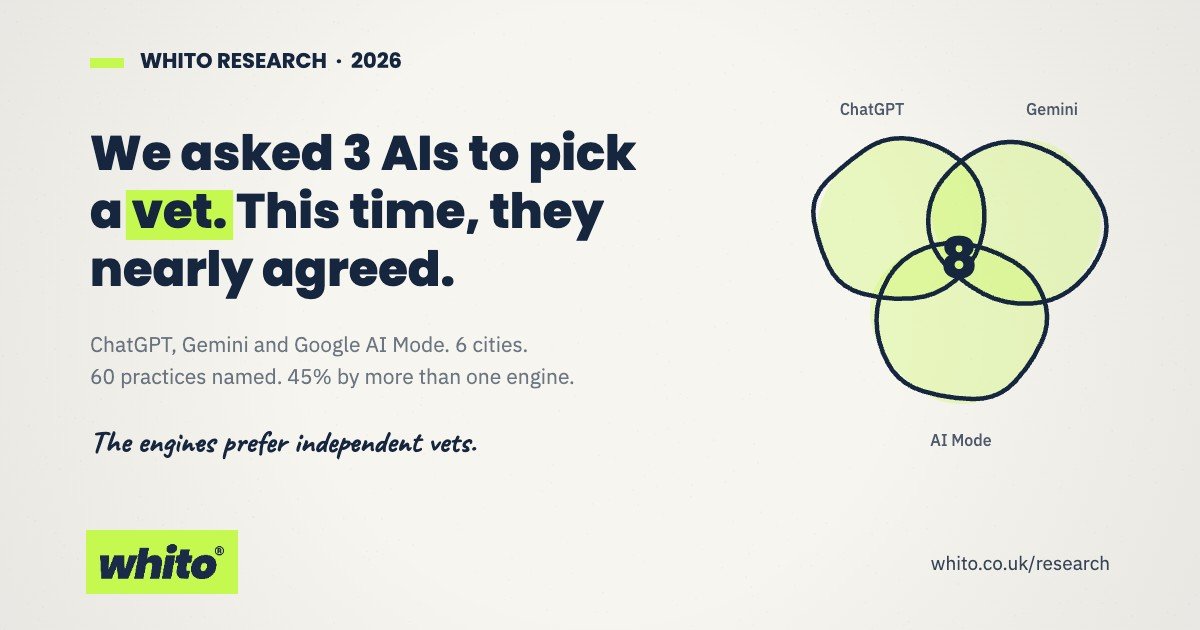
We asked ChatGPT, Google Gemini and Google AI Mode to name the best vet in six UK cities, and kept the screenshots. The fourth profession in our series produced the strongest agreement yet, and a finding we did not expect: the engines have picked a side in the corporate-versus-independent vet debate.
This week we have asked three AI engines to recommend an accountant, a solicitor and a dentist in the same six UK cities. Each profession agreed more than the last: accountants got almost no consensus, solicitors converged on legal directories, dentists on review volume.
Today, the final profession in the series: vets. And the trend did not just continue. It jumped.
What we did
One fixed question, worded the way a pet owner would ask it: “Who is the best vet in [city]?”
We asked it in Manchester, London, Birmingham, Leeds, Bristol and Glasgow, across three engines, all on 14 August 2026 from a UK browser: ChatGPT (free tier, with web search), Google Gemini (free app), and Google AI Mode (Google’s AI search). We recorded every practice named, matched the overlaps with set logic, and screenshotted what each engine showed.
One gap to declare upfront: Gemini answered four of the six cities, then its free tier began silently discarding new questions. Our Bristol and Glasgow questions to Gemini were typed, accepted and never answered, across repeated attempts. So this study covers 16 of 18 possible answers, and we flag below exactly where that affects the numbers.
The headline numbers
- The engines named 60 different veterinary practices across 95 recommendation slots.
- 45% of practices were named by more than one engine, the highest overlap we have measured. The series now runs: accountants 15%, solicitors 26%, dentists 34%, vets 45%. And the vet figure is understated, because in two cities only two engines were available to agree.
- In the four cities where all three engines answered, 8 of 43 practices were named by all three, a 19% three-way consensus rate. Dentists, the previous record holder, managed 8.5%.
- Leeds is the most agreed-upon city we have ever tested. Four practices there were named by all three engines, and ChatGPT and Google AI Mode quoted identical figures for three of them, down to the review count: 4.9 from 136 reviews, 4.9 from 61, 4.8 from 184.
- In two cities, two engines named the same explicit first choice: GoVets in Manchester and Leeds Veterinary Centre in Leeds, both by ChatGPT and Google AI Mode.
| City | Unique practices named | Named by 2+ engines | Named by all 3 |
|---|---|---|---|
| Birmingham | 13 | 5 | 1 (Horner Vets) |
| London | 12 | 4 | 1 (Streatham Hill Veterinary Surgery) |
| Manchester | 10 | 6 | 2 (Manchester Veterinary Specialists, Animal Trust Vets) |
| Leeds | 8 | 5 | 4 (Leeds Veterinary Centre, Perfect Paws, Oakwood, Abbey House) |
| Bristol* | 8 | 5 | n/a (2 engines) |
| Glasgow* | 9 | 2 | n/a (2 engines) |
| Total | 60 | 27 | 8 (of the 4 three-engine cities) |
*Gemini’s free tier did not deliver answers for Bristol and Glasgow, so full three-engine consensus was not possible there.
What the engines actually show
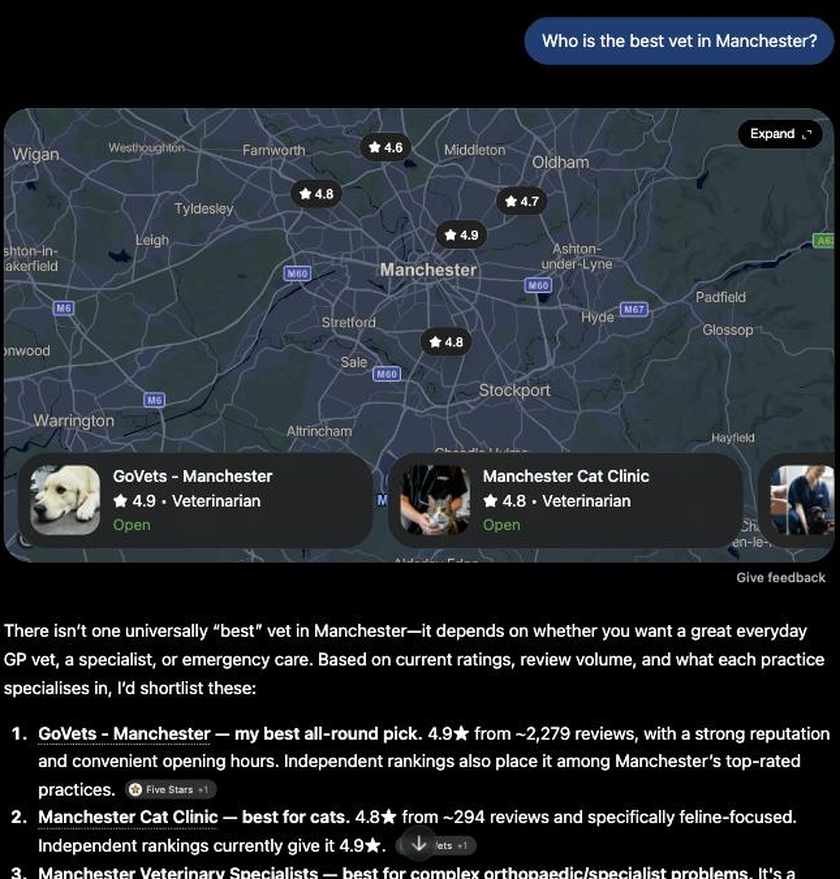
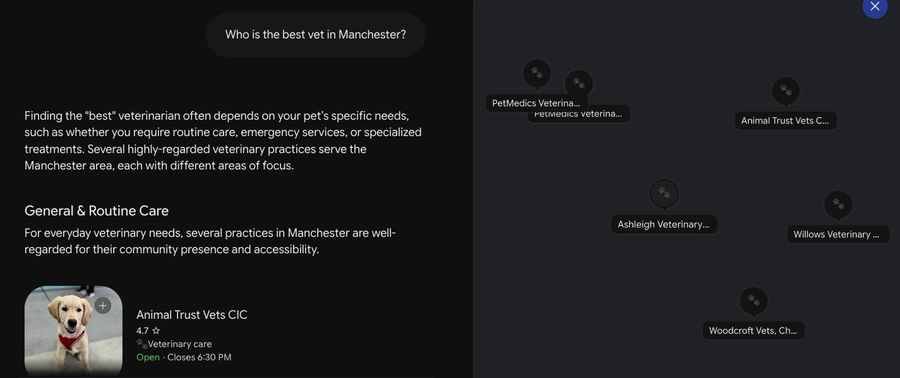
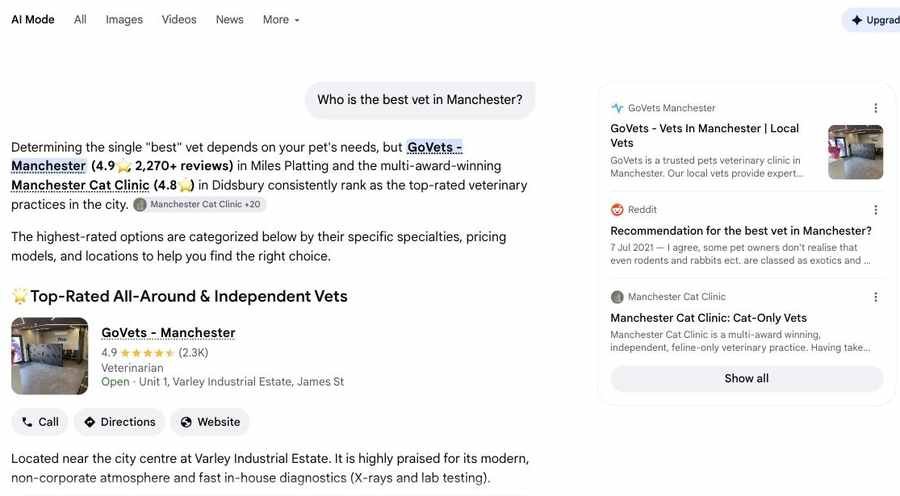
All three screenshots below are answers to the same question about the same city, so you can see how differently each engine packages the identical task.
ChatGPT opens with a map of star-rated pins and business cards, complete with a photo of a labrador in a waiting room, then writes a ranked shortlist where nearly every entry is justified by a rating and review count.
Gemini embeds live business listings and, for this study, opened a side panel map with paw-print pins marking each recommended practice.
Google AI Mode writes the most editorial answer of the three, ranking “top-rated” practices with citations down the side, including, in Manchester’s case, a Reddit thread.
Why vets agree most: the data is richer, and it is opinionated
This is our reading of the data, not something any engine documents.
Vets combine everything that drove consensus in the earlier studies at once. Huge review volume, like dentists: quoted counts ran to 2,279, with a median of 291. A client-voted awards layer, like solicitors’ directories: the “Best UK Vets” awards were quoted as the stated reason Streatham Hill Veterinary Surgery leads London on two engines. And something new: published local league tables. ChatGPT cited “a recent comparison of 69 practices” in Bristol and “a comparison of 52 Glasgow practices” as evidence.
When every engine can read the same rich, ranked data, they converge. Leeds shows the end state: three engines, four shared practices, identical numbers quoted independently by two of them.
One detail worth noticing: the two engines that both crowned Streatham Hill in London could not agree on its award streak. ChatGPT said it has won “for the sixth consecutive year”; AI Mode said four consecutive years. Engines repeat authority claims; they do not verify them.
The engines have picked a side: independent over corporate
The most striking pattern in these 16 answers was editorial. Again and again, engines treated independence as a virtue in itself.
ChatGPT justified its Leeds pick partly as an “independent practice rather than a large corporate chain”. AI Mode praised a Glasgow clinic as “completely independent… free from corporate sales targets”, a Bristol practice for “avoiding unnecessary upselling”, and profiled a mobile one-man “vet in a van” in Birmingham. Animal Trust Vets, a not-for-profit social enterprise offering free consultations, achieved full three-engine consensus in Manchester. Across 95 recommendation slots, corporate-owned chains barely appeared.
Our reading: vet reviews are full of the corporate-consolidation backlash that pet owners feel, engines are trained on and retrieve those reviews, and so the answers inherit the sentiment. If you are an independent practice competing with a chain, AI search is currently your friend.
The engines also name individual people, not just practices. These answers credited, among others, “Dr Becky Westwood”, “vet Andra”, a “head vet Bipin” of 50 years’ standing, and a Glasgow clinical director known simply as Dave, all details lifted from public reviews. Your team’s names are part of your visibility.
What a veterinary practice should do with this
Three things, in order of leverage.
Keep the review engine running. Ratings and counts were the stated justification for nearly every recommendation, and two engines quoted identical figures, meaning they read the same public data. Median quoted count: 291.
Enter the client-voted awards. The Best UK Vets awards were quoted by name as the reason a practice leads Britain’s biggest city on two engines. Client-nominated awards are built from the review activity you already generate.
Say you are independent, if you are. Engines are actively using independence, transparent pricing and “no upselling” as selection criteria. If it is true of your practice, make it easy to find in your profiles and site copy.
The sharp takeaway
Four professions, one experiment, and a clean staircase: the more rich, structured, public evidence a profession generates, the more AI engines agree about it. Accountants, with thin data, got a lottery. Vets, with thousands of reviews, client-voted awards and published league tables, got the closest thing to a consensus we have measured.
AI recommendation is not mysterious. It is a mirror held up to your public evidence. The only question is what yours shows.
Would AI recommend your business?
The free Whito Scorecard checks the surfaces AI engines actually read, and tells you the one thing to fix first. It takes about two minutes.
Method, limitations and what this study does not say
Method. One question, asked verbatim in each engine: “Who is the best vet in [city]?” Six cities: Manchester, London, Birmingham, Leeds, Bristol, Glasgow. Three engines, queried 14 August 2026 from a UK browser: ChatGPT (free tier, logged in, default model with web search), Google Gemini (free app, default model), Google AI Mode. Every practice named as a recommendation was recorded and matched by name within each city; agreement statistics were computed with deterministic set logic. Screenshots are unedited apart from cropping.
The Gemini gap. Gemini answered Manchester, London, Birmingham and Leeds, then its free tier stopped creating new chats: our Bristol and Glasgow questions were accepted and silently discarded across repeated attempts. All statistics are computed on the 16 delivered answers. Three-way consensus figures use only the four fully answered cities, and this is stated wherever they appear. The 45% named-by-2+ figure includes Bristol and Glasgow, where only two engines could agree, so it errs on the low side. Two practice-name judgement calls (Langford, Highcroft, in Bristol) are documented in our records.
On named practices. Practices are named only as having been recommended by an AI engine, a positive or neutral fact about visibility. We make no claims about the quality of any practice’s care. Ratings, review counts, awards and rankings are as quoted by the engines at query time; we have not audited them, and where two engines disagreed (as with one London award streak) we report both versions.
Snapshot, not league table. AI answers vary by day, account, session and location. A different day would produce different lists. The series comparison is directional: same day, same cities, same question structure, but the wording naturally differs by profession, and the accountants study used Perplexity as its third engine.
This article is general information based on a snapshot study, not advice for any specific business, and not a recommendation of any veterinary practice. Whito has no commercial relationship with any practice named. Nothing here is veterinary advice; choose a vet on clinical grounds, not AI visibility.
Common questions
Do AI engines recommend the same vets?
More than any profession we have tested. In our August 2026 study, 45% of the 60 practices recommended were named by more than one engine, and in the four cities where all three engines answered, 8 practices achieved full three-engine consensus, a 19% rate against 8.5% for dentists.
How does ChatGPT choose which vet to recommend?
Largely from review data, awards and published comparisons. In our test it justified almost every entry with a Google-style rating and review count, cited client-voted vet awards, and referenced local “comparison of N practices” rankings.
Do AI engines prefer independent vets over corporate chains?
In our study, visibly yes. Engines repeatedly cited independence, transparent pricing and the absence of upselling as reasons to recommend a practice, and a not-for-profit social enterprise achieved full three-engine consensus in Manchester. Corporate chains barely appeared across 95 recommendation slots.
Why do vets get more consistent AI recommendations than dentists or accountants?
Our reading: veterinary practices combine large review volume with client-voted awards and published local league tables. The richer and more structured the public evidence, the more the engines converge, a pattern that has held across all four professions in this series.
How many reviews does a vet practice need to be recommended by AI?
There is no fixed threshold, but the median quoted count in our study was 291, and consensus practices tended to combine strong volume with 4.7+ ratings. Two engines quoting identical counts shows they read the same public review data.
- Which dentists does AI recommend? Review volume as an authority layer, with screenshots
- Which solicitors does AI recommend? The directory effect, with screenshots
- Which accountants does AI recommend? One firm in 109 got consensus
- AI engines can’t agree on the best tradesperson, where the series began
Whito Intelligence
The paid data underneath this study
This study stays free, with no gate and no email wall, and it always will. Whito Intelligence is the deeper version of the same work: the method run at scale, repeated every quarter, with every business named and checked against the public register. It is priced for software vendors, lead platforms, franchisors, trade bodies and investors, not for the businesses we write about.
Related, August 2026: we checked 72 UK vet websites against the CMA price transparency deadline of 23 September 2026. Most now publish prices. Almost none are comparable.
The structural checks behind this research run on any website in about twenty seconds. Enter yours and read the full result on the page. Free, and we do not ask for your email.
Check your business freeIf your business is named here and you think we have a fact wrong, email hello@whito.co.uk and we will check it and correct it. If you want to respond, send us a statement and we will publish it alongside. Full detail: Corrections, right of reply and removals.