
Last Updated on October 16, 2026

Some links in this article are commission-based, meaning we may earn a small fee if you purchase through them, at no extra cost to you. They do not buy a place in any ranking. Full disclosure: https://whito.co.uk/how-we-make-money/ and https://whito.co.uk/review-methodology/
Nobody hires a law firm. They hire a person who happens to work at one, at a moment when something in their life has gone wrong or is about to get expensive. Most small firm websites are built to impress other solicitors: navy, serif fonts, a photograph of the building, the word “excellence”. The client is checking three things: whether you are real, whether they can afford you, and whether the person handling their house sale will answer emails. Your website gets marked on those three, and this guide builds it that way.
The rest of what we publish for firms is at whito.co.uk/solicitors/.
Start with the page the SRA already made you write
Since the SRA Transparency Rules, firms doing certain consumer work, residential conveyancing, probate, motoring offences, employment tribunal claims for individuals, immigration applications and some others, must publish price and service information. Most firms comply the way people pay parking fines: minimally, resentfully, in a PDF.
That is the opportunity. The fees page other firms bury is the highest-intent page a small firm owns, because the conveyancing client is comparing three quotes and the page that explains its numbers wins the instruction.
Build the conveyancing fees page like this:
- A worked example at the top. “Freehold purchase at £250,000: our fee £995 plus VAT, plus disbursements, typically £480, itemised below. Total you should budget: £1,715.” One realistic number a client can hold.
- Disbursements itemised and explained in one line each. Searches, Land Registry fee, bank transfer fee. The word “disbursements” alone loses people; the list wins them back.
- What moves the price. Leasehold, new build, shared ownership, gifted deposits. Say the uplift or the range for each. Surprises at completion are where one-star reviews are born.
- Who does the work. Name and photo of the actual conveyancer, their qualification, and who supervises. The rules point this way, and clients choose faces.
- Timescales with honesty. “Twelve to sixteen weeks is normal; chains break this estimate and we will tell you when yours does.”
The order of blocks on a conveyancing fees page: a worked example for a £250,000 freehold purchase, disbursements itemised, what changes the price, the named conveyancer, then the quote request.
The conveyancing fees page, block by block
Top of page
Worked example: £250,000 freehold purchase
Our fee £995 + VAT, disbursements typically £480, itemised below. Budget: £1,715.
Block 2
Disbursements, itemised
Searches, Land Registry fee, bank transfer fee. One line each.
Block 3
What changes the price
Leasehold, new build, shared ownership, gifted deposits. Say the uplift.
Block 4
Your conveyancer: name, photo, qualification
Clients choose faces, and the rules point this way too.
Bottom
Get your exact quote
Promise a written figure and a stated reply time.
Worked example first, itemised disbursements second, the person doing the work before the ask. This order wins three-quote comparisons.
The same template scales to probate (“estates under £325,000 with no property: from £X”) and employment matters. Publish honest ranges everywhere the rules apply, and anywhere else you dare. On a page where every competitor writes “fees on application”, a number is a differentiator you can deploy by Friday.
People pages are practice areas with a pulse
The second-most-visited page on almost every small firm site is the team page, and most firms treat it as a staff directory. Each solicitor should have their own page: name, photo taken this decade, SRA number, what they actually take on, two lines in their own voice about how they work (“I reply within one working day, usually faster, and I will tell you early if I think you should not litigate”), and a direct contact route. Clients shortlist people. Give each person a page that can be shortlisted, and let it rank for “[name] solicitor [town]”, which is exactly what a referred client types.
Proof that survives a suspicious hour
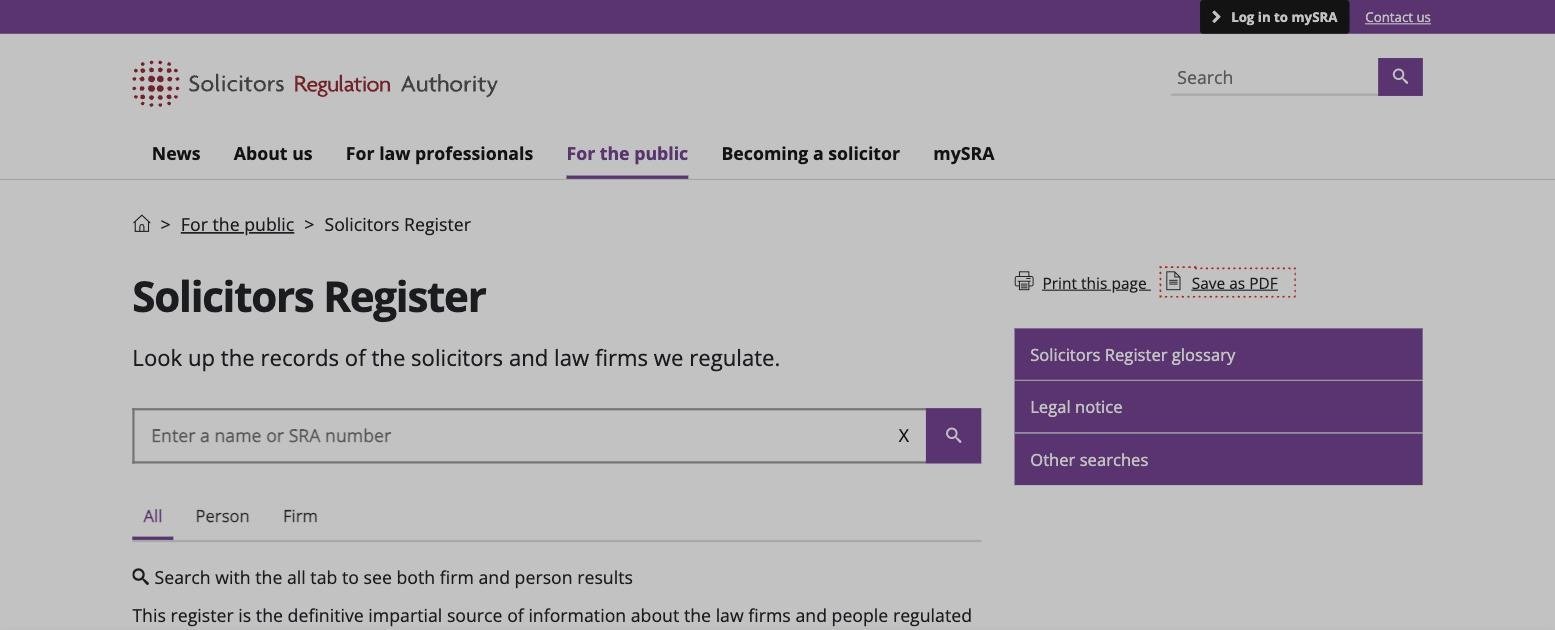
The register. Your SRA number in the footer, and the official clickable SRA badge installed, the one that pops up your firm’s regulatory record. It exists precisely so clients can verify you; a firm displaying it is making an argument no paragraph can make.
Reviews. Google reviews first, ReviewSolicitors if you have momentum there. Reply to every review, including the unfair ones, in the same calm register you would use in correspondence; prospective clients read the replies as a preview of being your client.
Accreditations that mean something. CQS for conveyancing, Lexcel, accredited specialist panels. One line each on what they mean. Skip the made-up “Top 3 Lawyers in York” plaques; the rules on misleading publicity aside, savvy clients now google those award names, and what they find embarrasses you.
Photos. The actual people, the actual office. No gavels, which are not used in courts in England and Wales and quietly announce that a stock library chose your imagery. Skip the scales and the handshake photos too, and the skyline of a city you are not in. Anything sourced must be licensed for use without attribution.
What not to say, because someone will screenshot it
- No “best solicitors in [town]”. Superlatives you cannot evidence are a publicity problem waiting for a complainant.
- No practice areas you do not actually take. A family page that funnels calls you always refer out wastes their time, your receptionist and your rankings.
- No outcome promises in testimonials. “They won my case” is fine as a client’s words; “we win cases” as yours is not.
- Publish the complaints procedure: how to complain to the firm, then the Legal Ombudsman’s details and timescales. It is required signposting, and paradoxically it converts; a firm that explains how to complain about it reads as a firm not expecting you to need to.
Five seconds, held by someone whose house purchase is wobbling
The mobile fold: firm name and town, one plain sentence (“Conveyancing, wills and probate in York, with fixed fees published below”), a phone number that dials, and one button, “Get a conveyancing quote”. Not a slider of the Minster. The stressed client does not need atmosphere; they need evidence that phoning you will not be another chore.
Local SEO for a firm with a brass plaque
You have premises, so run the premises playbook: Google Business Profile on the full address, categories set to your actual work (“Solicitor” primary, conveyancer and probate-type secondaries where offered), reviews that name the service. The structural work is page architecture: one page per practice area per office. A two-office firm doing conveyancing and probate needs four such pages with distinct content, local proof and the right named people, not a “services” page with anchors. Then let each solicitor’s own page catch their referral searches. That, plus the fees pages, is the entire first-year local SEO strategy; law firm SEO agencies charge £1,500 a month largely to do it slowly.
Build route: WordPress, and own everything
The three ways a law firm gets a website built: doing it yourself on a website builder (£15–£25/mo), hiring a freelancer (£1,500–£4,000), or a monthly website deal (£100–£300/mo).
What a law firm website costs in 2026
Do it yourself
£15–£25/mo
Workable for a sole practitioner starting out. The fee tables will outgrow it.
Freelancer
£1,500–£4,000
WordPress build. The default: practice pages, people pages and fee tables that change with Land Registry fees.
Monthly deal
£100–£300/mo
Never a deal where a platform keeps the domain. A regulated firm must control its own website.
The bands this guide uses throughout, side by side. Full reasoning in the build-route section below.
Default: WordPress on decent hosting (Hostinger is the host our review backs), built by a freelancer for £1,500 to £4,000. A firm site is a content system: practice pages times offices, people pages, fee tables that change with Land Registry fees, required regulatory text. WordPress handles that growth and hands you an asset the firm owns outright, which matters to the partners and at any future merger. Keep the maintenance contract separate from the design contract, so you can fire one without the other. If you take the WordPress route, check current Hostinger UK pricing.
When not to: a sole practitioner starting out can launch on a site builder for £15 to £25 a month, and the builders comparison shows the honest trade-offs. The line to never cross is renting: a “free website included” deal from a directory or marketing platform where they keep the domain. A regulated firm that does not control its own website is one contract dispute away from vanishing.
The domain goes in the firm’s own account, registered to the firm, with auto-renew on. Read our Namecheap review, check current domain pricing, and buy hartleylaw.co.uk, not york-solicitors-4u.com.
The homepage: before and after
Before: “Hartley & Co Solicitors. Providing excellence in legal services since 1987.” A stock gavel. Nav reading Home, About, Services, News, Contact. News last updated fourteen months ago. No people, no prices, a form.
After: “Solicitors in York for conveyancing, wills and probate. Fixed fees published. Your solicitor named before you pay anything.” Three buttons for the three services. Two faces with names and SRA numbers. The Google rating. The SRA badge in the footer doing its quiet work. The second homepage costs no more to build. It just commits to things.
Seven habits of unconvincing firm sites
- No fees anywhere, in the one consumer legal market where the regulator requires them.
- No people, or a team page of names without faces, numbers or personality.
- Practice areas listed that the firm refers out.
- Stock justice imagery: gavels, scales, columns.
- Superlatives (“leading”, “best”) with no evidence behind them.
- The complaints procedure missing or hidden, which fails signposting duties and reads evasive.
- A “News” section that died in 2024, proving in public that the firm starts things it does not maintain.
The longer list, with fixes, is in our law firm website mistakes guide.
Launch checklist for a firm site
- SRA number in the footer sitewide; clickable SRA badge installed.
- Fees published for every in-scope service, with a worked example each.
- Disbursements itemised on the conveyancing page.
- Every fee page names the person doing the work and their supervisor.
- A page per solicitor: photo, SRA number, direct contact.
- Complaints procedure page: firm process, then Legal Ombudsman details.
- Practice area pages only for work the firm genuinely takes.
- No superlative claims anywhere; someone sceptical has proofread for them.
- Real photography of people and office; anything bought is licensed without attribution.
- Mobile fold: town, one sentence, dialable number, one quote button.
- Google Business Profile: full address, correct categories, four reviews minimum.
- Domain registered to the firm in its own Namecheap account, auto-renew on.
- Privacy policy and required regulatory information pages live.
- Google Search Console verified, sitemap submitted, free.
- Quote-request form tested end to end, reply-time promise agreed with whoever answers it.
The first month, billed to marketing
Week one: ask the last ten satisfied clients for Google reviews, individually, by the fee earner who acted for them. Week two: watch the quote form; every question two callers ask gets its answer added to the fees page. Week three: Search Console will show which practice area is pulling searches; give that page one more worked example and one more named person. Week four: read your own site as a nervous first-time buyer, then delete every sentence that exists to impress another solicitor.
Four questions from behind the partners’ desk
Is publishing fees not just arming competitors? Your competitors can mystery-shop you any Tuesday. The only people the missing prices deter are clients, who assume the silence is expensive.
What about “no win no fee” wording? Only where you genuinely offer CFAs, and with the conditions summarised honestly on the same page. It is a regulated claim, not a slogan.
Do we need a blog? No. You need fee pages, people pages and practice pages that are correct. Publish commentary only if someone will still be publishing it in a year; a dead News page is worse than none.
Our clients come from referrals. Why does any of this matter? Referred clients still google the firm before ringing. The website’s job for them is thirty seconds of confirmation: real people, real register entry, published prices. Fail that and the referral leaks to the firm that passed.