
Finding
74% of the 61 law firms recommended by ChatGPT, Gemini and Google AI Mode across six UK cities were named by only one engine in Whito's August 2026 test, and just three firms, 4.9%, were named by all three, five times the rate for accountants.
Source: Whito, whito.co.uk/solicitors/research/ai-solicitor-recommendations, August 2026. Free to quote with a link to this page.
Last Updated on October 12, 2026
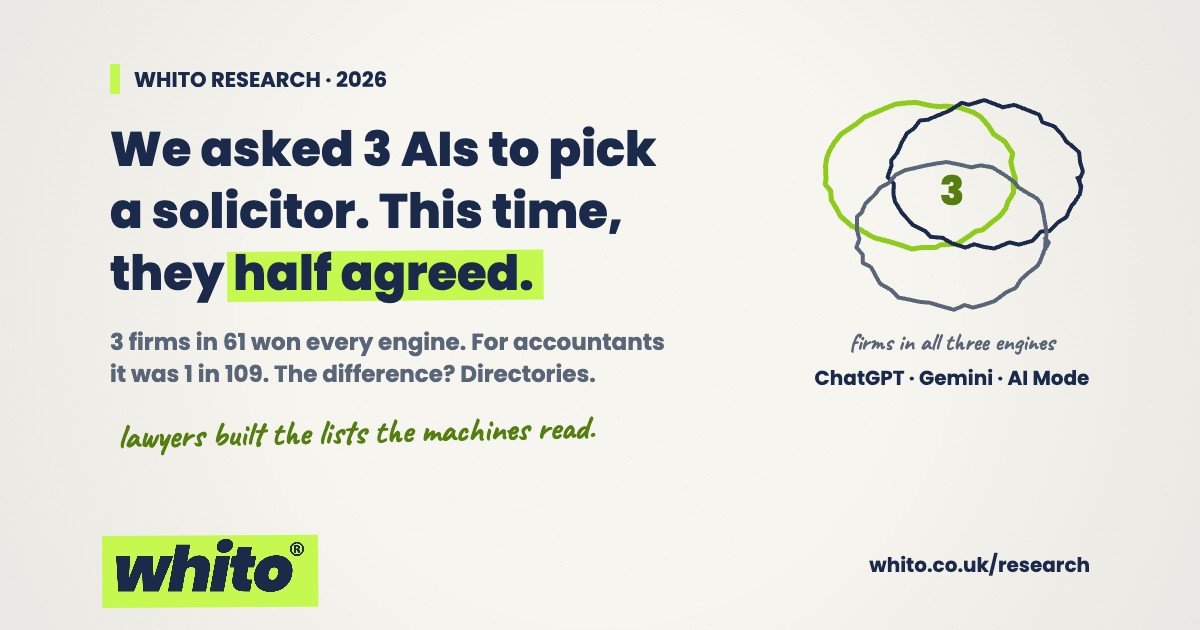
We asked ChatGPT, Google Gemini and Google AI Mode to recommend a solicitor in six UK cities, screenshotted what they showed, and recorded every firm named. The consensus rate was five times higher than for accountants, and the reason is a lesson for every professional services firm.
Yesterday we published what happened when we asked three AI engines to recommend an accountant: 109 firms named, and exactly one agreed on by all three.
Today, same experiment, same six cities, same day, different profession. And the results are different in a way that tells you exactly how AI recommendation works under the surface.
What we did
One fixed question, worded exactly as a business owner would ask it: “Who is the best solicitor for a business in [city]?”
We asked it in Manchester, London, Birmingham, Leeds, Bristol and Glasgow, across three engines, all on 14 August 2026 from a UK browser: ChatGPT (free tier, with web search), Google Gemini (free app), and Google AI Mode (Google’s AI search). We recorded every firm named, matched the overlaps with set logic, and this time we also kept the screenshots.
We originally planned to reuse Perplexity as the third engine for a like-for-like repeat of the accountants study, but its free tier rate-limited after a single answer, so Google AI Mode took its place. Details in the method section.
The headline numbers
- 18 answers named 61 different law firms across 80 recommendation slots.
- 74% of firms were named by only one engine. Still a lottery, but a smaller one: for accountants it was 85%.
- Three firms achieved full three-engine consensus: EM Law in London, Barcan+Kirby in Bristol, and Macdonald Henderson in Glasgow. That is 4.9% of firms, five times the consensus rate we measured for accountants (0.9%).
- In two cities, two engines named the same explicit first choice: EM Law in London and Barcan+Kirby in Bristol, both picked by ChatGPT and Google AI Mode.
| City | Unique firms named | Named by 2+ engines | Named by all 3 |
|---|---|---|---|
| Manchester | 13 | 3 | 0 |
| London | 10 | 1 | 1 (EM Law) |
| Birmingham | 10 | 3 | 0 |
| Bristol | 10 | 2 | 1 (Barcan+Kirby) |
| Leeds | 9 | 4 | 0 |
| Glasgow | 9 | 3 | 1 (Macdonald Henderson) |
| Total | 61 | 16 | 3 |
What the engines actually show
Numbers only tell you half of it. Here is what each engine actually put in front of us, unedited apart from cropping.
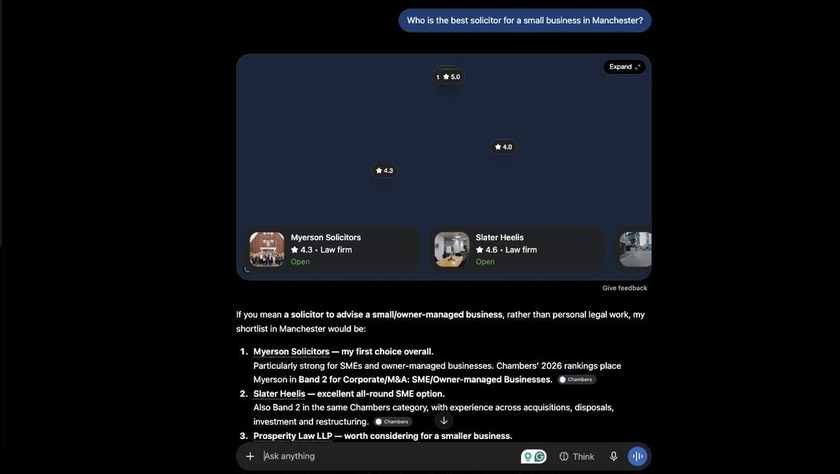
ChatGPT now answers like a local search engine. It opens with a map and business cards pulled from Google-style listings, then writes a numbered shortlist with citation chips. Note the chips: Chambers, the legal ranking directory, appears right inside the answer.
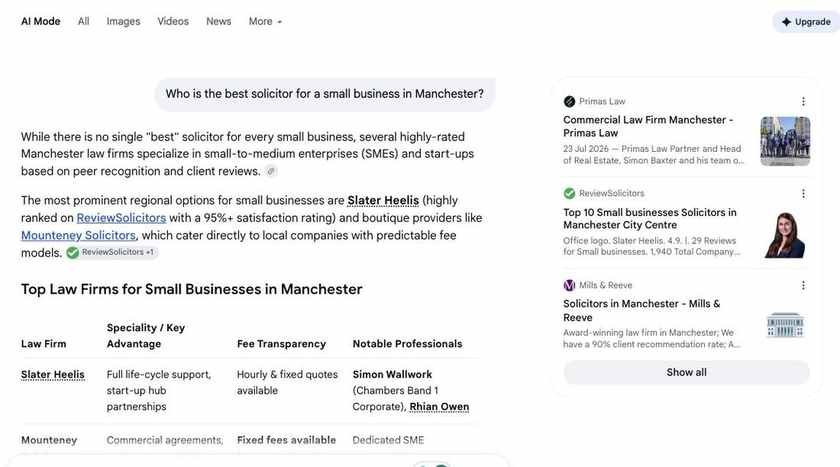
Google AI Mode builds a comparison table, complete with “fee transparency” columns and named partners, and cites ReviewSolicitors, the solicitor review directory, in the very first paragraph.
Gemini writes category lists (“boutique specialists”, “national firms with strong local bases”) and, in London, told us exactly where its shortlist comes from: firms “highly rated by independent legal directories like Chambers & Partners and The Legal 500”.
Three different interfaces, one common thread: every engine leaned on the same authority layer. Chambers, The Legal 500 and ReviewSolicitors were cited across all three engines, in city after city.
Why solicitors get five times more consensus than accountants
This is our reading of the data, not something any engine documents, but the mechanism is hard to miss.
The legal profession has spent decades building authoritative rankings: Chambers, The Legal 500, ReviewSolicitors. Every engine reads them, so every engine keeps landing on the same names. EM Law is Chambers-ranked for SME work; two engines made it their explicit first London choice. Barcan+Kirby tops Bristol on two engines. Macdonald Henderson leads Glasgow across all three.
Accountancy has no Chambers. When we asked the same engines about accountants, they fell back on Google reviews, ThreeBestRated and local blog roundups, each engine sampling a different pile, and consensus collapsed to one firm in 109.
The rule that falls out of this: where an authoritative directory exists, AI answers converge on it. Where none exists, AI recommendation is a lottery of scattered local signals. If you are in a profession without a Chambers, the directories and review platforms that do exist are fighting to become that layer, and being on them early is cheap visibility.
The firm that bought the answer page (and earned it too)
One more thing the screenshots caught. ChatGPT’s free tier now shows adverts beneath answers, and during this study one advertiser appeared again and again: Harper James, a commercial law firm. Its ads ran beneath our London, Birmingham, Leeds and Bristol answers.
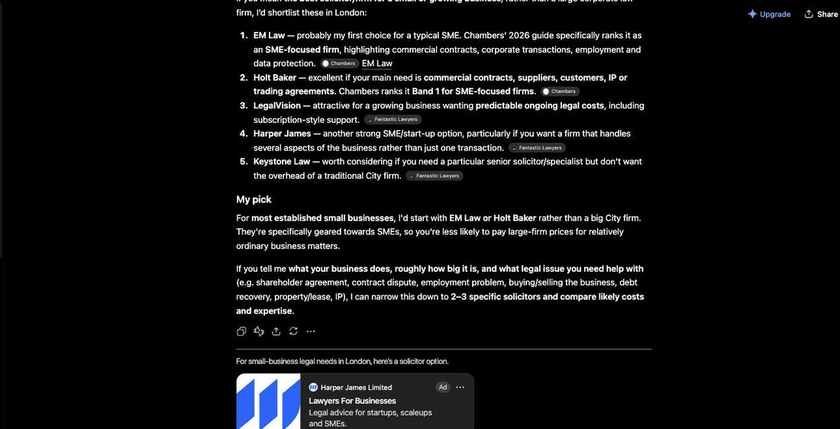
Here is the detail worth noticing: Harper James also appeared organically, named in four of our eighteen answers across ChatGPT and Gemini. To be clear, we saw no evidence the ads influence the answers, and Harper James is a Chambers-recognised SME firm, which on its own explains the organic mentions. What the screenshot really shows is a firm that has decided to occupy every layer of the answer page: the directory rankings that feed the organic result, and the ad slot underneath it. That is what taking AI search seriously looks like.
What the recommended firms look like
Where engines quoted review data (13 recommendations), the profile was broader than for accountants: quoted counts ran from 27 reviews to over 5,000, with a median of 113, and ratings of 4.0 to 5.0. The bar is higher than accountancy’s median of 37, but the pattern held: mid-sized, well-reviewed regional firms dominated, and no Magic Circle firm was recommended anywhere. Google AI Mode even said the quiet part out loud in Leeds: small businesses “achieve better outcomes” with specialist regional firms than with big national ones.
What a law firm should do with this
Three things, in order of leverage.
Treat Chambers, Legal 500 and ReviewSolicitors as AI infrastructure. They are no longer just prestige badges for pitch decks. They are the retrieval layer AI engines quote by name. A Band 1 or top-tier listing in your city is currently the single strongest predictor of being recommended, on the evidence of these 18 answers.
Say “business” in machine-readable places. Every consensus firm states its SME focus plainly, in directory profiles and on its own site. Engines matched the phrasing of the question to the phrasing of the profile.
Keep the review profile warm. Google review data fed the map cards and tables in two of three engines. Median to beat here: 113 reviews, rating 4.5 or better.
The sharp takeaway
For accountants, AI recommendation is a lottery. For solicitors, it is already half a league table, because the profession built the directories the machines now read.
Whatever your industry, the question is the same: when the engines go looking for an authority layer about you, does one exist, and are you on it?
Would AI recommend your business?
The free Whito Visibility Check checks the surfaces AI engines actually read, and tells you the one thing to fix first. It takes about two minutes.
Method, limitations and what this study does not say
Method. One question, asked verbatim in each engine: “Who is the best solicitor for a business in [city]?” Six cities: Manchester, London, Birmingham, Leeds, Bristol, Glasgow. Three engines, queried 14 August 2026 from a UK browser: ChatGPT (free tier, logged in, default model with web search), Google Gemini (free app, default model), Google AI Mode. Every firm named in any answer was recorded and matched by name within each city; agreement statistics were computed with deterministic set logic. Screenshots are unedited apart from cropping.
The Perplexity substitution. Our accountants study used Perplexity as the third engine. For this study Perplexity’s free tier rate-limited after one answer, so Google AI Mode replaced it for the full sweep. The accountants-versus-solicitors comparison is therefore directional, not strictly controlled; the day, cities and question wording were identical.
On named firms. Firms are named only as having been recommended by an AI engine, a positive or neutral fact about visibility. We make no claims about the quality of any firm’s work. Chambers, Legal 500 and ReviewSolicitors rankings are as cited by the engines at query time; ratings and review counts likewise. On Harper James: we report only what was on screen, an advert and separate organic mentions, and draw no causal link between the two; its directory recognition on its own explains the organic presence.
Snapshot, not league table. AI answers vary by day, account, session and location. A different day would produce different lists. That variability is, again, the point.
This article is general information based on a snapshot study, not advice for any specific business, and not a recommendation of any law firm. Whito has no commercial relationship with any firm named.
Common questions
Do AI engines recommend the same solicitors?
More than they do accountants, but mostly no. In our August 2026 test, 74% of the 61 firms recommended were named by only one of three engines. Three firms were named by all three, a consensus rate five times higher than we measured for accountants.
How does ChatGPT choose which solicitor to recommend?
Largely from legal directories and review data. In our test it cited Chambers rankings and ReviewSolicitors scores directly inside its answers, alongside Google-style local listing cards.
Why do solicitors get more consistent AI recommendations than accountants?
Because the legal profession has authoritative directories, Chambers, The Legal 500 and ReviewSolicitors, that all engines read. Professions without an equivalent authority layer get scattered, low-consensus answers.
Does being in Chambers or the Legal 500 help with AI visibility?
On this evidence, strongly. All three firms with full three-engine consensus in our study are directory-ranked, and engines quoted the rankings as their stated reasons.
Are there ads in ChatGPT’s solicitor recommendations?
ChatGPT’s free tier showed labelled adverts beneath four of our six city answers, all from the same commercial law firm, which also appeared organically in some answers. Ads are labelled and shown separately from the answer text.
- Which accountants does AI recommend? The companion study, where consensus was 1 firm in 109
- AI engines can’t agree on the best tradesperson either
- How an AI answer is built: the 5 layers, and the 2 you control
The paid data underneath this study
This study stays free, with no gate and no email wall, and it always will. Whito Data is the deeper version of the same work: the method run at scale, repeated every quarter, with every business named and checked against the public register. It is priced for software vendors, lead platforms, franchisors, trade bodies and investors, not for the businesses we write about.
If your business is named here and you think we have a fact wrong, email hello@whito.co.uk and we will check it and correct it. If you want to respond, send us a statement and we will publish it alongside. Full detail: Corrections, right of reply and removals.