
Finding
ChatGPT, Gemini and Perplexity named 109 different accountancy firms when asked for the best small business accountant in six UK cities in Whito's August 2026 test, and all three agreed on exactly one of them. 85% of firms were named by only one engine.
Source: Whito, whito.co.uk/accountants/research/ai-accountant-recommendations, August 2026. Free to quote with a link to this page.
Last Updated on October 12, 2026
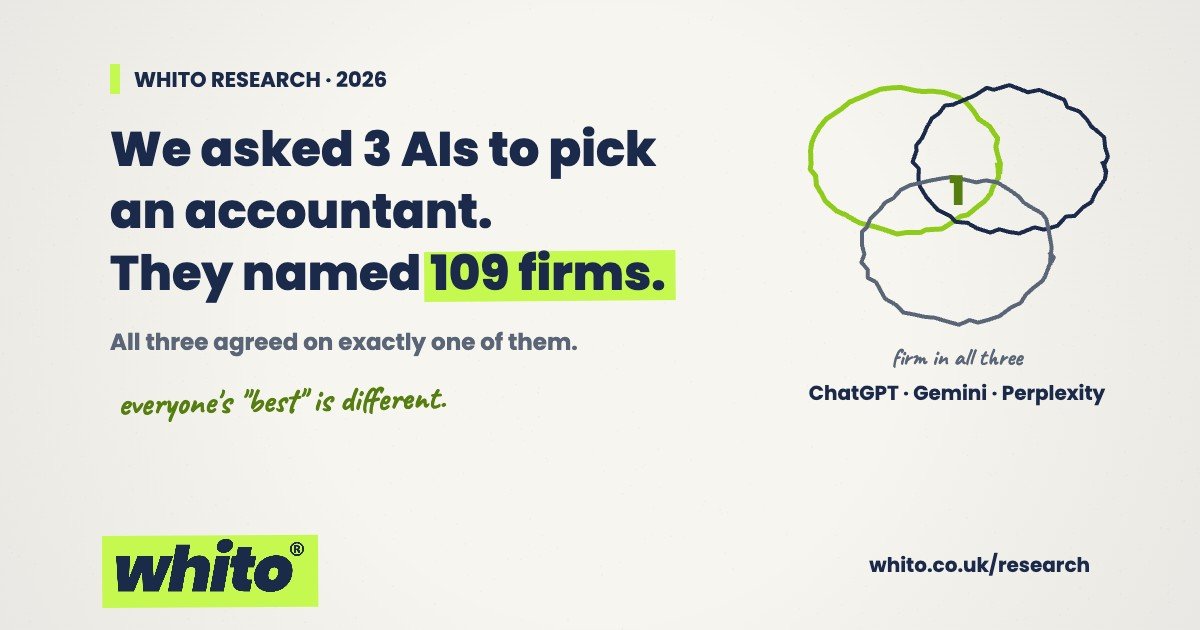
We asked ChatGPT, Gemini and Perplexity to recommend an accountant in six UK cities, and recorded every firm they named. 109 firms came back. The three engines agreed on exactly one of them.
Your next client is already asking AI for an accountant. The question is what the AI says back.
Most accountancy firms assume the answer works like a league table: the biggest, oldest, most established firms get recommended. We tested that assumption on 14 August 2026, with the same question a real business owner would ask, and it did not survive contact with the data.
The mistake most firms make
Treating “AI visibility” as one prize you either win or lose.
There is no single AI answer. Each engine samples a different slice of the web, leans on different sources, and reassembles a different shortlist. A firm can be ChatGPT’s first pick and completely invisible to Gemini, and in our data that was not the exception. It was the norm.
What we did
We asked one fixed question, worded exactly as a business owner would ask it: “Who is the best accountant for a business in [city]?”
We asked it in six cities (Manchester, London, Birmingham, Leeds, Bristol and Glasgow) across three engines: ChatGPT (free tier, with web search), Google Gemini (the free app’s default model) and Perplexity (logged out). All 18 answers were collected on the same day, 14 August 2026, from a UK browser. We recorded every firm each answer named, then checked the overlaps.
The headline numbers
- 18 answers named 109 different firms across 126 recommendation slots.
- 93 of the 109 firms (85%) were named by only one engine. Ask a different AI, get a different accountant.
- 16 firms (15%) were named by two engines for the same city.
- Exactly one firm in 109 was named by all three engines: Agile Accountants in Birmingham. That is under 1% three-way consensus.
- In only one city (Glasgow) did two engines share the same first choice: both ChatGPT and Perplexity led with TaxAssist Accountants. All three engines never agreed on a top pick anywhere.
| City | Unique firms named | Named by 2+ engines | Named by all 3 |
|---|---|---|---|
| London | 24 | 3 | 0 |
| Leeds | 18 | 2 | 0 |
| Glasgow | 18 | 3 | 0 |
| Birmingham | 18 | 1 | 1 |
| Manchester | 17 | 6 | 0 |
| Bristol | 14 | 1 | 0 |
| Total | 109 | 16 | 1 |
Gemini was the outlier throughout. In Leeds and Glasgow, its list shared not a single firm with either of the other two engines.
The one firm every AI agrees on
Here is the detail worth sitting with. The only firm named by all three engines, Agile Accountants of Birmingham, is not a century-old institution. Companies House shows Agile Accountants Limited was incorporated on 17 February 2022.
The single point of AI consensus in this study is a firm that did not exist five years ago. Whatever the engines are rewarding, it is not age, size or brand. It is visibility: strong reviews, presence on the lists the engines read, and a clear business focus stated everywhere the firm appears.
What the recommended firms actually look like
The engines frequently quoted Google review data alongside their recommendations, which let us profile what “AI-recommendable” looks like. Across the 21 recommendations where an engine quoted the numbers:
- Every quoted rating was 4.5 stars or higher, and most were a flat 5.0.
- The median review count was 37. The largest was 169. One Leeds firm was recommended with five reviews.
Read that again if your firm has been putting off asking clients for reviews. The bar is not thousands of reviews. It is a small, spotless, recent review profile. A 5.0 from 30 clients beat big-brand recognition in city after city.
Where the answers actually come from
The engines showed their working, and it was not firm websites.
ChatGPT cited ThreeBestRated, a curated “top 3 in your city” directory, in five of the six cities. Perplexity leaned on local directory roundups and Clutch listings, and in Bristol built its whole answer from them. Review platforms, curated lists and directories are the retrieval layer; your website is mostly evidence that you exist.
The data goes in raw, glitches included. One London “firm” recommended by Perplexity is actually a Google listing whose business name is a string of search keywords rather than a name. Two entries in other cities were street addresses presented as firm names. And Perplexity’s Glasgow answer opened by admitting it did not have live tools at that moment, then recommended five firms anyway.
One more thing we could not help noticing: ChatGPT’s free tier now shows adverts around its answers. While it recommended accountants, it also served us ads for a business-rates consultancy and a commercial law firm. The answer layer is becoming commercial real estate.
Where were the big names?
Almost entirely absent. No Big Four firm was recommended anywhere. Across 109 firms, national brands barely feature: TaxAssist (a franchise) was the only name to lead in any city, and a handful of larger regional firms appeared once each. Independent local practices dominated every list.
For a small accountancy firm, this is the quietly enormous finding: in AI answers, you are not competing with PwC. You are competing with the well-reviewed practice two streets away.
The pattern worth noticing
This is our reading of the data, not something any engine documents.
AI engines do not have an opinion about accountants. They reassemble other people’s opinions: Google reviews, curated directories, local roundups. Each engine samples that pile differently, which is why 85% of recommendations were unique to one engine and why consensus collapsed to a single firm out of 109.
So “getting recommended by AI” is not one battle. It is surface area. The firms that showed up repeatedly, Agile in Birmingham, TaxAssist and Hawthorn Tax in Glasgow, Ascentis in Leeds, A&C in Manchester, are the ones present and consistent across several of the surfaces the engines read.
What an accountancy firm should do with this
Three things, none of which require an “AI strategy” budget.
Fix the profile the engines quote. The engines read review counts, ratings, opening hours and addresses straight from your Google Business Profile, glitches and all. Correct name, correct category, small-business wording in the description, and a steady drip of recent reviews. Median to beat: 37.
Be on the lists, not just the map. ThreeBestRated, Clutch, local “best accountants in [city]” roundups and verified directories kept appearing as sources. One placement on a list an engine trusts does more than ten blog posts nobody cites.
Say “business” where machines can read it. Every winning answer matched firms whose public profiles literally say they serve businesses, sole traders and startups. If your site says “bespoke solutions for ambitious enterprises”, no engine knows who you are for.
The sharp takeaway
109 firms recommended. One point of agreement, and it is a firm incorporated in 2022.
AI recommendation is not a ranking you climb. It is a set of surfaces you either occupy or you do not. The good news for small firms: the winners here are small, local, and visible, not big. The bar is a clean profile and 40 reviews, and most of your competitors have not noticed yet.
Would AI recommend your business?
The free Whito Visibility Check checks the surfaces AI engines actually read, and tells you the one thing to fix first. It takes about two minutes.
Method, limitations and what this study does not say
Method. One question, asked verbatim in each engine: “Who is the best accountant for a business in [city]?” Six cities: Manchester, London, Birmingham, Leeds, Bristol, Glasgow. Three engines, queried 14 August 2026 from a UK browser: ChatGPT (free tier, logged in, default model with web search), Google Gemini (free app, default model), Perplexity (logged out). Every firm named in any answer was recorded and matched across engines by name within each city. Agreement statistics were computed with deterministic set logic, not by eye.
Snapshot, not league table. AI answers vary by day, account, session and location. These are the answers we received on one day. A different day would produce different lists, which is, in fact, the point of the study.
On named firms. Firms are named here only as having been recommended by an AI engine, which is a positive or neutral fact about their visibility. We make no claims about the quality of any firm’s work, and inclusion or absence implies nothing about competence. Ratings and review counts are as quoted by the engines at query time; we did not independently audit them. Company incorporation details are from the public Companies House register.
Comparison with our earlier study. Our July 2026 study of tradespeople found engines agreed on the top pick in 8% of questions. That measured top-pick agreement; this study measures full-list overlap, so the figures are not directly comparable.
This article is general information based on a snapshot study, not advice for any specific business, and not a recommendation of any accountancy firm. Whito has no commercial relationship with any firm named.
Common questions
Do AI engines recommend the same accountants?
Mostly, no. In our August 2026 test across six UK cities, 85% of the 109 firms recommended were named by only one of the three engines, and just one firm was named by all three.
How does ChatGPT choose which accountant to recommend?
From what it can retrieve: Google review data, curated directories and local roundups. In our test it cited ThreeBestRated in five of six cities and quoted Google ratings and review counts directly.
How many Google reviews does a firm need to be recommended by AI?
Fewer than most people assume. Among recommendations where engines quoted review data, the median was 37 reviews and one firm had five. Every quoted rating was 4.5 or above, so quality and recency matter more than volume.
Does AI recommend big accountancy firms?
Rarely. No Big Four firm was recommended in any of our 18 answers. Independent local practices dominated, with TaxAssist the only franchise to lead a city.
How do I get my accountancy firm recommended by AI?
Occupy the surfaces engines read: a complete and accurately named Google Business Profile, a steady flow of recent reviews, placement on curated local lists and directories, and public wording that says clearly who you serve.
- AI engines can’t agree on the best tradesperson either: our 3-engine study
- Review Forensics: inside the profiles behind AI’s most trusted roofers
- How an AI answer is built: the 5 layers, and the 2 you control
The paid data underneath this study
This study stays free, with no gate and no email wall, and it always will. Whito Data is the deeper version of the same work: the method run at scale, repeated every quarter, with every business named and checked against the public register. It is priced for software vendors, lead platforms, franchisors, trade bodies and investors, not for the businesses we write about.
If your business is named here and you think we have a fact wrong, email hello@whito.co.uk and we will check it and correct it. If you want to respond, send us a statement and we will publish it alongside. Full detail: Corrections, right of reply and removals.