
Last Updated on October 16, 2026

Some links in this article are commission-based, meaning we may earn a small fee if you purchase through them, at no extra cost to you. They do not buy a place in any ranking. Full disclosure: https://whito.co.uk/how-we-make-money/ and https://whito.co.uk/review-methodology/
Most plumbing websites are built for the wrong customer. They are built for the plumber’s mates, who will say it looks smart, and for the plumber, who wanted somewhere to put the van photo. The customer who matters is standing in a kitchen at 23:07 with water coming through the light fitting, holding a phone. This guide is about building for that person, and for the calmer one comparing three boiler quotes on a Sunday.
It sits alongside everything else we publish for the trade at whito.co.uk/plumbers/.
The 23:00 test comes before design
A plumbing site has two jobs in its first 90 days, and neither is “looking professional”.
Job one: when someone in your patch searches in a panic, your site answers the only three questions they have. Can you come now, roughly what will it cost, and are you safe to let in. If your opening hours are nowhere on the page, you have already lost the 23:00 job to a national call-handling outfit that charges £150 before anyone picks up a wrench, then subcontracts it to a plumber half a mile from you. Possibly to you, at a worse rate.
Job two: when someone is planning a £2,000 to £4,500 boiler replacement, your site earns a place on their three-quote shortlist. That customer is not in a panic. They will read. Give them something worth reading.
Everything else, the About page, the blog, the logo debate, is decoration until those two jobs are done.
Five seconds on a cracked phone screen
Nobody browses plumbing websites on a laptop. Test yours on a phone, held by someone stressed, and count five seconds. In that time they need to see:
- A phone number they can tap. Not copy. Tap.
- The words “Gas Safe registered” with your number next to them.
- One sentence that says what you do and where. “Gas Safe plumbers and heating engineers covering Leeds and Wakefield.”
- One button. “Call now” if you take emergencies, “Get a boiler quote” if you don’t.
Make the call button sticky, so it stays on screen as they scroll. Wix and most builders have a sticky header element that does this in about four minutes of work. It will outperform every design decision you agonise over.
A mobile homepage layout for a plumber: a sticky tap-to-call bar, the headline Gas Safe plumbers in Leeds, a Gas Safe registration badge, and one call button.
What a panicking customer must see first
Gas Safe plumbers in Leeds. Boilers fixed, fitted and serviced.
Gas Safe registered · No. 000000
Open until 10pm
Everything above the fold. Nothing else.
The whole first screen: a number they can tap, proof they can check, hours that answer the 23:00 question, one primary button.
The eight pages, in the words customers type
Customers do not search for “our services”. They search for the thing that is broken or the thing they want to buy. Your page list should read like their search history:
- Home
- Emergency plumber (24 hour, if true)
- Boiler installation
- Boiler repair and servicing
- Bathroom installation
- Central heating (radiators, powerflushing, smart controls)
- Areas we cover
- Contact
Emergency, boilers and bathrooms are three different customers with three different budgets and three different states of mind. One “Services” page that mentions all of them serves none of them, and Google has no page to rank for any single search.
The money page: boiler installation
The boiler page pays for the website many times over, so it gets the detail treatment:
- Brands you actually fit. Worcester Bosch, Vaillant, Ideal, whichever you install. If you hold a manufacturer accreditation that extends the warranty, say so, because it changes the maths of the whole quote.
- A real “from” price. “Combi swap from £1,950 including a magnetic filter, flush and 12 months’ cover” beats “competitive prices” in every test anyone has ever run. If you cannot commit to a number, commit to a range and say what moves it: relocating the boiler, converting from a conventional system, flue position.
- What happens when they enquire. “We survey in person, quote in writing within 48 hours, and the price we quote is the price you pay.”
- How long the job takes. A straight swap is a day. Customers do not know that. Telling them removes a fear.
- One photo of your actual pipework. Plumbers judge each other on pipework. Customers cannot articulate why tidy copper looks trustworthy, but they feel it.
Proof, stacked in the right order
Trust for a plumber is built from three layers, and the order matters.
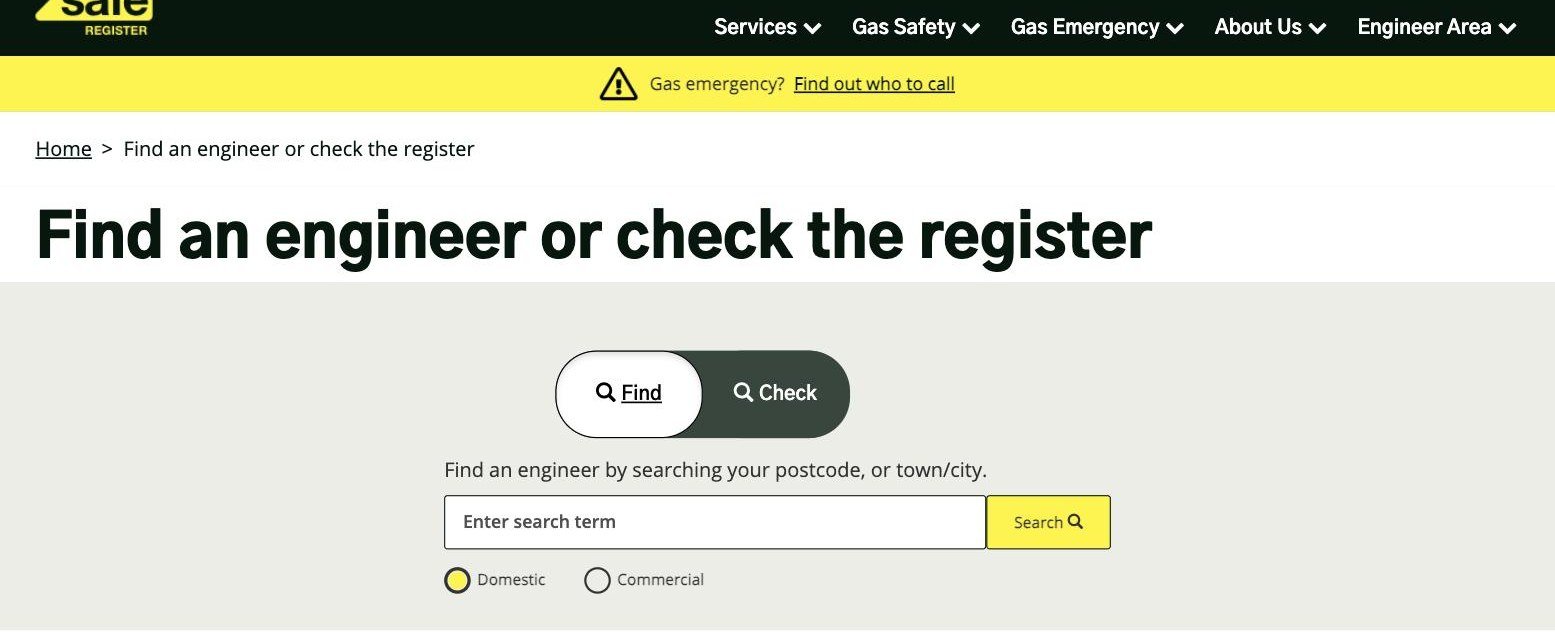
The register. Gas Safe registration is a legal requirement for gas work, and your registration number belongs on every page, header or footer, not buried on the About page. Customers can check it, and the smart ones do. Never write “Corgi registered”. That scheme ended in 2009, and the phrase now dates a website the way a fax number does.
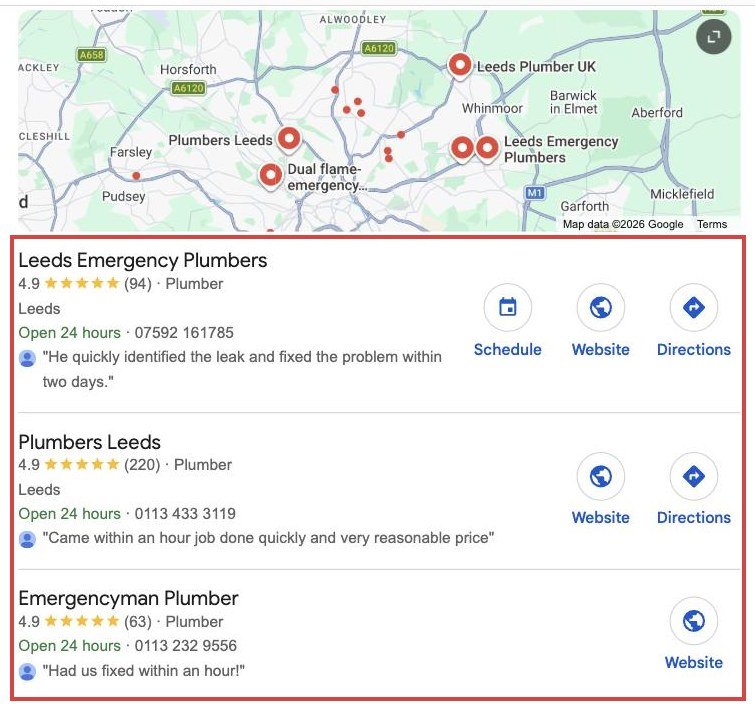
The reviews. Google reviews beat everything else because they show up in Maps, where emergency searches end. Embed your latest few on the homepage, but link out to the full Google profile rather than curating a wall of praise. Eleven reviews at 4.8 looks human. A hundred at 5.0 looks laundered.
The photos. One category wins: finished work in real houses. The airing cupboard after the cylinder swap. The bathroom after tiling. The van outside a job, not in a car park. No stock photos, and check any image you buy or generate is licensed for use without attribution, because a credit line under your hero photo looks amateur and most licences that demand one are the wrong licences for a commercial site anyway.
Local SEO for a business with no shopfront
You work out of a van, which changes the local SEO playbook:
- Set up your Google Business Profile as a service-area business. Hide the home address, list the towns you cover. Do not invent an office, and do not rent a virtual one; fake addresses get profiles suspended.
- Pick the primary category “Plumber” and add “Heating contractor” and “Boiler installation” style secondary categories where offered.
- Your “Areas we cover” page should list the towns you genuinely reach in under 40 minutes, each with a line of local truth (“we fit two or three boilers a month in Horsforth”) rather than a paragraph of the same sentence with the town swapped. If a town brings you real work, it can earn its own page later. Start with one.
- Get review-writers to mention the town and the job. “Fitted our new combi in Pudsey” is local SEO you cannot buy.
Search for your own money term and look at who already ranks. That page layout, a map pack of three profiles then a page of results, is what your site has to belong in.
Build route: what to use and what it costs
The three ways a plumber gets a website built: doing it yourself on a website builder (£10–£20/mo), hiring a freelancer (£600–£1,500), or a monthly website deal (£40–£100/mo).
What a plumber website costs in 2026
Do it yourself
£10–£20/mo
Wix or similar, plus a £10–£15/yr domain. Right for most one-van firms.
Freelancer
£600–£1,500
One-off. Good value if you supply the page list, prices and photos.
Monthly deal
£40–£100/mo
Read the exit terms: if leaving loses you the site and domain, it was rent.
The bands this guide uses throughout, side by side. Full reasoning in the build-route section below.
Three honest options:
DIY on a website builder: £10 to £20 a month. For most one-van and two-van plumbing firms this is the right answer, and Wix is our default for the trade. The reasons are boring and practical: the mobile templates put the call button where it belongs, the sticky header takes minutes, and there is nothing to update or patch while you are under a sink. Our full comparison is at best website builders UK and the head-to-head at Wix vs WordPress vs Squarespace if you want the working-out.
When not to use Wix: if you run a heating firm with several vans and you want fifteen or more service and town pages, build on WordPress with proper hosting instead; Hostinger is the host we use and review. It scales into a page-per-town strategy in a way builders resist. It also needs updates and backups, which is the price of the flexibility. If you take the WordPress route, check current Hostinger UK pricing.
A freelancer: £600 to £1,500 one-off. Good value if you supply the photos, the prices and the page list from this article. Poor value if you turn up with “just make it look professional”, because you will get a brochure. Our plumber website cost guide shows what the market charges at every level.
A monthly website deal: £40 to £100 a month. Fine for some, but read the exit terms. If stopping the payments takes both the site and the domain with it, every month so far bought nothing you can keep.
Whichever route you take, buy the domain yourself, in your own account, so nobody can hold it hostage. Something boring and yours: jonesheating.co.uk, not leeds-best-plumber-247.com. Namecheap is our pick for domains; register the .co.uk there and check the renewal price as well as the first-year offer.
Bad homepage, good homepage
Bad, and everywhere: a full-width slider of stock photos, then “Welcome to Smith Plumbing Services. With over 20 years of experience, we pride ourselves on customer satisfaction.” The phone number is in the footer. The only button says “Learn more”. At 23:07, this site loses.
Good: “Gas Safe plumbers in Leeds. Boilers fixed, fitted and serviced.” Registration number under the headline. Tappable number in a sticky bar. Three buttons: Emergency, New boiler quote, Bathrooms. Four Google reviews, one photo of copper pipework you are proud of. Nothing else above the fold.
A comparison of a bad plumber homepage (stock slider, welcome text, no visible phone number) against a good one (headline with town, Gas Safe number, tap-to-call, separate emergency, boiler and bathroom buttons).
The one that loses and the one that wins
The one that loses
✗ Full-width slider of stock photos
✗ “Welcome to Smith Plumbing Services. We pride ourselves…”
✗ Phone number in the footer only
✗ One button: “Learn more”
The one that wins
✓ “Gas Safe plumbers in Leeds. Boilers fixed, fitted and serviced.”
✓ Registration number under the headline
✓ Tappable number in a sticky bar
✓ Three buttons: Emergency, New boiler, Bathrooms
At 23:07 the left one loses. The right one answers can-you-come, what-will-it-cost and are-you-safe before a single scroll.
Seven mistakes plumbing sites keep making
- Gas Safe number missing, or worse, “Corgi registered”.
- No opening hours anywhere, which silently forfeits every out-of-hours job.
- One “Services” blob instead of separate emergency, boiler and bathroom pages.
- A contact form as the only way in. Emergencies do not fill in forms.
- Stock photography, including, weirdly often, American water heaters no UK house contains.
- No prices and no price context, which reads as “expensive” to every visitor.
- A “we cover all of Yorkshire” claim that Google ignores and customers distrust. Name your towns.
The launch checklist
Fifteen items, plumbing-specific. Do not launch until all fifteen are true.
- Gas Safe registration number visible on every page.
- Phone number tappable, sticky on mobile.
- Opening hours stated, including what “emergency” actually means for you.
- Emergency, boiler installation, boiler repair and bathroom pages live as separate pages.
- Boiler page has a from-price or an honest range with the reasons it moves.
- Areas page names real towns, no county-wide bluster.
- At least six photos of your own work, none stock, all licensed clean.
- Google Business Profile claimed, service-area mode, categories set.
- Reviews: at least five on Google, latest three embedded on the homepage.
- Domain registered in your own Namecheap account, auto-renew on.
- Site loads in under three seconds on 4G, tested on your actual phone.
- Every form sends to an inbox somebody reads, tested twice.
- Google Search Console verified and the sitemap submitted. Free, no catch.
- Legal footer: company or sole-trader name, and a privacy note if the form collects data.
- A mate has tried to break it on their phone and failed.
The first 30 days after launch
Week one, ask your last ten happy customers for a Google review, by text, with the direct link. Week two, add one job to the site: three photos, four sentences, the town named. Do this weekly forever. Week three, check Search Console for the first queries your pages appear for, and put the exact phrases customers used into your page headlines where they are more honest than what you wrote. Week four, phone your own number from the website like a stranger. Fix whatever annoyed you.
Search Console is the only SEO tool you need this quarter. If you later develop an appetite for keyword research, the paid options are reviewed in our SEO tools roundup, but do not buy software before you have review number twenty.
Four questions nervous plumbers ask
I’m booked solid from Checkatrade. Why bother? Because directory leads are rented and repriced whenever the directory chooses. Your site plus your Google profile is the only channel where the lead costs you nothing per job and nobody can undercut you on the same page.
Every job is different. How can I put up prices? Price one job: the straight combi swap. One honest from-price with its inclusions listed makes you the trustworthy quote of the three, even when your number is highest.
What does a website really cost per year? DIY route: roughly £130 to £250 all in, domain included. Less than one boiler service. The expensive version is the £75-a-month contract you cannot leave with a site you do not own.
How long before it brings work? The Google Business Profile can produce calls in days. The boiler page ranking for “boiler installation [your town]” typically takes months, which is why you start before boiler season, not during it.