
Last Updated on October 5, 2026
Most UK small businesses believe WhatsApp is free. For most of them it still is. The trouble is that “most” is doing a lot of work in that sentence, and the firms on the wrong side of it will not hear about it from Meta. They will hear about it from a supplier invoice.
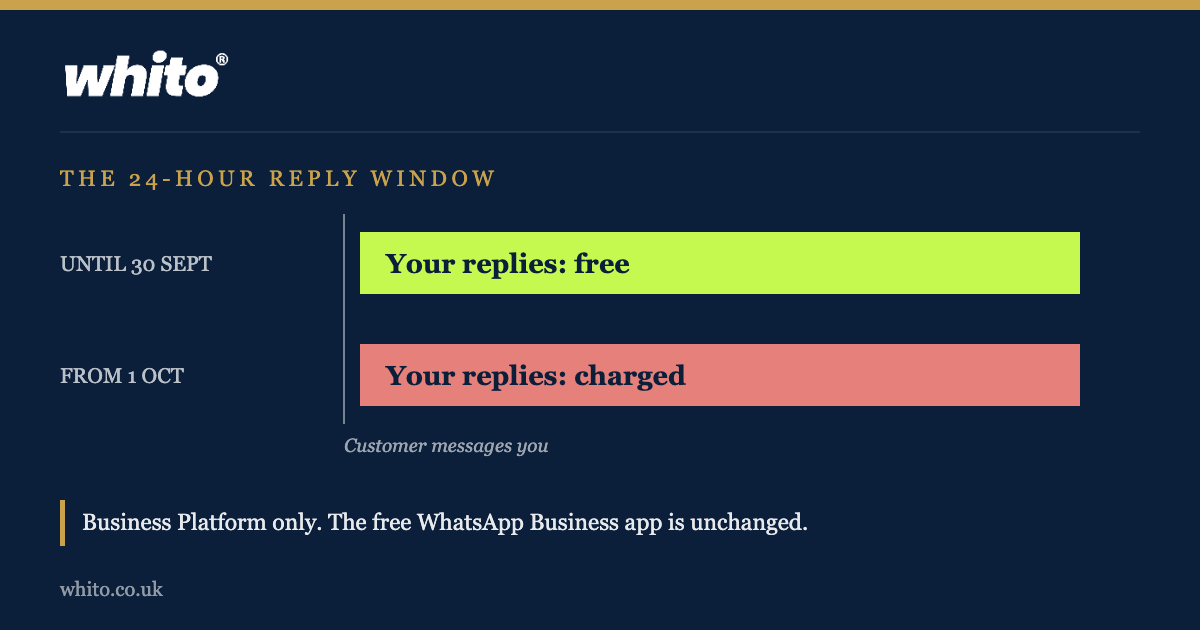
On 1 October 2026 Meta started charging for two kinds of business message that used to cost nothing.
What actually changed
Meta’s own developer documentation sets out two changes effective 1 October 2026. It will charge for service messages, which are the free-form replies a business sends inside the 24-hour customer service window after a customer gets in touch. It will also charge for utility messages, the templated order confirmations and appointment reminders, when those are sent in reply to a customer inside that same open window.
Both used to be free. Replying to someone who messaged you first was the part nobody paid for. That is the part that is now metered.
A third change landed earlier. From 1 August 2026, Meta’s documentation says it charges all businesses for Meta Business Agent messages, which are the AI-generated replies.
The distinction that decides whether this is your problem
This is a change to the WhatsApp Business Platform, the paid API route. It is not a change to the free WhatsApp Business app you downloaded onto a phone.
| Free WhatsApp Business app | WhatsApp Business Platform | |
|---|---|---|
| How you use it | You reply by hand on a phone | A booking system, CRM or chat widget sends for you |
| Who set it up | You did, from the app store | A developer or a software supplier |
| Affected on 1 October | No | Yes |
If you answer customers yourself, from the green app, nothing on your bill changed last week. If a booking system, a CRM, a live chat widget or an automated reminder sends on your behalf, something did. Plenty of owners do not know which of the two they are, because the tool was sold to them as “WhatsApp integration” and nobody said the word API.
Three questions for whoever runs your messaging
Ask your software supplier, in writing:
1. Do my WhatsApp messages go through the Business Platform or the free app?
2. From 1 October, what do you charge me per message for replies and for reminders, and is that Meta’s rate or Meta’s rate plus your margin?
3. How many of those messages did I send last month?
The third question is the one that turns a price into a budget. A rate per message means nothing until you know your volume, and the supplier holds that number, not you.
The figure nobody can give you yet
Meta’s documentation says that by market, the rates for service messages are the same as the rates it already charges for utility and authentication messages. The actual amounts sit in a separate rate card. We could not open it, and the Meta pricing page we did open carries no United Kingdom figure we can quote.
That gap matters. Vendor blogs are circulating per-message prices taken from India and Brazil and presenting them as the global picture. If a provider quotes you a rate this week, ask which country’s rate card it came from, and whether their own margin sits on top of it. We are not publishing a UK per-message figure we cannot point at, and neither should the supplier asking you to sign.
Why this keeps happening
A free channel is a rented channel. The price of a rented channel is set by the landlord, and the landlord revises it once the tenants have moved their furniture in.
Firms that moved customer service onto WhatsApp because that is where their customers already were did not make a mistake. They built on a floor somebody else owns. Ofgem’s research into what actually makes a customer satisfied put billing and being easy to reach at the top, which we covered in our breakdown of the Ofgem satisfaction findings. Being easy to reach is now a line item rather than a free side effect.
The answer is not to leave WhatsApp. It is to know what each channel costs you and what happens if that cost doubles. When we priced the software a small firm actually runs on, in our study of what a UK marketing stack costs in 2026, the brand-name version came to £2,667.00 a year before VAT for a one-person business, against £1,319.73 for tools doing the same five jobs. Most owners could not name either figure for their own setup. That is why a repricing arrives as a shock instead of a decision.
And if the answer comes back from an agency or a messaging supplier rather than from Meta, read the contract before you read the quote. When we read 39 UK agency pricing pages against their own terms, the fees that mattered most were the ones that never appeared on the pricing page.
The takeaway
Find out this week whether your WhatsApp replies travel through the free app or through the Platform. If it is the app, carry on. If it is the Platform, you have just acquired a variable cost on the one thing customers judge you by, which is how quickly you answer. Price it before your supplier prices it for you.