
Last Updated on October 23, 2026
A report went out on the wires on Thursday saying small businesses are losing online visibility because they are backing social media and AI ahead of Google. It landed on UK finance sites the same day. The finding underneath it is worth having. The framing it arrived in is not, and that matters more than the headline.
BrightLocal, a local SEO software company based in Brighton, surveyed 1,002 owners of locally operated businesses with 1 to 50 employees. Every one of them was in the United States.
What the report actually found
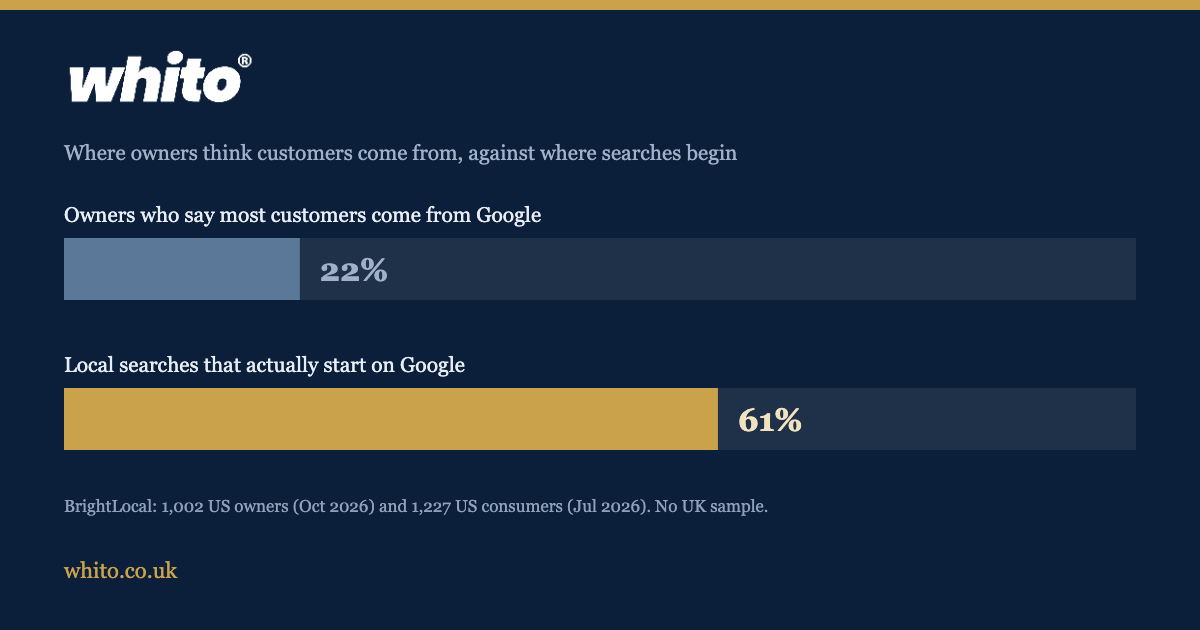
Owners rank Google fifth among the channels they treat as most important. Just 22% believe most of their customers come from it.
Set that against BrightLocal’s own consumer survey from July, which found 61% of local business searches start on Google, 52% in Search and 9% in Maps, with 71% of consumers using Google somewhere in the process.
That is the gap the report is pointing at, and it is a real gap. Effort is going somewhere other than where the searching starts.
| Channel | Owners saying most customers come from it |
|---|---|
| Word of mouth | 35% |
| Social media | 33% |
| AI tools | 23% |
| 22% | |
| Direct website traffic | 22% |
BrightLocal owner survey of 1,002 US business owners, reported 22 October 2026. For comparison, BrightLocal’s July consumer survey found 61% of local searches start on Google.
Those four other figures come from BrightLocal’s press release rather than the published report pages. The company has not put out the question wording behind them, so take the ordering as the solid part and the exact percentages as the soft part.
Two things to hold back before you act on it
The first is the sample. American owners, American consumers, an American local search market. The report does not claim to describe the UK, and the wire coverage that reached UK readers did not add that caveat. Read it as a direction of travel, not as a measurement of your market.
The second is who is asking. BrightLocal sells local SEO software and citation management. A finding that owners are neglecting their Google Business Profile and the directory ecosystem is a finding that sells the product. That does not make it wrong. It does mean you want a UK number in front of you before you move money because of it.
The part that has nothing to do with geography
Look again at word of mouth sitting top at 35%. Almost no small business can prove that figure.
Word of mouth is the answer owners give when nothing is being measured, because it is the only channel that produces a story you remember. A referral comes with a name attached. Fourteen people who found you in Maps at eleven at night do not.
So the honest reading of this report is not that owners are backing the wrong channel. It is that most of them are guessing, and then allocating money against the guess. That is a structure problem, and no amount of extra posting fixes it.
The test worth running this week: ask your next five customers how they found you, and write the answers down. If you cannot do that, your channel ranking is a feeling rather than a number, and every budget decision sitting on top of it is a guess.
What separates the businesses that do get found
We have UK data on this. In our check of 3,149 listings against the businesses Google AI Mode actually named, two things separated the named from the ignored: position in Google’s local results and review count. Star rating barely separated them at all. Our pilot index asking three AI assistants for an emergency plumber then checked all 32 businesses they named, one answer at a time.
Review count being a lever is awkward news. In BrightLocal’s US figures, 47% of small businesses have fewer than 20 Google reviews, while 47% of US consumers say they will not use a business with fewer than 20. Hold the consumer number loosely, since those are American buyers. The mechanism is not American.
Four things to do with this, none of them taking an afternoon
Open your Google Business Profile and look at the date. In the US sample, 85% of owners had one, 35% kept it active and 21% had not touched it in over three months. An unmaintained profile is not a listing, it is a gravestone.
Count your Google reviews. If the number is under 20, that is your next job, ahead of anything to do with content or ads. Ask the customers you have already made happy.
Write down where your last ten enquiries came from. Not where you think. Where they said. Two weeks of that is better evidence than any survey of a different country.
Then check what your agency is reporting back. If nobody is showing you which channel produced which enquiry, you have the same measurement gap the report found, you are just paying someone else to have it. Our checklist of what a monthly SEO report should contain lists the lines that usually go missing.
The takeaway
A survey of 1,002 American owners cannot tell you where your customers are. It can tell you something more useful, which is that most owners rank their channels by memory and then spend accordingly. Fix the measuring before you move the money. Structure first, then scale.